先考考自己:3 題
先想一下,再點題目看答案。
Q1核磁共振報告上寫了「labral tear」(盂唇撕裂),就一定是肩膀痛的原因嗎?(列出三個重點)
不一定就是它造成症狀。(1)上盂唇中年以後本來就會有老化變化,沒症狀的人做核磁共振也常被讀出「疑似撕裂」;(2)一般核磁共振不容易看清楚這個位置,要更準會安排核磁共振關節攝影(把顯影劑打進關節);(3)理學檢查沒有單一動作能確診,真正確定只能靠關節鏡直接看。所以報告要和症狀、年紀、運動需求一起看。
Q2確定是 SLAP 上唇撕裂,第一步就是開刀嗎?
不是。幾乎每個人都先復健約三個月。例外是肩膀明顯卡住,或盂唇旁長了囊腫壓到神經、造成肩膀後方肌肉無力,這時會早一點和骨科醫師討論手術。
Q3有一個研究把病人分成三組:修補上唇、二頭肌固定、只做關節鏡檢查不處理(假手術)。兩年後結果有差嗎?這代表手術沒用嗎?
三組兩年後的結果差不多。這不代表手術沒用,而是提醒:要不要開刀,需要仔細挑選對象。
先講最重要的一句:SLAP 上唇撕裂大多數先復健,不是一看到核磁共振報告就要開刀。 這個診斷在影像上很容易被「看太多」,而開刀的效果也沒有大家想像中那麼確定。
這篇寫給投球、打排球、游泳等常把手舉過頭的運動員,也寫給拿到核磁共振報告、上面寫著「labral tear」而不知道該怎麼辦的人。
SLAP 上唇撕裂是什麼?
肩關節像一顆高爾夫球放在很淺的球座上。球座邊緣有一圈軟骨墊,叫做「盂唇」,它把球座加深、讓關節比較穩。
盂唇的最上方,剛好是肱二頭肌長頭肌腱的起點。SLAP 是指這個位置的盂唇撕開或被拉離骨頭,範圍從二頭肌附著點的前方延伸到後方,英文是 Superior Labrum Anterior to Posterior,所以也有人叫它「上盂唇撕裂」或「上唇撕裂」。
醫師會講的「第幾型」
- 依撕裂的樣子分成好幾型,最常見的是 第二型:盂唇連同二頭肌的附著點一起被拉離骨頭
- 對治療來說,最重要的是兩件事:撕裂穩不穩、二頭肌有沒有一起受傷
什麼樣的人容易受傷?
- 投手與過頭運動員:手舉高往後拉到最底(投球的「拉弓」動作)時,二頭肌會扭轉拉扯上方的盂唇,反覆累積就可能撕裂
- 跌倒時用手撐地:力量從手臂往上撞到肩關節
- 手臂被突然用力拉扯:例如提重物時突然往下墜
- 中年以後的老化:盂唇本來就會隨年紀磨損,常和其他肩膀問題一起出現
有哪些症狀?
- 肩膀「很深的地方」痛,可能在前方也可能在後方,說不出確切的點
- 手舉過頭、投球、發球時特別痛
- 肩膀卡卡、有彈響聲,或覺得肩膀「不穩」,但醫師檢查時關節其實是穩的
- 投手可能覺得球速變慢、控球變差
這些症狀和旋轉肌、二頭肌肌腱炎、肩夾擠很像,而且常常同時存在,所以醫師通常要綜合問診、理學檢查與影像一起判斷。
核磁共振說我有撕裂,就一定是它嗎?
不一定。這是 SLAP 最需要知道的一件事。
- 上盂唇在中年以後本來就會有老化變化,沒有症狀的人做核磁共振,也常被讀出「疑似撕裂」
- 一般核磁共振不容易看清楚這個位置。若要更準,醫師會安排把顯影劑打進關節的「核磁共振關節攝影」
- 理學檢查也沒有一個動作能單獨確診。真正確定只能靠關節鏡直接看
所以報告上的「labral tear」,要和你的症狀、年紀、運動需求放在一起看。
要先復健還是開刀?
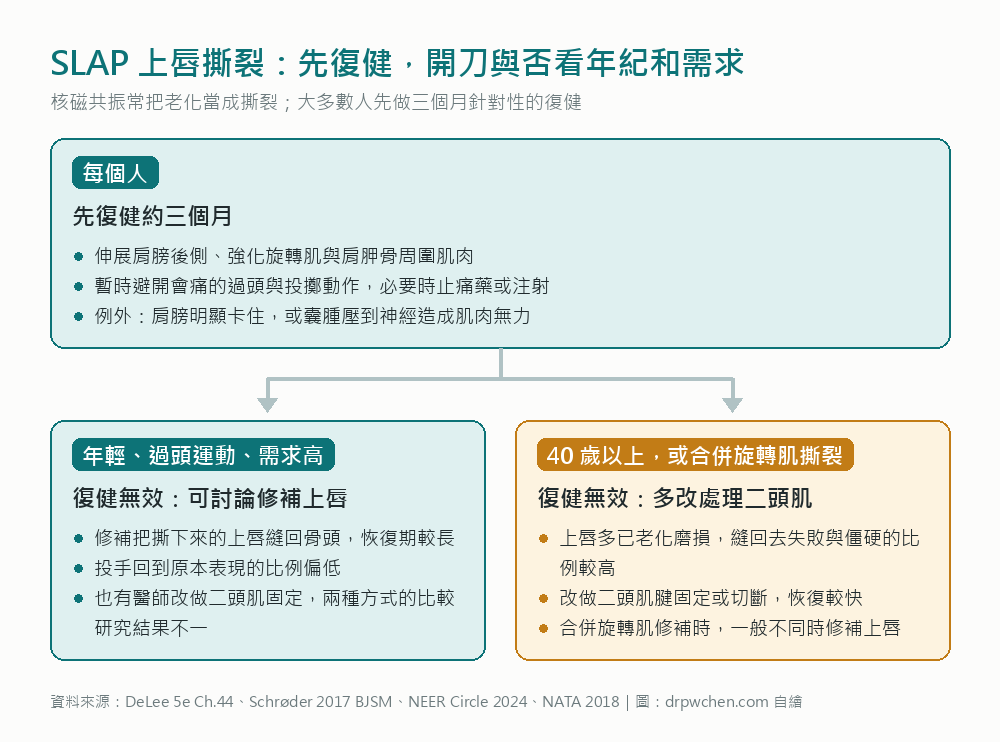
- 幾乎每個人都先復健約三個月
- 例外是肩膀明顯卡住,或盂唇旁長了囊腫壓到神經、造成肩膀後方肌肉無力,這時會早一點和骨科醫師討論手術
復健有效的比例不低。研究中,把復健課程完整做完的運動員,大多數能回到運動場上。
復健在做什麼?
- 先止痛:暫時避開會痛的過頭與投擲動作,必要時使用止痛藥,或由醫師評估是否打針
- 把活動角度找回來:特別是伸展肩膀後側。很多投手的肩膀後側很緊,往內轉的角度變小
- 加強穩定:強化旋轉肌與肩胛骨周圍的肌肉,讓肩膀在動的時候穩得住
- 回到運動:最後加入速度與爆發力訓練,再循序回到投球或原本的運動
復健也會依你受傷的方式調整。例如跌倒撐地受傷的人,一開始先少做手撐地的動作;投手則避免一開始就把手往後拉到底。
如果要開刀,有哪些選擇?
復健約三個月仍然沒改善,而且醫師高度懷疑症狀來自這裡,才會考慮手術。常見有兩條路:
- 修補上唇:用錨釘把撕下來的盂唇縫回骨頭。比較適合年輕、運動需求高、撕裂不穩的人
- 處理二頭肌:把二頭肌長頭肌腱從盂唇上切開,再固定到上臂骨頭上(固定術),或只切開不固定(切斷術)。四十歲以上、盂唇已經磨損的人,多半選這條路。同時要修補旋轉肌的人,多半不修補上唇,改成只清理磨損的盂唇或處理二頭肌
兩件事值得知道:
- 一個有「假手術」對照組的研究,比較修補上唇、二頭肌固定和只做關節鏡檢查不處理,三組兩年後的結果差不多。這不代表手術沒用,而是提醒:要不要開刀,需要仔細挑選對象。
- 年輕運動員該修補還是處理二頭肌,研究結果還不一致,專家之間也沒有共識,尤其是職業投手
開刀後多久能回到運動?
- 術後通常先用手臂吊帶保護幾週,期間仍會在保護下活動肩膀
- 修補上唇後,前幾週不能用力彎手肘、把手心往上翻,以免拉扯到剛縫好的地方
- 回到運動的時間,一般二頭肌固定約四個月,修補上唇約六個月,要依醫師與治療師的評估逐步進行
- 投手要回到原本的表現比較困難,常需要更長時間的投球訓練
什麼時候該回診?
- 復健做了一段時間,疼痛或卡卡的感覺沒有改善
- 肩膀常常卡住、無法正常活動
- 肩膀後方的肌肉變小,或手往外轉明顯沒力
- 手臂麻、無力,或疼痛延伸到脖子
—
專業段先自我測驗:5 題
先想一下,再點題目看答案。
Q1無症狀的 45-60 歲族群做 MRI,兩位放射科醫師分別讀出多少比例的 superior labrum 變化?這說明了什麼?
分別讀出 55% 與 72%。說明中年以上的 superior labrum 變化多為老化,MRI 容易 overcall。
Q2過頭運動員 SLAP 的 attritional 機轉 peel-back mechanism 是什麼?對應投球的哪個姿勢?列出文中提到的危險因子。
Abduction + ER 時 biceps 扭轉拉扯 posterosuperior labrum 與 anchor;對應投球的 late cocking 姿勢。危險因子:增加的肩 ER、posterior capsular contracture(GIRD)。
Q3Snyder 原始四型中,哪一型最常見?它的病灶與 biceps anchor 狀態為何?其餘三型各自的特徵與比例?
Type II 最常見(約 41%):superior labrum + biceps anchor 從 glenoid 剝離。Type I:labrum 磨損 fraying、anchor 完好,退化性,約 11%;Type III:bucket-handle tear、anchor 完好,約 33%;Type IV:bucket-handle tear 延伸入 biceps tendon、anchor 受累,約 15%。
Q4一般 SLAP 的第一線處置是什麼、多久?在哪些例外情況下可以直接考慮手術?
一線為保守治療約 3 個月。例外(可直接考慮手術):spinoglenoid notch cyst 壓迫 suprascapular nerve、unstable flap 的機械症狀。
Q5Type II 保守治療失敗後,什麼樣的病人偏向 SLAP repair?什麼樣的病人改做 biceps tenodesis / tenotomy?兩者如何再分?
年輕、高需求、anchor 不穩或有機械症狀 → 可 SLAP repair。>40 歲、退化 labrum、合併 RC tear、repair 失敗 → biceps tenodesis(活躍)/tenotomy(低需求)。年輕族群 repair vs tenodesis 證據分歧。
下面是我 vault 裡這則筆記的原樣,只拿掉了內部連結與有版權的教科書圖。查證流程與工具說明放在最後。
Superior labrum anterior to posterior (SLAP) lesion 上盂唇前後撕裂
Clinical Pearls
- SLAP = 上盂唇沿 anterior→posterior 撕裂,位在 LHBT 附著處(biceps anchor);Type II(biceps anchor 從 glenoid 剝離)最常見
Snyder 1990,Buckup 3e Ch.2- 診斷困難:無單一敏感又特異的 PE test;MRI 常 overcall(無症狀 45-60 歲讀出 labral tear 55% / 72%);arthroscopy 才是確診
DeLee 5e Ch.44,Giangarra 4e Ch.26- 一線為保守治療(posterior capsule stretch + RC / scapular strengthening)約 3 個月
DeLee 5e Ch.44,Michener 2018- Sham RCT:repair / tenodesis / sham 三組 2 年 無差異(平均 40 歲,isolated type II)→ 手術 indication 須嚴格
Schrøder 2017- 決策主軸是 年齡:年輕高需求、anchor 不穩 → 可 repair;>40 歲、合併 cuff tear、repair 失敗 → biceps tenodesis / tenotomy
DeLee 5e Ch.44,Verma 2025
縮寫
| 縮寫 | 全稱 | 中文 |
|---|---|---|
| SLAP | superior labrum anterior to posterior | 上盂唇前後撕裂 |
| LHBT | long head of biceps tendon | 肱二頭肌長頭肌腱 |
| GHJ | glenohumeral joint | 盂肱關節 |
| GIRD | glenohumeral internal rotation deficit | 盂肱關節內旋不足 |
| ER / IR | external / internal rotation | 外旋 / 內旋 |
| ROM / AROM / PROM | range of motion / active / passive | 關節活動度 / 主動 / 被動 |
| MRA | magnetic resonance arthrography | 磁振關節攝影 |
| MGHL | middle glenohumeral ligament | 中盂肱韌帶 |
| ACJ | acromioclavicular joint | 肩鎖關節 |
| FOOSH | fall on outstretched hand | 跌倒手撐地 |
| RC | rotator cuff | 旋轉肌 |
| RTP | return to play | 回到運動 |
| ASES | American Shoulder and Elbow Surgeons score | 美國肩肘外科醫學會評分 |
| UCLA | University of California at Los Angeles shoulder score | UCLA 肩關節評分 |
| ABOS | American Board of Orthopaedic Surgery | 美國骨科專科醫師委員會 |
| NATA | National Athletic Trainers’ Association | 美國運動防護師協會 |
| Se / Sp | sensitivity / specificity | 敏感度 / 特異度 |
| PT | physical therapy | 物理治療 |
疾病背景
定義
- SLAP = 上盂唇沿 anterior-to-posterior 方向撕裂,位於肱二頭肌長頭(LHBT)附著處(biceps anchor)
Snyder 1990- 原始系列:700 多例關節鏡中 27 例,平均 37.5 歲;最常見機轉為跌倒手撐地的壓迫力
Snyder 1990
- 原始系列:700 多例關節鏡中 27 例,平均 37.5 歲;最常見機轉為跌倒手撐地的壓迫力
- Labrum 為 GHJ 周緣的纖維軟骨環
- 約貢獻 glenoid 窩深度的 50%,增加接觸面積、提供 stability
Neumann 3e Ch.5 - 為 LHBT 與 glenohumeral ligaments 的附著點
DeLisa 6e Ch.29
- 約貢獻 glenoid 窩深度的 50%,增加接觸面積、提供 stability
流行病學
- 盛行率低:佔 Snyder 手術案例 3.3%,追蹤系列 4.7%
DeLee 5e Ch.44- 另有報告 labral injury 3.9-11.8%,關節鏡族群高達 26%
DeLisa 6e Ch.29
- 另有報告 labral injury 3.9-11.8%,關節鏡族群高達 26%
- 手術量與盛行率不成比例:美國兩州資料庫 2002-2009 SLAP repair 量增加 238%
DeLee 5e Ch.44 - 族群:過頭運動員(投手為主)、跌倒撐地者、手臂受牽拉者
DeLee 5e Ch.44 - 中年以上的 superior labrum 變化多為老化:無症狀 45-60 歲,兩位放射科醫師分別讀出 55% 與 72%
DeLee 5e Ch.44
機轉 / Etiology
- Acute traumatic
- Compression:跌倒撐地 FOOSH(fall on outstretched hand)
Snyder 1990,DeLee 5e Ch.44 - Traction:過頭或外展手臂受牽拉(Maffet 系列以此為主)
Maffet 1995,DeLee 5e Ch.44
- Compression:跌倒撐地 FOOSH(fall on outstretched hand)
- Attritional(過頭運動員):peel-back mechanism
- Abduction + ER 時 biceps 扭轉拉扯 posterosuperior labrum 與 anchor
DeLee 5e Ch.44 - 對應投球的 late cocking 姿勢
Maxey 3e Ch.6 - 危險因子:增加的肩 ER、posterior capsular contracture(GIRD)
DeLisa 6e Ch.29
- Abduction + ER 時 biceps 扭轉拉扯 posterosuperior labrum 與 anchor
- Degenerative:中年以上 labrum 與 biceps 老化,常合併其他病灶
DeLee 5e Ch.44
分類
Snyder 原始四型 (1990)
- 依 biceps anchor 是否受累 與 labrum 形態分四型;百分比為 Snyder 系列分布
Snyder 1990,Buckup 3e Ch.2
| Type | 病灶 | biceps anchor | 備註 |
|---|---|---|---|
| I | Superior labrum 磨損 fraying | 完好 | 退化性,約 11% |
| II | Superior labrum + biceps anchor 從 glenoid 剝離 | 剝離 | 最常見(約 41%) |
| III | Bucket-handle tear of labrum | 完好 | 約 33% |
| IV | Bucket-handle tear 延伸入 biceps tendon | 受累 | 約 15% |
擴充分類
- Maffet(1995):712 例中 84 例有明顯 superior labrum 病灶,其中 38%(32 例)無法歸入 Snyder 四型 → 增列 type V-VII
Maffet 1995 - 文獻已描述 至少 12 型
Helms MSK-MRI 3e Ch.10 - 臨床重點:MRI 精確分型價值有限,只需報告
Helms MSK-MRI 3e Ch.10- (1) labrum 為 partial vs full-thickness tear 或 detachment
- (2) biceps anchor / tendon 是否受累
預後
- 保守治療
- 63 名年輕活躍 isolated type II:71.4% 成功(ASES 54→86)
Jang 2016 - 運動員系統性回顧(SR)244 人:RTP 53.7%,完成 rehab 者 78%
Steinmetz 2022 - 問卷 case series 39 人:51% 保守失敗轉手術;成功者 ASES 58.5→84.7
Edwards 2010
- 63 名年輕活躍 isolated type II:71.4% 成功(ASES 54→86)
- 保守失敗因子
- 創傷史、compression-rotation test 陽性(仰臥、肩外展 90°、肘屈 90°,沿肱骨軸向加壓同時旋轉)、過頭活動
Jang 2016 - 年齡較大、投手、合併 cuff 病灶、症狀久、Bennett spur(投手後下 glenoid 緣、後關節囊附著處的鈣化骨刺)
Steinmetz 2022
- 創傷史、compression-rotation test 陽性(仰臥、肩外展 90°、肘屈 90°,沿肱骨軸向加壓同時旋轉)、過頭活動
- SLAP repair 後 RTP(競技過頭運動員)
- RTP 50-83.6%、回到原本表現 35.3-64%
DeFroda 2022 - 投手 RTP 62.5-80%、原表現 52-58.9%;合併需處理的 cuff 病灶最差
DeFroda 2022 - 學會立場聲明彙整(手術與保守治療合計,非僅 repair):運動員平均 55% 回到原運動,過頭運動員 45%
Michener 2018
- RTP 50-83.6%、回到原本表現 35.3-64%
併發症
- Paralabral cyst:幾乎是 labral tear 的特徵;延伸至 spinoglenoid notch → 壓迫 suprascapular nerve → infraspinatus 無力
DeLee 5e Ch.44 - SLAP repair 術後併發症
DeLee 5e Ch.44- 持續疼痛、僵硬 stiffness、hardware 鬆脫 / loss of fixation
- 關節軟骨傷害、持續滑膜炎、suprascapular nerve injury
- 早期 tack 固定因併發症高已多被放棄,現行標準為 suture anchor
臨床評估
表現 (Signs & symptoms)
- 肩膀 深部 疼痛,過頭動作時較痛
Snyder 1990;部位各書不一:DeLisa 寫前側為主DeLisa 6e Ch.29,DeLee 寫多數為後側痛DeLee 5e Ch.44 - 機械性症狀:popping、catching、clicking;有 instability 感但理學檢查關節穩定
Helms MSK-MRI 3e Ch.10 - 常被 impingement、biceps tendinitis、AC 痛掩蓋,不易單獨定位 pain generator
DeLee 5e Ch.44
檢查 (PE)
- 無單一 test 敏感又特異,需放回病史與族群脈絡解讀
Giangarra 4e Ch.26,DeLee 5e Ch.44;合併多個 test 是否較準,各來源不一(DeLee 引 Walsworth:合併並未改善;DeLisa、NATA:合併可能有幫助)- NATA 立場聲明:6 個 test 建議用於確認、1 個用於排除,組合使用可能有幫助
Michener 2018
- NATA 立場聲明:6 個 test 建議用於確認、1 個用於排除,組合使用可能有幫助
- Shoulder instability 評估
- 雙側對稱(shoulder girdle、muscle bulk、deltoid atrophy)
- Apprehension test、AROM/PROM、scapular dyskinesis、axillary nerve、muscle power、wrist pulse
- 排除神經問題
- Radiculopathy:Spurling maneuver
- Myelopathy:Hoffmann sign、finger escape、grip-and-release、inverted radial reflex
- SLAP / biceps provocative tests
| Test | 作法 | 對象 / 解讀 |
|---|---|---|
| O’Brien active compression | Flex 90° + add 10° + 最大 IR(拇指朝下)resisted;再最大 ER 重複 | IR 痛、ER 減輕 → 陽性;痛在關節內 → favor SLAP,痛在 AC 上方 → favor ACJ Buckup 3e Ch.2。單獨 Se 約 63%,合併他 test 較佳 DeLisa 6e Ch.29;對照關節鏡另一研究 Se 54%、Sp 31% Malanga 2e Ch.4 |
| Biceps load II | 仰臥 ABD 120° + 最大 ER + elbow flex 90° + forearm sup,resisted elbow flex | 單獨使用時 Se/Sp 最高 的 labral test DeLisa 6e Ch.29 |
| Dynamic labral shear | 檢查者在後方,肩外展 90-120° 間施前向力 | Se 近 80%(isolated SLAP)DeLisa 6e Ch.29 |
| Speed’s test | Shoulder flex、elbow 伸直、forearm sup,resisted flexion | biceps/LHBT DeLisa 6e Ch.29;痛應局限在近端二頭肌腱,前臂旋前時減輕 Giangarra 4e Ch.26 |
| Yergason’s test | Elbow flex 90°,resisted supination | biceps/LHBT;較特異但敏感度低 Giangarra 4e Ch.26 |
| Crank test | 肩上舉 160°(scapular plane),沿肱骨軸向加壓同時內外旋 | 痛(常在 ER 時)或重現卡住感 → 陽性;對照關節鏡 Se 46%、Sp 56% Malanga 2e Ch.4 |
鑑別診斷 (DDx)
- SLAP 常與下列並存,而非互斥
DeLee 5e Ch.44
| 類別 | 鑑別 |
|---|---|
| Impingement / RC | Subacromial impingement、rotator cuff tear |
| Biceps | LHBT tendinopathy / subluxation(見 Proximal biceps tendinopathy) |
| Degenerative | Adhesive capsulitis、GH OA |
| AC joint | AC separation、distal clavicle osteolysis、AC arthritis |
| 其他 | Glenohumeral instability、cervical radiculopathy、suprascapular neuropathy |
Imaging
- X-ray:true AP、axillary、outlet view — 先排除骨性病灶
Giangarra 4e Ch.26 - MR arthrography (MRA) 為首選:Se 82-100%、Sp 71-98%,優於 conventional MRI
DeLisa 6e Ch.29- 過度診斷陷阱:最高 35% 社區判讀 MRI 報告為(possible)labral tear
DeLee 5e Ch.44 - 真實盛行率約 3-5%,中年以上的影像變化多為老化
Giangarra 4e Ch.26,DeLee 5e Ch.44
- 過度診斷陷阱:最高 35% 社區判讀 MRI 報告為(possible)labral tear
- Ultrasound:無法可靠評估 superior labrum
DeLisa 6e Ch.29- 可看 LHBT 是否 subluxation / dislocation
Giangarra 4e Ch.26
- 可看 LHBT 是否 subluxation / dislocation
確診
- Diagnostic arthroscopy 是唯一確診方法
Giangarra 4e Ch.26,Snyder 1990- 經驗豐富的術者對 normal variant(如 sublabral recess)vs 病灶也常判讀不一
DeLee 5e Ch.44
- 經驗豐富的術者對 normal variant(如 sublabral recess)vs 病灶也常判讀不一
- Labral 基部出現 granulation tissue → 對 SLAP 高 specificity
DeLee 5e Ch.44
臨床處置
Management algorithm
Algorithm — 依 age × demand × concomitant pathology
- 一線:保守治療約 3 個月
DeLee 5e Ch.44
- 例外(可直接考慮手術):spinoglenoid notch cyst 壓迫 suprascapular nerve、unstable flap 的機械症狀
DeLee 5e Ch.44- Type I → debridement;Type III → 切除 bucket-handle 碎片
DeLee 5e Ch.44,Giangarra 4e Ch.26- Type II(保守失敗)
- 年輕、高需求、anchor 不穩或有機械症狀 → 可 SLAP repair
Verma 2025- >40 歲、退化 labrum、合併 RC tear、repair 失敗 → biceps tenodesis(活躍)/ tenotomy(低需求)
DeLee 5e Ch.44- 年輕族群 repair vs tenodesis 證據分歧(見下)
- Type IV → tenodesis 為主
DeLee 5e Ch.44- Spinoglenoid notch cyst + 神經症狀 → SLAP repair ± cyst decompression
DeLee 5e Ch.44- ⚠️ Sham RCT:isolated type II 的 repair / tenodesis 未優於 sham
Schrøder 2017
治療目標
- 恢復 pain-free function 與肩部 dynamic stability;overhead athlete 以回歸原運動為目標
Michener 2018
保守治療(first-line)
- 內容:避開誘發動作、NSAIDs、posterior capsule 伸展、RC 與 scapular stabilizer 強化
DeLisa 6e Ch.29- NATA 另列關節內 corticosteroid injection 為一線選項之一
Michener 2018
- NATA 另列關節內 corticosteroid injection 為一線選項之一
- Overhead athlete 復健要處理的缺損
Michener 2018- IR 不足、total arc of motion、horizontal adduction 受限
- Periscapular 與 GH 肌群的肌力、耐力、neuromuscular control
- 結構化 rehab phase
Giangarra 4e Ch.26- Phase I 止痛 + 恢復 full PROM 與 accessory motion
- Phase II AROM + early strengthening
- Phase III RC / periscapular strengthening,強調 dynamic stability(rhythmic stabilization)
- Return-to-sport phase:power 與高速度、sport-specific
- 依受傷機轉避開誘發姿勢
Giangarra 4e Ch.26- 壓迫型 → 早期避免手撐負重
- Peel-back 型 → 避免過度 ER
- 牽拉型 → 早期避免重的 eccentric / resisted biceps
- Evidence: Low-Moderate — 運動員完成 rehab 者 RTP 78%;放棄者平均只做 8 次 PT,成功者 20 次
Steinmetz 2022
手術
適應症
- 保守治療約 3 個月 無效,且強烈懷疑症狀來自 SLAP
DeLee 5e Ch.44,DeLisa 6e Ch.29 - Unstable flap 機械症狀、spinoglenoid notch cyst 壓迫神經
DeLee 5e Ch.44 - 決策受 age、tear type/location、tissue quality、concomitant pathology 影響(expert opinion)
Feldman 2022
依 type 決定術式
| Type | 術式 | 備註 |
|---|---|---|
| I | Debridement | Type I 適用;單純 debridement 用於其他 type 時,運動員族群失敗率高 DeLee 5e Ch.44, Giangarra 4e Ch.26 |
| II(最常見) | Suture anchor repair 或 biceps tenodesis / tenotomy | 視年齡、需求、組織品質 DeLee 5e Ch.44 |
| III | 切除 bucket-handle 碎片;MGHL 連在碎片上則一併修補 | Giangarra 4e Ch.26 |
| IV | Tenodesis;或依 biceps 受累比例清創 / 修補 | 受累 <30-40% 可清創,更多則修補 Giangarra 4e Ch.26 |
2024 NEER Circle 專家共識(ASES 相關專家組織)
- 92 位肩關節專家、Delphi 式問卷;78 個情境中僅 26 個達共識(≥80%)
Verma 2025 - 年齡是最主要的決策因素
Verma 2025- 年輕活躍、anchor 不穩或機械症狀 → 偏好 SLAP repair
- 大於 30 歲且低需求、有 biceps tendinopathy → 偏好處理 biceps
- SLAP repair 通常 不建議:年長、合併 rotator cuff tear、先前 repair 失敗
Verma 2025 - 職業 / 競技投手 仍無共識;年輕投手一般仍偏向 repair
Verma 2025
SLAP repair vs biceps tenodesis(isolated type II)
- 整體趨勢偏向 tenodesis,但 高品質證據不足
- Evidence: Low-Moderate — meta-analysis 23 篇 / 908 人:tenodesis “well” outcome 87.8% vs repair 62.9%(P=.0023;repair 組 I² 65.9%);再受傷率 1.5% vs 6.4% 無顯著差異
Recker 2022 - 美國保險資料庫 16,186 人:2 年再手術 repair 6.8% vs tenodesis 5.7%;40-49 歲再手術率最高 7.8%
Truong 2022 - 實務趨勢:ABOS 考生資料 isolated SLAP 的 repair 比例 69.3% → 44.8%(2002-2011)
Patterson 2014
- Evidence: Low-Moderate — meta-analysis 23 篇 / 908 人:tenodesis “well” outcome 87.8% vs repair 62.9%(P=.0023;repair 組 I² 65.9%);再受傷率 1.5% vs 6.4% 無顯著差異
- 年輕族群證據分歧
- 小於 40 歲 meta-analysis(5 篇 cohort):RTP、ASES、VAS 疼痛分數、再手術率皆無顯著差異
Hurley 2023 - 過頭運動員 meta-analysis(13 篇):tenodesis 不劣於 repair,各項無顯著差異
Shin 2021 - 小於 35 歲軍人 cohort:repair 失敗 5 年 20% → 10 年 40%,tenodesis 0%
Parnes 2021,Scanaliato 2026- 限制:非隨機;術前 biceps test 陰性且術中肌腱正常者才做 repair
Scanaliato 2026
- 限制:非隨機;術前 biceps test 陰性且術中肌腱正常者才做 repair
- 小於 40 歲 meta-analysis(5 篇 cohort):RTP、ASES、VAS 疼痛分數、再手術率皆無顯著差異
年齡對手術策略的影響
- >40 歲:repair 失敗、僵硬、再手術率上升;labrum 多退化
DeLee 5e Ch.44- Evidence: Moderate — 系統性回顧:大於 40 歲與 workers’ compensation 為併發症的獨立危險因子
Erickson 2014 - Prospective 179 例 type II repair:失敗 37%、revision 28%,age >36 為唯一失敗因子(RR 3.45)
Provencher 2013
- Evidence: Moderate — 系統性回顧:大於 40 歲與 workers’ compensation 為併發症的獨立危險因子
- 實務趨勢:平均年齡 repair 37.1 歲、tenodesis 47.2 歲、tenotomy 55.7 歲
Patterson 2014
Tenodesis vs Tenotomy
- 兩者細節(固定位置、Popeye、肌力)見 Proximal biceps tendinopathy
- Tenodesis:適合年輕高需求者;proximal(關節鏡)技術有長期追蹤仍良好、再手術率低的報告,subpectoral 為 DeLee 作者偏好術式
DeLee 5e Ch.44 - Tenotomy:簡單快速,適合低需求者;可能抽筋、外觀變形,術前須告知
DeLee 5e Ch.44- Popeye deformity 幾乎只是外觀問題,未證實造成功能損失
Giangarra 4e Ch.26
- Popeye deformity 幾乎只是外觀問題,未證實造成功能損失
合併 rotator cuff tear
- 合併 cuff repair 時,debridement / tenodesis / tenotomy 優於 SLAP repair
DeLee 5e Ch.44,Erickson 2014- Evidence: Moderate — 術中隨機分組 48 人(平均 51.9 歲,追蹤時失聯 10 人):SLAP debridement 優於 SLAP repair(UCLA 34 vs 31,P<.001)
Abbot 2009 - 大於 50 歲 RCT:合併 cuff repair 時,SLAP repair 相較 biceps tenotomy 無好處
DeLee 5e Ch.44 - 實務趨勢:合併 cuff repair 時 SLAP repair 由 60.2% 降至 15.3%(2002-2011)
Patterson 2014
- Evidence: Moderate — 術中隨機分組 48 人(平均 51.9 歲,追蹤時失聯 10 人):SLAP debridement 優於 SLAP repair(UCLA 34 vs 31,P<.001)
Paralabral cyst
- 延伸至 spinoglenoid notch → 壓迫 suprascapular nerve
DeLee 5e Ch.44 - 處理:關節鏡 SLAP repair ± cyst decompression
DeLee 5e Ch.44- Repair + 關節內 cyst decompression:90% good-excellent,6 個月 MRI cyst 消失
- 28 人 prospective cohort:加不加 decompression 結果無差異,25/28 cyst 消失
術後復健
- 大方向:保護 → ROM → 肌力 → 回歸
Maxey 3e Ch.6 - SLAP repair 禁忌:4 週內不做 active biceps contraction、3 週內 ER 不超過術中設定角度、6 週內不做 90°/90° ER(避免 peel-back)
Maxey 3e Ch.6
| Phase | 時間 | 重點 | 進階條件 |
|---|---|---|---|
| 1 Early protective | 0-4 wks | Sling 2-4 wks、PROM、RC submaximal isometrics、scapular 活動 | A/AROM:Flex 110-130° / Abd 70° / IR 60° / ER 至術中設定角度 |
| 2 Intermediate | 5-8 wks | 脫 sling、PROM ER 限 65°、Abd 限 70°、輕重量 isotonic、side-lying ER | Flex 160° / ER 65°(scapular plane)/ ER@90° abd 45° / IR 近 full |
| 3 Strengthening | 9-14 wks | 持續 ROM、強化;wall push-up 等閉鏈運動 對 labrum 的應力未知,延到 Phase 4 再漸進加入 | AROM 差 10° 內、IR/ER 肌力達健側 50% 以上 |
| 4 Advanced | 15-24 wks | Full AROM、isotonic / eccentric、plyometrics | Pain-free full ROM、IR/ER 肌力差 <20% |
| 5 Return to activity | 4-6 mos | Sport-specific | 肌力差 <10%、對肩膀完全有信心 |
- DeLee 作者流程(repair 與 tenodesis 相同)
DeLee 5e Ch.44- Sling 4 週;術後隔日 pendulum + passive ER;2 週起 active-assisted;4 週起 active;6 週起漸進強化
- 回歸運動:tenodesis 約 4 個月、SLAP repair 約 6 個月
- 年長者:術後僵硬風險較高,目標為日常生活活動(ADL)不痛
Erickson 2014
Evidence × Setting matrix
| 介入 / Setting | Evidence | 結論 | 主要研究 |
|---|---|---|---|
| 保守治療(isolated type II) | Low-Moderate | 一線;成功約 7 成,完成 rehab 者 RTP 78% | Jang 2016, Steinmetz 2022, Michener 2018 |
| Repair / tenodesis vs sham(isolated type II) | High (I) | 2 年無差異,手術未優於 placebo | Schrøder 2017 |
| Tenodesis vs repair(isolated type II) | Low-Moderate | 整體偏向 tenodesis;年輕與過頭運動員無顯著差異 | Recker 2022, Truong 2022, Hurley 2023, Shin 2021 |
| 年輕軍人長期追蹤 | Low (III) | Repair 10 年失敗 40%,tenodesis 0%(非隨機) | Scanaliato 2026 |
| SLAP repair,age >40 | Moderate | 失敗率、僵硬上升 → tenodesis / tenotomy | Erickson 2014, Provencher 2013 |
| 合併 rotator cuff tear | Moderate | 不做 SLAP repair | Abbot 2009, Erickson 2014 |
| 過頭運動員術後 RTP | Low | RTP 50-84%、原表現 35-64%;投手較差 | DeFroda 2022, Lack 2025 |
| 專家共識 | Expert (V) | 年齡為主軸;投手無共識 | Verma 2025 |
When to refer
- 保守治療約 3 個月無效、機械性症狀持續或惡化
DeLee 5e Ch.44 - 懷疑合併 RC tear、instability、spinoglenoid cyst(infraspinatus 無力)
DeLee 5e Ch.44 - 年輕高需求 overhead athlete 評估手術 timing 與術式
Verma 2025
這則筆記的產出流程
這則筆記是我門診與帶住院醫師時整理的肩膀參考之一,這次為了上站重新查證了一輪。
用到的材料
- 運動醫學、復健與骨科教科書:DeLee 運動醫學 5e、DeLisa 復健醫學 6e、Giangarra 骨科復健 4e、Maxey 術後骨科復健 3e、Buckup 肌骨理學檢查 3e、Malanga 肌骨理學檢查 2e、Helms 肌骨 MRI 3e、Neumann 肌動學 3e
- 學會立場聲明與專家共識:美國運動防護師協會(NATA)2018 年 SLAP 立場聲明、NEER Circle(美國肩肘外科醫學會相關專家組織)2024 年上盂唇與二頭肌複合體專家共識
- 隨機試驗與系統性回顧:假手術對照三臂隨機試驗、修補與二頭肌固定比較的統合分析(全年齡、小於 40 歲、過頭運動員三組)、非手術治療回場率回顧、術後回場率回顧
- 原始研究:179 例前瞻性 SLAP 修補世代、小於 35 歲軍人 5 年與 10 年追蹤、美國保險資料庫與骨科專科考試資料庫的術式趨勢
用到的工具
audit_note.py— 自己寫的筆記格式稽核腳本,檢查引用位置、圖片、標題結構- 教科書章節回查腳本 — 確認每個「書名+章號」對得到原書,不憑印象寫章號
- PubMed MCP — 逐篇以題名核對 PMID,補齊書目的卷期頁碼與 DOI,並讀摘要或全文核對數字
- textbook_search — 對本機的教科書 markdown 索引做語意搜尋
- OpenEvidence — 對「修補或二頭肌固定」做一次獨立交叉檢索,回答中的每一筆引用再回到 PubMed 原文比對
- 自寫的 Python/PIL 繪圖腳本 — 處置順序示意圖與封面(
scripts/figures/) - Hugo 的雙語流程
i18n_sync.py— 英文版先機器翻譯,醫學名詞再人工校一次
這條流程本身寫成了 textbook-to-note。如果你也有 Claude 或 Codex 的訂閱,這種查證與整理的機械勞動都可以交給它做,判斷留給自己。可以從 AI 上手:安裝與第一步 和 怎麼跟 AI 代理人講話 開始。
關於這個版本
專業版直接取自我自己的臨床筆記,未為部落格重寫,引用格式沿用筆記體例(書名+章節、或作者+年份,完整書目在下方)。教科書與期刊的版權圖未收錄於此,圖是自己重畫的。
如果有理解錯誤,也歡迎指正。
Reference
教科書
- DeLee 5e — DeLee, Drez & Miller’s Orthopaedic Sports Medicine, 5th ed, 2020. Ch.44 Superior Labrum Anterior to Posterior Tears
- DeLisa 6e — DeLisa’s Physical Medicine & Rehabilitation, 6th ed, 2015. Ch.29 Disorders of the Upper Limbs
- Buckup 3e — Buckup K, Buckup J. Clinical Tests for the Musculoskeletal System, 3rd ed, 2016. Ch.2 Shoulder
- Malanga 2e — Malanga GA, Mautner K. Musculoskeletal Physical Examination: An Evidence-Based Approach, 2nd ed, 2017. Ch.4 Physical Examination of the Shoulder
- Helms MSK-MRI 3e — Helms CA, Major NM, Anderson MW, et al. Musculoskeletal MRI, 3rd ed, 2019. Ch.10 Shoulder
- Neumann 3e — Neumann DA. Kinesiology of the Musculoskeletal System, 3rd ed, 2017. Ch.5 Shoulder Complex
- Giangarra 4e — Giangarra & Manske. Clinical Orthopaedic Rehabilitation, 4th ed, 2018. Ch.26 Rehabilitation for Biceps Tendon Disorders and SLAP Lesions
- Maxey 3e — Maxey & Magnusson. Rehabilitation for the Postsurgical Orthopedic Patient, 3rd ed, 2013. Ch.6 Superior Labral Anterior Posterior Repair
學會立場聲明與專家共識
- Michener 2018 — Michener LA, Abrams JS, Bliven KCH, et al. National Athletic Trainers’ Association position statement: evaluation, management, and outcomes of and return-to-play criteria for overhead athletes with superior labral anterior-posterior injuries. J Athl Train. 2018;53(3):209-229. doi:10.4085/1062-6050-59-16. PMID: 29624450
- Verma 2025 — Verma NN, Hoenecke H, MacDonald P, et al. Principles of the superior labrum and biceps complex: an expert consensus from the NEER Circle. J Shoulder Elbow Surg. 2025;34(6):1543-1557 (epub 2024). doi:10.1016/j.jse.2024.09.040. PMID: 39622358
期刊文獻
- Snyder 1990 — Snyder SJ, Karzel RP, Del Pizzo W, Ferkel RD, Friedman MJ. SLAP lesions of the shoulder. Arthroscopy. 1990;6(4):274-279. doi:10.1016/0749-8063(90)90056-j. PMID: 2264894
- Maffet 1995 — Maffet MW, Gartsman GM, Moseley B. Superior labrum-biceps tendon complex lesions of the shoulder. Am J Sports Med. 1995;23(1):93-98. doi:10.1177/036354659502300116. PMID: 7726358
- Schrøder 2017 — Schrøder CP, Skare Ø, Reikerås O, Mowinckel P, Brox JI. Sham surgery versus labral repair or biceps tenodesis for type II SLAP lesions of the shoulder: a three-armed randomised clinical trial. Br J Sports Med. 2017;51(24):1759-1766. doi:10.1136/bjsports-2016-097098. PMID: 28495804
- Provencher 2013 — Provencher MT, McCormick F, Dewing C, McIntire S, Solomon D. A prospective analysis of 179 type 2 superior labrum anterior and posterior repairs: outcomes and factors associated with success and failure. Am J Sports Med. 2013;41(4):880-886. doi:10.1177/0363546513477363. PMID: 23460326
- Erickson 2014 — Erickson J, Lavery K, Monica J, Gatt C, Dhawan A. Surgical treatment of symptomatic superior labrum anterior-posterior tears in patients older than 40 years: a systematic review. Am J Sports Med. 2015;43(5):1274-1282 (epub 2014). doi:10.1177/0363546514536874. PMID: 24961444
- Recker 2022 — Recker AJ, Waters TL, Bullock G, et al. Biceps tenodesis has greater expected value than repair for isolated type II SLAP tears: a meta-analysis and expected-value decision analysis. Arthroscopy. 2022;38(10):2887-2896.e4. doi:10.1016/j.arthro.2022.05.005. PMID: 35662668
- Parnes 2021 — Parnes N, Dunn JC, Czajkowski H, et al. Biceps tenodesis as an attractive alternative to superior labral anterior-posterior (SLAP) repair for type II SLAP lesions in active-duty military patients younger than 35 years. Am J Sports Med. 2021;49(14):3945-3951. doi:10.1177/03635465211049373. PMID: 34672809
- Scanaliato 2026 — Scanaliato JP, Sandler AB, Darwish B, Gilat R, Tyler JR, Parnes N. Failure rates of SLAP repair compared with subpectoral biceps tenodesis for young military patients with type 2 SLAP at 10-year follow-up. Am J Sports Med. 2026;54(6):1314-1323. doi:10.1177/03635465261429405. PMID: 41863149
- Hurley 2023 — Hurley ET, Baker R, Danilkowicz RM, et al. Similar outcomes between biceps tenodesis and SLAP repair for SLAP tears in younger patients - a meta-analysis. J ISAKOS. 2024;9(1):79-83 (epub 2023). doi:10.1016/j.jisako.2023.09.007. PMID: 37797939
- Shin 2021 — Shin MH, Baek S, Kim TM, Kim H, Oh KS, Chung SW. Biceps tenodesis versus superior labral anterior and posterior (SLAP) lesion repair for the treatment of SLAP lesion in overhead athletes: a systematic review and meta-analysis. Am J Sports Med. 2022;50(14):3987-3997 (epub 2021). doi:10.1177/03635465211039822. PMID: 34591715
- Truong 2022 — Truong NM, Cevallos N, Lansdown DA, Ma CB, Feeley BT, Zhang AL. Biceps tenodesis demonstrates lower reoperation rates compared to SLAP repair for treatment of SLAP tears in a large cross-sectional population. Arthroscopy. 2022;38(6):1802-1809.e2. doi:10.1016/j.arthro.2021.11.049. PMID: 34920004
- Feldman 2022 — Feldman MD. Editorial commentary: Indications for shoulder SLAP lesion repair versus biceps tenodesis depend on patient age, tear type and location, and quality of tissue. Arthroscopy. 2022;38(6):1810-1811. doi:10.1016/j.arthro.2022.01.031. PMID: 35660178
- Abbot 2009 — Abbot AE, Li X, Busconi BD. Arthroscopic treatment of concomitant superior labral anterior posterior (SLAP) lesions and rotator cuff tears in patients over the age of 45 years. Am J Sports Med. 2009;37(7):1358-1362. doi:10.1177/0363546509331940. PMID: 19364887
- Edwards 2010 — Edwards SL, Lee JA, Bell JE, et al. Nonoperative treatment of superior labrum anterior posterior tears: improvements in pain, function, and quality of life. Am J Sports Med. 2010;38(7):1456-1461. doi:10.1177/0363546510370937. PMID: 20522835
- Jang 2016 — Jang SH, Seo JG, Jang HS, Jung JE, Kim JG. Predictive factors associated with failure of nonoperative treatment of superior labrum anterior-posterior tears. J Shoulder Elbow Surg. 2016;25(3):428-434. doi:10.1016/j.jse.2015.09.008. PMID: 26671775
- Steinmetz 2022 — Steinmetz RG, Guth JJ, Matava MJ, Brophy RH, Smith MV. Return to play following nonsurgical management of superior labrum anterior-posterior tears: a systematic review. J Shoulder Elbow Surg. 2022;31(6):1323-1333. doi:10.1016/j.jse.2021.12.022. PMID: 35063641
- Patterson 2014 — Patterson BM, Creighton RA, Spang JT, Roberson JR, Kamath GV. Surgical trends in the treatment of superior labrum anterior and posterior lesions of the shoulder: analysis of data from the American Board of Orthopaedic Surgery certification examination database. Am J Sports Med. 2014;42(8):1904-1910. doi:10.1177/0363546514534939. PMID: 24890780
- DeFroda 2022 — DeFroda SF, Vadhera AS, Quigley RJ, et al. Moderate return to play and previous performance after SLAP repairs in competitive overhead athletes: a systematic review. Arthroscopy. 2022;38(10):2909-2918. doi:10.1016/j.arthro.2022.03.026. PMID: 35367301
- Lack 2025 — Lack BT, Childers JT, Mowers CC, et al. Biceps tenodesis and SLAP repair show similar outcomes in overhead throwing athletes with baseball pitchers exhibiting worse rates of return to sport: a systematic review. Arthroscopy. 2025;41(9):3715-3729.e2. doi:10.1016/j.arthro.2025.01.061. PMID: 39938668