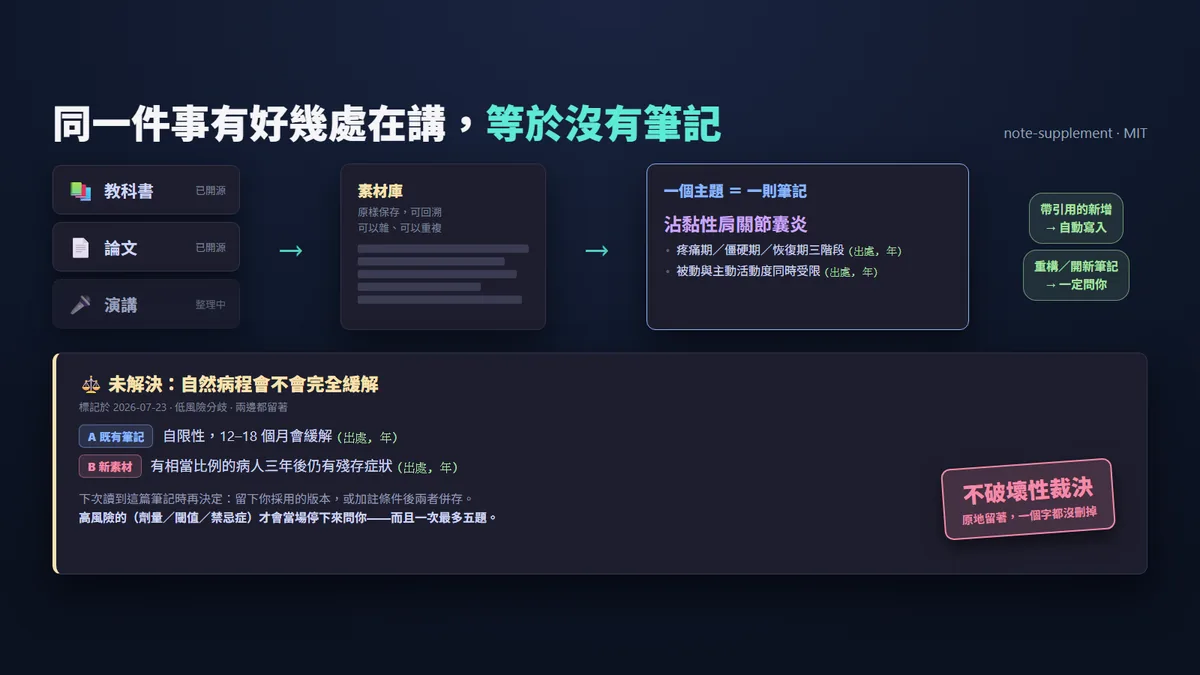
Textbooks, papers, and lectures flowing into a source library, then into a single topic note; below is a conflict block preserving both the old and new claims

Too Many Notes is No Notes: The Design of note-supplement

Why “too many notes” and “no notes” are the same thing Let me start with a rule I decided on early and haven’t changed since: in my note vault, there can only be one note per topic. It’s not about being a neat freak. It’s because if the same thing is covered in five different places, I have to open five files when I look something up, and figure out which version actually counts. That organization work didn’t disappear, it was just left intact for my future self. And my future self is usually seeing patients in clinic or rushing to finish slides, with no time to do this. The chaos caused by too much information is the exact same pain as not having enough information. ...
July 23, 2026 · 15 min · 3063 words · 陳柏威 Po-Wei Chen
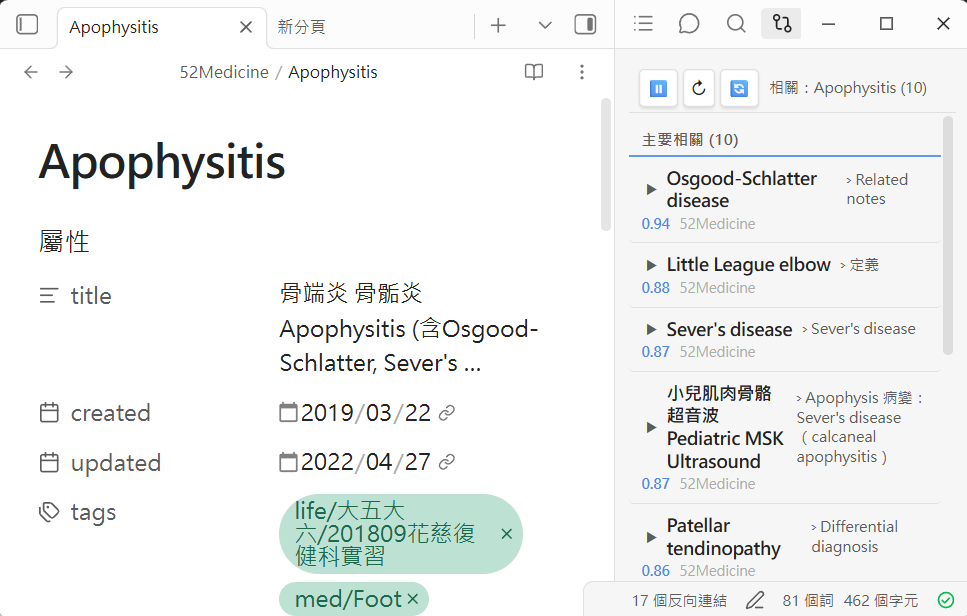
Vault Search semantic search panel

I turned Obsidian into a second brain that "searches notes by meaning" (and open-sourced it)

A minor annoyance that bothered me for a long time I’m a heavy Obsidian user, with thousands of notes sitting in my vault. But there’s one really inconvenient thing: Obsidian’s built-in search only looks for the exact words you type. The problem is, how would I remember what words I used back then for a note written three years ago? I’m thinking “how to manage a flaccid bladder,” but the note says Neurogenic Bladder → flaccid type → intermittent catheterization. The words don’t match, so the search returns a blank page. The worst part is, there were several times when I thought I hadn’t written about it, so I rewrote the whole thing, only to find out later that a more complete version had been lying there all along 😅 ...

June 23, 2026 · 5 min · 1007 words · 陳柏威 Po-Wei Chen
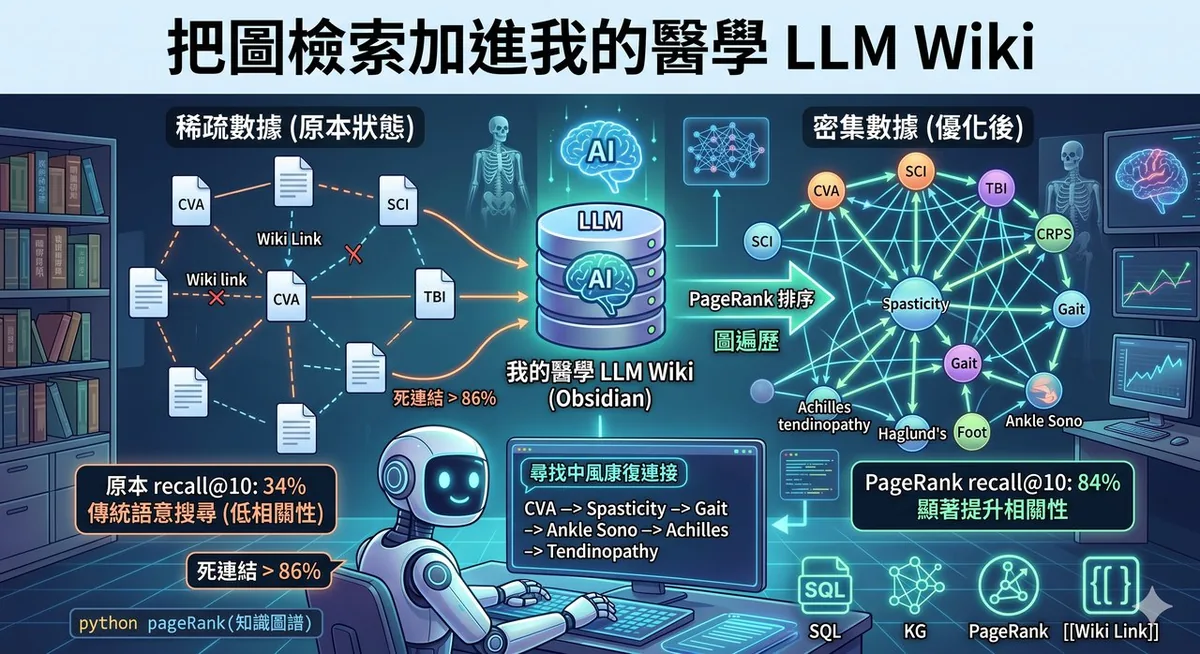
Adding graph retrieval to a medical note vault

Adding graph retrieval to my medical LLM Wiki, and it actually works this time

Background: What I was already using When studying for the board examination, I set up a RAG (Retrieval Augmented Generation) pipeline for myself. Using semantic search to look at similarity, I turned hundreds of physical medicine and rehabilitation (PM&R) textbooks and my own notes into something I could search and query. I use it for reading in Obsidian, while also letting Claude find what I need via MCP. Its weakest point right now is connecting knowledge across different documents. So a few days ago, when I saw someone share a newly published paper, SAG (SQL-Retrieval Augmented Generation), claiming that adding SQL and graph concepts on top of semantic search makes cross-document search easier—with effects similar to GraphRAG but easier to build and maintain—my eyes lit up. ...

June 22, 2026 · 9 min · 1802 words · 陳柏威 Po-Wei Chen