GitHub-style cover card for paper-fetch, illustrating a four-tier route: open access, official publisher TDM APIs, your own hospital library's off-campus connection, and printing the library resolver link

The last piece of The Paper Trilogy: paper-fetch. Give it a DOI, and it fetches the full text itself

When I shared my critical appraisal tool a while ago (to have Claude help with critical appraisal and summarizing content), a friend gave me a very honest reply: the tool is nice, but having to dig up the PDF yourself every single time is actually the most annoying part. It really is. To let AI read papers for you, you first need the full text. And when it comes to getting the full text, what usually gets you stuck isn’t the AI—it’s permissions, publishers, and the library. ...
July 14, 2026 · 7 min · 1399 words · 陳柏威 Po-Wei Chen
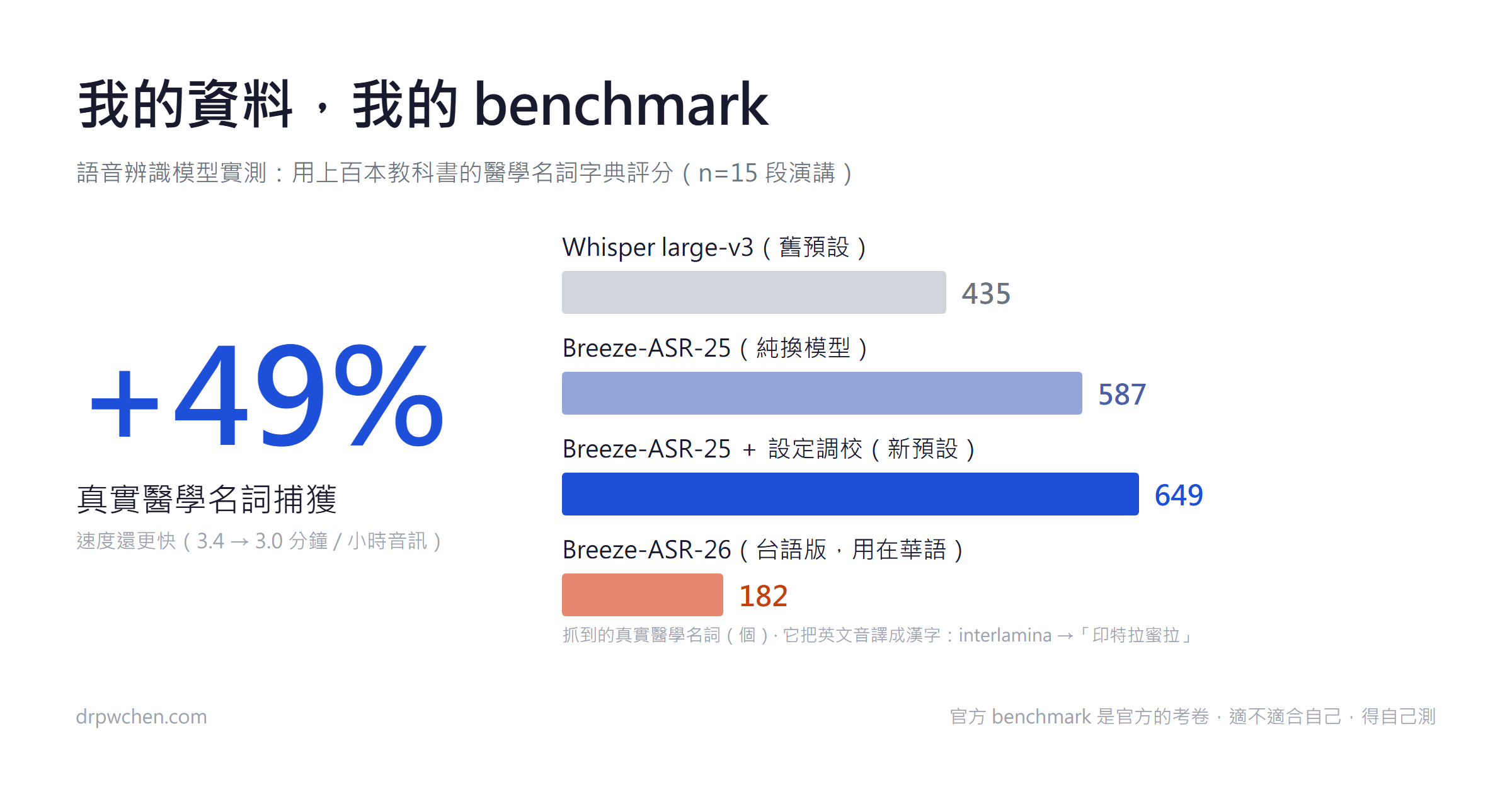
ASR model test results: Breeze-ASR-25 with tuned settings captures 649 real medical terms, 49% more than Whisper large-v3's 435; the Taiwanese Breeze-ASR-26 captures only 182 when used on Mandarin

My data, my benchmark: Swapping the speech recognition (ASR) engine for my lecture note system

Introduction: Why official scores aren’t enough My workflow for turning recorded lectures into notes goes in a straight line: transcript → matching slides → final summary. The foundation of this line is automatic speech recognition (ASR). However much it mishears, every subsequent layer of notes will be just as wrong. Originally, I was using OpenAI’s Whisper large-v3. The starting point for all this was actually me scrolling on my phone and seeing MediaTek Research announce their Taiwanese model, Breeze-ASR-26. A Taiwanese model is intriguing enough on its own, but clicking through, I learned they had already released Breeze-ASR-25 last year. Fine-tuned from Whisper-large-v2, it was optimized specifically for Taiwanese Mandarin and Mandarin-English code-switching, and open-sourced under Apache 2.0. Medical lectures happen to be ground zero for Mandarin-English code-switching. I had somehow missed this for a whole year. ...

July 13, 2026 · 18 min · 3743 words · 陳柏威 Po-Wei Chen
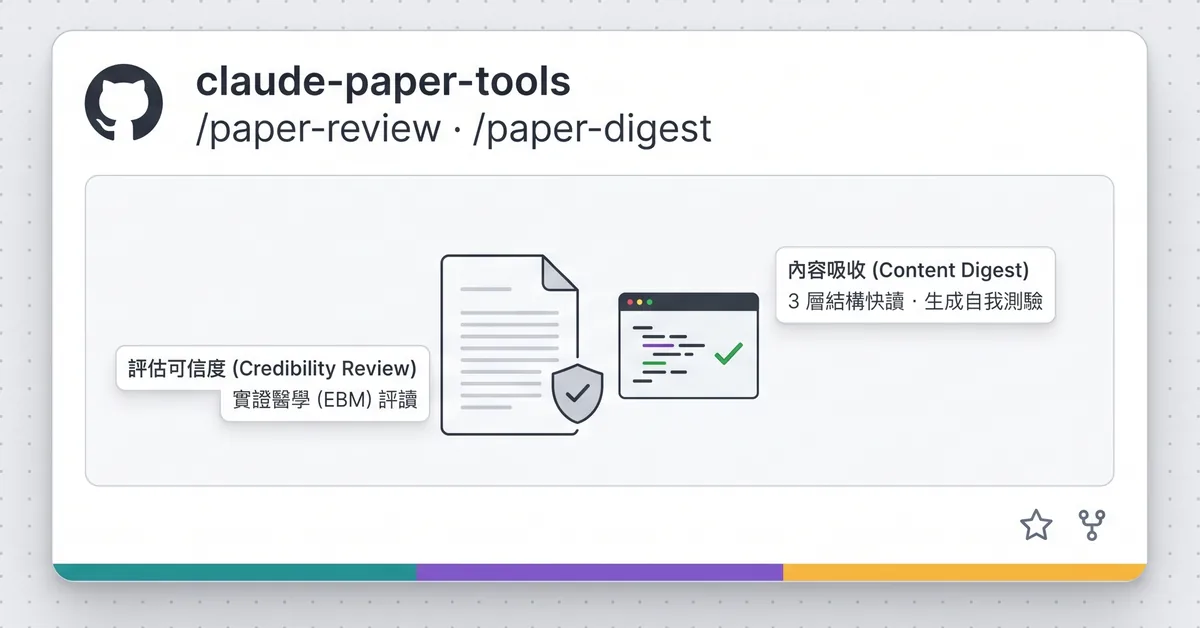
GitHub-style cover card for paper-review-and-digest, highlighting two skills: evidence-based medicine critical appraisal for assessing credibility, and a three-tier structure quick read with self-test generation for content absorption

I turned my journal club "paper-reading brain" into an AI skill, and forced it not to bullshit from impressions

The paper learning station I shared earlier had “Quality” and “Content” buttons, but I didn’t release the backend implementation back then. It was basically a platform with a frontend web page, but you still had to organize the backend yourself. But for my own setup, of course the backend still had to be wired to AI to reduce the cognitive load. So here I’m sharing those two backend skills to help speed up everyone’s learning! ...

July 7, 2026 · 6 min · 1176 words · 陳柏威 Po-Wei Chen
A friendly robot looking at a budget dashboard, the needle is in the normal pace zone, and token coins flow into a piggy bank

I installed a money-saving dashboard for my AI

📖 Saving Tokens series (four parts): Part 1: Why your AI gets dumber the more you chat · Part 2: Don’t boot up a supercomputer if an abacus will do · Part 3: Setting up a clean desk for your AI · Part 4 (this post, the finale) We’ve arrived at the final post of the series. Over the first three parts, we went from “why your AI gets dumber the more you chat” all the way to “when not to use AI” and “how to clean up its desk.” This post is about the moment you actually spend the money: how to make every penny count. ...

June 29, 2026 · 8 min · 1532 words · 陳柏威 Po-Wei Chen
A warm wooden abacus on the left, a glowing but power-hungry supercomputer on the right, with an implied scale in the middle, symbolizing choosing the right tool.

If an abacus works, don't boot up the supercomputer: When to actually make AI think?

📖 Token Saving Series (4 parts): Part 1: Why your AI gets dumber the longer you chat · Part 2 (This post) · Part 3: Clearing a clean desk for your AI · Part 4: I built a budget dashboard for my AI In the previous post, we talked about how longer AI chats get more expensive and dumber, along with three ways to save right now. This post takes it a step further to discuss a more fundamental divide: ...

June 29, 2026 · 6 min · 1173 words · 陳柏威 Po-Wei Chen
A friendly robot tidies messy papers into labeled drawers, leaving only one key piece of paper on a clean desk.

Organizing a clean desk for the AI

📖 The Token Saving Series (4 parts): Part 1: Why your AI gets dumber the more you chat · Part 2: If an abacus works, don’t boot up a supercomputer · Part 3 (This post) · Part 4: I built a budget dashboard for my AI The first two posts were still at the “everyone can use this” level. Starting with this one, I’ll show you the setup on my computer that I’ve endlessly tinkered with. ...

June 29, 2026 · 6 min · 1186 words · 陳柏威 Po-Wei Chen
A taxi meter carrying a sinking chat bubble crushed by token coins, with a friendly robot struggling to drag it

Why Does Your AI Get Slower and Dumber the Longer You Chat?

📖 Token Saving Series (4 parts in total): Part 1 (this post) · Part 2: If an Abacus Works, Don’t Boot Up a Supercomputer · Part 3: Organizing a Clean Desk for AI · Part 4: I Installed a Budget Dashboard for AI You’ve definitely had this experience: you chat with ChatGPT or Claude for an afternoon, and the longer it goes, the more sluggish it gets. It replies slower, suddenly “forgets” what you said earlier, or even starts talking in circles. ...

June 29, 2026 · 6 min · 1096 words · 陳柏威 Po-Wei Chen
Screenshot of the PM&R Continuing Education Radar website at courses.drpwchen.com

Built a PM&R Continuing Education Radar

Ever since becoming a resident, looking for continuing education courses has hit the same pain point every time: ultrasound, manual therapy, foot and ankle, neuro, pediatric rehab… The courses are scattered across a dozen society and institution websites. I’d have to refresh the sites every few days, and I was never sure if I’d actually seen a particular post before. Later on, I set up web scrapers for these course pages in my Home Assistant at home to automatically notify me of new courses, and things finally got a lot easier. But realizing I’d be completing residency soon, this little tool sitting at home wouldn’t be able to keep reminding the junior residents. Figuring I had Claude anyway, I just asked it to scrape all the courses and announcements from these 17 rehab-related societies and institutions, aggregate them in one place, update automatically every 3 hours, and put it on the web for everyone to use. ...

June 24, 2026 · 2 min · 423 words · 陳柏威 Po-Wei Chen
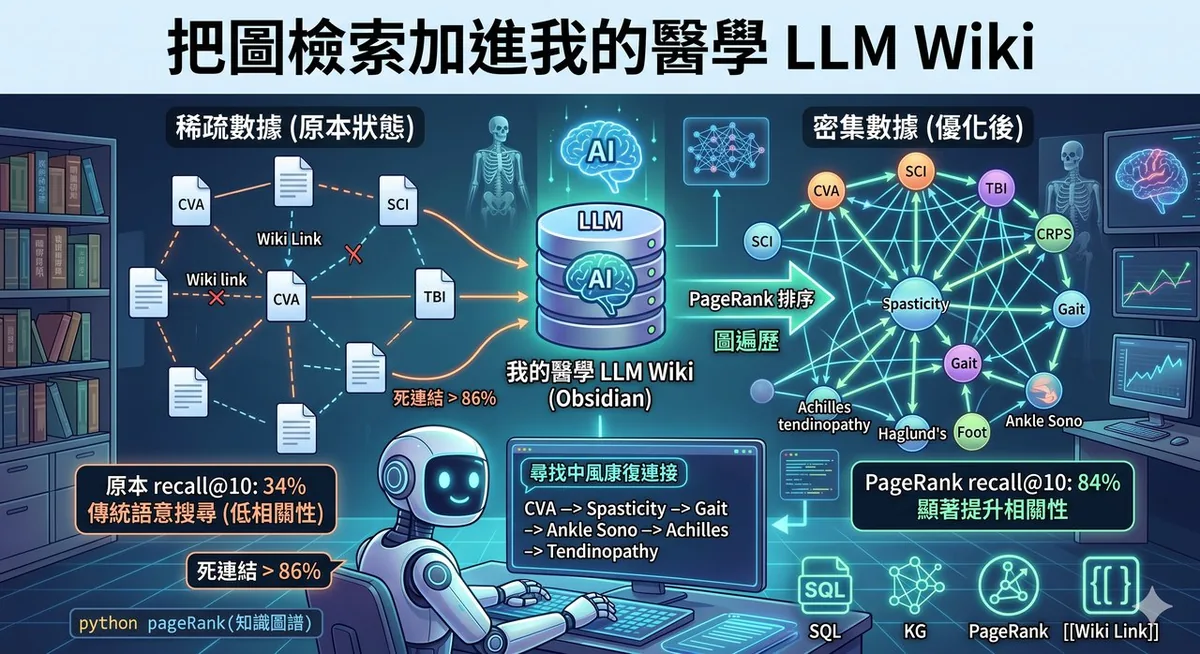
Adding graph retrieval to a medical note vault

Adding graph retrieval to my medical LLM Wiki, and it actually works this time

Background: What I was already using When studying for the board examination, I set up a RAG (Retrieval Augmented Generation) pipeline for myself. Using semantic search to look at similarity, I turned hundreds of physical medicine and rehabilitation (PM&R) textbooks and my own notes into something I could search and query. I use it for reading in Obsidian, while also letting Claude find what I need via MCP. Its weakest point right now is connecting knowledge across different documents. So a few days ago, when I saw someone share a newly published paper, SAG (SQL-Retrieval Augmented Generation), claiming that adding SQL and graph concepts on top of semantic search makes cross-document search easier—with effects similar to GraphRAG but easier to build and maintain—my eyes lit up. ...

June 22, 2026 · 9 min · 1802 words · 陳柏威 Po-Wei Chen