What the permission prompt is asking you: default asks every step, plan mode can only read, accept edits allows edits, auto mode only asks for dangerous ones. Press Shift+Tab to switch.

What is the permission prompt actually asking? Four modes, auto mode data, and Codex equivalents

Last week I gave an intro class on AI agents for some anesthesiologist friends. The post-class feedback was interesting: “permission prompts and auto mode” showed up near the top of two different lists. A lot of people voted it “most useful,” but a lot also voted it “didn’t understand.” That means it’s important, but the pacing of a single class just wasn’t enough to cover it. I’ll explain it all here in this post. ...

August 21, 2026 · 7 min · 1287 words · 陳柏威 Po-Wei Chen
Is it safe to let AI drive my browser: terminal screen showing 13 critical URLs blocked for Kimi WebBridge. When AI tries to open online banking, it gets "Cannot attach to this target". Unblocked sites remain automated as usual. The extension's site access whitelist cannot block it; we must start from the browser policy.

Storing Passwords in the Browser While Letting AI Drive It: Is This Safe?

A few days ago, a junior colleague who just started coding with AI asked me a great question: she lets AI directly drive her browser to do things, but her passwords are all saved in the browser. Is this actually safe? I think this question is worth breaking down into two layers, because people often mix them up when worrying about them. After looking into it seriously, I turned the answer into an open-source tool, which I’ll introduce at the end of the post. ...

August 9, 2026 · 7 min · 1431 words · 陳柏威 Po-Wei Chen
lecture-to-notes: turning any combination of video, audio, slides, and photos into structured, traceable notes

Turning lecture videos into notes you'll actually revisit: lecture-to-notes is now open source

A while back on Facebook, I shared the results of using AI to organize lecture videos. I got an unexpectedly huge response, and people kept asking when I’d release the tool. I’ve spent some time cleaning it up, and today it’s officially open source: lecture-to-notes. Key takeaways from this post Why everyone records lectures, but nobody goes back to finish watching them Notes don’t have to be shaped like “text + pictures”: video, transcript, and summary synced on one page Bring whatever you have: video, audio, slides, photos, all connected to the same timeline A few technical insistences: the transcript never automatically changes words, timing uses evidence instead of guessing Why OCR alone isn’t enough: how to tell if textless flowcharts and ultrasounds are important Fallback options for running without an NVIDIA GPU The forest of tripods at the back of the classroom I’ve always found physical medicine and rehabilitation (PM&R) lectures hard to take notes on. For classes like manual therapy and musculoskeletal ultrasound, the knowledge is hidden in the “movements.” You can’t capture it no matter how much text you write down. So the venue is always packed with tripods. Everyone’s recording, planning to review it later over a meal. ...

August 3, 2026 · 10 min · 1920 words · 陳柏威 Po-Wei Chen
Getting Started with AI Part 3: Automations Aren't Designed, They Grow — Five Things to Start With and Upgrading When You Repeat It a Third Time

Automations Aren't Designed, They Grow: From One Sentence to a Production Line

This is the third post in the getting-started-with-AI series. Part 1 covered how to set it up, and Part 2 covered how to talk to it and set up guardrails. At the end of Part 2, I said: the hard part is never “how to ask,” it’s “how to design the workflow.” This post will wrap up that statement. The answer might be the opposite of what you think: workflows aren’t designed, they grow. ...

July 27, 2026 · 13 min · 2631 words · 陳柏威 Po-Wei Chen
claude-pacer status line illustration: usage bars, context, model, and three-layer design

AI running out of gas halfway through a midnight task? I built it a fuel gauge and automatic brakes

I previously shared building a money-saving dashboard for AI. Back then, I was mostly looking at “how much money I spent.” Using it now, I realized what really hurts isn’t the money, it’s the quota: Claude Code’s subscription has 5-hour and 7-day rolling windows. Hit the limit, and it just stops dead in its tracks. In this post, I’ll share the open-source little tool we made for this: claude-pacer (github.com/drpwchen/claude-pacer). Why build this? It started with getting cut off in the middle of the night a few times. ...

July 25, 2026 · 5 min · 961 words · 陳柏威 Po-Wei Chen
AI getting started series 1: Getting started with AI agents from scratch - a four-step guide to installing with one command, understanding GitHub, having AI install it for you, and getting results

Getting started with AI agents from scratch: installing, understanding GitHub, and running your first tool

This is an article that I’ll keep updating. ...

July 24, 2026 · 25 min · 5260 words · 陳柏威 Po-Wei Chen
AI Getting Started Series ②: How I talk to AI agents — the hooks / permissions / CLAUDE.md three-layer constraint hierarchy

How I talk to AI agents: three mindsets, four meta-skills, and a rules file that shouldn't keep growing

The previous post, Getting Started from Scratch, was about how to install it and get it running. This post is about using it well. And that is completely different from just getting it to run. I’ve found that what really determines the outcome isn’t which model you use or whether you can code. It’s how you delegate tasks and how you set up guardrails. The stuff in this post isn’t tied to a specific tool; it applies even if you use ChatGPT (I’ll explain the differences in the last section). ...

July 24, 2026 · 19 min · 3994 words · 陳柏威 Po-Wei Chen
Textbooks, papers, and lectures flowing into a source library, then into a single topic note; below is a conflict block preserving both the old and new claims

Too Many Notes is No Notes: The Design of note-supplement

Why “too many notes” and “no notes” are the same thing Let me start with a rule I decided on early and haven’t changed since: in my note vault, there can only be one note per topic. It’s not about being a neat freak. It’s because if the same thing is covered in five different places, I have to open five files when I look something up, and figure out which version actually counts. That organization work didn’t disappear, it was just left intact for my future self. And my future self is usually seeing patients in clinic or rushing to finish slides, with no time to do this. The chaos caused by too much information is the exact same pain as not having enough information. ...

July 23, 2026 · 15 min · 3067 words · 陳柏威 Po-Wei Chen
My complete AI toolbox: A categorized list of tools

My Complete AI Toolbox: Find the Tool for Whatever You Want to Do

I was recently preparing an introductory AI lecture for our therapist colleagues, and thought I’d put together an advanced list of all the tools I normally use and the programs I’ve written. This way, when you want to do something, you can quickly look up “who to go to for this function.” It’s also something I’ve always wanted to organize for myself, so I’m taking this chance to write it all out. ...

July 20, 2026 · 12 min · 2490 words · 陳柏威 Po-Wei Chen
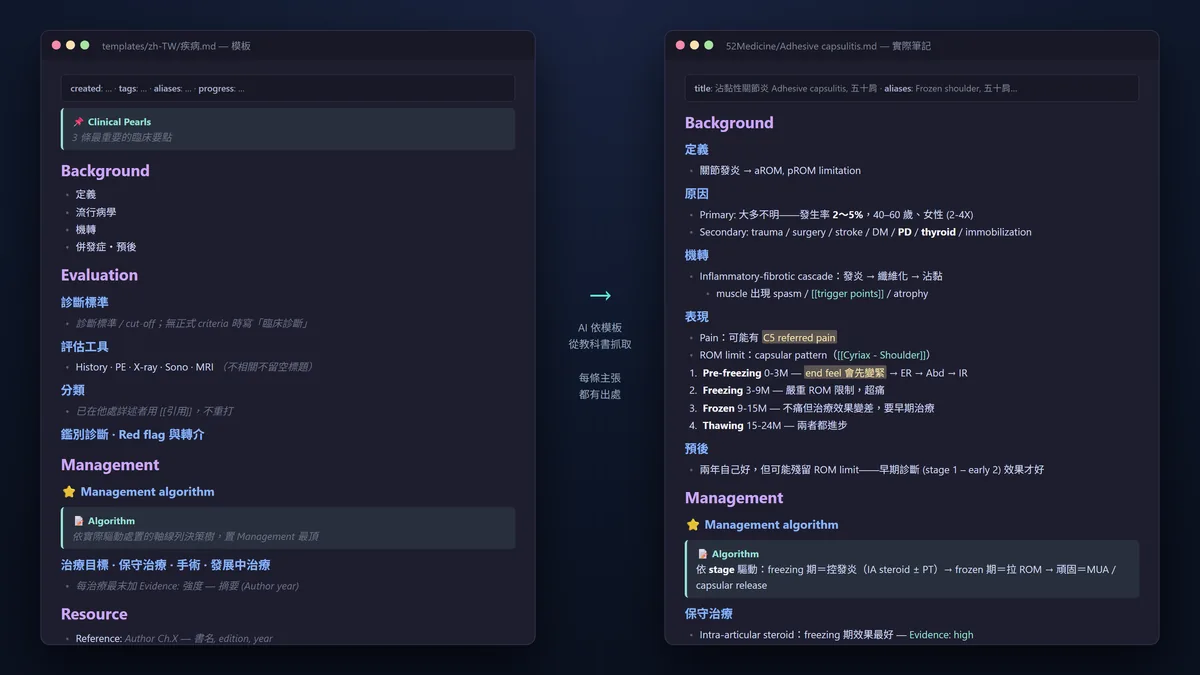
Note template on the left, actual notes generated by the system using the template on the right, with every claim cited

Cross-Textbook Automated Note-Generation Workflow: A Product of the Board Examination

Origin I’ve loved taking notes since medical school and have accumulated thousands of medical notes over the years. But honestly, with information so easy to get and so much to learn now, it’s become hard to keep every note at the same quality using my own structure. On the other hand, in an era of ever-increasing information, trustworthy, high-quality sources have ironically become precious, which makes textbooks a great source of information. However, there are over forty designated reference books for the physical medicine and rehabilitation (PM&R) board examination, and the same concept might be scattered across different chapters in several books. Actually reading through all of them is almost impossible. ...

July 19, 2026 · 7 min · 1479 words · 陳柏威 Po-Wei Chen