AI getting started series 1: Getting started with AI agents from scratch - a four-step guide to installing with one command, understanding GitHub, having AI install it for you, and getting results

Getting started with AI agents from scratch: installing, understanding GitHub, and running your first tool

This is an article that I’ll keep updating. ...

July 24, 2026 · 21 min · 4311 words · 陳柏威 Po-Wei Chen
AI Getting Started Series ②: How I talk to AI agents — the hooks / permissions / CLAUDE.md three-layer constraint hierarchy

How I talk to AI agents: three mindsets, four meta-skills, and a rules file that shouldn't keep growing

The previous post, Getting Started from Scratch, was about how to install it and get it running. This post is about using it well. And that is completely different from just getting it to run. I’ve found that what really determines the outcome isn’t which model you use or whether you can code. It’s how you delegate tasks and how you set up guardrails. The stuff in this post isn’t tied to a specific tool; it applies even if you use ChatGPT (I’ll explain the differences in the last section). ...

July 24, 2026 · 19 min · 3990 words · 陳柏威 Po-Wei Chen
My complete AI toolbox: A categorized list of tools

My Complete AI Toolbox: Find the Tool for Whatever You Want to Do

I was recently preparing an introductory AI lecture for our therapist colleagues, and thought I’d put together an advanced list of all the tools I normally use and the programs I’ve written. This way, when you want to do something, you can quickly look up “who to go to for this function.” It’s also something I’ve always wanted to organize for myself, so I’m taking this chance to write it all out. ...

July 20, 2026 · 12 min · 2470 words · 陳柏威 Po-Wei Chen
GitHub-style cover card for paper-fetch, illustrating a four-tier route: open access, official publisher TDM APIs, your own hospital library's off-campus connection, and printing the library resolver link

The last piece of The Paper Trilogy: paper-fetch. Give it a DOI, and it fetches the full text itself

When I shared my critical appraisal tool a while ago (to have Claude help with critical appraisal and summarizing content), a friend gave me a very honest reply: the tool is nice, but having to dig up the PDF yourself every single time is actually the most annoying part. It really is. To let AI read papers for you, you first need the full text. And when it comes to getting the full text, what usually gets you stuck isn’t the AI—it’s permissions, publishers, and the library. ...

July 14, 2026 · 7 min · 1399 words · 陳柏威 Po-Wei Chen
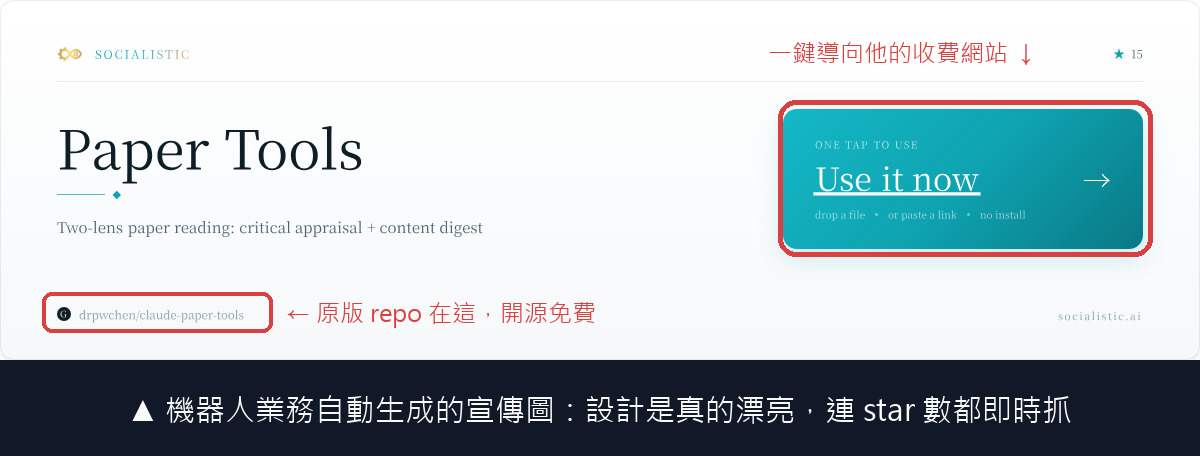
A promotional image for Paper Tools automatically generated by a bot, with a red box highlighting the referral button to the paid site and the location of the original open-source repo

My Open-Source Tool Was Targeted by a Bot Marketer!

The paper tool paper-review-and-digest I shared earlier had only been open-sourced for a few days when it received its first GitHub issue! I was actually quite happy to get my first issue, and I was even more surprised when I opened it: they didn’t just read my code, but accurately pointed out the parts of the design I was most proud of. He said he appreciated the “hard split between the model and deterministic checks”: grade_judge.py doesn’t trust the level of evidence reported by the model itself, but recalculates it from the downgrade items; argdown_lint.py catches argumentative leaps like “jumping from surrogate endpoints to hard endpoints.” Then he said he built an online portal for me, so visitors don’t need to install Claude Code and can just upload a PDF to run the critical appraisal workflow. He even made a promotional image: ...

July 9, 2026 · 5 min · 1036 words · 陳柏威 Po-Wei Chen
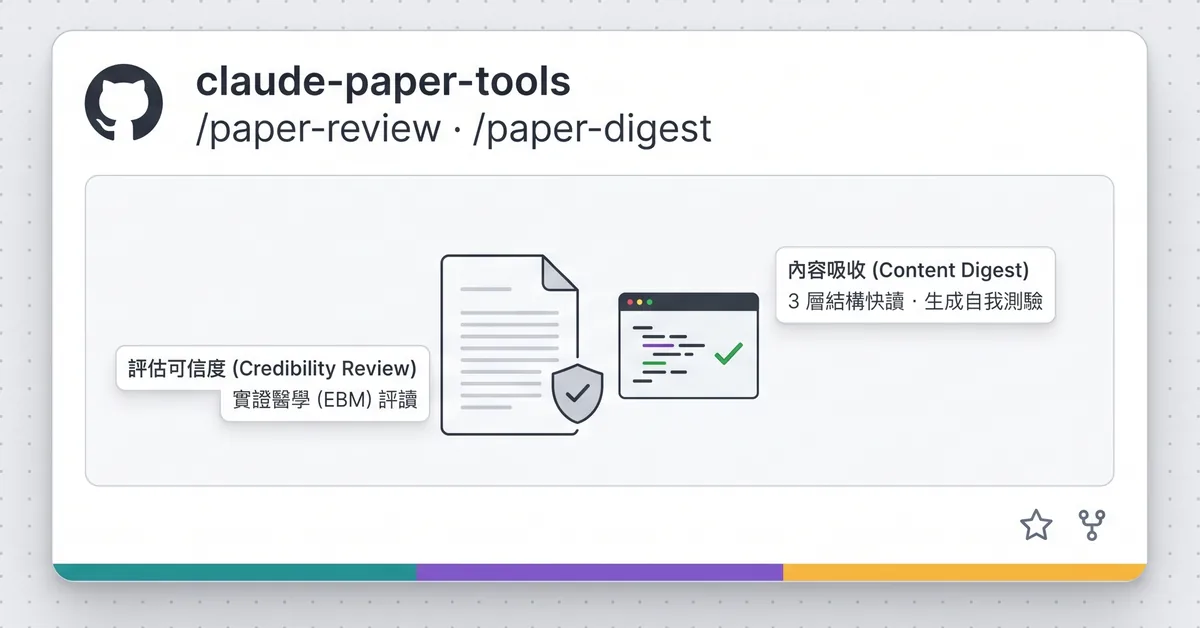
GitHub-style cover card for paper-review-and-digest, highlighting two skills: evidence-based medicine critical appraisal for assessing credibility, and a three-tier structure quick read with self-test generation for content absorption

I turned my journal club "paper-reading brain" into an AI skill, and forced it not to bullshit from impressions

The paper learning station I shared earlier had “Quality” and “Content” buttons, but I didn’t release the backend implementation back then. It was basically a platform with a frontend web page, but you still had to organize the backend yourself. But for my own setup, of course the backend still had to be wired to AI to reduce the cognitive load. So here I’m sharing those two backend skills to help speed up everyone’s learning! ...

July 7, 2026 · 6 min · 1176 words · 陳柏威 Po-Wei Chen
A friendly robot looking at a budget dashboard, the needle is in the normal pace zone, and token coins flow into a piggy bank

I installed a money-saving dashboard for my AI

📖 Saving Tokens series (four parts): Part 1: Why your AI gets dumber the more you chat · Part 2: Don’t boot up a supercomputer if an abacus will do · Part 3: Setting up a clean desk for your AI · Part 4 (this post, the finale) We’ve arrived at the final post of the series. Over the first three parts, we went from “why your AI gets dumber the more you chat” all the way to “when not to use AI” and “how to clean up its desk.” This post is about the moment you actually spend the money: how to make every penny count. ...

June 29, 2026 · 8 min · 1532 words · 陳柏威 Po-Wei Chen
A warm wooden abacus on the left, a glowing but power-hungry supercomputer on the right, with an implied scale in the middle, symbolizing choosing the right tool.

If an abacus works, don't boot up the supercomputer: When to actually make AI think?

📖 Token Saving Series (4 parts): Part 1: Why your AI gets dumber the longer you chat · Part 2 (This post) · Part 3: Clearing a clean desk for your AI · Part 4: I built a budget dashboard for my AI In the previous post, we talked about how longer AI chats get more expensive and dumber, along with three ways to save right now. This post takes it a step further to discuss a more fundamental divide: ...

June 29, 2026 · 6 min · 1173 words · 陳柏威 Po-Wei Chen
A friendly robot tidies messy papers into labeled drawers, leaving only one key piece of paper on a clean desk.

Organizing a clean desk for the AI

📖 The Token Saving Series (4 parts): Part 1: Why your AI gets dumber the more you chat · Part 2: If an abacus works, don’t boot up a supercomputer · Part 3 (This post) · Part 4: I built a budget dashboard for my AI The first two posts were still at the “everyone can use this” level. Starting with this one, I’ll show you the setup on my computer that I’ve endlessly tinkered with. ...

June 29, 2026 · 6 min · 1186 words · 陳柏威 Po-Wei Chen
A taxi meter carrying a sinking chat bubble crushed by token coins, with a friendly robot struggling to drag it

Why Does Your AI Get Slower and Dumber the Longer You Chat?

📖 Token Saving Series (4 parts in total): Part 1 (this post) · Part 2: If an Abacus Works, Don’t Boot Up a Supercomputer · Part 3: Organizing a Clean Desk for AI · Part 4: I Installed a Budget Dashboard for AI You’ve definitely had this experience: you chat with ChatGPT or Claude for an afternoon, and the longer it goes, the more sluggish it gets. It replies slower, suddenly “forgets” what you said earlier, or even starts talking in circles. ...

June 29, 2026 · 6 min · 1096 words · 陳柏威 Po-Wei Chen