claude-pacer status line illustration: usage bars, context, model, and three-layer design

AI running out of gas halfway through a midnight task? I built it a fuel gauge and automatic brakes

I previously shared building a money-saving dashboard for AI. Back then, I was mostly looking at “how much money I spent.” Using it now, I realized what really hurts isn’t the money, it’s the quota: Claude Code’s subscription has 5-hour and 7-day rolling windows. Hit the limit, and it just stops dead in its tracks. In this post, I’ll share the open-source little tool we made for this: claude-pacer (github.com/drpwchen/claude-pacer). Why build this? It started with getting cut off in the middle of the night a few times. ...

July 25, 2026 · 5 min · 961 words · 陳柏威 Po-Wei Chen
Textbooks, papers, and lectures flowing into a source library, then into a single topic note; below is a conflict block preserving both the old and new claims

Too Many Notes is No Notes: The Design of note-supplement

Why “too many notes” and “no notes” are the same thing Let me start with a rule I decided on early and haven’t changed since: in my note vault, there can only be one note per topic. It’s not about being a neat freak. It’s because if the same thing is covered in five different places, I have to open five files when I look something up, and figure out which version actually counts. That organization work didn’t disappear, it was just left intact for my future self. And my future self is usually seeing patients in clinic or rushing to finish slides, with no time to do this. The chaos caused by too much information is the exact same pain as not having enough information. ...

July 23, 2026 · 15 min · 3063 words · 陳柏威 Po-Wei Chen
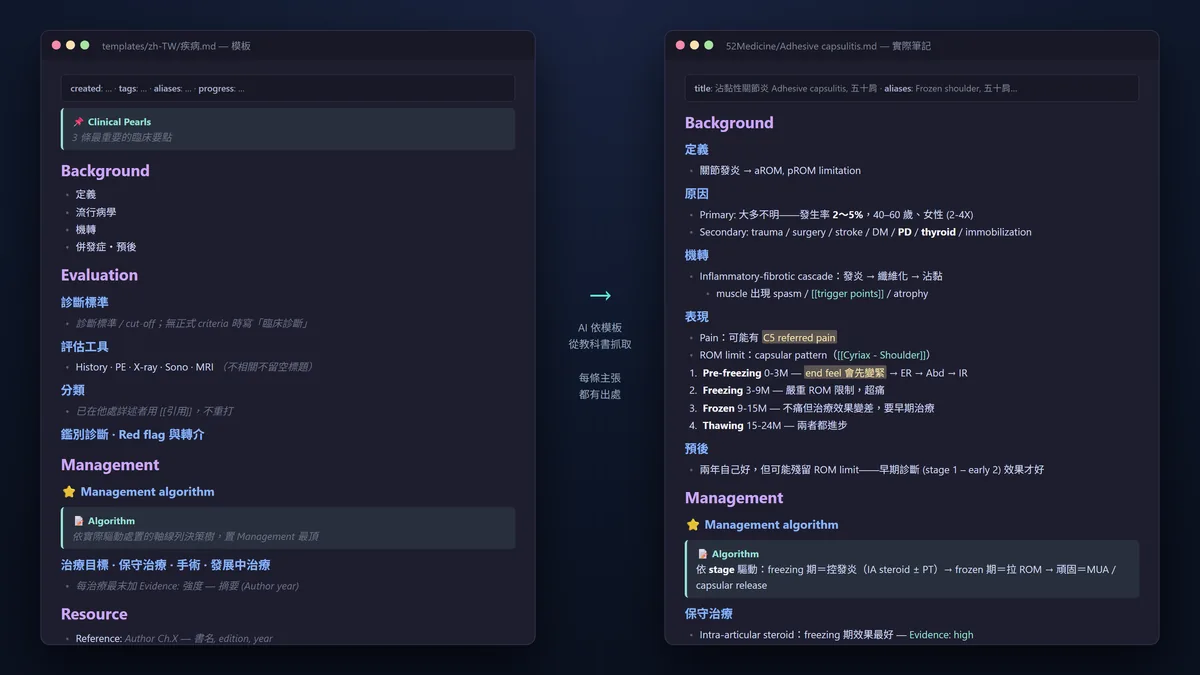
Note template on the left, actual notes generated by the system using the template on the right, with every claim cited

Cross-Textbook Automated Note-Generation Workflow: A Product of the Board Examination

Origin I’ve loved taking notes since medical school and have accumulated thousands of medical notes over the years. But honestly, with information so easy to get and so much to learn now, it’s become hard to keep every note at the same quality using my own structure. On the other hand, in an era of ever-increasing information, trustworthy, high-quality sources have ironically become precious, which makes textbooks a great source of information. However, there are over forty designated reference books for the physical medicine and rehabilitation (PM&R) board examination, and the same concept might be scattered across different chapters in several books. Actually reading through all of them is almost impossible. ...

July 19, 2026 · 7 min · 1475 words · 陳柏威 Po-Wei Chen
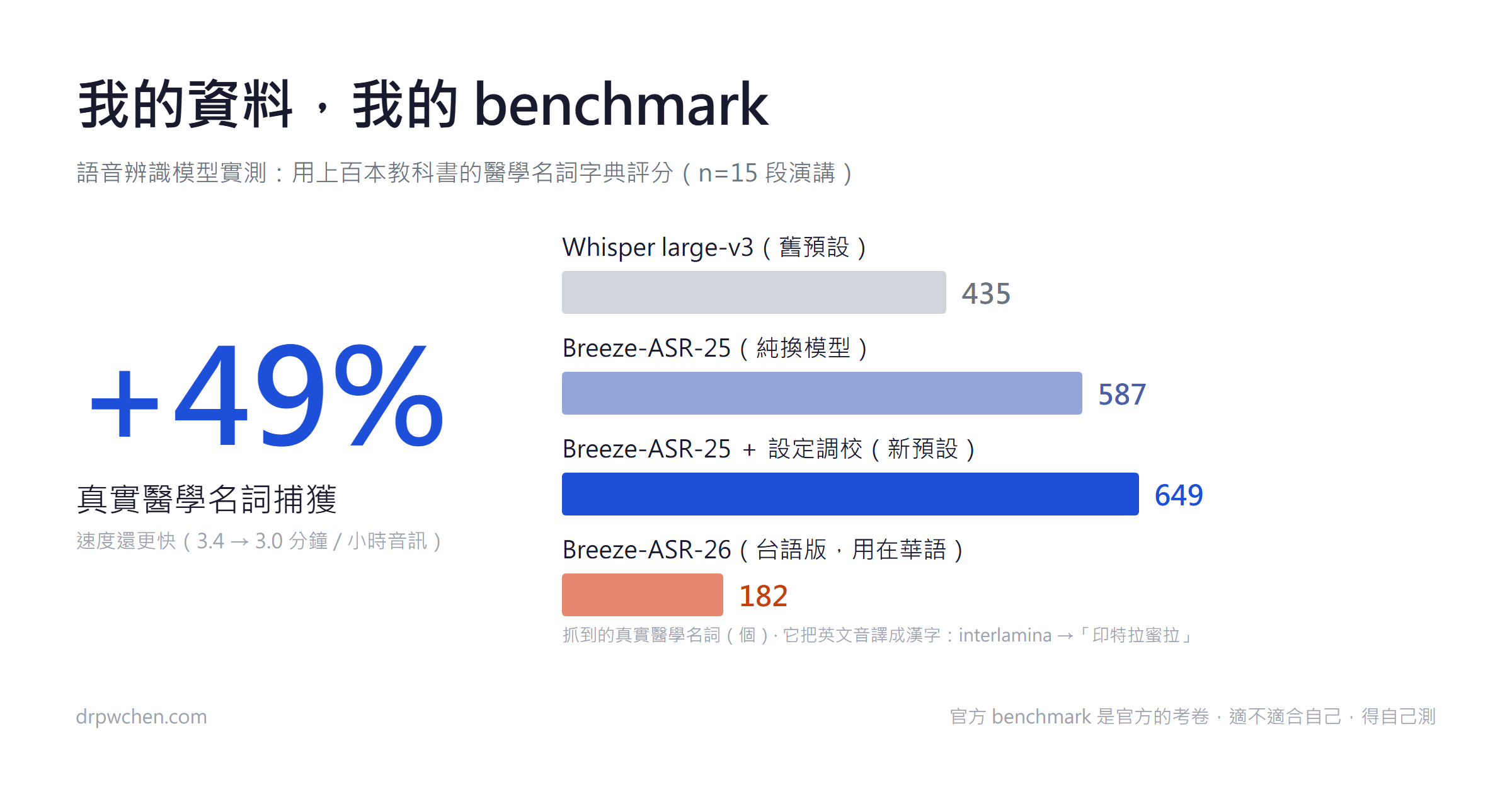
ASR model test results: Breeze-ASR-25 with tuned settings captures 649 real medical terms, 49% more than Whisper large-v3's 435; the Taiwanese Breeze-ASR-26 captures only 182 when used on Mandarin

My data, my benchmark: Swapping the speech recognition (ASR) engine for my lecture note system

Introduction: Why official scores aren’t enough My workflow for turning recorded lectures into notes goes in a straight line: transcript → matching slides → final summary. The foundation of this line is automatic speech recognition (ASR). However much it mishears, every subsequent layer of notes will be just as wrong. Originally, I was using OpenAI’s Whisper large-v3. The starting point for all this was actually me scrolling on my phone and seeing MediaTek Research announce their Taiwanese model, Breeze-ASR-26. A Taiwanese model is intriguing enough on its own, but clicking through, I learned they had already released Breeze-ASR-25 last year. Fine-tuned from Whisper-large-v2, it was optimized specifically for Taiwanese Mandarin and Mandarin-English code-switching, and open-sourced under Apache 2.0. Medical lectures happen to be ground zero for Mandarin-English code-switching. I had somehow missed this for a whole year. ...

July 13, 2026 · 18 min · 3743 words · 陳柏威 Po-Wei Chen