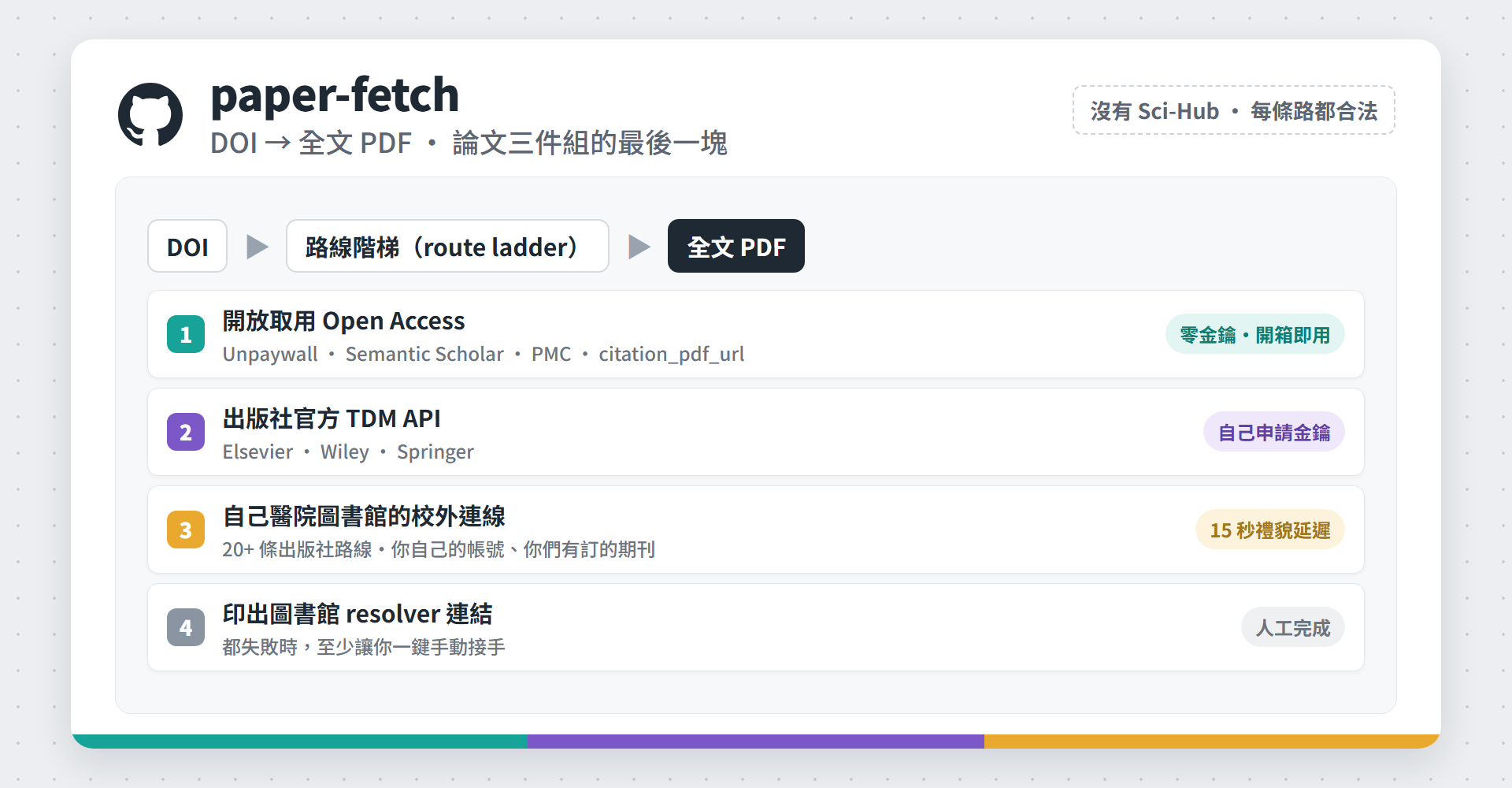
GitHub-style cover card for paper-fetch, illustrating a four-tier route: open access, official publisher TDM APIs, your own hospital library's off-campus connection, and printing the library resolver link

The last piece of The Paper Trilogy: paper-fetch. Give it a DOI, and it fetches the full text itself

When I shared my critical appraisal tool a while ago (to have Claude help with critical appraisal and summarizing content), a friend gave me a very honest reply: the tool is nice, but having to dig up the PDF yourself every single time is actually the most annoying part. It really is. To let AI read papers for you, you first need the full text. And when it comes to getting the full text, what usually gets you stuck isn’t the AI—it’s permissions, publishers, and the library. ...
July 14, 2026 · 7 min · 1399 words · 陳柏威 Po-Wei Chen
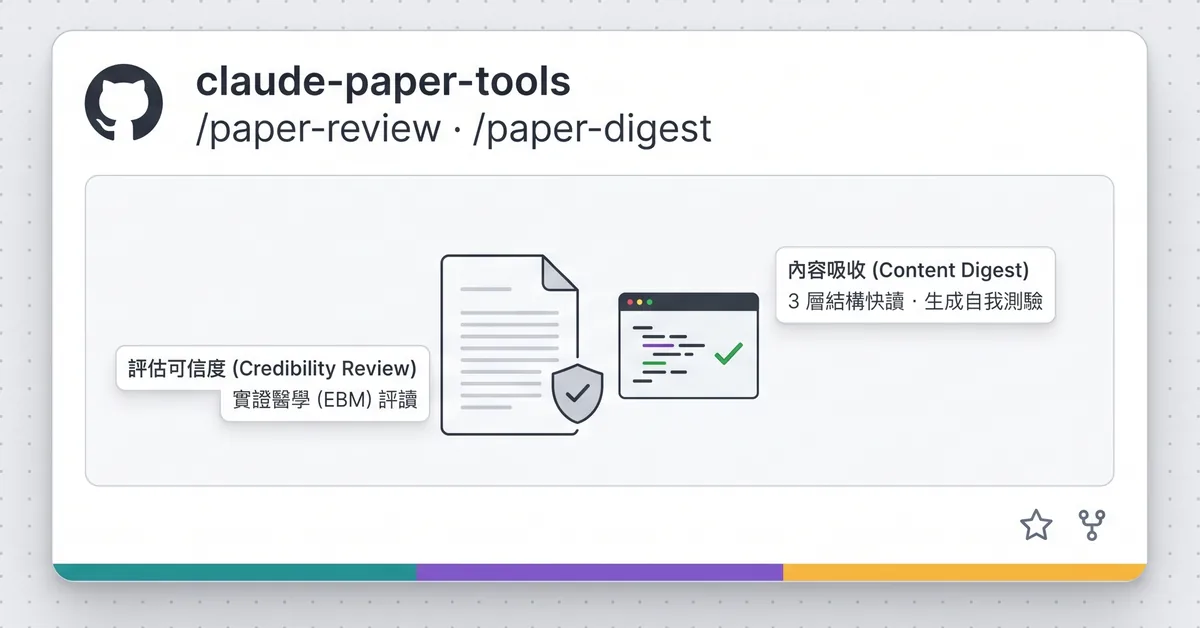
GitHub-style cover card for paper-review-and-digest, highlighting two skills: evidence-based medicine critical appraisal for assessing credibility, and a three-tier structure quick read with self-test generation for content absorption

I turned my journal club "paper-reading brain" into an AI skill, and forced it not to bullshit from impressions

The paper learning station I shared earlier had “Quality” and “Content” buttons, but I didn’t release the backend implementation back then. It was basically a platform with a frontend web page, but you still had to organize the backend yourself. But for my own setup, of course the backend still had to be wired to AI to reduce the cognitive load. So here I’m sharing those two backend skills to help speed up everyone’s learning! ...

July 7, 2026 · 6 min · 1176 words · 陳柏威 Po-Wei Chen
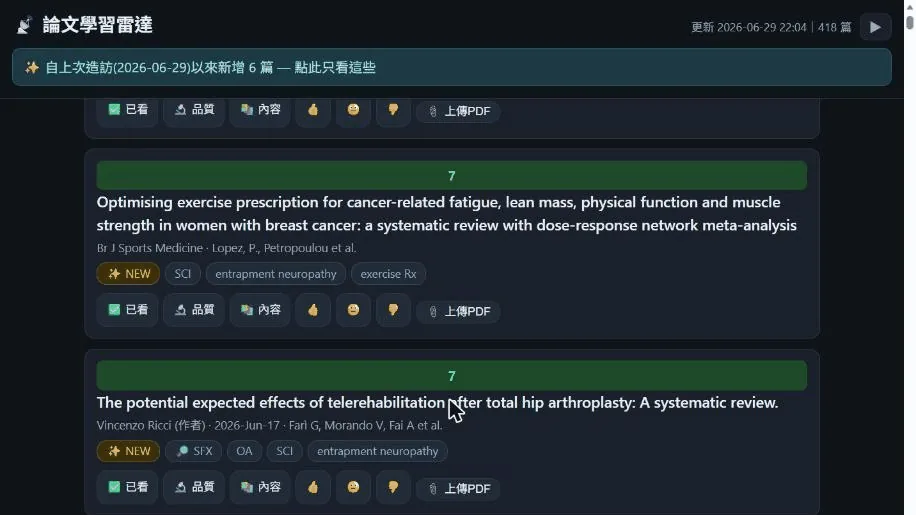
A screenshot of the paper radar web interface showing paper cards with full-text badges and action checkboxes

I Open-Sourced My Paper Reading Radar

A while back, I shared the paper reading site I built for myself, and I got quite a few messages asking, “Can I use this too?” and “How exactly does it work?” I’ll explain it clearly in this post, and while I’m at it, I’ll let you know that I’ve organized it into an open-source version and put it on GitHub. First, the problem I wanted to solve. As a physiatrist, there are dozens of journals I want to track, along with a few authors I really want to follow and a couple of topics I’m always keeping an eye on. The traditional approach is to dump a bunch of RSS subscriptions into a reader or a notes app. As a result, hundreds of papers pile up every day, and it quickly turns into a garbage dump of “I’ll never finish reading this, and I don’t even know where to start.” In the end, you either get anxious or just give up reading altogether. ...

July 1, 2026 · 5 min · 1063 words · 陳柏威 Po-Wei Chen