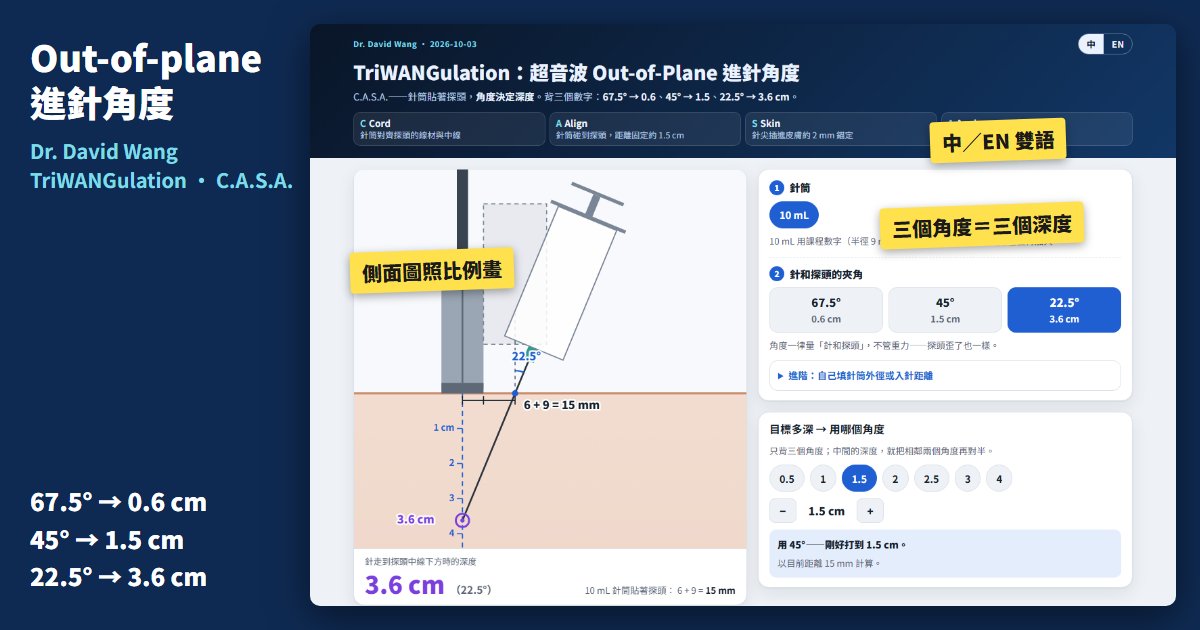
I’ve joined the prolotherapy volunteer clinic every year since 2023. This year (2026-10-03), Dr. David Wang (David C. Wang, DO, founder of Virtuosity Physical Medicine in Reston, Virginia, USA) taught a method for out-of-plane needling. The whole system comes down to three angles and three numbers, and as soon as I heard it I wanted something I could pull out and check at any time.
So when I got back, I turned my recording into notes (using lecture-to-notes, a tool I open-sourced earlier), then built a web page around it. It’s bilingual (English and Chinese) and made for phones first:
Open the needle angle page English & Chinese · works on phones · nothing to install
Why is out-of-plane hard?
On screen the needle is just a bright dot: you can’t see where it came from, so you can only guess how deep it will show up.
Dr. Wang estimates that about 90–95% of physicians in the US only inject in-plane, for a simple reason: nobody teaches out-of-plane. Yet out-of-plane is usually faster, lets you use a finer needle, and hurts the patient less. His fix is to take the guessing out and make depth something you can calculate.
C.A.S.A.: how do you turn three directions into one?
Lock down side-to-side and front-to-back first, so depth is the only thing left. These are the four steps he developed with Dr. Sean Hessler, ND:
- Cord: Line the syringe up with the probe cord and the probe’s center line, so the needle always stays in the middle of the probe.
- Align: The syringe actually touches the probe. The probe’s center line is about 6 mm from its side edge and a 10 cc syringe has a radius of about 9 mm, so the entry point always sits about 1.5 cm from the ultrasound beam.
- Skin: Slide down along the probe and push the tip about 2 mm into the skin to anchor it, so your reference point doesn’t drift.
- Angle: Only now do you set the angle between the needle and the probe. That angle decides the depth.
TriWANGulation: are three angles enough?
Yes. Once the distance is fixed at 1.5 cm, depth depends only on the angle:
| Angle between needle and probe | Depth where the needle crosses under the probe center line |
|---|---|
| 67.5° | 0.6 cm |
| 45° | 1.5 cm |
| 22.5° | 3.6 cm |
Why these three? His reasoning is practical: people judge 0° and 90° well, and 45° isn’t hard either. Halving 45° to get 22.5°, or splitting 45° and 90° to get 67.5°, is something most people can do. Nobody can reliably eyeball a “calculated” angle like 26.57°.
What if the target is in between? Just halve it again. A 2.25 cm target, for example, falls between 45° and 22.5°, so you go halfway: 33.75°. He says this kind of estimate usually lands within 3–5 mm of the target.
He named TriWANGulation himself: triangulation plus his surname, Wang. He says American audiences always laugh at it 😁
The angle is always measured from the probe, not from gravity
You often need to tilt the probe about 20° to get a clean image. If you still measure 45° from vertical, the needle is really at 65° to the probe and only reaches 0.7 cm, which is too shallow. His two mantras: Align with the cord. Ignore gravity. Forget the bed and the patient’s position; only the probe counts.
Why not walk the needle down?
Because every pass that isn’t aimed at the target is another chance to go wrong. Superficial layers of hyperechoic fascia hide the needle tip, so if the target is at 3 cm, inching down from 1 cm just wastes time. The only place he walks down a little is near the lung, for example around the ribs.
What does the web page do?
Pick a syringe and an angle, and it shows how deep the needle will appear. Main features:
- To-scale side view: The 12 mm probe, the syringe’s outer diameter, the entry distance and the depth share one scale, and the drawing moves with the angle.
- Target lookup: Enter a target depth and it tells you which angle to use, or which two angles it falls between and what the halfway angle is.
- Advanced: your own distance: If you’re not using a 10 cc syringe, or you enter farther from the probe, type in the syringe’s outer diameter or drag the “entry distance from probe” slider, and the depths for all three angles update at once. When you want to know “entering this far out at this angle, how deep am I under the probe center line?”, one drag answers it.
- Common sites and depths: 30 sites where three textbooks use out-of-plane, each marked as OOP preferred, either approach (like De Quervain), or OOP as an alternative. For 6 of these sites I found a published skin-to-target depth, plotted on a chart against the three angle reference lines. Where I couldn’t find a source, I left it blank instead of estimating.
- An Ignore gravity illustration and a short quiz.
- English and Chinese: It opens in English if your browser is set to English, and you can switch by hand, so it’s easy to pass on to Dr. Wang and colleagues abroad.
Where the numbers come from
The 1.5 cm is the course figure for a standard linear probe + 10 cc syringe, measured on his own machine. Syringe outer diameters differ by brand, and the public data I found for 3 cc and 5 cc syringes contradicted itself, so the page only lists 10 cc for now. I’ll add the others after measuring them myself. If your probe or syringe is different, open “Advanced” and enter your own numbers.
Thank you, Dr. David Wang
What struck me most is how the method turns something that usually depends on feel into steps anyone can follow. He said he has taught it to at least 40 physicians with almost no out-of-plane experience; after about 10–15 minutes of explanation and about 3 minutes of practice, their needles landed within about 3 mm of the target on average (as reported by the speaker, unpublished).
Thank you to Dr. David Wang for sharing TriWANGulation and C.A.S.A., to Dr. Sean Hessler for developing the teaching method with him, and to everyone at this year’s prolotherapy volunteer clinic. Every number on the page has a source; if you spot anything wrong, please tell me!
If you teach residents ultrasound-guided injection too, just send them the page and have them memorize three numbers before they practice: 0.6, 1.5, 3.6.