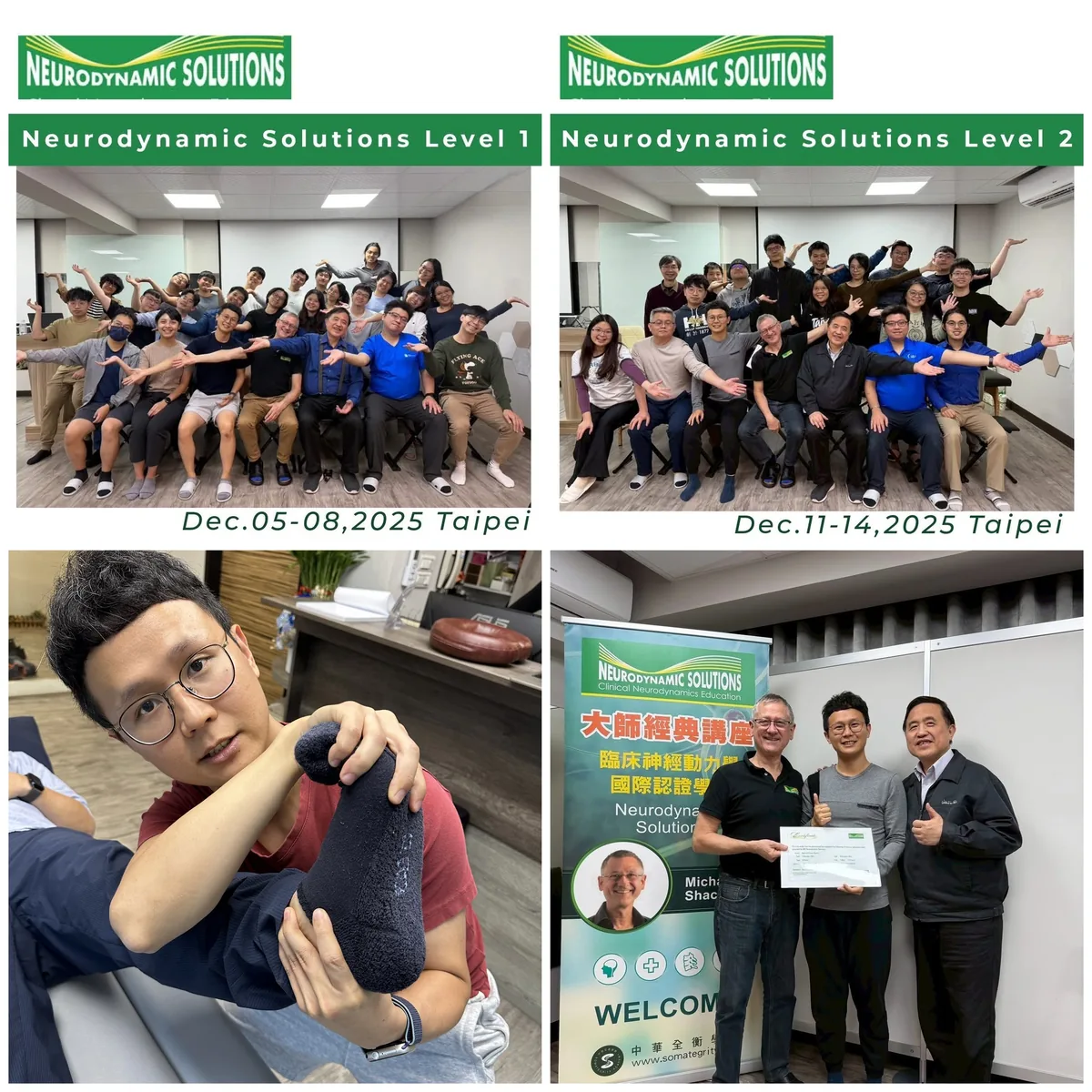
Last December, I took Neurodynamic Solutions (NDS) Level 1 and Level 2, taught by Michael Shacklock himself in Taiwan. Shacklock is the founder of the clinical neurodynamics system, and having him walk us through demonstrations step-by-step was a rare opportunity. After finishing both levels, I had taken over a hundred pages of notes, and it completely changed the way I look at “nerve pain.”
To be honest, very few courses out there truly target nerves for treatment, which is one of the reasons I went out of my way to take NDS.
Simply put, neurodynamics deals with movement-related nerve pain. Its premise is intuitive: nerves aren’t fixed wires; they slide, stretch, and get compressed by surrounding tissues as our joints move. When this interaction of mechanics and blood flow goes wrong, they get inflamed, become sensitive, and start to hurt.
1. Turns out my usual nerve exams weren’t standard enough
The first shock was realizing that the nerve tension tests I used to do (like SLR, upper limb neurodynamic test) were actually never rigorous enough.
This system heavily emphasizes position, position, position. Each joint must be moved into a fixed, ergonomic posture, added on slowly one by one, and locked in place once moved, to truly feel the change in nerve tension and ensure reproducibility. There are also details like “test the asymptomatic side first, move only one joint at a time, stop as soon as symptoms (P1) or resistance (R1) appear.” Only after standardizing could I reliably judge: is this a musculoskeletal problem, or a nerve problem?
2. Designing exams and treatments starting from “how nerves actually move”
What fascinated me most about this class was that it doesn’t start from abstract diagnoses, but goes back to anatomy, looking at how nerves actually move during each action.
To give a few points that overturned my understanding: nerves move toward the “joint being tensioned” (convergence), so even with a slider technique, if you move the wrong joint, the nerve actually isn’t sliding relatively at all; what we thought was a “cervical slider” (moving the neck and arm together) actually produces zero relative motion for the nerve, because the intervertebral foramen moves together with it. Or, taking spinal cord movement into account, finding out that tensioning the contralateral nerve actually relaxes the ipsilateral nerve root. These are all deduced straight from mechanics, rather than memorizing mnemonics.
Then, dividing the interface (the muscles, ligaments, and bones surrounding the nerve) into open / close, dividing the nerve’s own issues into tension / sliding / pathophysiology, and using a 2x2 box to think “is the nerve itself diseased, or is it caused by interface compression”—the whole clinical reasoning suddenly became much more organized.
3. Whether injecting or not, I have more patient education and home exercises to teach
As a physiatrist, we often think about whether to do an injection or which modalities to use. But this class reminded me that nerve issues have an incredibly rich set of manual therapy and home exercises we can teach. After an injection, maybe we could try teaching the patient some exercises, and perhaps get an even better result?
Evidence
Moreover, the instructor cited research proving that as long as the movement quality and dosage of home exercises equal that of manual therapy, the effects are the same—or even better if done enough. What left the deepest impression in class was a pilot RCT on acute herniated intervertebral disc (HIVD) patients: just repeatedly doing a static opener (opening the intervertebral foramen to decompress the nerve and allow blood flow, as shown below) for sixteen days cut opioid use in half and drastically dropped pain scores. This means many patients don’t actually need to rush into injections or surgery; you can just give them a set of evidence-based homework to do themselves at home.
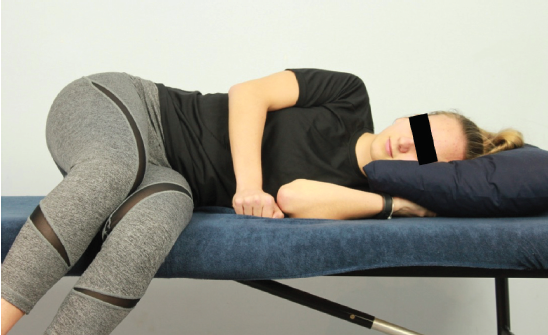
Ref: Shacklock M, Rade M, Poznic S, Marčinko A, Fredericson M, Kröger H, Kankaanpää M, Airaksinen O. Treatment of Sciatica and Lumbar Radiculopathy with an Intervertebral Foramen Opening Protocol: Pilot Study in a Hospital Emergency and In-patient Setting. Physiother Theory Pract. 2023 Jun;39(6):1178-1188. doi: 10.1080/09593985.2022.2037797
4. No obvious nerve symptoms doesn’t mean no neurodynamic issues (especially in athletes)
The final takeaway filled a gap in my assessment toolbox.
In the past, I always figured: if the patient has no numbness, no weakness, and a normal neurological exam, we’ve probably ruled out nerve problems. But this system told me that someone with entirely normal standard exams might still have neurodynamic abnormalities; they just haven’t crossed their “demand” threshold to be provoked yet. This is especially important for high-performance athletes—a nerve tightness so small it’s asymptomatic for regular people might be enough to impair performance for an athlete requiring extremely high function.
So the course designed a whole set of advanced tests (Level 3), using longer levers, changing the movement sequence, or asking patients to go do the provoking activity first before coming back for testing, to dig out these “hidden” problems. Shacklock said: for musculoskeletal patients who haven’t improved after two or three weeks of treatment, you have to look back and wonder if it’s a neurodynamic problem. This gave me a completely new angle to re-examine those stuck cases.
Summary
After taking NDS, my biggest shift wasn’t learning a few new manual techniques, but putting on a new pair of glasses for looking at nerves: starting from mechanics and anatomy, standardizing the exams, making the reasoning clear, and doing the exercise education right. For colleagues looking to treat “movement-related nerve pain,” I highly recommend this system.