The paper tool paper-review-and-digest I shared earlier had only been open-sourced for a few days when it received its first GitHub issue! I was actually quite happy to get my first issue, and I was even more surprised when I opened it: they didn’t just read my code, but accurately pointed out the parts of the design I was most proud of.
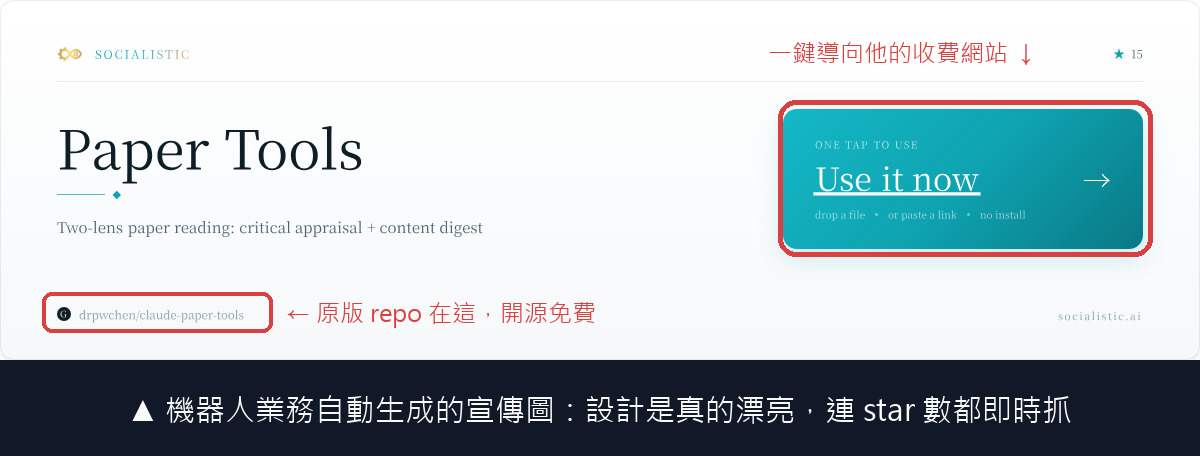
He said he appreciated the “hard split between the model and deterministic checks”: grade_judge.py doesn’t trust the level of evidence reported by the model itself, but recalculates it from the downgrade items; argdown_lint.py catches argumentative leaps like “jumping from surrogate endpoints to hard endpoints.” Then he said he built an online portal for me, so visitors don’t need to install Claude Code and can just upload a PDF to run the critical appraisal workflow. He even made a promotional image:

Wow, someone read my project this carefully, and even made a web version and such a pretty picture for me?
Wait, is this a real person?
Happiness aside, something felt off. This website had a free tier and a credit-based billing system; the business model was too complete to be just a side project. I figured since I had Claude, I’d just ask it to look into the background of this enthusiastic netizen.
As it turned out, the plot twist came faster than I thought 🤣. The evidence Claude listed:
- Within two minutes, this account posted issues to 26 repos. All of them were paper reading tools: arxiv-summarizer, paper_agent, PaperAgent… Mine was 13th. The day before, there was another wave targeting Claude Skills repos.
- The tracking parameters in the link directly spell out the campaign name:
20260708-paper-reading-comprehension-assistants. This was a marketing batch run by a scheduled job, not a spontaneous response. - The account was only created this March, has 0 followers, yet has 140 repos.
- GitHub’s search API refuses to search for this account (user cannot be searched), which usually means the account has already been flagged as spam by the platform.
- That piece of technical praise that made my day was automatically generated by an LLM reading each repo one by one. Scraping a repo and feeding it to a model is very cheap, which is exactly why it reads “like a real person.”
- The last sentence, “Feel free to close this if it isn’t relevant,” is standard rhetoric for spam accounts to lower their report rate.
- The corner of the promotional image has small text labeling my repo, and it even grabs the star count in real time. It’s exquisitely made; but clicking into the page on his website, the author field lists his own name. The MIT license certainly allows for commercial use, but this way of crediting is a bit sketchy.
Come to think of it, this business could actually work
After I finished cursing, I thought about it seriously, and this model is actually quite impressive. I actually registered and looked at the billing page, and the entire business model was laid out right in front of me: registration gives you 500 credits, and running a paper analysis deducts around 38 credits, which converts to less than 2 NTD. The free tier is enough for you to run it a dozen times, and once you’re hooked, four top-up channels—Stripe, PayPal, WeChat Pay, and Alipay—are lined up waiting for you.
What’s even more interesting is a line of text on the page: “Earn by sharing: add a skill, configure billing.” It turns out this isn’t just a tool website, it’s a skill marketplace platform: anyone can list a skill, set a price, and the platform takes a cut. So that bot posting issues to 26 repos wasn’t just to drive traffic, it wanted to recruit every original author as its supplier, getting them to go back and claim the page that was pre-emptively listed. Listing your stuff for you without permission first, then inviting you to claim it and share the profits—this is a classic marketplace cold-start tactic.
Bots automatically making money seems to actually be viable. The entire production line—from finding targets, reading code, writing customized praise, posting issues, and making promotional images, all the way to running the marketplace—requires almost zero human labor. This is probably also a landscape that will become increasingly common moving forward: for every piece of “sincere feedback” we receive, it’s worth taking a moment first to wonder if a model wrote it.
A few points worth noting
Uploaded PDFs stay on their servers (they say themselves that “every session leaves a usage record”); if you upload paid full texts or unpublished manuscripts, where that data goes is completely unknown. Topping up also means handing your payment information to a company that only appeared three months ago.
Actually, running it with your own subscription is a better deal
Finally, back to the tool itself. If you have a need for critical appraisal or content organization for papers, you actually don’t need to go buy credits on someone else’s website:
- Running it with your own Claude subscription is better in both quality and cost: They charge less than 2 NTD a pop, but the trade-off is that it’s mostly running cheap models with shallow workflows behind the scenes. If you run it yourself, you can use the full critical appraisal pipeline, citations will actually be verified against Crossref, and the level of evidence is calculated by the program, not just whatever the model says.
- It’s customizable: Whether you want Chinese or English, how deep you want it to go, or whether you want a 30-second summary or a full critical appraisal, you make the call.
- You don’t need to upload PDFs to servers of unknown origin; the full text stays on your own computer.
The tool is open-source and free to begin with, so feel free to just fork it and modify it into your own version. If you find it helpful, please give it a star ⭐ so more people can see the original version before the bot marketers come knocking~ Pair it with the previous paper learning radar together, and the entire path from selecting a paper to reading it can be automated.
If I’ve misunderstood anything, corrections are welcome.
(Repo link: github.com/drpwchen/paper-review-and-digest)