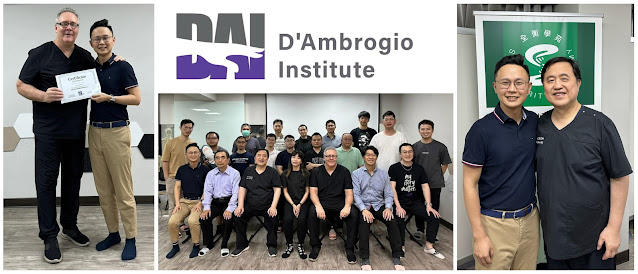
One of my original intentions in becoming a physiatrist was hoping to help patients recover and improve their quality of life with more than just medications. I was fortunate earlier this year to attend a lecture by Dr. Tso-Liang Wang, president of the Somategrity Academy. He shared insights from his many years of practicing manual therapy and how he uses it to help patients improve. In Dr. Wang, I saw my ideal image of a physiatrist, and I also heard him highly recommend a brand new course in Taiwan—DAI Osteopathy (D’Ambrogio Institute).
DAI is one of the three major systems under IAHE, alongside the Upledger Institute (craniosacral therapy) and the Barral Institute (visceral manipulation). And after finishing this six-day course, I actually felt this was a major learning milestone this year! I tried this technique on a friend, and it brought his long-standing finger stiffness down from an 8 to a 1 or 2. I’m documenting my thoughts on the course here to share with the physicians and therapists around me, and to recruit friends who are willing to let me practice on them or who want to learn together~
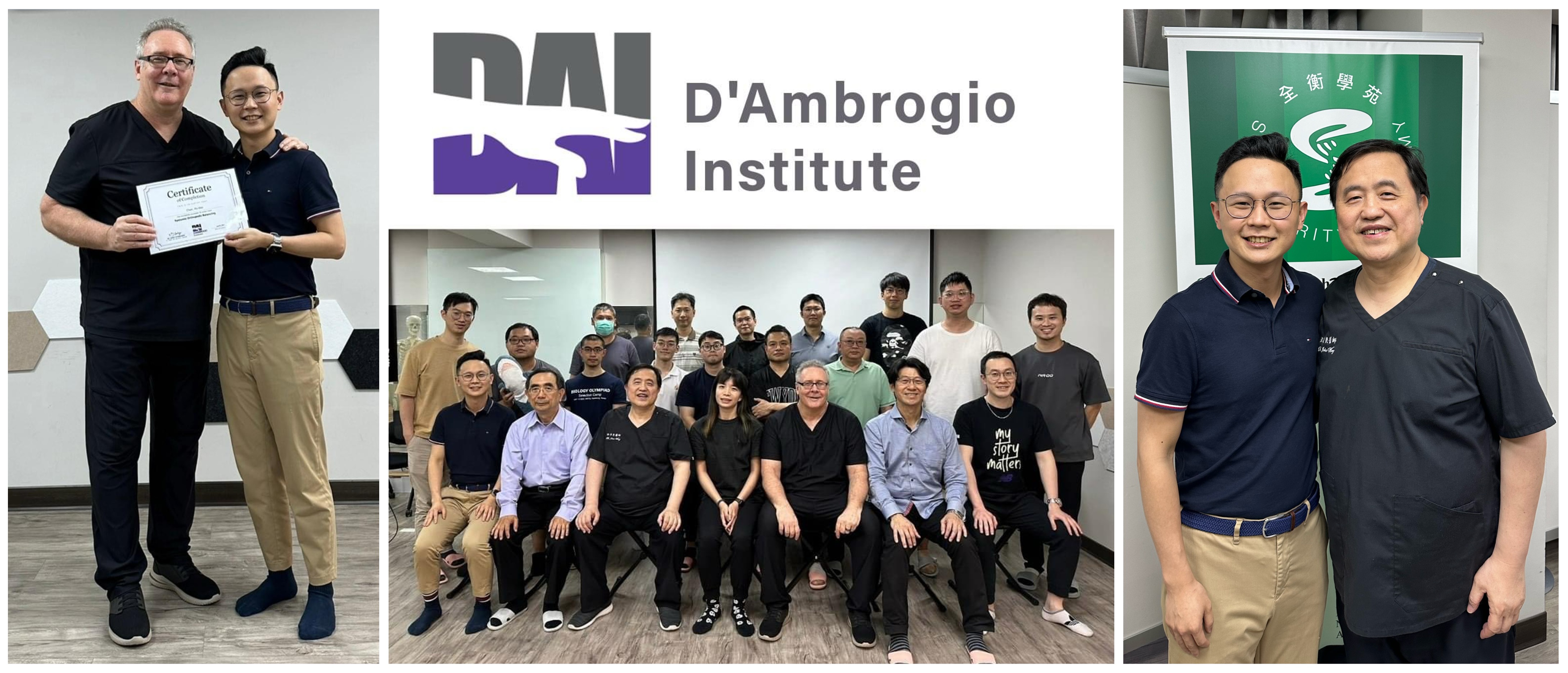
Honored to take a photo with Dr. Kerry D’Ambrogio (left) and Dr. Tso-Liang Wang (right).
Course Features
This was my first manual therapy course. I can’t use my own experience to compare what makes this class special, but over these six days I asked the physicians and therapists around me, and they unanimously gave it extremely high praise! Here’s a synthesis of insights shared by experienced classmates:
Typical manual therapy courses mostly have their own systems, focusing on different individual areas, like the spine, fascia, viscera, etc. But after learning many maneuvers, there’s usually no clear answer on how to comprehensively evaluate the patient as a whole, or how to pick the most suitable technique. It seems like you have to finish learning all the moves and then fumble around on your own to figure out when to use them.
The instructor, Dr. Kerry D’Ambrogio, integrated his expertise as a physical therapist, doctor of osteopathy, and acupuncturist to bring forth a highly structured knowledge system infused with a spirit of scientific experimentation. It’s as if we finally have a reference manual for the intricate human body.
Dr. D’Ambrogio is very admirable. Clinically, he values patient progress and continuously reflects and improves with every treatment. In his teaching, he structures knowledge clearly and accessibly, earnestly answers every question, and holds nothing back. He has turned treatment and teaching into his life’s work—it’s what he most happily pours himself into every day. He currently sees 15 to 20 patients a day and teaches 48 classes a week!
The Core of DAI Osteopathy
The Concepts of Whole-Person and Self-Healing
Shoulder discomfort isn’t necessarily just a shoulder problem.
Humans have the capacity to self-heal. We can improve the body’s recovery by clearing the path for tissue healing. What’s needed on this path to self-healing? We need nutrient supply, waste removal, and tissue mobility. Nutrients and waste require our circulation system to be in good shape, including the arteries, veins, and lymphatics. Tissue mobility involves our fascia, muscles, bones, and joints.
The systems mentioned above are body-wide. If we only focus on the painful shoulder and don’t address its perfusion and tissues, we’ll be working twice as hard for half the result. Therefore, Dr. D’Ambrogio classifies lesions into two types: systemic and specific. Systemic problems require full-body adjustments to heal properly, making up about 70-80% of all lesions. This is especially true for chronic pain patients, who often have issues throughout their bodies and require a systemic perspective to treat.
The method for distinguishing between systemic and specific problems is the essence of this course! In class, we learned a quick full-body evaluation. In just 3 to 5 minutes, we can rapidly determine whether systemic treatment is appropriate.
Evaluate, Treat, Re-evaluate
The reason I say Dr. D’Ambrogio approaches clinical practice with a scientific spirit is that he does a very complete evaluation for every patient. After truly understanding the patient’s condition, he provides structured treatment, and then comprehensively re-evaluates the patient’s response. He said if he only had 20 minutes to treat a patient, he’d rather spend 15 minutes evaluating and the remaining 5 minutes treating, just to ensure he knows what he’s treating.
This process allows him to try adjusting different parameters during each treatment, see the outcomes, and further achieve better results. It was only after practical application on thousands of patients that this effective system gradually took shape.
At the heart of this is the core philosophy of “repeated reassessment.” Besides the quick full-body evaluation, the class also taught assessment methods specific to lymph and tension. This allows us to grasp the patient’s actual changes and gives us a way to keep improving ourselves.
What left a deep impression was when we asked him in class if there were any “shortcuts” to make treatments faster. Although he shared his thoughts, he also told us not to just think about shortcuts. We have to do complete evaluations. That’s the only way we can learn what works and what doesn’t over the course of treatment after treatment.
Technique Features
In DAI’s systemic treatment, thrust techniques aren’t used. Instead, everything is very gentle. Dr. D’Ambrogio said we need to imagine being as gentle and rhythmic as putting a child to sleep. That’s how we activate the patient’s parasympathetic nervous system, dilate peripheral capillaries, and improve perfusion and lymphatic return.
During the class, I gradually developed a feel for it and understood the “feather barrier"—the point where we feel the very first hint of tension. In the DAI system, we don’t push tissues to their absolute tightest; we stop when it’s just a little tight. And amazingly, without being pushed to maximum tightness, the tissues actually slowly release!
DAI incorporates concepts from Osteopathy. So, aside from directly pulling tissues tight, we also take them in the opposite direction toward looseness. It’s like pulling a drawer: when it won’t open, push it closed first, and it’ll be easier to open. In practice, bringing contracted tissues closer together really does help them relax!
Doubts in Class, and a Magical Discovery
What was amazing was that in a class of over 20 people, when the instructor talked about different lesion presentations, he could accurately point out classmates who had those exact presentations, calling them to the front to do a live evaluation for everyone to see.
By the second day of class, I couldn’t help but ask the instructor how on earth he was doing that. He said this is the third part of his course—“Energy.” The instructor would mentally ask himself, “Does this person have this problem?” and then observe his own body’s response. An even more advanced version is asking, “Who in the room has this problem?” or “Where is this person’s problem?” and then observing where his eyes lead him to look.
This testing method, which sounds almost metaphysical, comes from his background in acupuncture and traditional Chinese medicine. The instructor said he also built this intuitive training through the aforementioned “repeated reassessment.” Every time he tests using energy, he follows up with an actual physical evaluation to confirm it. When confirmed correct, he trusts his intuition more; and trusting yourself more improves your accuracy.
Energy Treatment Demonstrations
Right after bringing up the concept of “energy,” the instructor did two “energy treatment” demonstrations in class.
Evidence
The first was on a physiatrist. The instructor checked his hip range of motion, then pulled the energy of the psoas major out from his waist from a distance, stretched it in the air, gave it a twist, and said, “Done." The instructor immediately rechecked the hip range of motion, and it had actually increased! During the pre- and post-tests, the instructor asked me to come up and verify if it was real. I did indeed feel the increase in mobility, and the physiatrist also clearly felt his hip loosen up.
In the second treatment, the instructor said he pulled out the subject’s pericardium. He said he felt anger and frustration there. After a twist of his hand, just like the previous subject, the fascial mobility of the respiratory diaphragm improved. After the treatment, the instructor mentioned that the body is our final physical manifestation. In his understanding, energy, emotions, and cognition come before it. Our cognition affects our emotions, our emotions affect our energy, and our energy affects our body.
I followed up: we treated the energy, but does he also treat the emotions and cognition? He replied that he does indeed have lots of conversations with subjects during treatment, using dialogue to resolve the stuck emotions and cognition in their minds. This coincides perfectly with the “mind-body medicine” practiced by Dr. Jui-Yun Hsu. Back when I shadowed her clinic, I frequently saw her look at a painful joint, point out the emotion or story stuck inside it, and guide the patient to resolve it, after which the pain disappeared.
Things like this are indeed hard to explain with current science. But as Dr. D’Ambrogio demonstrated, he looks at every effect through very practical and complete evaluations. If this kind of treatment is indeed effective, maybe it’s just that current science can’t formulate a reasonable explanation yet. It doesn’t mean it doesn’t exist. Of course, we could try doing more double-blind studies to see if there’s a placebo effect. But on the other hand, I’m also really looking forward to Dr. D’Ambrogio’s future energy balancing courses (please bring them in, Dr. Wang!). If we could evaluate with a single glance and treat with a single twist just like him, how fast our treatments could be!
Final Thoughts
As Dr. Wang said, I’m truly lucky to be exposed to such a complete manual therapy course, with hands-on practice and holistic concepts, in my second year as a resident, during my very first manual therapy learning experience. I’m so grateful. I can’t finish sharing all my thoughts, and I wrote over 13,000 words of notes alone~ I’m really looking forward to interested friends around me coming to learn together!