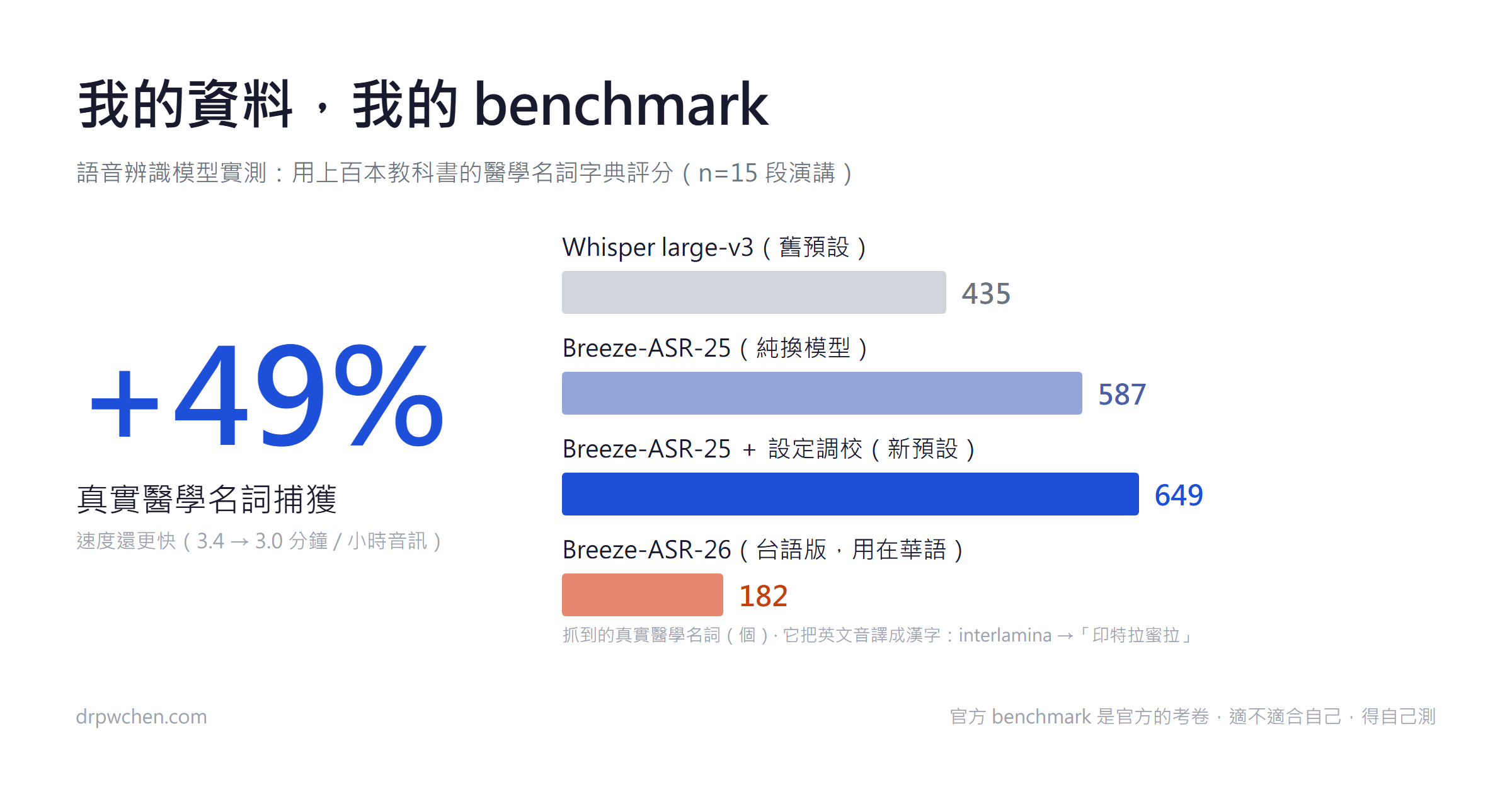
A taxi meter carrying a sinking chat bubble crushed by token coins, with a friendly robot struggling to drag it

Why Does Your AI Get Slower and Dumber the Longer You Chat?

📖 Token Saving Series (4 parts in total): Part 1 (this post) · Part 2: If an Abacus Works, Don’t Boot Up a Supercomputer · Part 3: Organizing a Clean Desk for AI · Part 4: I Installed a Budget Dashboard for AI You’ve definitely had this experience: you chat with ChatGPT or Claude for an afternoon, and the longer it goes, the more sluggish it gets. It replies slower, suddenly “forgets” what you said earlier, or even starts talking in circles. ...

Post · June 29, 2026 · 6 min · 1101 words · 陳柏威 Po-Wei Chen
In a study at night, a person calmly checks a bunch of glowing keys, next to a friendly AI assistant and a faintly glowing home server

When AI Can Do It All, I Double-Check My Keys at Home

Lately I’ve been relying more and more on Claude Code to manage my digital life. From organizing my Obsidian notes to maintaining a bunch of self-hosted services at home (OpenWrt router, AdGuard Home, Synology NAS, Oracle cloud instance, Home Assistant), down to the various automations running themselves in the middle of the night, I hand almost everything over to it. He can do more and more, and I seriously thought about something the other day that I hadn’t thought through before: I’ve given an AI assistant that can read files on my computer, execute commands, and connect to the internet such vast permissions. If something goes wrong one day, how wrong could it go? ...

Post · June 28, 2026 · 7 min · 1281 words · 陳柏威 Po-Wei Chen
"Group photos from Neurodynamic Solutions Level 1 and Level 2, practical demonstrations, and a photo with Michael Shacklock and Dr. Wang"

"Neurodynamic Solutions: Turns out my nerve exams have never been standard enough"

Last December, I took Neurodynamic Solutions (NDS) Level 1 and Level 2, taught by Michael Shacklock himself in Taiwan. Shacklock is the founder of the clinical neurodynamics system, and having him walk us through demonstrations step-by-step was a rare opportunity. After finishing both levels, I had taken over a hundred pages of notes, and it completely changed the way I look at “nerve pain.” To be honest, very few courses out there truly target nerves for treatment, which is one of the reasons I went out of my way to take NDS. ...

Post · June 24, 2026 · 5 min · 922 words · 陳柏威 Po-Wei Chen
Screenshot of the PM&R Continuing Education Radar website at courses.drpwchen.com

Built a PM&R Continuing Education Radar

Ever since becoming a resident, looking for continuing education courses has hit the same pain point every time: ultrasound, manual therapy, foot and ankle, neuro, pediatric rehab… The courses are scattered across a dozen society and institution websites. I’d have to refresh the sites every few days, and I was never sure if I’d actually seen a particular post before. Later on, I set up web scrapers for these course pages in my Home Assistant at home to automatically notify me of new courses, and things finally got a lot easier. But realizing I’d be completing residency soon, this little tool sitting at home wouldn’t be able to keep reminding the junior residents. Figuring I had Claude anyway, I just asked it to scrape all the courses and announcements from these 17 rehab-related societies and institutions, aggregate them in one place, update automatically every 3 hours, and put it on the web for everyone to use. ...

Post · June 24, 2026 · 3 min · 427 words · 陳柏威 Po-Wei Chen
Vault Search semantic search panel

I turned Obsidian into a second brain that "searches notes by meaning" (and open-sourced it)

A minor annoyance that bothered me for a long time I’m a heavy Obsidian user, with thousands of notes sitting in my vault. But there’s one really inconvenient thing: Obsidian’s built-in search only looks for the exact words you type. The problem is, how would I remember what words I used back then for a note written three years ago? I’m thinking “how to manage a flaccid bladder,” but the note says Neurogenic Bladder → flaccid type → intermittent catheterization. The words don’t match, so the search returns a blank page. The worst part is, there were several times when I thought I hadn’t written about it, so I rewrote the whole thing, only to find out later that a more complete version had been lying there all along 😅 ...

Post · June 23, 2026 · 5 min · 1013 words · 陳柏威 Po-Wei Chen
Adding graph retrieval to a medical note vault

Adding graph retrieval to my medical LLM Wiki, and it actually works this time

Background: What I was already using When studying for the board examination, I set up a RAG (Retrieval Augmented Generation) pipeline for myself. Using semantic search to look at similarity, I turned hundreds of physical medicine and rehabilitation (PM&R) textbooks and my own notes into something I could search and query. I use it for reading in Obsidian, while also letting Claude find what I need via MCP. Its weakest point right now is connecting knowledge across different documents. So a few days ago, when I saw someone share a newly published paper, SAG (SQL-Retrieval Augmented Generation), claiming that adding SQL and graph concepts on top of semantic search makes cross-document search easier—with effects similar to GraphRAG but easier to build and maintain—my eyes lit up. ...

Post · June 22, 2026 · 9 min · 1807 words · 陳柏威 Po-Wei Chen
Completing PM&R Residency — taking photos with mentors like Prof. Cifu, Prof. Henry Lew, and Prof. Lien, and getting Braddom signed

Completing PM&R Residency

I finished the board examination last weekend, and I’m finally going to be a PM&R attending physician! After more than a decade in Hualien, taking the train back and forth to Taipei for classes so many times, I made myself a Taiwan Railways gold member early on. Recently, while preparing for a hospital promotion, I asked Claude to scrape and organize all the PM&R courses I’ve taken over the years. Adding up the online and offline ones, I found out the total broke 150! I never expected to have racked up so much tuition expense without even realizing it 🤣 ...

Post · June 20, 2026 · 3 min · 543 words · 陳柏威 Po-Wei Chen
A Physiatrist's Learning of the DAI Osteopathy Course

A Physiatrist's Learning of the DAI Osteopathy Course

One of my original intentions in becoming a physiatrist was hoping to help patients recover and improve their quality of life with more than just medications. I was fortunate earlier this year to attend a lecture by Dr. Tso-Liang Wang, president of the Somategrity Academy. He shared insights from his many years of practicing manual therapy and how he uses it to help patients improve. In Dr. Wang, I saw my ideal image of a physiatrist, and I also heard him highly recommend a brand new course in Taiwan—DAI Osteopathy (D’Ambrogio Institute). ...

Post · April 11, 2024 · 8 min · 1688 words · 陳柏威 Po-Wei Chen
First Time in the US, First International PM&R Conference at AAP Physiatry '23

First Time in the US, First International PM&R Conference at AAP Physiatry '23

I went to the US in February to attend the Association of Academic Physiatrists (AAP) annual meeting. This was my first international PM&R conference, a rare trip abroad post-pandemic, and my very first time in the US. The whole 12-day trip was full of takeaways, from professional PM&R insights to cultural shocks. Even though two months have passed, I still felt I should write something to document this trip. The differences I saw abroad made what I took for granted in Taiwan feel unusual, and they’ve been lingering in my mind since I got back. I hope to share my takeaways through these words with other residents and readers. ...

Post · April 30, 2023 · 9 min · 1822 words · 陳柏威 Po-Wei Chen
[EBM] Should I calculate study power when results are not significant? Misleading post-hoc power

[EBM] Should I calculate study power when results are not significant? Misleading post-hoc power

Note When reading papers or doing research and hitting a non-significant result, I always remember what my statistics teacher said: “Not significant means we cannot reject the null hypothesis, not that the two are the same.” We’ve also learned that the ability to detect a difference between the two is called statistical power. So, if we calculate the power of the data, and if this “ability to detect a difference” is greater than 80%, but we still get a non-significant result, does that mean the two groups of data are really similar? ...

Post · November 11, 2022 · 4 min · 841 words · 陳柏威 Po-Wei Chen