Vault Search semantic search panel

I turned Obsidian into a second brain that "searches notes by meaning" (and open-sourced it)

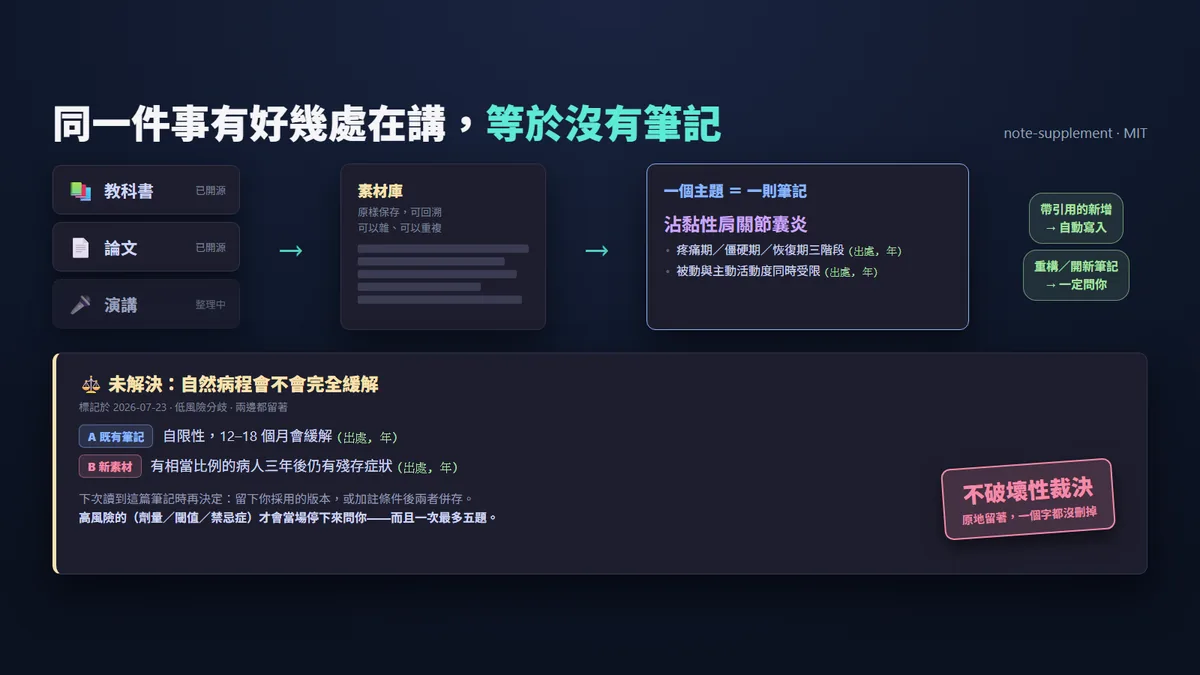
A minor annoyance that bothered me for a long time I’m a heavy Obsidian user, with thousands of notes sitting in my vault. But there’s one really inconvenient thing: Obsidian’s built-in search only looks for the exact words you type. The problem is, how would I remember what words I used back then for a note written three years ago? I’m thinking “how to manage a flaccid bladder,” but the note says Neurogenic Bladder → flaccid type → intermittent catheterization. The words don’t match, so the search returns a blank page. The worst part is, there were several times when I thought I hadn’t written about it, so I rewrote the whole thing, only to find out later that a more complete version had been lying there all along 😅 ...

June 23, 2026 · 5 min · 1007 words · 陳柏威 Po-Wei Chen
Adding graph retrieval to a medical note vault

Adding graph retrieval to my medical LLM Wiki, and it actually works this time

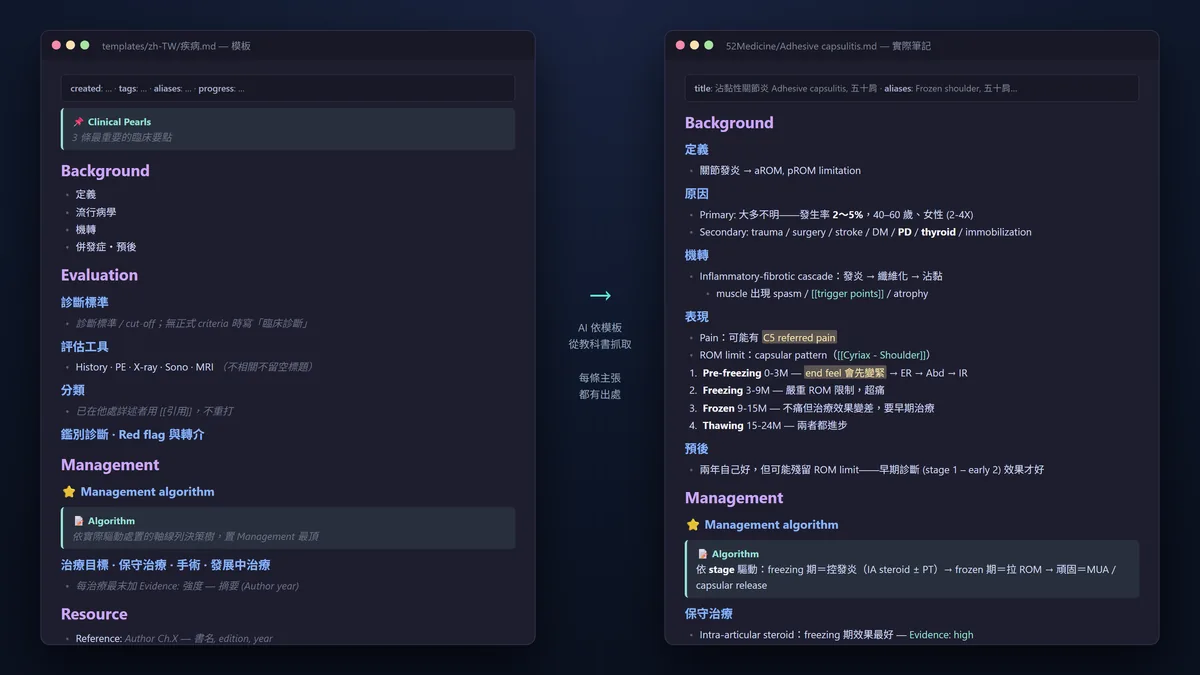
Background: What I was already using When studying for the board examination, I set up a RAG (Retrieval Augmented Generation) pipeline for myself. Using semantic search to look at similarity, I turned hundreds of physical medicine and rehabilitation (PM&R) textbooks and my own notes into something I could search and query. I use it for reading in Obsidian, while also letting Claude find what I need via MCP. Its weakest point right now is connecting knowledge across different documents. So a few days ago, when I saw someone share a newly published paper, SAG (SQL-Retrieval Augmented Generation), claiming that adding SQL and graph concepts on top of semantic search makes cross-document search easier—with effects similar to GraphRAG but easier to build and maintain—my eyes lit up. ...

June 22, 2026 · 9 min · 1802 words · 陳柏威 Po-Wei Chen
Completing PM&R Residency — taking photos with mentors like Prof. Cifu, Prof. Henry Lew, and Prof. Lien, and getting Braddom signed

Completing PM&R Residency

I finished the board examination last weekend, and I’m finally going to be a PM&R attending physician! After more than a decade in Hualien, taking the train back and forth to Taipei for classes so many times, I made myself a Taiwan Railways gold member early on. Recently, while preparing for a hospital promotion, I asked Claude to scrape and organize all the PM&R courses I’ve taken over the years. Adding up the online and offline ones, I found out the total broke 150! I never expected to have racked up so much tuition expense without even realizing it 🤣 ...

June 20, 2026 · 3 min · 543 words · 陳柏威 Po-Wei Chen
A Physiatrist's Learning of the DAI Osteopathy Course

A Physiatrist's Learning of the DAI Osteopathy Course

One of my original intentions in becoming a physiatrist was hoping to help patients recover and improve their quality of life with more than just medications. I was fortunate earlier this year to attend a lecture by Dr. Tso-Liang Wang, president of the Somategrity Academy. He shared insights from his many years of practicing manual therapy and how he uses it to help patients improve. In Dr. Wang, I saw my ideal image of a physiatrist, and I also heard him highly recommend a brand new course in Taiwan—DAI Osteopathy (D’Ambrogio Institute). ...

April 11, 2024 · 8 min · 1687 words · 陳柏威 Po-Wei Chen
First Time in the US, First International PM&R Conference at AAP Physiatry '23

First Time in the US, First International PM&R Conference at AAP Physiatry '23

I went to the US in February to attend the Association of Academic Physiatrists (AAP) annual meeting. This was my first international PM&R conference, a rare trip abroad post-pandemic, and my very first time in the US. The whole 12-day trip was full of takeaways, from professional PM&R insights to cultural shocks. Even though two months have passed, I still felt I should write something to document this trip. The differences I saw abroad made what I took for granted in Taiwan feel unusual, and they’ve been lingering in my mind since I got back. I hope to share my takeaways through these words with other residents and readers. ...

April 30, 2023 · 9 min · 1820 words · 陳柏威 Po-Wei Chen
[EBM] Should I calculate study power when results are not significant? Misleading post-hoc power

[EBM] Should I calculate study power when results are not significant? Misleading post-hoc power

When reading papers or doing research and hitting a non-significant result, I always remember what my statistics teacher said: “Not significant means we cannot reject the null hypothesis, not that the two are the same.” We’ve also learned that the ability to detect a difference between the two is called statistical power. So, if we calculate the power of the data, and if this “ability to detect a difference” is greater than 80%, but we still get a non-significant result, does that mean the two groups of data are really similar? ...

November 11, 2022 · 4 min · 840 words · 陳柏威 Po-Wei Chen
ACSM-CPT Prep (Part 1): Introduction

ACSM-CPT Prep (Part 1): Introduction

I got my American College of Sports Medicine (ACSM-CPT) certification! I guess I’m someone who really learns through my body. Back in college, I especially loved anatomy because I could feel those structures on myself. By observing my body, I could feel the presence of each part, try to see how they change under different conditions, and verify what the textbooks said. During my internship, learning about exercise prescription in PM&R was really interesting too. Even though I’m not a particularly sporty person, it gave me another discipline where I could observe the body. Trying to dissect the mechanics of a movement and imagining what’s happening inside is really fascinating! Maybe that’s also why I eventually chose PM&R~ ...

June 3, 2022 · 2 min · 285 words · 陳柏威 Po-Wei Chen
ACSM-CPT Prep (2): Resources

ACSM-CPT Prep (2): Resources

ACSM isn’t very common in Taiwan, but it’s an internationally important certification, so if you study in English, there are a lot of resources! However, because time was limited, around the time I registered for the ACSM, I also signed up for the neurorehabilitation annual meeting, lower limb orthotics, dysphagia, and pediatric muscle spasticity courses (everyone crams these into April and May!). So, I moved forward with the goal of learning as quickly as possible. Here are the resources I used during my prep: ...

June 3, 2022 · 5 min · 1034 words · 陳柏威 Po-Wei Chen
ACSM-CPT Prep (Part 3): Question Trends

ACSM-CPT Prep (Part 3): Question Trends

The ACSM exam is 135 multiple-choice questions. Overall, the questions are very flexible. There are very few rote memorization questions. Many questions don’t have a single correct answer, only a best answer. You have to rely on a thorough understanding of each topic to judge which is the best option. This post is mainly to let you understand the direction of the questions, and I’ll also provide a few questions I remember so you can see how flexible they are. ...

June 3, 2022 · 6 min · 1224 words · 陳柏威 Po-Wei Chen
ACSM-CPT Prep (Part 4): The Prep Process and Test Day

ACSM-CPT Prep (Part 4): The Prep Process and Test Day

It took me 25 days from taking the course to taking the exam. I was taking other classes in between, so my actual time spent studying for the ACSM was about 10 days. Because I’d previously interned in physical medicine and rehabilitation (PM&R), I’d already picked up a lot of related knowledge, and I was very familiar with the anatomy and physiology. My prep time was probably on the shorter side, so you can adjust the time you need accordingly. ...

June 3, 2022 · 5 min · 891 words · 陳柏威 Po-Wei Chen