
Let’s start with the most frequently asked, and most counter-intuitive, statement: As long as someone teaches the movements and an adult is supervising, elementary schoolers can do weight training, and it won’t stunt their growth.
What really gets kids hurt isn’t lifting heavy things, but having no instruction, no supervision, starting too heavy, and progressing too fast. If even one of these four things slips, injuries happen; if you do all four, the injury rate is lower than many ball sports.
I’m writing this for parents scheduling their kids’ summer activities, and for coaches leading youth teams.
60 minutes a day, not 60 minutes of each
Start with age, because the standard changes as kids grow. The World Health Organization (WHO) splits it like this:
| Age | Daily activity |
|---|---|
| 1 to 2 years | At least 3 hours at any intensity, spread through the day |
| 3 to 4 years | At least 3 hours, of which at least 1 hour gets them out of breath |
| 5 to 17 years | An average of 60 minutes of moderate-to-vigorous activity a day |
For those 60 minutes from age 5 up, a lot of parents panic when they see “also add strength training and bone-loading exercises,” thinking they need to scrape together three hours.
No. All three count toward the same 60 minutes.
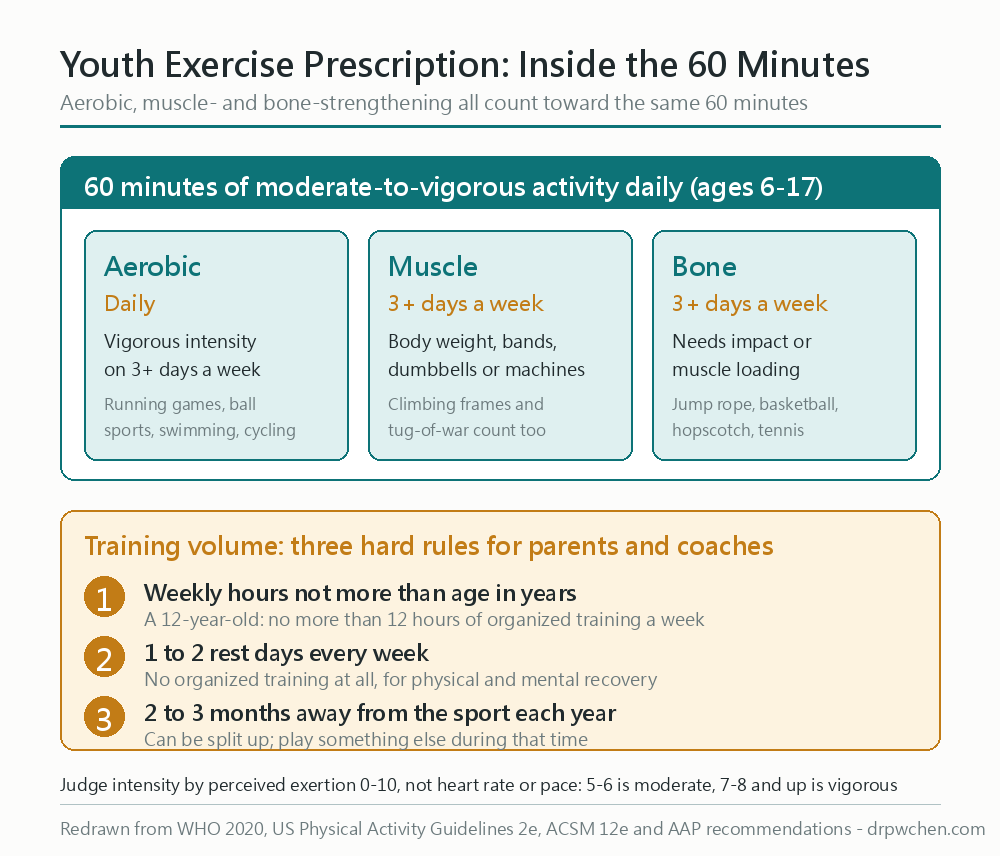
In reality, an afternoon running and jumping in the park, climbing on the playground, or playing half-court basketball covers all three within those 60 minutes. The only two things you actually need to intentionally schedule are:
- At least 3 days a week should be intense enough that they’re panting too hard to speak in full sentences (they can’t just go for a walk every day).
- At least 3 days a week should involve exerting force against resistance (climbing monkey bars, tug-of-war, and push-ups all count).
The age most people get wrong is 3 to 4: those 3 hours don’t count at any intensity. At least 1 hour should be running, jumping and chasing, the kind of play that gets them breathing hard. “Any intensity” is the rule for ages 1 to 2. For bones at that age, it’s hopping, jumping and tumbling. (Thanks to a reader for the correction; this section was fixed on Sept 30.)
There’s also a practical way to judge: Don’t use heart rate or pace to gauge a kid’s intensity, use “how tired they feel." 0 is sitting down, 10 is pushing to the absolute limit, 5 to 6 is moderate, and 7 to 8 or above is vigorous. Numbers like heart rate mean different things for kids than for adults; just asking them is more accurate.
At what age can kids start weight training?
There is no specific age number for this. The criterion is “can they understand and follow instructions." If they can pay attention to the coach and are willing to follow along, they can start.
Regarding the stunting growth thing, the evidence is very direct: well-designed, supervised resistance training has no adverse effects on height, growth plate health, or the cardiovascular system. This is the official position of the American Academy of Pediatrics as of 2020, not my personal opinion.
What you really need to watch out for are four conditions. You need all of them:
- Someone to teach technique. Get the form right before adding weight.
- A knowledgeable adult supervising.
- Starting with a light weight.
- Timing and increments for adding weight must be reasonable.
As for the programming, beginners should stick to 3 days a week, 1 to 2 sets, 8 to 12 reps per set, at a weight light enough that they could still do a few more. Only after their movement quality is stable can you move toward lower reps and higher weights.
You don’t need to buy equipment. Body weight, resistance bands, dumbbells, and machines have all been proven effective. None of them are strictly necessary.
Can kids do squats and deadlifts that load the spine?
Yes. What the textbooks limit is technique and the pace of progression, not age. The latest edition of the American College of Sports Medicine (ACSM) guidelines lists squatting as a beginner strength movement kids can start with, alongside pushing, pulling, and rotating.
A common objection is “you have to hold your breath to brace your core and protect your back, and kids can’t do that.” The premise is wrong:
- Stabilizing the spine does not require holding your breath. With the mouth open and breathing normally, the abdominal muscles and diaphragm can still contract hard and support the lower spine. This is safer than breath-holding, and it is how most weight training should be done anyway.
- Breath-holding is a technique experienced lifters use for near-maximal loads, and only for 1 or 2 seconds. Hold it longer and blood pressure spikes, causing dizziness or even fainting. Adult beginners don’t need it, and kids need it even less.
- The usual breathing pattern: breathe out through the hardest part of the lift, breathe in on the way down.
The thing to actually watch for is different. If a teenager who lifts starts having low back pain, think first of a stress fracture of the lumbar pars (spondylolysis). It is more common in sports with repeated back-bending and twisting (gymnastics, dance, volleyball, soccer), and adding weight too fast in the gym can also trigger it. Don’t tough out this kind of back pain; have a doctor look at it.
How should the weight go up?
One rule: get the movement right first, then add weight.
- Beginners: learn the movement with an empty bar or a stick, then move to light weights, 1 to 2 sets per exercise.
- Once the movement is stable: 2 to 3 sets, working up toward moderate weights.
- With enough experience and technique: blocks of heavier training are fine, as long as form holds.
- Add 5% to 10% at a time. Only go up when 8 to 15 reps still look clean and the child is just moderately tired.
- Not every session has to be heavier than the last. When fatigue makes form slip, stop; that is when injuries happen.
Whether a child is ready to progress depends on technique, how long they’ve been training, and physical maturity, not age. Two 14-year-olds can be in very different places: one may be ready to start Olympic lifting, the other not yet.
Three red lines for training too much
These three are for parents and coaches to use as brakes. They are more practical than anything else:
- Weekly organized training hours shouldn’t exceed the kid’s age. If they are 12, keep it under 12 hours a week.
- Leave at least 1 to 2 days a week for complete rest. Not “a light workout,” but not participating at all.
- Take a cumulative 2 to 3 months off from that specific sport every year. You can break this up, and they can play other sports during this time.
There’s one more: Only play for one team per season. Playing for the school team and a club team at the same time is the most common source of overtraining.
When increasing training volume, weekly increments shouldn’t exceed 10%.
The risks of only playing one sport
The current consensus is very unified: Don’t specialize in just one sport before puberty.
The reason isn’t some vague “fear of breaking the kid,” but a few specific ones:
- Specialization itself is an independent risk factor for injury, regardless of how much they train. At the same training volume, only playing one sport makes you more likely to get hurt.
- When the ratio of organized training to free play is too high, the injury rate more than doubles.
- There is no evidence that early specialization is necessary to become an elite athlete.
In other words, letting your kid play multiple sports won’t drag down their future, and they’ll be less likely to get injured. Sports like gymnastics, figure skating, and diving, where peak performance occurs very early, are exceptions.
Warning signs to watch out for:
- Repeated unexplained pain, or old injuries constantly flaring up.
- Poor sleep, big mood swings, constant fatigue, declining grades.
- Irregular periods or weight loss in girls—this is a red flag for low energy availability and requires seeing a doctor.
Kids are especially fragile during growth spurts
A lot of parents haven’t heard this part, but it explains “why my kid is always hurting here and there lately.”
During the peak height velocity period (roughly ages 10 to 12 for girls, 12 to 14 for boys), the body develops two temporary weak points:
- Bones “lengthen” faster than they “harden”, so during the fastest growth spurt, bones are actually relatively fragile.
- Bones grow first, and muscles and tendons are pulled along to catch up, so kids will feel tight and less flexible. This is part of where so-called “growing pains” come from.
There’s also a structural difference: A kid’s ligaments and tendons are stronger than their growth plates and tendon attachments. So with the exact same forceful pull, an adult would sprain a ligament, but for a kid, the bone end fails first.
That painful bony bump right below the knee comes from this exactly. I wrote about the details in Knee Pain Below the Kneecap Isn’t Growing Pains.
Three practical things you can do for kids who run
- Encourage a faster cadence and shorter stride. A study tracking high school cross-country runners found that the group with the slowest step rate had several times the risk of shin injury compared with the fastest group. At the same speed, just take choppier steps.
- Don’t just run. Loading the bones in only one direction has limited benefits. Letting them play multi-directional, jumping sports like basketball or soccer is better for their bones and can actually reduce running injuries.
- Strength train 2 to 3 times a week. Not only will resistance training not hinder growth, it can also lower the risk of running injuries.
As for “can kids run marathons?"—currently, there is no evidence supporting setting a distance cap based on age. In recorded road races, there are thousands of finishers under 18, the youngest being 7, with no significant medical injuries reported. But let me be clear: This doesn’t mean “the risk is lower than for adults." We don’t actually have answers on the long-term health impacts, and expert opinions are still divided. The original text’s stance is: if the kid wants to do it on their own, and their daily routine, academics, and psychology aren’t disrupted, there’s no need to forbid it.
Screen time counts too
Screen time is a health factor independent of exercise volume. Even if they are exercising, watching too much still has an impact (obesity, mood, fitness, blood pressure, lipids, and blood sugar).
Current recommendations:
- Under 18 months: no screen time.
- Ages 2 to 5: under 1 hour a day.
- Older kids: recreational screen time under 2 hours a day.
The American Academy of Pediatrics later shifted to a more flexible approach: making rules as a family, managing both “how long” and “what” they watch.
When to see a doctor
- Pain persists after resting, or hurts enough to affect walking or sports performance.
- Repeated pain in the same spot, or an old injury that won’t heal.
- A teenager who lifts or does a lot of back-bending has low back pain that doesn’t improve with rest.
- Joint swelling, catching, or reduced range of motion during a growth spurt.
- Irregular periods, weight loss, or previous fractures in girls.
- Chest tightness, vision going black, or fainting during exercise—this is the most important one. Don’t brush it off as heat exhaustion or not getting enough sleep.
I need to emphasize that last one. There’s a rumor online that “kids don’t drop dead from exercise,” which is wrong. Sudden cardiac arrest is the leading cause of death in young athletes, with an incidence of about one case per 100,000 to 200,000 high school athletes a year. The odds are very low, but not zero, and 90% occur during training or competition. Most kids have absolutely no symptoms beforehand. So if fainting or chest tightness happens during exercise, you must take it seriously.
I wrote separately about being outdoors in the summer in Heatstroke Isn’t Just Fainting: Cold Water First, Then Hospital.
Clinical Pearls
- Target for ages 6–19 is an average of 60 minutes of MVPA per day; aerobic, resistance, and bone-loading exercises all count toward the same 60 minutes.
- Resistance and bone loading: at least 3 days a week each; vigorous aerobic: at least 3 days a week.
- METs are not applicable to children (basal metabolic rate, energy expenditure per kg, and movement efficiency all differ). Use RPE 0–10 for intensity: 5–6 is moderate, 7–8 and above is vigorous.
- Resistance training does not affect height or growth plates; injuries almost always stem from a failure in one of four things: technique, supervision, initial load, or progression rate.
- Prepubescent strength can increase, but the mechanism is neural adaptation rather than hypertrophy; VO2peak only improves by 5–10% (around 20% in adults).
- Three hard rules for training volume: weekly hours should not exceed age, rest 1–2 days per week, and take 2–3 months away from the primary sport annually.
- Single-sport specialization is itself an independent risk factor, regardless of training volume; it is recommended to delay this until after puberty.
- Exercise-related sudden death in children does occur: SCA is the leading cause of death in young athletes, about 1:100,000–1:200,000 in high schoolers.
Abbreviations
| Abbreviation | Full Term |
|---|---|
| MVPA | Moderate-to-vigorous physical activity |
| RPE | Rating of perceived exertion |
| FMS | Fundamental movement skills |
| HIIT | High-intensity interval training |
| 1-RM | One repetition maximum |
| RER | Respiratory exchange ratio |
| PHV | Peak height velocity |
| SCA | Sudden cardiac arrest |
| HCM | Hypertrophic cardiomyopathy |
| MTSS | Medial tibial stress syndrome |
| PACER | Progressive aerobic cardiovascular endurance run |
Population Definitions and Current Activity Levels
- Children and adolescents are defined as ages 6–19, also known as youth
ACSM 12e Ch.6 - They are generally more physically active than adults, but activity levels drop significantly with age, with a steeper decline in girls than in boys.
- Goal attainment rates
- Only 27–33% of youth globally meet MVPA recommendations
ACSM 12e Ch.6 - Old US data (11th ed.): overall 21.6%, boys 26.0%, girls 16.9%; by age, 42.5% for 6–11, 7.5% for 12–15, 5.1% for 16–19
ACSM 11e Ch.6 - These two sets of numbers come from different editions and different populations; be sure to specify which edition you’re citing.
- Only 27–33% of youth globally meet MVPA recommendations
- Youth with disabilities have lower activity levels than the general population.
- Activity and sedentary behavior patterns in youth carry over into adulthood, which is the reason for early intervention.
Physiological Responses and Training Adaptations
Acute responses (compared to adults) ACSM 12e Ch.6 Table 6.1
- The direction of the response is the same as in adults; the difference lies in the magnitude, mostly explained by body weight, muscle mass, and height.
- Oxygen: lower absolute VO2, higher relative VO2, lower RER.
- Lower anaerobic capacity → inability to sustain vigorous-intensity exercise.
- Cardiac: CO, SV, SBP, and DBP are all lower; HR is higher.
- Respiratory: MV and VT are lower; RR is higher.
Long-term adaptations
- Aerobic
- Small improvements in VO2peak: 5–10% before puberty, around 20% in adults
ACSM 12e Ch.6 - Aerobic improvements from HIIT are superior to continuous moderate-intensity exercise.
- → Assessment should use performance indicators (1-mi walk/run, PACER) rather than VO2peak.
- Small improvements in VO2peak: 5–10% before puberty, around 20% in adults
- Resistance
- Prepubescent relative strength gains are comparable to those of adolescents
ACSM 12e Ch.6 - Before puberty, this relies on neural adaptation (insufficient androgens); noticeable hypertrophy only occurs after puberty
NSCA 4e Ch.7
- Prepubescent relative strength gains are comparable to those of adolescents
- Bone: A review of 22 pediatric intervention trials showed that exercise can lead to an additional 0.6–1.7% in annual bone accretion
ACSM 12e Ch.6
Musculoskeletal Vulnerabilities During Growth
- Temporary period of skeletal fragility
- Most common during PHV (roughly ages 10–12 for girls, 12–14 for boys).
- Mechanism: Bones lengthen faster than they mineralize → they become relatively porous, so the fracture risk is actually higher during the growth spurt than during slower growth periods.
- Soft tissue lengthening lags behind
- During rapid growth spurts, bones lengthen first, and soft tissues are passively stretched
Pountney Ch.16 - → Muscles become relatively tight, flexibility drops, and the risk of tensile injury rises.
- During rapid growth spurts, bones lengthen first, and soft tissues are passively stretched
- The growth plate and apophysis are the weakest links
- Children’s ligaments and tendons are stronger than the physis and apophysis
Pountney Ch.16 - Under the same tensile force: adults get ligament tears or tendon strains; children get growth plate injuries or apophysitis.
- Corresponding conditions: Osgood-Schlatter (tibial tuberosity), Little League shoulder (proximal humeral growth plate), gymnast’s wrist (distal radial growth plate).
- Children’s ligaments and tendons are stronger than the physis and apophysis
- Articular cartilage: Immature cartilage is thicker but softer, with poor tolerance for shear forces → risk of osteochondritis dissecans.
- Long bone diaphyses are more elastic than in adults and can withstand more deformation without a complete fracture, but they are vulnerable to bending and torsion.
Recommended Doses and Intensity Judging
| Age | Daily recommendation | Source |
|---|---|---|
| Under 1 | Interactive floor-based play several times a day; if not yet mobile, ≥30 minutes of awake tummy time | WHO 2019 |
| 1–2 | ≥180 minutes at any intensity (including MVPA), spread through the day | WHO 2019 |
| 3–4 | ≥180 minutes, of which ≥60 minutes is MVPA, spread through the day | WHO 2019 |
| 5–17 | An average of 60 minutes of MVPA a day; vigorous aerobic, resistance and bone loading each ≥3 days a week | WHO 2020 |
- Guideline sources: WHO 2020
WHO 2020, for under-5sWHO 2019 Guidelines on physical activity, sedentary behaviour and sleep for children under 5 years of age, and the 2018 Physical Activity Guidelines for Americans, 2nd editionHHS PAG 2e 2018 - Core prescription: An average of 60 minutes of MVPA per day, with aerobic, resistance, and bone loading combined.
- Resistance and bone loading: each at least 3 days a week.
- Vigorous aerobic: at least 3 days a week.
- The difference between “every day” and “an average of”
- HHS 2018 states 60 minutes every day; WHO 2020 changed this to an average of 60 minutes a day over the week.
- The ACSM 12th edition adopts the WHO phrasing → this allows for flexibility during the week, but the goal is still to move every day.
- The 3–5-year-old preschool group was first included in the 2018 edition
HHS PAG 2e 2018- Formal recommendation: be physically active throughout the day, with caregivers encouraging a variety of active play.
- Reference volume: a reasonable target is 3 hours a day across all intensities (this is the observed average for children this age rather than an evidence-derived dose, and it matches the Canadian, UK and Australian guidelines).
- HHS says intensity does not need careful monitoring at this age; WHO 2019 sets at least 60 minutes of MVPA for ages 3–4, and where the two differ, follow the more specific WHO standard.
- For bone strengthening at this age: hopping, skipping, jumping and tumbling.
- HHS 2018 did not review evidence for children under 3; use WHO 2019 for that range.
- Age boundaries: WHO 2020’s 60 minutes of MVPA applies to ages 5–17; HHS 2018 uses 6–17, with 3–5 listed separately as preschool.
- Intensity judging
- METs are not suitable for direct use in children.
- Preferred metric is RPE 0–10: 5–6 is moderate, 7–8 and above is vigorous (relative to their personal capacity).
Sedentary Behavior and Screen Time
- Screen time is an indicator of sedentary behavior and is a health factor independent of physical activity levels
ACSM 12e Ch.6- Correlated with: obesity, depressive symptoms, declining fitness, and elevated blood pressure, lipids, and HbA1c.
- NHLBI and AAP recommendations: none under 18 months; less than 1 hour a day for ages 2–5; recreational screen time less than 2 hours a day for older youth.
- The AAP has since shifted to a tailored Family Media Use Plan, managing both quality and quantity.
- Current status: Only about half of US 6–11-year-olds meet the guidelines; globally, about 25% of kids under 2 and 35% of 2–5-year-olds meet them.
Preparticipation Screening
- Healthy youth do not need medical screening before starting moderate-to-vigorous exercise, but they should start at a lower intensity and progress gradually
ACSM 12e Ch.6 - There is no evidence-based minimum age for resistance training; they can start once they can understand and execute instructions and are ready for sports participation.
- Requires prior medical evaluation: uncontrolled hypertension or epilepsy, specific cardiovascular diseases, previous anthracycline chemotherapy, and complex congenital heart disease
AAP 2020
FITT Prescription
Aerobic
- F: Every day; with vigorous intensity at least 3 days a week.
- I: Moderate to vigorous intensity (RPE 5–6 to 7–8); HIIT benefits exceed those of continuous exercise for adolescents.
- T: Counts toward the 60 minutes a day.
- T: Tag games, hiking or brisk walking, jump rope, swimming, dancing, cycling, ball sports.
Resistance
- F: At least 3 days a week.
- I: Beginners 1–2 sets, 8–12 reps submaximal (under 60% 1-RM); Advanced lower reps, load over 80% 1-RM, provided movement quality is solid.
- T: Counts toward the 60 minutes a day.
- T: Body weight, resistance bands, machines, free weights, medicine balls—all modes are effective; unstructured types like playground climbing, tree climbing, and tug-of-war also count.
- Beginner movements: squatting, pushing, pulling, rotating; any child who can follow instructions and is ready for sport can start
ACSM 12e Ch.6
- Beginner movements: squatting, pushing, pulling, rotating; any child who can follow instructions and is ready for sport can start
- Order is the same as adults: large muscle groups first, multi-joint first.
- Four keys to safety (injuries are almost always due to a failure in one of these, not the exercise itself):
- Teaching proper form and technique.
- Knowledgeable adult supervision (ratio adjusted based on training age and skill level)
AAP 2020 - Appropriate initial load.
- Appropriate timing and increments for progression.
Resistance progression
- Progression is driven by technical competency, training age, and maturity, not chronological age
NSCA 4e Ch.7- Training age: years of consistent, supervised, formal resistance training.
- Children of the same age and training age can still differ in technique and learning rate.
- Three loading stages
NSCA 1e Ch.11- Novice: 1–2 sets, 40–60% 1RM, a range of exercises.
- Once basic technique is established: 2–3 sets, 40–80% 1RM.
- More experience and better technique: periodic phases at 80% 1RM or more, provided technical competency holds.
- Increase load by 5–10% as performance, technique, and strength improve
NSCA 1e Ch.11,NSCA 4e Ch.7- Alternative threshold: 8–15 reps to moderate fatigue with good form before increasing resistance
Braddom 7e Ch.16
- Alternative threshold: 8–15 reps to moderate fatigue with good form before increasing resistance
- Volume: strength exercises 1–3 sets × 6–15 reps; power exercises 1–3 sets × 3–6 reps
NSCA 1e Ch.11 - Frequency: 2–3 nonconsecutive days a week; youth with a higher training age can train more often
NSCA 4e Ch.7 - Not every session needs to be heavier or longer than the last; leave room to develop form
NSCA 4e Ch.7 - Periodize the program across the year, varying the stimulus and building in recovery
NSCA 4e Ch.7 - Supervision focus: watch for fatigue-induced breakdown in technique, which raises injury risk
NSCA 1e Ch.11
Bone Loading
- Optimal FITT is not yet clearly defined.
- F: At least 3 days a week. I: Moderate-to-vigorous bone loading (impact or muscular force).
- T: Running, jump rope, basketball, tennis, hopscotch, resistance training.
- Characteristics of effective stimuli: dynamic, brief, moderate-to-vigorous intensity, variable force directions.
Prescription Principles
- Emphasize fundamental movement skills (FMS): locomotor (running, jumping, climbing), object control (throwing, kicking), and stability (bending, twisting).
- Children’s natural activity pattern is unstructured play (short bursts of moderate-to-vigorous intensity alternating with rest), which can still be prescribed using the FITT framework.
- Obese or sedentary individuals: start with moderate intensity and progress; there’s no need to hit the full 60 minutes right away.
- Conditions requiring specialist referral: asthma, diabetes, obesity, cystic fibrosis, and cerebral palsy.
Specialization and Training Volume Management
Consensus stance AOSSM 2016
- Single-sport specialization should be delayed, encouraging variety and unstructured free play.
- There is no evidence that early specialization is a prerequisite for elite performance in adulthood; on the contrary, it may be harmful.
- Exceptions: sports like gymnastics, figure skating, and diving, where peak performance precedes maturation.
Definition of early specialization (all three conditions must be met) AOSSM 2016
- Engaged in organized training or competition for more than 8 months a year (almost year-round).
- Excluding other sports in favor of a single sport, with limited free play.
- Occurs before puberty (around seventh grade, under age 12).
Risks AOSSM 2016
- Specialization itself is an independent risk factor for overuse injuries.
- Those with a disproportionately high ratio of organized sports to free play have an injury rate more than twice as high.
- There’s an upward trend in injury risk for those specializing before age 12.
- Psychological aspects: loss of intrinsic motivation, burnout, and early dropout.
Training volume rules (AAP recommendations) Magee 2e Ch.29
- Weekly training time, reps, or total distance should not increase by more than 10%/week.
- Play for only one team per season.
- Leave 1–2 days a week for complete rest (physical and mental).
- Spend a cumulative 2–3 months away from that specific sport each year.
- Focus on fun, skill acquisition, safety, and sportsmanship.
Thresholds requiring close monitoring AOSSM 2016
- Weekly training hours exceeding their age (age 12 → 12 hours/week).
- Or weekly vigorous training exceeding 16 hours.
- Another set of recommendations: maximum of 5 days a week for a single sport, with 2–4 consecutive months off each year
Miranda-Comas Ch.4
Red flags
- Repeated unexplained pain or flare-ups of old injuries.
- Sleep disturbances, mood swings, chronic fatigue, declining academics.
- Menstrual irregularities or weight loss in females (warning signs of low energy availability).
Adolescent Runners
Timing of participation and distance
- Core concept: “Readiness” matters more than chronological age.
- There is no evidence supporting setting running distance caps based on age
Roberts 2007 - Marathons: Thousands of under-18 finishers in the LA Marathon, and nearly 300 in the Twin Cities Marathon, the youngest being 7, with no significant medical injuries reported
Roberts 2007- However, the original text also emphasizes that long-term health impacts remain an unresolved issue, and expert opinions are divided; this should not be reverse-interpreted as “the risk is lower than for adults.”
- Stance: If the child does it willingly, and their social, academic, psychological, and physiological development aren’t disrupted, there’s no need to forbid it.
Intrinsic risk factors
- Injury risk is higher in females than in males (especially for bone stress injuries)
Rauh 2007 (cited in Magee 2011) - A history of previous injury is the strongest single predictor of future injury.
- A Q-angle greater than or equal to 20 degrees is associated with injuries and knee injuries in female cross-country runners
Rauh 2007 (cited in Magee 2011) - High BMI and being female are associated with MTSS
Plisky 2007 (cited in Magee 2011) - A history of a running injury in the previous summer is a risk factor for injury during that season for girls
Rauh 2006 (cited in Magee 2011) - Step rate: Among high school cross-country runners, those in the lowest tertile of step rate had a significantly higher risk of shin injury
Luedke 2016- Fixed speed: Under 164 steps/min vs over 174 steps/min, OR 6.67 (95% CI 1.2–36.7)
- Self-selected speed: Under 166 steps/min vs over 178 steps/min, OR 5.85 (95% CI 1.1–32.1)
- In the same study, step rate had no significant association with anterior knee pain; do not over-interpret this.
Training recommendations
- Progression principle: Weekly training volume increases shouldn’t exceed 10%.
- Mandatory rest: Do not run at least 1–2 days a week; take a cumulative 2–3 months away from specialized running annually.
- Monitor with RPE 0–10 rather than heart rate or pace alone.
- Diversified sports: High-impact, multi-directional ball sports aid bone health and neuromuscular control.
- Bone health: Running, which involves unidirectional loading, offers limited benefits for bone density; it needs to be paired with jumping and multi-directional loading.
- Strength training: Resistance training does not stunt growth and can reduce the risk of sports injuries
AAP 2020; 2–3 times a week, focusing on core, lower-body strength, and plyometrics.
Overtraining and Burnout
- The pathophysiological core is an imbalance between training load and recovery; it is a continuum rather than a single diagnosis
AAP 2024 - When training loads chronically exceed recovery, it leads to systemic consequences: decreased performance, increased risk of injury and illness, and dysregulation of the endocrine, neurological, cardiovascular, and psychological systems
AAP 2024 - Burnout is defined as physical or emotional exhaustion coupled with a reduced sense of accomplishment, ultimately leading to a devaluation of the sport; it is a primary reason adolescents drop out of sports
AAP 2024- Clinical significance: burnout directly threatens the goal of “lifelong physical activity,” not just a seasonal performance issue.
- Overuse injuries, meanwhile, stem from repetitive stress without sufficient recovery, leading to accumulated musculoskeletal damage
AAP 2024 - The pediatric-specific preventive measure is the set of training volume rules in the previous section.
Exercise Testing
- Cardiorespiratory and muscular fitness are highly correlated with health, and testing is mostly conducted by schools.
- Clinical exercise testing is generally not necessary unless there are existing health issues or concerns
ACSM 12e Ch.6 - Clinical CPET
- Using peak VO2 to evaluate training outcomes before puberty will yield an underestimate (blunted response) → functional metrics are more meaningful.
- Treadmills yield higher VO2peak and HRmax; cycle ergometers have a lower risk of injury but require the correct size and pedaling technique.
- Familiarize them with the protocol before testing; the process requires extra encouragement.
- Strength testing
- Handgrip strength is a static strength assessment with a low skill threshold.
- 1-RM or 10-RM testing can be used for youth, provided there is proper instruction and progressive loading.
- School fitness testing via FITNESSGRAM (has age- and sex-adjusted standards)
- Body composition: BMI, skinfold thickness, bioelectrical impedance.
- Cardiorespiratory fitness: 1-mi walk/run, PACER.
- Muscular fitness: curl-up, trunk lift, pull-ups, push-up.
- Flexibility: back-saver sit-and-reach, shoulder stretch.
Evidence of Benefits and Safety Myths
Benefits
- Overall, the benefits of exercise far outweigh the risks (the main risk being overuse injuries)
ACSM 12e Ch.6 - Evidence-supported benefits for ages 3–17
HHS PAG 2e 2018- Bone health, weight status.
- Cardiorespiratory and muscular fitness, cardiometabolic health (ages 6–17).
- Cognitive function and reduced risk of depression (ages 6–13)—these are now listed as evidence-based benefits, not just “new research.”
- Preseason preparatory training that includes strength training can reduce the risk of sports injuries in young athletes.
Resistance training myths
- Will it stunt growth? No. Well-designed and supervised resistance training has no adverse effects on height, growth plate health, or the cardiovascular system
AAP 2020 - Injury rates: quite low under qualified supervision; most injuries stem from a lack of supervision or lifting at home on their own.
- 1-RM testing: safe and feasible for youth under qualified supervision and standard protocols
ACSM 12e Ch.6 - Weightlifting: Low injury and severe injury rates, and it can improve body composition, strength, and power, provided there is age-appropriate programming and proper supervision
Pierce 2022 - You must distinguish between “supervised resistance training” and “high-volume repetitive specialized sports”: the latter is what actually causes stress injuries around the growth plate.
Spinal Loading, Breathing, and the Valsalva Maneuver
Spine-loading exercises
- The limit is technique and training age, not age; squatting is listed as a beginner movement, and advanced loads can exceed 80% 1-RM
ACSM 12e Ch.6 - The snatch and clean and jerk can be added after foundational strength and technique progressions are complete
NSCA 4e Ch.7- Learn new lifts with an unloaded barbell, a wooden stick, or PVC pipe.
- If technique cannot be maintained, lower the load.
- Age-based progression
Magee 2007 Table 21-4(citing Kraemer & Fleck 1993)- 7 and under: little or no weight; learn movements and the concept of a training session.
- 8–10: practice technique in all lifts; begin gradual progressive loading.
- 11–13: introduce advanced exercises with little or no resistance.
- 16 and over: move to entry-level adult programs.
- A child of any age with no experience starts at the beginning level.
Where “avoid maximal lifts” comes from
- One of the 13 AAP 2008 recommendations: avoid maximal lifts (powerlifting)
Braddom 6e Ch.39 - Reported growth plate injuries were attributed to poor technique, maximal lifts, and lack of adult supervision
Braddom 6e Ch.39 - Newer ACSM and NSCA texts: 1-RM testing is feasible under standard protocols
ACSM 12e Ch.6,NSCA 4e Ch.7
Spinal stability does not require breath-holding
- The diaphragm and abdominal muscles can contract with the glottis open, forming a “fluid ball” in the abdomen that supports the lumbar spine
NSCA 4e Ch.2- The chest is not pressurized; NSCA considers this safer and the technique to use for most resistance training.
- During a strenuous rep, the abdominals and diaphragm contract reflexively even with the airway open.
- Standard breathing: exhale through the sticking point, inhale during the lowering phase
NSCA 4e Ch.15 - The Valsalva maneuver is suggested only when an experienced lifter, a structural exercise, and a high load all apply
NSCA 4e Ch.15- Structural exercise: one that loads the spine (squat, deadlift, etc.).
- Breath-holding should last only 1–2 seconds; blood pressure can triple resting levels, causing dizziness or blackout.
- Above 80% of MVC or when lifting to failure, the Valsalva maneuver may be unavoidable
NSCA 4e Ch.16
- Bottom line: at appropriate loads, children only need open-airway bracing; breath-holding to build intra-abdominal pressure is an advanced skill that adult beginners don’t need either.
The spinal risk to watch: spondylolysis
- Spondylolysis: a stress fracture of the pars interarticularis, acquired during childhood and adolescence
Frontera 4e Ch.49- 70–90% occur at L5; new cases are rare after skeletal maturity.
- Accounts for up to 47% of low back pain in adolescents in some series
DeLee 5e Ch.140
- High-risk sports: repeated flexion-extension plus rotation, e.g., gymnastics, soccer, wrestling, dance, volleyball
Frontera 4e Ch.49 - Case: a 15-year-old track athlete developed back pain after rapidly increasing squat and deadlift intensity over 6 weeks
Dunleavy 2019- Attributed to progressing too fast plus lifting form, along with reduced flexibility during the growth spurt.
- In practice: a lifting adolescent with low back pain should be evaluated for spondylolysis first.
Risks of Exercise-Related Sudden Death
- “Kids don’t drop dead from exercise” is wrong. SCA is the leading cause of death in young athletes
Braddom 6e Ch.39,Brukner 5e Ch.9 - Incidence
Braddom 6e Ch.39- High school athletes: 1:100,000 to 1:200,000
- College athletes: 1:65,000 to 1:69,000
- Male risk is about 5 times that of females; 90% occur during training or competition.
- Etiology distribution
Braddom 6e Ch.39- HCM about 30%
- Commotio cordis about 5–20% (second most common)
- Coronary artery anomalies about 15%, which is the most common cause in young female athletes.
- Practical implications
- Most athletes are completely asymptomatic prior to a fatal event, making prevention difficult.
- Sideline AEDs and early defibrillation (within 1–3 minutes) are the critical interventions
Bahr IOC Manual Ch.6
Evidence Gaps
- The optimal FITT combination for bone health is not yet determined
ACSM 12e Ch.6 - The long-term health impacts of pediatric marathons still lack follow-up studies
Roberts 2007 - The quantitative thresholds for the “safe upper limit” of specialization still need research; current numbers are mostly expert consensus
AOSSM 2016 - The coach-to-trainee ratio for resistance training has no fixed evidence-based number; the guidelines just say to “adjust based on training age and skill level”
AAP 2020
Note Production Workflow
These notes were originally compiled when I was reading the ACSM’s Guidelines for Exercise Testing and Prescription. After providing sideline medical coverage at the 2026 International Children’s Games (ICG), I added the section on youth sports injuries.
Materials Used
- Sports medicine and PM&R textbooks: ACSM 12th and 11th ed., Braddom 6th and 7th ed., Brukner & Khan 5th ed., NSCA Essentials of Strength Training and Conditioning and Essentials of Training Special Populations, Magee’s three musculoskeletal rehabilitation books, Frontera Essentials of PM&R, DeLee Orthopaedic Sports Medicine, Dunleavy Therapeutic Exercise Prescription, Pountney Physiotherapy for Children, Miranda-Comas Essential Sports Medicine, IOC Manual of Sports Injuries.
- Guidelines and society documents: WHO 2020 guidelines on physical activity and sedentary behaviour, Physical Activity Guidelines for Americans 2nd ed. (2018), AOSSM 2016 Early Sport Specialization Consensus Statement, AAP 2020 clinical report on resistance training, and AAP 2024 clinical report on overuse injuries, overtraining, and burnout.
- Original literature: Prospective study on step rate and shin injuries in high school cross-country runners (Luedke 2016), review of children and marathons (Roberts 2007), summary tables of risk factors for adolescent runners.
Tools Used
audit_note.py— my own python script for auditing note formats, checking citation placements, images, and heading structures.- PubMed MCP — for looking up society documents and filling in volume, issue, page numbers, DOIs, and PMIDs for the bibliography.
- textbook_search — for semantic search against my local markdown textbook index.
- OpenEvidence — for independent cross-referencing on the safety of pediatric resistance training.
- Custom Python/PIL drawing script — for the dosage diagram and cover image.
- Hugo’s bilingual workflow
i18n_sync.py— first machine-translating the English version, then manually proofreading medical terms.
This workflow itself is written up in textbook-to-note. If you also have a Claude or Codex subscription, you can hand off this kind of mechanical labor of fact-checking and compiling to them, leaving the judgment calls to yourself. You can get started with Getting Started with AI: Installation and First Steps and How to Talk to AI Agents.
About this version
The pro version is taken directly from my own clinical notes and wasn’t rewritten for the blog. The citation format follows my note-taking style (book + chapter, or author + year, full bibliography below). Copyrighted images from textbooks and journals are not included here; all diagrams are redrawn by me.
If there are any errors in my understanding, corrections are always welcome.
Reference
Guidelines and Society Documents
- WHO 2020 — Bull FC, Al-Ansari SS, Biddle S, et al. World Health Organization 2020 guidelines on physical activity and sedentary behaviour. Br J Sports Med. 2020;54(24):1451-1462. doi:10.1136/bjsports-2020-102955. PMID 33239350
- HHS PAG 2e 2018 — Physical Activity Guidelines for Americans. 2nd ed. Washington, DC: US Department of Health and Human Services; 2018.
- AOSSM 2016 — LaPrade RF, Agel J, Baker J, et al. AOSSM Early Sport Specialization Consensus Statement. Orthop J Sports Med. 2016;4(4):2325967116644241. doi:10.1177/2325967116644241
- AAP 2020 — Stricker PR, Faigenbaum AD, McCambridge TM; Council on Sports Medicine and Fitness. Resistance Training for Children and Adolescents. Pediatrics. 2020;145(6):e20201011. doi:10.1542/peds.2020-1011. PMID 32457216
- AAP 2024 — Brenner JS, Watson A; Council on Sports Medicine and Fitness. Overuse Injuries, Overtraining, and Burnout in Young Athletes. Pediatrics. 2024;153(2):e2023065129. doi:10.1542/peds.2023-065129. PMID 38247370
- AAP 2016 — Brenner JS; Council on Sports Medicine and Fitness. Sports Specialization and Intensive Training in Young Athletes. Pediatrics. 2016;138(3):e20162148. doi:10.1542/peds.2016-2148. PMID 27573090
- AAP 2008 — McCambridge TM, Stricker PR; Council on Sports Medicine and Fitness. Strength training by children and adolescents. Pediatrics. 2008;121(4):835-840. (Cited via Braddom 6e Ch.39; superseded by AAP 2020.)
Journals
- Krabak 2021 — Krabak BJ, Roberts WO, Tenforde AS, et al. Youth running consensus statement: minimising risk of injury and illness in youth runners. Br J Sports Med. 2021;55(6):305-318. doi:10.1136/bjsports-2020-102518. PMID 33122252
- Roberts 2007 — Roberts WO. Can children and adolescents run marathons? Sports Med. 2007;37(4-5):299-301. doi:10.2165/00007256-200737040-00007. PMID 17465593
- Luedke 2016 — Luedke LE, Heiderscheit BC, Williams DSB, Rauh MJ. Influence of Step Rate on Shin Injury and Anterior Knee Pain in High School Runners. Med Sci Sports Exerc. 2016;48(7):1244-1250. doi:10.1249/MSS.0000000000000890. PMID 26818150
- Pierce 2022 — Pierce KC, Hornsby WG, Stone MH. Weightlifting for Children and Adolescents: A Narrative Review. Sports Health. 2022;14(1):45-56. doi:10.1177/19417381211056094. PMID 34781771
Textbooks
- ACSM 12e Ch.6 — ACSM’s Guidelines for Exercise Testing and Prescription. 12th ed. Wolters Kluwer; 2025. Children and Adolescents.
- ACSM 11e Ch.6 — ACSM’s Guidelines for Exercise Testing and Prescription. 11th ed. Wolters Kluwer; 2021. Children and Adolescents.
- Braddom 6e Ch.39 — Cifu DX, ed. Braddom’s Physical Medicine and Rehabilitation. 6th ed. Elsevier; 2021. Sports Medicine and Adaptive Sports.
- Brukner 5e Ch.9 — Brukner P, Khan K. Clinical Sports Medicine. 5th ed. Vol 2. McGraw-Hill; 2019. Sudden cardiac death in sport.
- NSCA 4e Ch.7 — Haff GG, Triplett NT, eds. Essentials of Strength Training and Conditioning. 4th ed. Human Kinetics; 2016.
- Magee 2e Ch.29 — Magee DJ, Zachazewski JE, Quillen WS. Pathology and Intervention in Musculoskeletal Rehabilitation. 2nd ed. Elsevier; 2016. Pediatric and Adolescent Populations.
- Magee 2011 — Magee DJ, Zachazewski JE, Quillen WS. Athletic and Sport Issues in Musculoskeletal Rehabilitation. Elsevier; 2011.
- Pountney Ch.16 — Pountney T, ed. Physiotherapy for Children. Elsevier; 2007. Sports Injuries.
- Miranda-Comas Ch.4 — Essential Sports Medicine. 2nd ed. Springer; 2021. Preparticipation Evaluation.
- Bahr IOC Manual Ch.6 — Bahr R, ed. The IOC Manual of Sports Injuries. Wiley-Blackwell; 2012. Chest and Abdomen.
- NSCA 4e Ch.2/Ch.15/Ch.16 — Haff GG, Triplett NT, eds. Essentials of Strength Training and Conditioning. 4th ed. Human Kinetics; 2016. Biomechanics of Resistance Exercise; Exercise Technique for Free Weight and Machine Training; Exercise Technique for Alternative Modes.
- NSCA 1e Ch.11 — Jacobs PL, ed. NSCA’s Essentials of Training Special Populations. 1st ed. Human Kinetics; 2018. Children and Adolescents.
- Braddom 7e Ch.16 — Braddom’s Physical Medicine and Rehabilitation. 7th ed. Elsevier. Therapeutic Exercise.
- Magee 2007 Table 21-4 — Magee DJ, Zachazewski JE, Quillen WS. Scientific Foundations and Principles of Practice in Musculoskeletal Rehabilitation. Elsevier; 2007. Physiological Principles of Resistance Training.
- Frontera 4e Ch.49 — Frontera WR, Silver JK, Rizzo TD, eds. Essentials of Physical Medicine and Rehabilitation. 4th ed. Elsevier; 2019. Lumbar Spondylolysis and Spondylolisthesis.
- DeLee 5e Ch.140 — Miller MD, Thompson SR, eds. DeLee, Drez & Miller’s Orthopaedic Sports Medicine. 5th ed. Elsevier; 2020. Spine Issues in Skeletally Immature Athletes.
- Dunleavy 2019 — Dunleavy K, Slowik AK. Therapeutic Exercise Prescription. Elsevier; 2019. Spine Workbook, Case 11.3 Spondylolysis in an Adolescent Athlete.