Let’s state the most important thing first: most SLAP tears start with rehab—you don’t need surgery just because you saw it on an MRI report. This diagnosis is easily overcalled on imaging, and surgery isn’t as certain a fix as most people think.
This page is for athletes who pitch, play volleyball, swim, or otherwise regularly bring their arms overhead—and for anyone who just got an MRI report back that says “labral tear” and has no idea what to do next.
What is a SLAP tear?
The shoulder joint is like a golf ball sitting on a very shallow tee. Around the edge of the tee is a ring of cartilage called the “labrum,” which deepens the socket and makes the joint more stable.
The very top of the labrum happens to be the starting point of the long head of the biceps tendon. SLAP refers to the labrum in this area tearing or pulling away from the bone, with the damage extending from in front of the biceps attachment to behind it. It stands for Superior Labrum Anterior to Posterior, which is why some people call it a superior labral tear.
What doctors mean by “type”
- Tears are classified into several types based on how they look. The most common is Type II: the labrum and the biceps attachment pull away from the bone together.
- For treatment, two things matter most: is the tear stable, and is the biceps injured as well?
Who’s at risk for this injury?
- Pitchers and overhead athletes: when the arm is raised and cocked all the way back (the late cocking phase of throwing), the biceps twists and tugs on the superior labrum. Over time, this repetitive stress can cause a tear.
- Falling on an outstretched hand: force travels up the arm and impacts the shoulder joint.
- A sudden, forceful tug on the arm: like a heavy object dropping unexpectedly while you’re holding it.
- Aging after middle age: the labrum naturally frays as we get older, often showing up alongside other shoulder problems.
What are the symptoms?
- Pain “deep inside” the shoulder, in the front or the back, without a specific pinpoint spot.
- Pain that’s especially bad when reaching overhead, throwing, or serving.
- Catching, popping, or a feeling of “instability” in the shoulder—even though the joint is actually stable when your doctor examines it.
- Pitchers might notice decreased velocity and worse command.
These symptoms closely mimic rotator cuff issues, biceps tendinitis, and shoulder impingement, and they often happen at the same time. That’s why doctors usually have to combine your history, physical exam, and imaging to figure it out.
My MRI says I have a tear—is that definitely the problem?
Not necessarily. This is the most important thing to know about SLAP tears.
- The superior labrum naturally undergoes age-related changes after middle age. Even in people with zero symptoms, MRIs are often read as “possible tears.”
- A standard MRI doesn’t show this area very well. For a clearer picture, your doctor might order an MR arthrogram, where dye is injected into the joint.
- No single physical exam maneuver can confirm it on its own, either. The only way to know for sure is to look directly with an arthroscope.
So a “labral tear” on a report has to be weighed against your symptoms, age, and athletic demands.
Should I start with rehab or surgery?
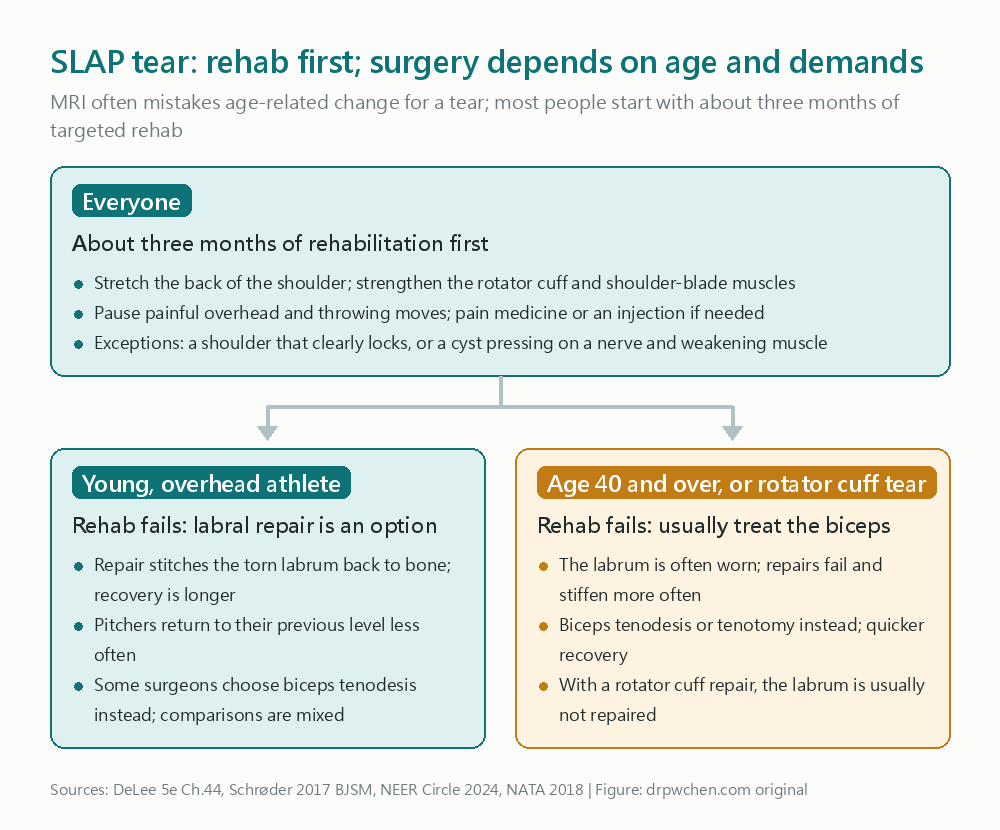
- Almost everyone starts with about three months of rehab.
- The exceptions are if your shoulder is clearly locked up, or if a cyst has grown next to the labrum and is pressing on a nerve, causing weakness in the muscles at the back of your shoulder. In those cases, surgery is discussed with an orthopedic surgeon earlier.
Rehab works for many people. In studies, most athletes who actually finish their full rehab program manage to return to their sport.
What does rehab involve?
- Pain control first: temporarily avoid the overhead and throwing motions that hurt, use painkillers if needed, or have your doctor evaluate whether an injection makes sense.
- Get your range of motion back: especially stretching the back of the shoulder. A lot of pitchers have a very tight posterior capsule, losing their internal rotation.
- Improve stability: strengthen the rotator cuff and the muscles around the shoulder blade so the shoulder stays stable while moving.
- Return to play: finally, add speed and power training, then gradually ease back into throwing or your original sport.
Rehab is tailored to how you got hurt. For instance, if you were hurt falling on an outstretched hand, early rehab limits weight-bearing on the hands; pitchers avoid cocking their arms all the way back at the beginning.
What are the surgical options?
Surgery is only considered if you haven’t improved after about three months of rehab, and your doctor strongly suspects the pain is coming from the tear. There are two common paths:
- Labral repair: using suture anchors to sew the torn labrum back to the bone. Better suited for younger patients with high athletic demands and unstable tears.
- Biceps management: detaching the long head of the biceps tendon from the labrum and either anchoring it to the upper arm bone (tenodesis) or just releasing it without fixing it (tenotomy). People over forty or those with a frayed labrum usually go this route. If a rotator cuff repair is needed at the same time, the labrum is usually not repaired; the surgeon either just cleans up the frayed labrum or treats the biceps.
Two things worth knowing:
- A study with a “sham surgery” control group compared labral repair, biceps tenodesis, and diagnostic arthroscopy alone. All three groups had similar outcomes after two years. This doesn’t mean surgery is useless, but it’s a reminder: who should have surgery needs to be chosen carefully.
- Research is still mixed on whether young athletes should get a repair or a biceps procedure, and experts don’t agree—especially when it comes to professional pitchers.
How soon can I return to sports after surgery?
- You usually spend a few weeks in a sling after surgery, though you’ll still do protected shoulder movements during that time.
- After a labral repair, you can’t forcefully bend your elbow or turn your palm up for the first few weeks, to avoid tugging on what was just sutured.
- Return to play generally takes about four months for a biceps tenodesis and six months for a labral repair, progressing step-by-step based on your doctor and therapist’s evaluation.
- It’s harder for pitchers to get back to their baseline performance, which often requires a longer throwing program.
When should you follow up?
- You’ve done rehab for a while, but the pain or catching hasn’t improved.
- Your shoulder keeps locking up and you can’t move it normally.
- The muscles on the back of your shoulder shrink, or you have obvious weakness when rotating your arm outward.
- Your arm feels numb or weak, or the pain radiates into your neck.
—
Further reading: Rotator Cuff: Injuries, Tears, and Rehab, Shoulder Impingement: Pain When Reaching Overhead, Shoulder Dislocation and Instability, Proximal Biceps Tendinopathy
Below is the raw note from my vault, just with the internal links and copyrighted textbook figures removed. My verification process and tool stack are detailed at the end.
Superior Labrum Anterior to Posterior (SLAP) Lesion
Clinical Pearls
- SLAP = tear of the superior labrum along the anterior→posterior direction, located at the LHBT attachment (biceps anchor); Type II (biceps anchor stripped from the glenoid) is the most common
Snyder 1990,Buckup 3e Ch.2- Diagnostic challenges: no single sensitive and specific PE test; MRI often overcalls (asymptomatic 45-60yo read as labral tear 55% / 72%); arthroscopy is the gold standard for diagnosis
DeLee 5e Ch.44,Giangarra 4e Ch.26- First-line is conservative management (posterior capsule stretch + RC / scapular strengthening) for about 3 months
DeLee 5e Ch.44,Michener 2018- Sham RCT: repair / tenodesis / sham show no difference at 2 years (mean 40yo, isolated type II) → surgical indications must be strict
Schrøder 2017- Decision-making is driven by age: young, high demand, unstable anchor → consider repair; >40yo, concomitant cuff tear, failed repair → biceps tenodesis / tenotomy
DeLee 5e Ch.44,Verma 2025
Abbreviations
| Abbreviation | Full Term |
|---|---|
| SLAP | superior labrum anterior to posterior |
| LHBT | long head of biceps tendon |
| GHJ | glenohumeral joint |
| GIRD | glenohumeral internal rotation deficit |
| ER / IR | external / internal rotation |
| ROM / AROM / PROM | range of motion / active / passive |
| MRA | magnetic resonance arthrography |
| MGHL | middle glenohumeral ligament |
| ACJ | acromioclavicular joint |
| FOOSH | fall on outstretched hand |
| RC | rotator cuff |
| RTP | return to play |
| ASES | American Shoulder and Elbow Surgeons score |
| UCLA | University of California at Los Angeles shoulder score |
| ABOS | American Board of Orthopaedic Surgery |
| NATA | National Athletic Trainers’ Association |
| Se / Sp | sensitivity / specificity |
| PT | physical therapy |
Disease Background
Definition
- SLAP = tear of the superior labrum in an anterior-to-posterior direction, located at the long head of biceps tendon (LHBT) attachment (biceps anchor)
Snyder 1990- Original series: 27 cases out of >700 arthroscopies, mean 37.5yo; most common mechanism was compression from a fall on an outstretched hand
Snyder 1990
- Original series: 27 cases out of >700 arthroscopies, mean 37.5yo; most common mechanism was compression from a fall on an outstretched hand
- Labrum is the fibrocartilaginous ring around the GHJ rim
- Contributes about 50% of the glenoid fossa depth, increasing contact area and providing stability
Neumann 3e Ch.5 - Serves as the attachment for the LHBT and glenohumeral ligaments
DeLisa 6e Ch.29
- Contributes about 50% of the glenoid fossa depth, increasing contact area and providing stability
Epidemiology
- Low prevalence: accounted for 3.3% of Snyder’s surgical cases, 4.7% in a follow-up series
DeLee 5e Ch.44- Others report labral injury at 3.9-11.8%, and up to 26% in arthroscopic populations
DeLisa 6e Ch.29
- Others report labral injury at 3.9-11.8%, and up to 26% in arthroscopic populations
- Surgical volume disproportionate to prevalence: US two-state database showed a 238% increase in SLAP repairs from 2002-2009
DeLee 5e Ch.44 - Demographics: overhead athletes (mostly pitchers), individuals with a FOOSH injury, traction injuries of the arm
DeLee 5e Ch.44 - Superior labrum changes in older populations are mostly age-related: in asymptomatic 45-60yo patients, two radiologists read a labral tear in 55% and 72% of cases
DeLee 5e Ch.44
Etiology
- Acute traumatic
- Compression: fall on outstretched hand (FOOSH)
Snyder 1990,DeLee 5e Ch.44 - Traction: traction from an overhead or abducted arm (the predominant mechanism in the Maffet series)
Maffet 1995,DeLee 5e Ch.44
- Compression: fall on outstretched hand (FOOSH)
- Attritional (overhead athletes): peel-back mechanism
- Abduction + ER causes the biceps to twist and tug the posterosuperior labrum and anchor
DeLee 5e Ch.44 - Corresponds to the late cocking phase of throwing
Maxey 3e Ch.6 - Risk factors: increased shoulder ER, posterior capsular contracture (GIRD)
DeLisa 6e Ch.29
- Abduction + ER causes the biceps to twist and tug the posterosuperior labrum and anchor
- Degenerative: age-related fraying of the labrum and biceps after middle age, often seen with other lesions
DeLee 5e Ch.44
Classification
Original Snyder Classification (1990)
- Classified into four types based on biceps anchor involvement and labrum morphology; percentages are from the Snyder series
Snyder 1990,Buckup 3e Ch.2
| Type | Lesion | Biceps Anchor | Notes |
|---|---|---|---|
| I | Superior labrum fraying | Intact | Degenerative, ~11% |
| II | Superior labrum + biceps anchor stripped from glenoid | Detached | Most common (~41%) |
| III | Bucket-handle tear of labrum | Intact | ~33% |
| IV | Bucket-handle tear extending into biceps tendon | Involved | ~15% |
Expanded Classification
- Maffet (1995): of 712 patients, 84 had significant superior labral lesions, and 38% of these (32) couldn’t fit Snyder’s four types → added types V-VII
Maffet 1995 - The literature has described at least 12 types
Helms MSK-MRI 3e Ch.10 - Clinical pearl: precise MRI typing has limited value; just report
Helms MSK-MRI 3e Ch.10:- (1) whether the labrum is a partial vs full-thickness tear or detachment
- (2) whether the biceps anchor / tendon is involved
Prognosis
- Conservative management
- 63 young active patients with isolated type II: 71.4% success (ASES 54→86)
Jang 2016 - Systematic review (SR) of 244 athletes: RTP 53.7%, 78% for those completing rehab
Steinmetz 2022 - Questionnaire case series of 39: 51% failed nonoperative care and had surgery; in successful cases ASES improved 58.5→84.7
Edwards 2010
- 63 young active patients with isolated type II: 71.4% success (ASES 54→86)
- Predictors of conservative failure
- History of trauma, positive compression-rotation test (supine, shoulder abducted 90° and elbow flexed 90°, axial load through the humerus while rotating it), overhead activities
Jang 2016 - Older age, pitchers, concurrent cuff lesions, prolonged symptoms, Bennett spur (mineralized spur at the posteroinferior glenoid rim where the posterior capsule attaches, seen in pitchers)
Steinmetz 2022
- History of trauma, positive compression-rotation test (supine, shoulder abducted 90° and elbow flexed 90°, axial load through the humerus while rotating it), overhead activities
- RTP after SLAP repair (competitive overhead athletes)
- RTP 50-83.6%, return to previous performance 35.3-64%
DeFroda 2022 - Pitchers RTP 62.5-80%, previous performance 52-58.9%; worst outcomes if concurrent cuff lesions require treatment
DeFroda 2022 - Society position statement summary (surgical and nonoperative combined, not repair alone): athletes average 55% return to previous sport, overhead athletes 45%
Michener 2018
- RTP 50-83.6%, return to previous performance 35.3-64%
Complications
- Paralabral cyst: practically a hallmark of a labral tear; extension into the spinoglenoid notch → suprascapular nerve compression → infraspinatus weakness
DeLee 5e Ch.44 - Post-op complications of SLAP repair
DeLee 5e Ch.44- Persistent pain, stiffness, hardware loosening / loss of fixation
- Articular cartilage damage, persistent synovitis, suprascapular nerve injury
- Early tack fixation was mostly abandoned due to high complication rates; the current standard is suture anchors
Clinical Evaluation
Signs & Symptoms
- Deep shoulder pain, worse with overhead motions
Snyder 1990; location varies by source: mainly anterior per DeLisaDeLisa 6e Ch.29, mostly posterior per DeLeeDeLee 5e Ch.44 - Mechanical symptoms: popping, catching, clicking; sense of instability but the joint is stable on physical exam
Helms MSK-MRI 3e Ch.10 - Often masked by impingement, biceps tendinitis, or AC joint pain, making it hard to isolate the pain generator
DeLee 5e Ch.44
Physical Examination (PE)
- No single test is both sensitive and specific; interpret within the context of the history and patient demographic
Giangarra 4e Ch.26,DeLee 5e Ch.44; sources disagree on whether combining tests helps (DeLee cites Walsworth: no improvement; DeLisa and NATA: combinations may help)- NATA position statement: 6 tests recommended to rule in, 1 to rule out; combinations may be helpful
Michener 2018
- NATA position statement: 6 tests recommended to rule in, 1 to rule out; combinations may be helpful
- Assessment for shoulder instability
- Bilateral symmetry (shoulder girdle, muscle bulk, deltoid atrophy)
- Apprehension test, AROM/PROM, scapular dyskinesis, axillary nerve, muscle power, wrist pulse
- Rule out neuro issues
- Radiculopathy: Spurling maneuver
- Myelopathy: Hoffmann sign, finger escape, grip-and-release, inverted radial reflex
- SLAP / biceps provocative tests
| Test | Procedure | Target / Interpretation |
|---|---|---|
| O’Brien active compression | Flex 90° + add 10° + max IR (thumb down) resisted; repeat with max ER | Pain with IR, relieved with ER → positive; deep joint pain → favors SLAP, pain over AC → favors ACJ Buckup 3e Ch.2. Isolated Se ~63%, better when combined with other tests DeLisa 6e Ch.29; another study vs arthroscopy found Se 54%, Sp 31% Malanga 2e Ch.4 |
| Biceps load II | Supine ABD 120° + max ER + elbow flex 90° + forearm sup, resisted elbow flex | Labral test with the highest Se/Sp when used alone DeLisa 6e Ch.29 |
| Dynamic labral shear | Examiner behind, applies anterior force while shoulder is abducted 90-120° | Se near 80% (isolated SLAP) DeLisa 6e Ch.29 |
| Speed’s test | Shoulder flex, elbow extended, forearm sup, resisted flexion | biceps/LHBT DeLisa 6e Ch.29; pain should localize to the proximal biceps tendon and decrease with the forearm pronated Giangarra 4e Ch.26 |
| Yergason’s test | Elbow flex 90°, resisted supination | biceps/LHBT; more specific but low sensitivity Giangarra 4e Ch.26 |
| Crank test | Arm elevated 160° in the scapular plane, axial load along the humerus while rotating it | Pain (usually with ER) or reproduced catching → positive; vs arthroscopy: Se 46%, Sp 56% Malanga 2e Ch.4 |
Differential Diagnosis (DDx)
- SLAP often coexists with the following, rather than being mutually exclusive
DeLee 5e Ch.44
| Category | Differential |
|---|---|
| Impingement / RC | Subacromial impingement, rotator cuff tear |
| Biceps | LHBT tendinopathy / subluxation (see Proximal biceps tendinopathy) |
| Degenerative | Adhesive capsulitis, GH OA |
| AC joint | AC separation, distal clavicle osteolysis, AC arthritis |
| Other | Glenohumeral instability, cervical radiculopathy, suprascapular neuropathy |
Imaging
- X-ray: true AP, axillary, outlet views — rule out bony lesions first
Giangarra 4e Ch.26 - MR arthrography (MRA) is preferred: Se 82-100%, Sp 71-98%, superior to conventional MRI
DeLisa 6e Ch.29- Overdiagnosis trap: up to 35% of community MRI reports are read as (possible) labral tears
DeLee 5e Ch.44 - True prevalence is around 3-5%; imaging changes in those over middle age are usually just degeneration
Giangarra 4e Ch.26,DeLee 5e Ch.44
- Overdiagnosis trap: up to 35% of community MRI reports are read as (possible) labral tears
- Ultrasound: cannot reliably evaluate the superior labrum
DeLisa 6e Ch.29- Can check for LHBT subluxation / dislocation
Giangarra 4e Ch.26
- Can check for LHBT subluxation / dislocation
Definitive Diagnosis
- Diagnostic arthroscopy is the only definitive diagnostic method
Giangarra 4e Ch.26,Snyder 1990- Even experienced surgeons often disagree on normal variants (e.g., sublabral recess) vs actual lesions
DeLee 5e Ch.44
- Even experienced surgeons often disagree on normal variants (e.g., sublabral recess) vs actual lesions
- Granulation tissue at the labral base → high specificity for SLAP
DeLee 5e Ch.44
Clinical Management
Management Algorithm
Algorithm — based on age × demand × concomitant pathology
- First-line: conservative management for ~3 months
DeLee 5e Ch.44
- Exceptions (can consider surgery directly): spinoglenoid notch cyst compressing the suprascapular nerve, mechanical symptoms from an unstable flap
DeLee 5e Ch.44- Type I → debridement; Type III → excise bucket-handle fragment
DeLee 5e Ch.44,Giangarra 4e Ch.26- Type II (failed conservative)
- Young, high demand, unstable anchor or mechanical symptoms → consider SLAP repair
Verma 2025- >40yo, degenerative labrum, concurrent RC tear, failed repair → biceps tenodesis (active) / tenotomy (low demand)
DeLee 5e Ch.44- Repair vs tenodesis in the young evidence is mixed (see below)
- Type IV → primarily tenodesis
DeLee 5e Ch.44- Spinoglenoid notch cyst + nerve symptoms → SLAP repair ± cyst decompression
DeLee 5e Ch.44- ⚠️ Sham RCT: repair / tenodesis for isolated type II not superior to sham
Schrøder 2017
Treatment Goals
- Restore pain-free function and dynamic shoulder stability; for overhead athletes, the goal is return to previous sport
Michener 2018
Conservative Management (First-Line)
- Components: avoid provocative motions, NSAIDs, posterior capsule stretching, RC and scapular stabilizer strengthening
DeLisa 6e Ch.29- NATA also lists intra-articular corticosteroid injection as a first-line option
Michener 2018
- NATA also lists intra-articular corticosteroid injection as a first-line option
- Deficits to address in overhead athlete rehab
Michener 2018- IR deficit, total arc of motion, limited horizontal adduction
- Strength, endurance, and neuromuscular control of periscapular and GH musculature
- Structured rehab phases
Giangarra 4e Ch.26- Phase I: Pain relief + restore full PROM and accessory motion
- Phase II: AROM + early strengthening
- Phase III: RC / periscapular strengthening, emphasizing dynamic stability (rhythmic stabilization)
- Return-to-sport phase: power, high velocity, sport-specific
- Avoid provocative positions based on injury mechanism
Giangarra 4e Ch.26- Compression type → avoid early weight-bearing on the hands
- Peel-back type → avoid excessive ER
- Traction type → avoid early heavy eccentric / resisted biceps
- Evidence: Low-Moderate — 78% RTP in athletes who complete rehab; dropouts averaged only 8 PT sessions, successes averaged 20
Steinmetz 2022
Surgical Intervention
Indications
- Conservative management fails after about 3 months, and symptoms are strongly suspected to be from the SLAP lesion
DeLee 5e Ch.44,DeLisa 6e Ch.29 - Mechanical symptoms from an unstable flap, spinoglenoid notch cyst compressing a nerve
DeLee 5e Ch.44 - Decision is influenced by age, tear type/location, tissue quality, and concomitant pathology (expert opinion)
Feldman 2022
Surgical Technique by Type
| Type | Procedure | Notes |
|---|---|---|
| I | Debridement | Appropriate for type I; debridement alone of other types has a high failure rate in athletes DeLee 5e Ch.44, Giangarra 4e Ch.26 |
| II (Most common) | Suture anchor repair or biceps tenodesis / tenotomy | Depends on age, demand, and tissue quality DeLee 5e Ch.44 |
| III | Excise bucket-handle fragment; repair MGHL if attached to the fragment | Giangarra 4e Ch.26 |
| IV | Tenodesis; or debride / repair based on percentage of biceps involvement | Can debride if <30-40% involved, repair if more Giangarra 4e Ch.26 |
2024 NEER Circle Expert Consensus (ASES-Affiliated Expert Group)
- 92 shoulder experts, Delphi questionnaire; consensus (≥80%) reached in only 26 of 78 scenarios
Verma 2025 - Age is the primary driver of decision-making
Verma 2025- Young and active, unstable anchor, or mechanical symptoms → favor SLAP repair
30yo, low demand, presence of biceps tendinopathy → favor biceps management
- SLAP repair is generally not recommended for: older age, concurrent rotator cuff tear, failed previous repair
Verma 2025 - Professional / competitive pitchers still lack consensus; generally still lean toward repair for young pitchers
Verma 2025
SLAP Repair vs Biceps Tenodesis (Isolated Type II)
- Overall trend favors tenodesis, but high-quality evidence is lacking
- Evidence: Low-Moderate — meta-analysis of 23 studies / 908 patients: “well” outcome 87.8% for tenodesis vs 62.9% for repair (P=.0023; repair group I² 65.9%); re-injury rate 1.5% vs 6.4%, no significant difference
Recker 2022 - US insurance database of 16,186 patients: 2-year reoperation rate 6.8% for repair vs 5.7% for tenodesis; highest reoperation rate in 40-49yo at 7.8%
Truong 2022 - Practice trends: ABOS candidate data shows repair for isolated SLAP dropped from 69.3% → 44.8% (2002-2011)
Patterson 2014
- Evidence: Low-Moderate — meta-analysis of 23 studies / 908 patients: “well” outcome 87.8% for tenodesis vs 62.9% for repair (P=.0023; repair group I² 65.9%); re-injury rate 1.5% vs 6.4%, no significant difference
- Evidence is mixed in younger populations
- Meta-analysis for <40yo (5 cohorts): no significant differences in RTP, ASES, VAS pain score, or reoperation rates
Hurley 2023 - Meta-analysis for overhead athletes (13 studies): tenodesis not inferior to repair, no significant differences across metrics
Shin 2021 - <35yo military cohort: repair failure at 5 years 20% → 40% at 10 years, tenodesis 0%
Parnes 2021,Scanaliato 2026- Limitations: non-randomized; repairs were only done if pre-op biceps tests were negative and the tendon looked normal intra-op
Scanaliato 2026
- Limitations: non-randomized; repairs were only done if pre-op biceps tests were negative and the tendon looked normal intra-op
- Meta-analysis for <40yo (5 cohorts): no significant differences in RTP, ASES, VAS pain score, or reoperation rates
Impact of Age on Surgical Strategy
- >40yo: increased rates of repair failure, stiffness, and reoperation; the labrum is often degenerative
DeLee 5e Ch.44- Evidence: Moderate — Systematic review: age >40 and workers’ compensation are independent risk factors for complications
Erickson 2014 - Prospective 179 cases of type II repair: 37% failure, 28% revision; age >36 was the only failure factor (RR 3.45)
Provencher 2013
- Evidence: Moderate — Systematic review: age >40 and workers’ compensation are independent risk factors for complications
- Practice trends: average age for repair 37.1yo, tenodesis 47.2yo, tenotomy 55.7yo
Patterson 2014
Tenodesis vs Tenotomy
- Details for both (fixation location, Popeye sign, strength) see Proximal biceps tendinopathy
- Tenodesis: Suitable for young, high-demand patients; proximal (arthroscopic) techniques have shown good results with low revision rates even at long-term follow-up, and subpectoral tenodesis is the DeLee authors’ preferred technique
DeLee 5e Ch.44 - Tenotomy: Simple and fast, suitable for low-demand patients; can cause cramping and cosmetic deformity, requires preoperative informed consent
DeLee 5e Ch.44- Popeye deformity is almost purely cosmetic; it hasn’t been proven to cause functional loss
Giangarra 4e Ch.26
- Popeye deformity is almost purely cosmetic; it hasn’t been proven to cause functional loss
Concurrent Rotator Cuff Tear
- When paired with a cuff repair, debridement / tenodesis / tenotomy outperforms SLAP repair
DeLee 5e Ch.44,Erickson 2014- Evidence: Moderate — 48 patients randomized intra-op (mean age 51.9, 10 lost to follow-up): SLAP debridement outperformed SLAP repair (UCLA 34 vs 31, P<.001)
Abbot 2009 - RCT in >50yo: SLAP repair offered no benefit over biceps tenotomy when done alongside a cuff repair
DeLee 5e Ch.44 - Practice trends: SLAP repair alongside cuff repair dropped from 60.2% to 15.3% (2002-2011)
Patterson 2014
- Evidence: Moderate — 48 patients randomized intra-op (mean age 51.9, 10 lost to follow-up): SLAP debridement outperformed SLAP repair (UCLA 34 vs 31, P<.001)
Paralabral Cyst
- Extending into the spinoglenoid notch → compresses the suprascapular nerve
DeLee 5e Ch.44 - Management: arthroscopic SLAP repair ± cyst decompression
DeLee 5e Ch.44- Repair + intra-articular cyst decompression: 90% good-excellent, MRI cyst resolution at 6 months
- 28-patient prospective cohort: no difference in outcomes whether decompression was added or not; cyst resolved in 25/28
Post-Operative Rehabilitation
- General progression: Protect → ROM → Strength → Return
Maxey 3e Ch.6 - SLAP repair contraindications: No active biceps contraction for 4 weeks, ER no greater than intra-op settings for 3 weeks, no 90°/90° ER for 6 weeks (to avoid peel-back)
Maxey 3e Ch.6
| Phase | Time | Focus | Advancement Criteria |
|---|---|---|---|
| 1 Early protective | 0-4 wks | Sling 2-4 wks, PROM, RC submaximal isometrics, scapular mobility | A/AROM: Flex 110-130° / Abd 70° / IR 60° / ER to intra-op set limit |
| 2 Intermediate | 5-8 wks | Wean sling, PROM ER limit 65°, Abd limit 70°, light isotonic, side-lying ER | Flex 160° / ER 65° (scapular plane) / ER@90° abd 45° / near full IR |
| 3 Strengthening | 9-14 wks | Continue ROM, strengthening; stress on labrum from closed-chain like wall push-ups is unknown; hold until Phase 4, then progress cautiously | AROM within 10° of normal, IR/ER strength ≥50% of contralateral |
| 4 Advanced | 15-24 wks | Full AROM, isotonic / eccentric, plyometrics | Pain-free full ROM, IR/ER strength deficit <20% |
| 5 Return to activity | 4-6 mos | Sport-specific | Strength deficit <10%, full confidence in shoulder |
- DeLee author’s protocol (identical for repair and tenodesis)
DeLee 5e Ch.44- Sling for 4 weeks; post-op day 1 pendulum + passive ER; active-assisted from 2 weeks; active from 4 weeks; progressive strengthening from 6 weeks
- Return to sports: ~4 months for tenodesis, ~6 months for SLAP repair
- Older patients: higher risk of post-op stiffness; the goal is pain-free activities of daily living (ADL)
Erickson 2014
Evidence × Setting Matrix
| Intervention / Setting | Evidence | Conclusion | Key Studies |
|---|---|---|---|
| Conservative management (isolated type II) | Low-Moderate | First-line; ~70% success, 78% RTP for those completing rehab | Jang 2016, Steinmetz 2022, Michener 2018 |
| Repair / tenodesis vs sham (isolated type II) | High (I) | No difference at 2 years, surgery not superior to placebo | Schrøder 2017 |
| Tenodesis vs repair (isolated type II) | Low-Moderate | Overall favors tenodesis; no significant difference for young or overhead athletes | Recker 2022, Truong 2022, Hurley 2023, Shin 2021 |
| Long-term follow-up in young military | Low (III) | Repair failure 40% at 10 years, tenodesis 0% (non-randomized) | Scanaliato 2026 |
| SLAP repair, age >40 | Moderate | Failure and stiffness increase → tenodesis / tenotomy | Erickson 2014, Provencher 2013 |
| Concurrent rotator cuff tear | Moderate | Do not perform SLAP repair | Abbot 2009, Erickson 2014 |
| Post-op RTP in overhead athletes | Low | RTP 50-84%, previous performance 35-64%; pitchers worse | DeFroda 2022, Lack 2025 |
| Expert consensus | Expert (V) | Age is the primary driver; no consensus for pitchers | Verma 2025 |
When to Refer
- Conservative management fails after ~3 months, mechanical symptoms persist or worsen
DeLee 5e Ch.44 - Suspect concurrent RC tear, instability, spinoglenoid cyst (infraspinatus weakness)
DeLee 5e Ch.44 - Young, high-demand overhead athlete to evaluate surgical timing and technique
Verma 2025
How This Note Was Produced
This note is one of my shoulder references for clinic and when teaching residents. I re-verified everything for this blog post.
Materials Used
- Sports medicine, PM&R, and orthopedics textbooks: DeLee 5e, DeLisa 6e, Giangarra 4e, Maxey 3e, Buckup 3e, Malanga 2e, Helms 3e, Neumann 3e
- Position statements and expert consensuses: NATA 2018 SLAP position statement, NEER Circle (ASES-related expert group) 2024 superior labrum and biceps complex expert consensus
- RCTs and systematic reviews: sham-controlled three-arm RCT, meta-analyses comparing repair and tenodesis (all-age, <40yo, and overhead athlete groups), RTP reviews for non-operative management, post-op RTP reviews
- Original research: prospective cohort of 179 SLAP repairs, 5- and 10-year follow-up of military <35yo, procedure trends from US insurance databases and orthopaedic board examination databases
Tools Used
audit_note.py— a custom note-formatting audit script I wrote to check citation placement, images, and heading structure- Textbook chapter cross-reference script — ensures every “book + chapter” matches the original text, so I’m not guessing chapter numbers from memory
- PubMed MCP — verifies PMIDs title-by-title, fills in volume/issue/pages and DOIs, and pulls abstracts or full texts to double-check numbers
- textbook_search — runs semantic searches against my local textbook markdown indexes
- OpenEvidence — ran an independent cross-check on “repair vs tenodesis”; every citation in the response was verified against the original text in PubMed
- Custom Python/PIL plotting scripts — generated the management algorithm diagram and cover image (
scripts/figures/) - Hugo bilingual workflow
i18n_sync.py— machine-translates the English version first, then I manually proofread the medical terms
This workflow itself is written up in textbook-to-note. If you have a Claude Code or Codex subscription, you can hand off all this mechanical verification and formatting grunt work to it, leaving the decision-making to yourself. You can get started with Getting Started with AI: Installation and First Steps and How to Talk to AI Agents.
About This Version
The clinical version is taken straight from my own clinical notes, not rewritten for the blog. Citations follow my note conventions (book + chapter, or author + year, with full references below). Copyrighted textbook and journal figures are omitted; the diagrams are ones I redrew myself.
If I got anything wrong, feel free to correct me.
Reference
Textbooks
- DeLee 5e — DeLee, Drez & Miller’s Orthopaedic Sports Medicine, 5th ed, 2020. Ch.44 Superior Labrum Anterior to Posterior Tears
- DeLisa 6e — DeLisa’s Physical Medicine & Rehabilitation, 6th ed, 2015. Ch.29 Disorders of the Upper Limbs
- Buckup 3e — Buckup K, Buckup J. Clinical Tests for the Musculoskeletal System, 3rd ed, 2016. Ch.2 Shoulder
- Malanga 2e — Malanga GA, Mautner K. Musculoskeletal Physical Examination: An Evidence-Based Approach, 2nd ed, 2017. Ch.4 Physical Examination of the Shoulder
- Helms MSK-MRI 3e — Helms CA, Major NM, Anderson MW, et al. Musculoskeletal MRI, 3rd ed, 2019. Ch.10 Shoulder
- Neumann 3e — Neumann DA. Kinesiology of the Musculoskeletal System, 3rd ed, 2017. Ch.5 Shoulder Complex
- Giangarra 4e — Giangarra & Manske. Clinical Orthopaedic Rehabilitation, 4th ed, 2018. Ch.26 Rehabilitation for Biceps Tendon Disorders and SLAP Lesions
- Maxey 3e — Maxey & Magnusson. Rehabilitation for the Postsurgical Orthopedic Patient, 3rd ed, 2013. Ch.6 Superior Labral Anterior Posterior Repair
Position Statements and Expert Consensuses
- Michener 2018 — Michener LA, Abrams JS, Bliven KCH, et al. National Athletic Trainers’ Association position statement: evaluation, management, and outcomes of and return-to-play criteria for overhead athletes with superior labral anterior-posterior injuries. J Athl Train. 2018;53(3):209-229. doi:10.4085/1062-6050-59-16. PMID: 29624450
- Verma 2025 — Verma NN, Hoenecke H, MacDonald P, et al. Principles of the superior labrum and biceps complex: an expert consensus from the NEER Circle. J Shoulder Elbow Surg. 2025;34(6):1543-1557 (epub 2024). doi:10.1016/j.jse.2024.09.040. PMID: 39622358
Journal Articles
- Snyder 1990 — Snyder SJ, Karzel RP, Del Pizzo W, Ferkel RD, Friedman MJ. SLAP lesions of the shoulder. Arthroscopy. 1990;6(4):274-279. doi:10.1016/0749-8063(90)90056-j. PMID: 2264894
- Maffet 1995 — Maffet MW, Gartsman GM, Moseley B. Superior labrum-biceps tendon complex lesions of the shoulder. Am J Sports Med. 1995;23(1):93-98. doi:10.1177/036354659502300116. PMID: 7726358
- Schrøder 2017 — Schrøder CP, Skare Ø, Reikerås O, Mowinckel P, Brox JI. Sham surgery versus labral repair or biceps tenodesis for type II SLAP lesions of the shoulder: a three-armed randomised clinical trial. Br J Sports Med. 2017;51(24):1759-1766. doi:10.1136/bjsports-2016-097098. PMID: 28495804
- Provencher 2013 — Provencher MT, McCormick F, Dewing C, McIntire S, Solomon D. A prospective analysis of 179 type 2 superior labrum anterior and posterior repairs: outcomes and factors associated with success and failure. Am J Sports Med. 2013;41(4):880-886. doi:10.1177/0363546513477363. PMID: 23460326
- Erickson 2014 — Erickson J, Lavery K, Monica J, Gatt C, Dhawan A. Surgical treatment of symptomatic superior labrum anterior-posterior tears in patients older than 40 years: a systematic review. Am J Sports Med. 2015;43(5):1274-1282 (epub 2014). doi:10.1177/0363546514536874. PMID: 24961444
- Recker 2022 — Recker AJ, Waters TL, Bullock G, et al. Biceps tenodesis has greater expected value than repair for isolated type II SLAP tears: a meta-analysis and expected-value decision analysis. Arthroscopy. 2022;38(10):2887-2896.e4. doi:10.1016/j.arthro.2022.05.005. PMID: 35662668
- Parnes 2021 — Parnes N, Dunn JC, Czajkowski H, et al. Biceps tenodesis as an attractive alternative to superior labral anterior-posterior (SLAP) repair for type II SLAP lesions in active-duty military patients younger than 35 years. Am J Sports Med. 2021;49(14):3945-3951. doi:10.1177/03635465211049373. PMID: 34672809
- Scanaliato 2026 — Scanaliato JP, Sandler AB, Darwish B, Gilat R, Tyler JR, Parnes N. Failure rates of SLAP repair compared with subpectoral biceps tenodesis for young military patients with type 2 SLAP at 10-year follow-up. Am J Sports Med. 2026;54(6):1314-1323. doi:10.1177/03635465261429405. PMID: 41863149
- Hurley 2023 — Hurley ET, Baker R, Danilkowicz RM, et al. Similar outcomes between biceps tenodesis and SLAP repair for SLAP tears in younger patients - a meta-analysis. J ISAKOS. 2024;9(1):79-83 (epub 2023). doi:10.1016/j.jisako.2023.09.007. PMID: 37797939
- Shin 2021 — Shin MH, Baek S, Kim TM, Kim H, Oh KS, Chung SW. Biceps tenodesis versus superior labral anterior and posterior (SLAP) lesion repair for the treatment of SLAP lesion in overhead athletes: a systematic review and meta-analysis. Am J Sports Med. 2022;50(14):3987-3997 (epub 2021). doi:10.1177/03635465211039822. PMID: 34591715
- Truong 2022 — Truong NM, Cevallos N, Lansdown DA, Ma CB, Feeley BT, Zhang AL. Biceps tenodesis demonstrates lower reoperation rates compared to SLAP repair for treatment of SLAP tears in a large cross-sectional population. Arthroscopy. 2022;38(6):1802-1809.e2. doi:10.1016/j.arthro.2021.11.049. PMID: 34920004
- Feldman 2022 — Feldman MD. Editorial commentary: Indications for shoulder SLAP lesion repair versus biceps tenodesis depend on patient age, tear type and location, and quality of tissue. Arthroscopy. 2022;38(6):1810-1811. doi:10.1016/j.arthro.2022.01.031. PMID: 35660178
- Abbot 2009 — Abbot AE, Li X, Busconi BD. Arthroscopic treatment of concomitant superior labral anterior posterior (SLAP) lesions and rotator cuff tears in patients over the age of 45 years. Am J Sports Med. 2009;37(7):1358-1362. doi:10.1177/0363546509331940. PMID: 19364887
- Edwards 2010 — Edwards SL, Lee JA, Bell JE, et al. Nonoperative treatment of superior labrum anterior posterior tears: improvements in pain, function, and quality of life. Am J Sports Med. 2010;38(7):1456-1461. doi:10.1177/0363546510370937. PMID: 20522835
- Jang 2016 — Jang SH, Seo JG, Jang HS, Jung JE, Kim JG. Predictive factors associated with failure of nonoperative treatment of superior labrum anterior-posterior tears. J Shoulder Elbow Surg. 2016;25(3):428-434. doi:10.1016/j.jse.2015.09.008. PMID: 26671775
- Steinmetz 2022 — Steinmetz RG, Guth JJ, Matava MJ, Brophy RH, Smith MV. Return to play following nonsurgical management of superior labrum anterior-posterior tears: a systematic review. J Shoulder Elbow Surg. 2022;31(6):1323-1333. doi:10.1016/j.jse.2021.12.022. PMID: 35063641
- Patterson 2014 — Patterson BM, Creighton RA, Spang JT, Roberson JR, Kamath GV. Surgical trends in the treatment of superior labrum anterior and posterior lesions of the shoulder: analysis of data from the American Board of Orthopaedic Surgery certification examination database. Am J Sports Med. 2014;42(8):1904-1910. doi:10.1177/0363546514534939. PMID: 24890780
- DeFroda 2022 — DeFroda SF, Vadhera AS, Quigley RJ, et al. Moderate return to play and previous performance after SLAP repairs in competitive overhead athletes: a systematic review. Arthroscopy. 2022;38(10):2909-2918. doi:10.1016/j.arthro.2022.03.026. PMID: 35367301
- Lack 2025 — Lack BT, Childers JT, Mowers CC, et al. Biceps tenodesis and SLAP repair show similar outcomes in overhead throwing athletes with baseball pitchers exhibiting worse rates of return to sport: a systematic review. Arthroscopy. 2025;41(9):3715-3729.e2. doi:10.1016/j.arthro.2025.01.061. PMID: 39938668