Let me start with the most important point: what you need to watch out for after your first shoulder dislocation mostly depends on your age. Young people need to worry about “will it pop out again”, while those over forty need to worry about “did the nearby tendons get injured too”.
I wrote this for anyone who just dislocated their shoulder for the first time, and for families of older folks who fell, dislocated their shoulder, and haven’t been able to lift their arm since.
Why does the shoulder dislocate so easily?
The shoulder is the most mobile joint in the body, and the price is instability. Its structure is like a golf ball sitting on a very shallow tee; the ball is much larger than the tee.
What keeps the ball from falling off are the surrounding ligaments, the joint capsule, a ring of cartilage (the labrum), and a set of tendons wrapping the joint—commonly known as the “rotator cuff”.
In medicine, we call this problem “shoulder instability”. It covers everything from a subluxation that “slips out and pops right back in”, to a full dislocation that “completely pops out and needs someone else to push it back in”.
Most common presentations
- Over 95% are anterior dislocations (forward)
- Typical scenario: falling with an outstretched arm, or getting hit from behind when your arm is raised and turned outward
- Posterior dislocations (backward) are rare, often happening during violent muscle contractions like seizures or electric shocks
What should you do right when it dislocates?
- Don’t try to force it back in yourself or ask a friend to do it. If there’s a fracture, forcing it could displace the bone.
- Support the injured arm with your other hand, keep it in the least painful position, and get to the ER as soon as possible.
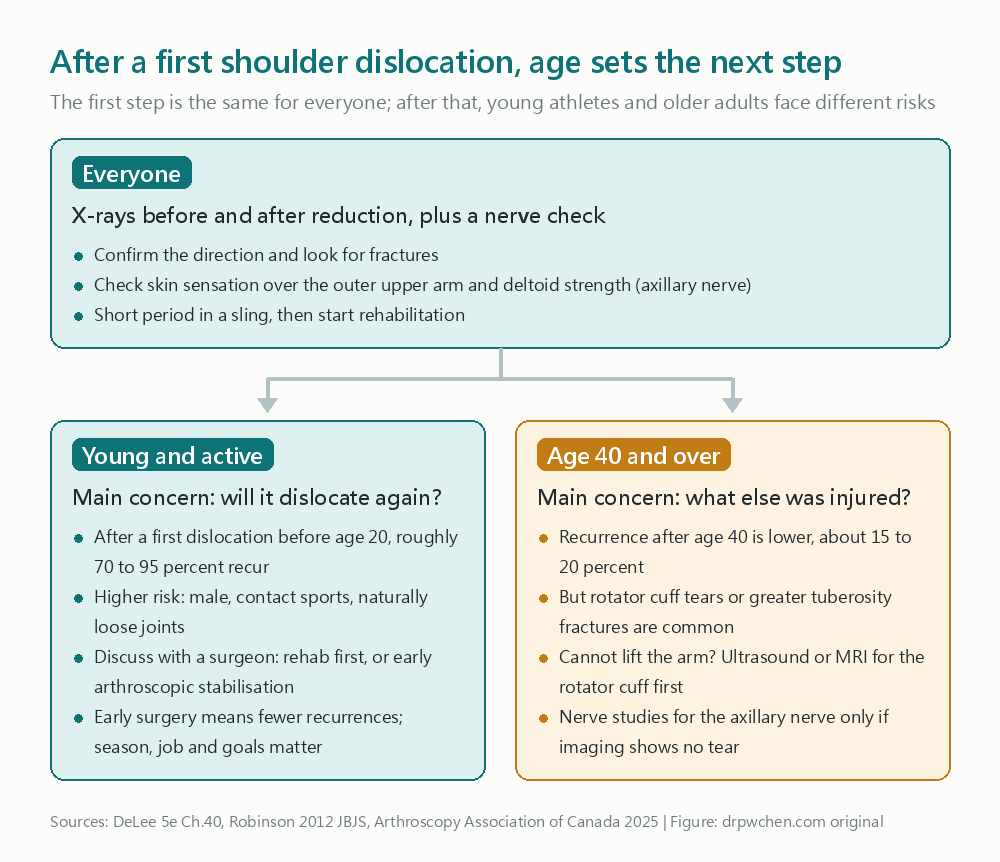
- Doctors will usually take an X-ray first to confirm the direction and check for fractures, then take another one after reducing it (putting it back in).
- Before and after reduction, the doctor will check if the skin on the outside of your upper arm is numb and if your deltoid muscle can fire. They’re checking your axillary nerve.
After reduction, you’ll usually wear an arm sling for a short time before starting rehabilitation. Studies comparing one week to three weeks of immobilization found similar recurrence rates. Immobilizing it for too long actually makes the shoulder prone to stiffness, especially in older adults.
Will it dislocate again after the first time?
This is the question young people ask most. The answer is heavily tied to your age at the time of the first dislocation.
- Under twenty at first dislocation: about 70% to 95% chance of doing it again.
- Ages 20 to 30: about 60% to 80%.
- Over forty: drops to 15% to 20%.
Other factors that raise the risk: being male, playing contact sports like basketball or rugby, having naturally loose joints, and having bone defects on the joint edge from the dislocation.
It’s not all bad news. A Swedish study tracking patients for 25 years found that among those aged 12 to 25 who only got conservative treatment, about half never dislocated again, or eventually stabilized on their own after a few recurrences.
Should young people get surgery right away?
This is still debated in orthopedics and sports medicine. Here are the considerations on both sides:
- Early surgery (usually arthroscopic labral repair): Pooled studies show a significantly lower chance of recurring dislocation and a higher rate of returning to the original level of sport.
- Rehab first: The study subjects were almost all young men, and the studies weren’t large. Plus, since about half stabilize with conservative treatment, not everyone needs surgery.
- In-season athletes: Some choose to rehab first, wear a brace, and finish the season. Most can return to play within a week or two, but the chance of re-dislocating in the same season isn’t low.
The Arthroscopy Association of Canada’s 2025 position is: males, young age, contact sport athletes, and those with loose joints can consider early surgery. The timing is a shared decision based on the season, work, and personal goals.
If an older adult can’t lift their arm after, is the nerve damaged?
This is the part I felt was most worth writing down.
People over forty have a lower chance of re-dislocating, but they have more concurrent injuries. The most common are:
- Rotator cuff tear: More common as you age. The rate of concurrent tears in older adults after dislocation ranges from over 30% to over 80% across studies.
- Greater tuberosity fracture: The bone on the outside of the shoulder gets snapped off.
- Axillary nerve injury: Leaves the deltoid weak and the outside of the upper arm numb.
The trouble is, both a rotator cuff tear and an axillary nerve injury look like “I can’t lift my arm.” It’s very easy to confuse the two. Patients have been reported to wait months under a diagnosis of nerve palsy, only to find out later that the rotator cuff was torn.
So the order of evaluation matters:
How to check when an older adult can’t lift their arm
- First, use ultrasound or MRI to check the rotator cuff for tears.
- If imaging shows no tear, then do electrodiagnostic testing to check the axillary nerve.
- If the nerve is injured but the rotator cuff is fine, many people slowly recover within a few months to a year, but some do not recover fully; if there is still no progress after a few months of follow-up, go back to your doctor for re-evaluation.
- If it’s a rotator cuff tear, especially a full-thickness one, surgical repair often works better. You can discuss this with an orthopedic surgeon.
I put together how to evaluate and treat rotator cuff tears in this rotator cuff note.
How long do I wear the sling? Can I wear the “outward rotation” brace?
The standard sling rests your arm across your belly. You wear it for one to a few weeks, mostly for pain relief and to let tissues stabilize.
Some studies found that immobilizing the arm in an “outward rotation” (external rotation) position helps the labrum adhere better, lowering the chance of re-dislocation. But large meta-analyses found both positions yield similar results. There’s no international consensus yet. In the trials, plenty of people in both groups didn’t wear their brace as instructed, and if you can’t tolerate wearing it, it doesn’t matter how good the effect is. So just discuss whether to use one with your doctor.
What does rehab actually do?
Whether you had surgery or not, rehab generally has three phases:
- Acute phase (first 1-2 weeks): Pain and swelling control, gentle motion within painless limits, and maintaining the muscles around your shoulder blade.
- Recovery phase (about 2-6 weeks): Getting your range of motion back, stretching the back of the shoulder, and strengthening your rotator cuff and shoulder blade stabilizers.
- Functional phase (6 weeks to half a year): Building strength, endurance, and control, finally adding sport-specific training for your chosen activity.
During rehab, young people should progress very slowly back to that “arm up and turned out” position, since it’s the most vulnerable. Before returning to sports, your range of motion and strength should be roughly equal on both sides, and you shouldn’t feel afraid when making that movement.
Those who have surgery usually take four to six months to return to full activity.
When should you go back to the doctor?
- Your shoulder feels like it’s “slipping out” again, or it dislocates again.
- A few weeks pass and you still can’t lift your arm, or it feels very weak when you try.
- The outside of your upper arm stays numb, or your outer shoulder muscle looks smaller.
- The pain keeps you awake at night, or it keeps getting worse.
—
Further reading: Milwaukee shoulder: the shoulder that keeps filling with fluid (another older-adult shoulder issue linked to rotator cuff tears)
Below is exactly how this note looks in my vault, I just stripped out the internal links and copyrighted textbook figures. The verification process and tools I used are detailed at the end.
Glenohumeral instability
Clinical Pearls
- Instability is a spectrum: subluxation (partial, self-reducing) → dislocation (complete, often needs manual reduction); classified by direction / frequency / etiology / degree
Frontera 4e Ch.14- Anterior accounts for 95-97%; typical mechanism is abduction + external rotation force, often with Bankart (anteroinferior labrum/glenoid) + Hill-Sachs (posterolateral humeral head compression defect)
Kahn Ch.13,Mitra Ch.30- Age at first dislocation is the strongest predictor of recurrence: <20 y/o 70-95%, 20-30 y/o 60-80%, >40 y/o 15-20%
DeLee 5e Ch.40; for older adults with first-time dislocation, think rotator cuff tear, greater tuberosity fracture, axillary nerve injury firstRobinson 2012- Young traumatic first-time dislocation: early arthroscopic Bankart repair reduces recurrence odds by ~94% (OR 0.06), but WOSI difference did not reach statistical significance; individual RCTs are small, with a median fragility index of only 2
Abdel Khalik 2025- Surgical technique depends on bone loss: traditional glenoid bone loss critical threshold is 20-27%; functional scores worsen starting at 13.5% (but recurrence rate only spikes in the top quartile) → Latarjet / remplissage
Shaha 2015,DeLee 5e Ch.40
Abbreviations
| Abbreviation | Full Name |
|---|---|
| GHJ | glenohumeral joint |
| IGHL | inferior glenohumeral ligament |
| MDI | multidirectional instability |
| TUBS | Traumatic, Unidirectional, Bankart, Surgery |
| AMBRI | Atraumatic, Multidirectional, Bilateral, Rehabilitation, Inferior capsular shift |
| HAGL | humeral avulsion of glenohumeral ligament |
| FTSD | first-time shoulder dislocation |
| ABR | arthroscopic Bankart repair |
| WOSI | Western Ontario Shoulder Instability Index |
| ROM | range of motion |
| ER / IR | external / internal rotation |
| MRA | magnetic resonance arthrography |
| RTS | return to sport |
| RTP | return to play |
| GT | greater tuberosity |
| AAC | Arthroscopy Association of Canada |
| ABER | abduction and external rotation (MRI positioning) |
| SR | systematic review |
| ITT | intention-to-treat |
| CPG | clinical practice guideline |
| PT | physical therapy |
| US | ultrasound |
| OA | osteoarthritis |
| Se / Sp | sensitivity / specificity |
Pathophysiology and Background
Definition
- Shoulder instability = symptomatic abnormal translation of the humeral head relative to the glenoid; it exists on a spectrum
Frontera 4e Ch.14- Subluxation: Humeral head partially slips out of the glenoid fossa, self-reducing
- Dislocation: Humeral head completely separates from the glenoid, often requires manual reduction
- Microinstability: Caused by capsular laxity, mostly multidirectional, often accompanied by rotator cuff internal impingement
Braddom 6e Ch.35
- Must be distinguished from laxity (asymptomatic looseness): instability is a patient’s subjective symptom, not just a physical exam finding
DeLee 5e Ch.40,Buckup Ch.2
Epidemiology
- General population instability incidence is ~1.7%; mostly affects young people, females, athletes, though also seen in sedentary populations
Frontera 4e Ch.14 - The GHJ is the most commonly dislocated large joint; anterior makes up 80-95% of first-time shoulder girdle dislocations
Magee Pathology 2e Ch.6 - Directional distribution
Kahn Ch.13,Maitin Ch.29- anterior 95-97%; posterior 2-4%
- inferior (luxatio erecta) 0.5-1%
- Concurrent lesion rates
- Hill-Sachs lesions are seen in 35-40% of anterior dislocations
Kahn Ch.13; another estimate puts it at 70-90% after a single dislocationDeLee 5e Ch.40 - Hill-Sachs is nearly 100% in recurrent anterior instability
Provencher 2012 - Bony Bankart is ~5% in anterior dislocations
Kahn Ch.13 - Average glenoid bone loss after a single dislocation is only ~6.5% (Dickens study, cited in
Abdel Khalik 2025)
- Hill-Sachs lesions are seen in 35-40% of anterior dislocations
Mechanism of Injury
Stabilizing mechanisms (Why is it prone to dislocation?)
- The GHJ has high mobility and low bony stability, maintained by static + dynamic restraints
Frontera 4e Ch.14- Static: glenohumeral ligaments, joint capsule, glenoid labrum (dominant at extreme ranges of motion)
Frontera 4e Ch.14 - Dynamic: rotator cuff + scapular stabilizers, pressing the humeral head into the glenoid via concavity compression in the mid-range of motion
Braddom 6e Ch.35
- Static: glenohumeral ligaments, joint capsule, glenoid labrum (dominant at extreme ranges of motion)
- The subscapularis is especially important for both anterior and posterior stability
Braddom 6e Ch.35
Injury mechanisms
- Anterior: Falling on an outstretched arm in abduction and external rotation, or taking a hit from behind while the arm is abducted and externally rotated
Frontera 4e Ch.14- Injury to the anterior band of the IGHL and anteroinferior labrum
Magee Pathology 2e Ch.6
- Injury to the anterior band of the IGHL and anteroinferior labrum
- Posterior: Posteriorly directed force on the arm while flexed, adducted, and internally rotated
Frontera 4e Ch.14- Typically seen in seizures or electric shock (tetanic contractions)
Kahn Ch.13
- Typically seen in seizures or electric shock (tetanic contractions)
- Inferior (luxatio erecta): Falling with the arm in an abducted and externally rotated position
Maitin Ch.29 - Atraumatic / multidirectional instability (MDI): A patulous (loose) capsule is the primary lesion, often bilateral
Frontera 4e Ch.14 - Neurologic conditions (stroke, brachial plexus injury, myopathy) causing shoulder girdle weakness → secondary instability
Frontera 4e Ch.14
Lesion anatomy
- Bankart lesion: Anteroinferior labrum avulsion from the glenoid (soft); if it includes a glenoid rim fracture, it’s a bony Bankart (osseous)
Kahn Ch.13- Perthes: Nondisplaced Bankart; the capsulolabral complex is avulsed but the medial scapular periosteum stays intact
DeLee 5e Ch.40 - Anterior labroligamentous periosteal sleeve avulsion: Labral avulsion with stripped periosteum that heals medially, basically a medialized Bankart
DeLee 5e Ch.40
- Perthes: Nondisplaced Bankart; the capsulolabral complex is avulsed but the medial scapular periosteum stays intact
- Hill-Sachs lesion: Compression impaction defect on the posterolateral humeral head (caused by striking the anteroinferior glenoid rim)
Mitra Ch.30 - HAGL: Glenohumeral ligament avulsion from the humeral side (not the glenoid side), 1-9% incidence, must be distinguished from Bankart to pick the right surgery
DeLee 5e Ch.40 - Posterior counterparts: reverse Bankart (posterior labrum/glenoid) + reverse Hill-Sachs (anteromedial humeral head compression defect, aka McLaughlin lesion)
Mitra Ch.30
Complications
- Recurrence (most common complication)
Magee Pathology 2e Ch.6 - Overall prevalence of concurrent injuries (prospective cohort of 3633 anterior dislocations, mean age 47.6)
Robinson 2012- Neurologic deficits 13.5%; rotator cuff tear or GT fracture 33.4%
- Females ≥60 y/o, low-energy falls are most likely to have a cuff tear or GT fracture
- Interpretation (not from the paper): a low-energy fall is a marker of an older population with degenerated tissue, where a worn cuff and an osteoporotic greater tuberosity fail under small forces; younger people mostly dislocate in high-energy sports injuries, and the damage lands on the labrum and ligaments. It does not mean high energy is less likely to tear the cuff, and the abstract does not separate the effects of energy and age
- Those with cuff tear or GT fracture have an RR 1.9 risk of neurologic deficits → you have to check for both if you find one
- Textbooks vary wildly on the numbers for older adults (due to different study definitions and populations, so I’m listing them side-by-side rather than averaging)
- Rotator cuff rupture after first-time dislocation in middle-aged/older adults is 40-90%
Bahr IOC Ch.7 - Another estimate: 40% concurrent injuries in older adult dislocations; GT fracture ~15%, cuff tear ~10%, nerve ~5%
DeLee 5e Ch.40
- Rotator cuff rupture after first-time dislocation in middle-aged/older adults is 40-90%
- Nerve injuries: Axillary nerve is most common; 5-60% of traumatic anterior dislocations, more frequent in older adults
Bahr IOC Ch.7- Systematic review (13 papers, 17,087 subjects): incidence 0.4-65.5%; time to reduction was not significantly correlated with nerve injury incidence
Lorente 2023 - Motor and sensory recovery are often incomplete, with sensory doing worse
Lorente 2023 - Most spontaneously recover in 3-12 months; if no recovery by 4 months → refer for nerve graft evaluation
Bahr IOC Ch.7
- Systematic review (13 papers, 17,087 subjects): incidence 0.4-65.5%; time to reduction was not significantly correlated with nerve injury incidence
- Unhappy triad: Dislocation + rotator cuff tear + peripheral nerve (usually axillary nerve) injury
Trescot Ch.31- 19-55% of anterior dislocations have axillary nerve injuries; higher risk if >40 y/o or >12 hours to reduction
Trescot Ch.31 - But the SR above reached the opposite conclusion on “delayed reduction increases nerve injury”: time to reduction was not significantly associated with nerve injury incidence
Lorente 2023; the two sources agree on age >40
- 19-55% of anterior dislocations have axillary nerve injuries; higher risk if >40 y/o or >12 hours to reduction
- Cuff weakness after dislocation in older adults is often misdiagnosed as axillary nerve palsy
DeLee 5e Ch.40- If axillary palsy is suspected, do ultrasound or MRI first to rule out a cuff tear; only do electrodiagnostics if the cuff is intact. Prognosis here is great
DeLee 5e Ch.40 - Axillary nerve originates from the posterior cord, C5-C6; do EMG 3-6 weeks post-injury, track reinnervation at 12 weeks
Mitra Ch.30 - Normal C7-T1 testing doesn’t rule out axillary nerve; you must test the deltoid patch sensation and deltoid contraction
Mitra Ch.30
- If axillary palsy is suspected, do ultrasound or MRI first to rule out a cuff tear; only do electrodiagnostics if the cuff is intact. Prognosis here is great
- Greater tuberosity fracture: 5-13% of anterior dislocations, more common with older age; post-reduction displacement ≥5 mm needs surgical evaluation
Bahr IOC Ch.7- Those with concurrent GT fractures actually have lower recurrence rates: recurrence odds drop 3.8 times after conservative treatment
DeLee 5e Ch.40 - In a 25-year cohort, only 2 out of 24 shoulders with GT fractures re-dislocated
Hovelius 2008
- Those with concurrent GT fractures actually have lower recurrence rates: recurrence odds drop 3.8 times after conservative treatment
- Less common: musculocutaneous / median nerve, brachial plexus injuries
Magee Pathology 2e Ch.6 - Long-term recurrent dislocations → glenohumeral osteoarthritis
Bahr IOC Ch.7
Prognosis
- Age at first dislocation is the strongest predictor of recurrence
DeLee 5e Ch.40- Pooled data: <20 y/o 70-95%, 20-30 y/o 60-80%, >40 y/o 15-20%
DeLee 5e Ch.40 - Hovelius 25-year prospective study: <20 y/o 72%, 23-29 y/o 56%, 30-40 y/o 27% (as cited in textbook)
DeLee 5e Ch.40 - Patients over 60 still have a 22% recurrence rate, it doesn’t drop to negligible levels
DeLee 5e Ch.40 - Pediatric ≤18 y/o recurrence 73%; closed physis 94% vs open 61%
DeLee 5e Ch.40
- Pooled data: <20 y/o 70-95%, 20-30 y/o 60-80%, >40 y/o 15-20%
- Adolescent athletes: recurrence rates up to 72.3% (within 5.3 years)
Frontera 4e Ch.14(citingZaremski 2017)- Original meta-analysis: Recurrence odds for the conservative group were 13.4 times higher than the primary surgery group; <14 y/o still had a 44% recurrence rate
Zaremski 2017 - Conservative group RTP (return to play) 41.3% vs primary surgery group 95.3%
Zaremski 2017
- Original meta-analysis: Recurrence odds for the conservative group were 13.4 times higher than the primary surgery group; <14 y/o still had a 44% recurrence rate
- The long-term natural history isn’t quite so bleak: 25 years later, about half of the 12-25 y/o patients managed conservatively had not re-dislocated or had stabilized on their own
Hovelius 2008- Same study: Immobilization after dislocation does not change prognosis
Hovelius 2008
- Same study: Immobilization after dislocation does not change prognosis
- Other recurrence risk factors: Male, young age at first dislocation, joint hypermobility, contact/overhead sports, significant bone loss
Mitra Ch.30,Magee Pathology 2e Ch.6 - Surgery vs. Conservative (RCT for first-time traumatic anterior dislocation, 15-39 y/o, n=76, open repair)
- 2-year recurrence: Surgery 3% vs Conservative 54%
Jakobsen 2007 - 10-year: Surgery group 72% good/excellent on the Oxford Shoulder Instability Score; Conservative group 74% unsatisfactory results
Jakobsen 2007 - Textbook cited 10-year recurrence at 9% vs 62%
Kahn Ch.13; from the original abstract I could only back-calculate the conservative group (21 at 2 years plus 3 more by 8 years, 24/39 ≈ 62%)
- 2-year recurrence: Surgery 3% vs Conservative 54%
Clinical Evaluation
Diagnostic Criteria
- Mainly a clinical diagnosis: History (dislocation/subluxation event, provocative positions) + Physical Exam (positive apprehension/relocation, increased translation)
Frontera 4e Ch.14 - Imaging is used to confirm direction, rule out fractures, and quantify bone loss and soft tissue lesions (see “Evaluation Tools”). It’s not strictly for diagnosis but guides management
Cuccurullo Ch.4 - Manual diagnosis of acute dislocations is often self-evident: step deformity, emptiness under the acromion, loss of ROM
Magee Pathology 2e Ch.6
Evaluation Tools
History
- Clarify: Age, hand dominance, sport/position, competition level, mechanism of injury, direction, any neurologic/functional deficits
Frontera 4e Ch.14 - Prognostic factors the international consensus unanimously agreed to ask about
Hurley 2022a- Age, sex, mechanism, number of dislocations, whether it required manual reduction by someone else
- Occupation, sport/position/level, collision sports, bone loss, hyperlaxity
- Think about concurrent injuries by age: >40 y/o suspect cuff tear; >60 y/o add axillary nerve and brachial plexus
DeLee 5e Ch.40 - Dead arm syndrome: Sudden weakness, numbness, or slipping sensation in the throwing position (abduction + ER); common in pitchers/volleyball players
Cuccurullo Ch.4 - Voluntary instability: the patient can make the shoulder slip out without external force, by selectively contracting certain muscles (often demonstrable on the spot); the opposite of involuntary (dislocating without wanting to)
- Must identify → may involve secondary gain and is hard to treat; surgical reconstruction is generally contraindicated
Magee Pathology 2e Ch.6,AAOS Postop Rehab 2018 Ch.6
- Must identify → may involve secondary gain and is hard to treat; surgical reconstruction is generally contraindicated
Physical Exam
- Inspection: Deformity, muscle atrophy, scapular asymmetry/winging (points to nerve injury)
Frontera 4e Ch.14 - ROM: Throwers often have increased external rotation + decreased internal rotation, related to posterior capsule tightness and humeral torsion
Frontera 4e Ch.14- The IR loss is GIRD (glenohumeral internal rotation deficit); see the impingement note together with internal impingement. The IR / total ROM return-to-play thresholds come from the same research line (see “Rehabilitation (Three Phases)”)
- Strength: Lift-off test (subscapularis), scapular stabilizers (serratus anterior, rhomboid, via wall push-ups)
Frontera 4e Ch.14 - Provocative tests (see DDx and directional localization)
| Test | Direction | Technique | Positive Finding | Se/Sp |
|---|---|---|---|---|
| Ant apprehension | Anterior | Supine, 90° abd + ER, anterior force to humeral head | Apprehension of imminent dislocation | Se 98.3 / Sp 71.6 |
| Relocation (Jobe) | Anterior | Posterior force applied in apprehension position | Apprehension relieved, increased ER | Se 96.7 / Sp 78.0 |
| Release (surprise) | Anterior | Sudden release of posterior force | Apprehension/sense of imminent dislocation | Se 91.7 / Sp 83.5 |
| Post apprehension Jerk test | Posterior | 90° flexion + max IR, horizontal adduction + posterior force | Jerks back into place to prevent posterior dislocation | — |
| Sulcus sign | Inferior | Arm adducted, distal traction applied | Sulcus appears between acromion and humeral head | — |
- Se/Sp data
Kahn Ch.13; test techniquesBraddom 7e Ch.36,Cuccurullo Ch.4 - If apprehension test provokes posterior pain rather than apprehension → think internal impingement
Frontera 4e Ch.14 - Positive sulcus sign points to inferior/multidirectional instability (glenohumeral laxity)
Cuccurullo Ch.4 - Labral lesions (including SLAP): O’Brien active compression test, crank test, biceps loading test
Frontera 4e Ch.14
Radiography (X-ray)
- At least two orthogonal planes to avoid missed diagnoses (especially posterior dislocations)
Magee Pathology 2e Ch.6 - Standard views: AP (internal/external rotation), axillary lateral, scapular Y view
Cuccurullo Ch.4- Axillary view is crucial for determining dislocation direction, but acute patients often struggle with positioning due to pain
Magee Pathology 2e Ch.6 - Society position: Maximize utility of plain films (AP, lateral, axillary) before considering CT/MRI
Abdel Khalik 2025
- Axillary view is crucial for determining dislocation direction, but acute patients often struggle with positioning due to pain
- Special views
- West Point axillary → looks at Bankart (anteroinferior glenoid)
Cuccurullo Ch.4 - Stryker notch → looks at Hill-Sachs
Cuccurullo Ch.4,Frontera 4e Ch.14
- West Point axillary → looks at Bankart (anteroinferior glenoid)
- Posterior dislocation imaging: empty glenoid sign on the AP view, with abnormal overlap of the humeral head and glenoid shadows; the axillary view shows it clearly but is often hard to obtain acutely
Magee Pathology 2e Ch.6
MRI / MRA
- MRA (Magnetic Resonance Arthrography) is the top choice for young athletes: Best for evaluating the labrum, glenohumeral ligaments, and rotator cuff
Frontera 4e Ch.14- MRI sensitivity for soft tissue lesions is ~70%; intra-articular gadolinium bumps it to the mid-90s; ABER positioning increases it further
DeLee 5e Ch.40
- MRI sensitivity for soft tissue lesions is ~70%; intra-articular gadolinium bumps it to the mid-90s; ABER positioning increases it further
- Indications: No response to treatment, suspecting rotator cuff/labral lesions
Frontera 4e Ch.14 - In first-time dislocations, MRI is mostly for finding concurrent lesions (cuff tear, HAGL) and should be obtained in a timely manner
Abdel Khalik 2025 - CT (including 3D reconstructions) for evaluating bone loss
AAOS Postop Rehab 2018 Ch.6- Society position: Only order a CT if suspecting bone loss or a bony Bankart, and bone reconstruction might be needed
Abdel Khalik 2025 - International consensus: Ordering advanced imaging for those at high risk of re-dislocation is a strong consensus (90%)
Abdel Khalik 2025
- Society position: Only order a CT if suspecting bone loss or a bony Bankart, and bone reconstruction might be needed
Ultrasound (US)
- Can evaluate the rotator cuff, paralabral cysts, and anterior/posterior labrum (limited); dynamic rotation exams are key for labrum evaluation
Frontera 4e Ch.14 - Abduction weakness after dislocation in older adults → US is the first step to rule out a cuff tear (see “Complications”)
DeLee 5e Ch.40
Classification
- Instability uses a descriptive multi-axial classification, with axes coexisting (the algorithm branches based on this, see “Management algorithm”)
Braddom 6e Ch.35
| Axis (Category) | Types | Description |
|---|---|---|
| Direction | anterior / posterior / inferior / multidirectional | Anterior is most common; MDI = ≥2 directions |
| Degree | dislocation / subluxation / microinstability | Complete dislocation / self-reducing subluxation / lax microinstability |
| Frequency | acute / chronic | Chronic means repeated episodes; “chronic dislocation” can also mean a long-unreduced dislocation, most often a missed posterior one |
| Etiology | traumatic / atraumatic | Dictates TUBS vs. AMBRI |
| Volition | involuntary / voluntary | Voluntary = the patient can contract muscles to make the shoulder dislocate; usually a surgical contraindication (see “History”) |
TUBS vs. AMBRI (Clinical archetypes that drive decisions)
- TUBS: Traumatic, Unidirectional, Bankart lesion, favors Surgery (especially young athletes)
Cuccurullo Ch.4 - AMBRI: Atraumatic, Multidirectional, Bilateral, mainly Rehabilitation, Inferior capsular shift if needed
Cuccurullo Ch.4
Gerber Classification (1997)
- A clinically practical 6-type classification
Buckup Ch.2
| Type | Description |
|---|---|
| I | Chronic luxation |
| II | Unidirectional instability, no hyperlaxity |
| III | Unidirectional instability + multidirectional hyperlaxity |
| IV | Multidirectional instability, no hyperlaxity |
| V | Multidirectional instability + multidirectional hyperlaxity |
| VI | Unidirectional/multidirectional voluntary luxation |
Translation Grading (Hawkins)
- AP drawer test evaluates translation severity
Buckup Ch.2- Grade 0: No translation (normal laxity)
- Grade 1: Humeral head translates to the glenoid rim
- Grade 2: Translates over the rim but spontaneously reduces
- Grade 3: Complete dislocation, does not spontaneously reduce
Bone Loss and the Glenoid Track
- Glenoid track: The contact zone between the glenoid and humeral head during max external rotation and horizontal extension; a Hill-Sachs lesion that falls completely within the track (on-track) will not engage
DeLee 5e Ch.40- Off-track (engaging) Hill-Sachs: Defect extends past the track → it will engage and dislocate; even small, shallow defects can be off-track if located medially
DeLee 5e Ch.40 - Glenoid-sided bone loss narrows the track → you have to calculate bone loss on both sides together (bipolar)
DeLee 5e Ch.40,Provencher 2012
- Off-track (engaging) Hill-Sachs: Defect extends past the track → it will engage and dislocate; even small, shallow defects can be off-track if located medially
- Glenoid bone loss critical thresholds (determines if soft tissue repair is enough)
- Traditional critical threshold: 20-27% (inverted-pear glenoid)
DeLee 5e Ch.40- Original series: ABR recurrence without significant bone loss 4% vs with bone loss 67%; contact athletes 6.5% vs 89%
Burkhart 2000
- Original series: ABR recurrence without significant bone loss 4% vs with bone loss 67%; contact athletes 6.5% vs 89%
- Subcritical: In a military cohort (72 patients, mean age 26.3, after isolated arthroscopic Bankart repair, bone loss measured on preoperative imaging, mean follow-up 48 months), WOSI scores dropped into the poor range starting at 13.5%, even without re-dislocation
Shaha 2015- Recurrence rates: The first three quartiles (0-19.8%) totaled 7.3%, only spiking significantly in the top quartile (≥20%) at 27.8%
Shaha 2015 - ⚠️ Textbook cited it as “<13.5% failure 5% vs >13.5% failure 22%”
DeLee 5e Ch.40, which contradicts the original abstract; sticking with the original paper.
- Recurrence rates: The first three quartiles (0-19.8%) totaled 7.3%, only spiking significantly in the top quartile (≥20%) at 27.8%
- Biomechanics: Soft tissue surgery can’t restore stability if >15%
DeLee 5e Ch.40 - Measurement: 3D CT best-fit circle; subcritical is often defined as 10-20%
Khan 2024
- Traditional critical threshold: 20-27% (inverted-pear glenoid)
Differential Diagnosis
| Diagnosis (Category) | Key Distinctions |
|---|---|
| Rotator cuff tendinopathy / tear | No apprehension; positive painful arc, positive Neer / Hawkins-Kennedy impingement tests; must rule out cuff tear after older adult dislocations |
| Glenoid labral tear (SLAP) | Positive O’Brien / crank, deep click; can coexist with instability |
| Suprascapular neuropathy | Supraspinatus/infraspinatus atrophy and weakness, no instability signs |
| Subacromial bursitis | Local tenderness, positive Neer / Hawkins-Kennedy impingement tests, no increased translation |
| Bicipital tendinopathy | Bicipital groove tenderness, positive Speed/Yergason |
- DDx list
Kahn Ch.13,Frontera 4e Ch.14; instability itself is sub-classified into traumatic / atraumatic / MDIFrontera 4e Ch.14
Red Flags and Referrals
- Acute dislocation with signs of neurovascular injury → Immediate management, evaluate axillary nerve (deltoid sensation/strength) before and after reduction
Magee Pathology 2e Ch.6 - Suspect fracture or posterior dislocation → Imaging prior to reduction; re-image after reduction
Frontera 4e Ch.14 - Chronic / missed posterior dislocation → Usually requires open reduction, don’t blindly force a closed reduction
Magee Pathology 2e Ch.6 - Abduction weakness after first-time dislocation in older adults → Image first to rule out a cuff tear, then consider electrodiagnostics
DeLee 5e Ch.40,Robinson 2012 - Axillary nerve palsy not recovered by 4 months → Refer for nerve graft evaluation
Bahr IOC Ch.7 - Young traumatic anterior dislocation (males, contact sport, hyperlaxity) → Refer to ortho to discuss early surgery (shared decision-making)
Abdel Khalik 2025
Clinical Management
Management Algorithm
- Driving axes: Direction × Traumatic (TUBS/AMBRI) × Age/Activity Level × Bone Loss; for classification see “Classification”, for bone loss see “Bone Loss and the Glenoid Track”
- No society CPG (Clinical Practice Guidelines); the closest are the AAC 2025 position statement (first-time dislocation) and the 2022 International Delphi Consensus
Abdel Khalik 2025,Hurley 2022a
Algorithm
- Step 0 — Acute Dislocation: Evaluate neurovascular status → Image first if suspecting fracture/posterior dislocation → Manual reduction (Stimson / Milch / Spaso / FARES) → Post-reduction imaging
Frontera 4e Ch.14- Step 1 — Short-term Immobilization + Early Rehab: Sling for 1-4 weeks, no difference in recurrence between 1 and 3 weeks
Frontera 4e Ch.14,Kahn Ch.13
- Positioning (IR vs ER): Two meta-analyses have contradictory conclusions, and international consensus was not reached, see “Immobilization”
Hurley 2022a- Step 2 — Triage
- First-time traumatic, young, male, contact sport, hyperlaxity → Recommend ABR, timing via shared decision-making
Abdel Khalik 2025- In-season athletes, no significant bone loss → Can rehab and return to play, but same-season recurrence is high
DeLee 5e Ch.40- Older adults / low activity level → Conservative rehab preferred; concurrently check for cuff tear, GT fracture, axillary nerve
Kahn Ch.13,Robinson 2012
- If still weak around 3 weeks → MRI to find cuff tear; full-thickness tears lean toward surgery
Kucirek 2025- Atraumatic / MDI (AMBRI) → Rehab-focused (periscapular + rotator cuff/deltoid force couple); only consider inferior capsular shift if it fails
Frontera 4e Ch.14,Cuccurullo Ch.4- Step 3 — Surgical Technique Dictated by Bone Loss (see “Surgery”)
- No significant bone loss → arthroscopic Bankart repair
Frontera 4e Ch.14- Off-track Hill-Sachs, no severe glenoid bone loss → Bankart + remplissage
Hurley 2022b- Glenoid bone loss reaches critical (traditionally 20-27%) → Latarjet / glenoid bone graft
AAOS Postop Rehab 2018 Ch.6,Burkhart 2000- Subcritical (~10-20%) → Optimal technique undetermined, RCT ongoing
Khan 2024- Posterior instability → Prefer arthroscopic stabilization (suture anchors)
Frontera 4e Ch.14
Treatment Goals
- Pain relief, restore full functional ROM, correct strength deficits, achieve muscle balance, return to activity asymptomatically
Frontera 4e Ch.14
Conservative Management
Reduction Techniques
- Anterior dislocations: Stimson, Milch, Spaso, FARES (Fast, Reliable and Safe)
Frontera 4e Ch.14- Spaso and FARES are single-operator, no sedation required
Frontera 4e Ch.14- Spaso: patient supine; the operator holds the affected wrist and applies gentle traction straight up toward the ceiling with slight external rotation
Frontera 4e Ch.14 - FARES: patient supine; the operator holds the wrist in neutral, keeps gentle longitudinal traction with small vertical oscillations while slowly abducting; once past 90° of abduction, gently externally rotates while traction, abduction and oscillation continue
Frontera 4e Ch.14
- Spaso: patient supine; the operator holds the affected wrist and applies gentle traction straight up toward the ceiling with slight external rotation
- Success rates are similar across methods; scapular manipulation succeeds in 80-100%
Kahn Ch.13
- Spaso and FARES are single-operator, no sedation required
- Posterior dislocations need forward traction + humeral pressure; inferior (luxatio erecta) needs two-step reduction under conscious sedation
Maitin Ch.29 - Signs of success: Hearing a pop, pain relief, restoration of the rounded shoulder contour
Kahn Ch.13
Immobilization
- Post-reduction sling 1-4 weeks (traditional IR position)
Frontera 4e Ch.14- 1-week vs 3-week immobilization shows no difference in recurrence; immobilizing too long increases adhesive capsulitis (especially in older adults)
Kahn Ch.13 - Immobilizing longer than 3-4 weeks doesn’t lower recurrence risk
Bahr IOC Ch.7
- 1-week vs 3-week immobilization shows no difference in recurrence; immobilizing too long increases adhesive capsulitis (especially in older adults)
- ER (External Rotation) immobilization vs IR: Evidence is contradictory, listing both without taking sides
- Pro-ER: The first RCT (n=198, 3 weeks of immobilization) ITT recurrence 26% vs 42%, relative risk for ≤30 y/o dropped 46%
Itoi 2007 - Pro-ER: 9-RCT meta-analysis (795 patients, mean age 29, 82% male), recurrence 22.2% vs 33.4%, 20-40 y/o 12.1% vs 31.4%
Hurley 2021 - Anti-ER: 17-study (1170 subjects) meta-analysis, no difference in recurrence, RTS, or apprehension
Boutros 2026 - Where the two meta-analyses differ (from the abstracts)
- Design: Hurley included only RCTs; Boutros added comparative cohort studies, and analyzed each outcome only in the subset of studies reporting it
Hurley 2021,Boutros 2026 - Age: in both pro-ER sources the benefit concentrated in younger patients (Itoi ≤30, Hurley 20-40); the Boutros abstract has no age stratification
- Inference (not from the papers): if ER works, it most likely works in traumatic first-time dislocations under 40; pooling non-randomized studies and all ages may dilute the effect. This is a hypothesis, not a conclusion
- Design: Hurley included only RCTs; Boutros added comparative cohort studies, and analyzed each outcome only in the subset of studies reporting it
- International Delphi Consensus: Optimal immobilization position did not reach consensus
Hurley 2022a - Compliance: often cited as a drawback of the ER brace, but the trial data show higher compliance with ER: Itoi IR 53% vs ER 72%
Itoi 2007; 9-RCT meta 67.4% vs 74.5%Hurley 2021- The real problem is that a quarter to half of patients in both groups did not wear it as instructed
- Pro-ER: The first RCT (n=198, 3 weeks of immobilization) ITT recurrence 26% vs 42%, relative risk for ≤30 y/o dropped 46%
- ER + abduction immobilization vs ABR (multicenter RCT, n=112)
Minkus 2021- Population: age 18-40, first-time traumatic anterior dislocation, enrolled within 3 days, Gerber unidirectional instability (B2 / B3); mean age 26.2, 92% male
- Immobilization: 60° external rotation + 30° abduction
- 2-year recurrence 19.1% vs 2.3%; no difference in clinical scores (Constant, Rowe, WOSI)
Rehabilitation (Three Phases)
- For overlap with post-op rehab, see “Post-op Rehabilitation”; below are the core non-operative rehab principles
Frontera 4e Ch.14 - Acute phase (1-2 weeks): Tissue healing, pain/inflammation reduction, restoring painless active ROM, preventing scapular dysfunction
- Active rest, cryotherapy, protected motion, isometric + closed-chain exercises
- Recovery phase (2-6 weeks): Restore full ROM, posterior capsule flexibility (sleeper stretch, cross-arm stretch), strengthen scapular (lower trapezius, serratus anterior) and rotator cuff muscles
- How to do them
- Sleeper stretch: lie on the affected side (body weight pins the scapula), shoulder flexed no more than 70°, elbow at 90°, and use the other hand to press the forearm toward the bed (passive IR), slowly and pain-free
Maxey 3e Ch.3 - Cross-arm stretch: bring the affected arm across the chest in horizontal adduction and pull the elbow toward the opposite side with the other hand; to progress, stabilize the lateral border of the scapula so the stretch focuses on the glenohumeral joint
Maxey 3e Ch.3
- Sleeper stretch: lie on the affected side (body weight pins the scapula), shoulder flexed no more than 70°, elbow at 90°, and use the other hand to press the forearm toward the bed (passive IR), slowly and pain-free
- Are they OK after a dislocation: anterior instability injures the anterior capsule and labrum; these two stretches load the posterior structures and are not contraindicated
Frontera 4e Ch.14- A tight posterior capsule can actually worsen subtle anterior instability
Maxey 3e Ch.3 - What to avoid is the position that opens the front (end-range abduction + ER); see the next point on slow progression
- Posterior instability is the opposite: after posterior repair, no cross-body motion for 6 weeks and no IR for 6-8 weeks
AAOS Postop Rehab 2018 Ch.5
- A tight posterior capsule can actually worsen subtle anterior instability
- Young patients with symptomatic instability must progress slowly into the abduction + ER position; older adults progress even slower
- How to do them
- Functional phase (6 weeks - 6 months): Increase power/endurance, neuromuscular control, integrate the kinematic chain, sport-specific training
- MDI rehab focus: Scapular stabilizer strengthening + balancing the rotator cuff/deltoid force couple
Frontera 4e Ch.14 - Return to play (throwing athletes)
Frontera 4e Ch.14- ROM: IR side-to-side difference <18°, total ROM (ER + IR) difference ≤5°; Frontera takes these thresholds from Wilk’s GIRD study in professional pitchers
Wilk 2011, the same GIRD and total rotation discussed in the internal impingement section of the impingement note; an 8-season prospective study in the same population later found GIRD alone did not predict shoulder injuryWilk 2015, so treat this as a return-to-play reference, not a hard cutoff- The thrower’s increased ER and decreased IR noted under PE is the same thing: losing some IR is acceptable, losing total rotational arc is not
- Strength: eccentric ER strength = isometric IR strength
- Rationale (mechanism, not explained in Frontera): in throwing, the IR muscles (subscapularis, pectoralis major, latissimus) accelerate the arm, and the posterior cuff (infraspinatus, teres minor) brakes it eccentrically after release; if braking can’t keep up with acceleration, passive structures must stop the humeral head, which is bad for a recently dislocated shoulder
- Before RTS, ROM and strength must be symmetric, apprehension negative; recommend at least 3 months of rehab
Bahr IOC Ch.7 - International consensus: Minimum time to RTS is unknown; must look at strength, ROM, proprioception, pain, apprehension, and incorporate psychological factors
Matache 2022
- ROM: IR side-to-side difference <18°, total ROM (ER + IR) difference ≤5°; Frontera takes these thresholds from Wilk’s GIRD study in professional pitchers
- In-season dislocation: Rehab without immobilization, 90% return in the same season (average ~10 days), but 37% recur in the same season
DeLee 5e Ch.40,Abdel Khalik 2025- Military academy contact athletes: 73% return same-season, only 27% finish the season without recurrence
DeLee 5e Ch.40
- Military academy contact athletes: 73% return same-season, only 27% finish the season without recurrence
Injections / Medications
- Acute phase: Relative rest, ice, analgesics / NSAIDs
Frontera 4e Ch.14 - If rotator cuff irritation pain persists after rehab → consider subacromial injection (landmark or US-guided)
Frontera 4e Ch.14- The goal is cuff irritation pain, not the instability itself
- Contents: local anesthetic + corticosteroid, 3-5 mL total (e.g., 4 mL 1% lidocaine + 1 mL triamcinolone or methylprednisolone 40 mg/mL); avoid aggressive overhead activity for a week afterward
Frontera 4e Ch.14 - US guidance increases accuracy of hitting the bursa, but clinical superiority is unclear
Frontera 4e Ch.14 - PRP, prolotherapy: no data for instability; see “Emerging Treatments”
Surgical Management
First-time Dislocation: Early Surgery vs. Conservative
- Latest evidence synthesis (AAC 2025 position statement, 11 papers, 695 shoulders, mean age 21.6)
Abdel Khalik 2025- Recurrence 6.2% vs 50.6% (OR 0.06); cumulative instability 9.6% vs 64.0% (OR 0.04)
- Subsequent stabilization surgery 6.1% vs 39.2%; ABR complications 1.8%
- Return to original level of sport 79.2% vs 48.5% (OR 3.87)
- WOSI differed by 8.08 points but did not reach statistical significance (95% CI crosses 0)
- Evidence limitations must be stated together
Abdel Khalik 2025- Precision via the 95% CI: redislocation OR 0.06 (0.02-0.17), the upper bound is still far below 1, so the pooled direction (surgery means fewer redislocations) is robust; WOSI difference 8.08 (-1.54 to 17.69) crosses 0, meaning the functional difference is imprecisely estimated, not proven absent
- Individual RCTs have a median fragility index of 2 (mean 3.5): if just 2 participants’ outcomes flipped, that trial would lose statistical significance
- Why so fragile with 695 shoulders: the FI is calculated per RCT (citing Davey 2023), not on the pooled 695-shoulder result; each RCT has only tens of patients, and 695 is the total across 11 studies (including observational ones)
- So what is fragile is each single trial, not the pooled direction
- Subjects were almost exclusively young males (13.7% female); extrapolation to females or older adults is limited
- Level 1 RCT meta-analysis (5 papers, 259 subjects): Recurrent instability 6.3% vs 46.6%, re-operation 4.0% vs 30.8%
Belk 2023 - Textbooks are divided
- Support Bankart repair for young first-time dislocations, but global satisfaction is the same between groups
DeLee 5e Ch.40 - No routine indication for surgery after first-time dislocation, otherwise many athletes would get unnecessary operations
Bahr IOC Ch.7
- Support Bankart repair for young first-time dislocations, but global satisfaction is the same between groups
- Society recommendation: Males, young, contact sport, hyperlaxity consider ABR, timing via shared decision-making
Abdel Khalik 2025
Older Adult (Over ~40) Dislocations with Concurrent Cuff Tears
- Epidemiology
Kucirek 2025- Cuff tear after older adult dislocation 35-86%; >60 y/o 61%, 70-80 y/o 83%, >80 y/o 100%
- Tears almost always involve the supraspinatus; females are at higher risk
- ~27-53% also have a Bankart lesion
- Is it caused by the dislocation or preexisting? Among >60 y/o, full-thickness tears were found in 56% of the dislocation group vs 44% of controls; 83% of the tears in the dislocation group looked acute on ultrasound
- 67 cases of first-time dislocation over age 60 all got MRI or US: 36 had concurrent injuries, 33 of which were cuff tears
Shin 2012- After triaged treatment based on concurrent injuries, at an average of 55 months, none had re-dislocated
Shin 2012
- After triaged treatment based on concurrent injuries, at an average of 55 months, none had re-dislocated
- Misdiagnosis history: 37 cases >40 y/o with undiagnosed cuff tears, often mistaken for axillary nerve palsy; 11 went on to recurrent anterior instability (Neviaser 1993, cited in
Kucirek 2025) - The authors’ proposed workflow (narrative review, not guidelines)
Kucirek 2025- ROM and strength preserved → Try PT first
- Still weak or apprehensive ~3 weeks post-injury → MRI
- Full-thickness tear or multiple dislocations → Surgery; technique depends on tear size, activity level, tendon quality
- Large-to-massive tear, low-to-moderate activity → repairing the cuff alone is acceptable; irreparable or preexisting OA → reverse total shoulder arthroplasty
- Surgery vs. Conservative: 4 comparative studies found the surgery group had better pain, function, and less recurrent instability
Kucirek 2025; only 4 studies, summarized in a narrative review, so the evidence is limited- For frail older adults with large tears, PT and symptomatic treatment is a reasonable choice
Kucirek 2025
- For frail older adults with large tears, PT and symptomatic treatment is a reasonable choice
Indications and Surgical Techniques Overview
- Soft tissue vs. bone reconstruction depends on bone loss (see “Management algorithm”); arthroscopic and open have similar outcomes, no recognized gold standard
Frontera 4e Ch.14
| Technique (Category) | Mechanism / Indications | Source |
|---|---|---|
| (Arthroscopic) Bankart repair | Suture anchors reattach labrum to glenoid rim; used for no significant bone loss | Frontera 4e Ch.14, DeLee 5e Ch.40 |
| Open Bankart (± capsular shift) | Anterior capsulolabral repair + capsulorrhaphy to restore tension; young high-risk (contact/military), subcritical bone loss | AAOS Postop Rehab 2018 Ch.6 |
| Latarjet (coracoid transfer) | Transfer coracoid + conjoint tendon → extends bony glenoid + sling effect; used for glenoid bone loss | AAOS Postop Rehab 2018 Ch.6, DeLee 5e Ch.40 |
| Glenoid bone graft | Defect larger than coracoid can cover, failed Latarjet, or patients with epilepsy | Hurley 2022b |
| Remplissage | Infraspinatus + posterior capsule filled into Hill-Sachs; used for off-track without severe glenoid bone loss | Hurley 2022b, DeLee 5e Ch.40 |
| Inferior capsular shift | Tightens loose capsule; used for MDI / AMBRI | Cuccurullo Ch.4, Magee Pathology 2e Ch.6 |
Surgical Details and Outcomes
- Arthroscopic Bankart
- International consensus: Few complications; inferior anchors, anchor spacing 5-8 mm, multiple small anchors lower recurrence
Hurley 2022a - The authors concluded that, without bone loss, ABR can match open Bankart results (this study had no open-repair group)
Burkhart 2000
- International consensus: Few complications; inferior anchors, anchor spacing 5-8 mm, multiple small anchors lower recurrence
- Open Bankart
- Indications: Young athletes with first or recurrent anterior dislocations, high-risk (contact athlete, military), subcritical bone loss
AAOS Postop Rehab 2018 Ch.6 - Relative contraindications: Glenoid bone loss >20% (switch to bone graft), poor capsule quality; voluntary instability is a contraindication, and uncontrolled epilepsy is generally considered one too
AAOS Postop Rehab 2018 Ch.6
- Indications: Young athletes with first or recurrent anterior dislocations, high-risk (contact athlete, military), subcritical bone loss
- Latarjet
- Stabilizing mechanism: Extends anterior bony glenoid + anterior capsular reconstruction + conjoint tendon inferior sling effect
AAOS Postop Rehab 2018 Ch.6 - Outcomes: Recurrence <5%, collision sport RTP >70%
AAOS Postop Rehab 2018 Ch.6 - International consensus: Recommends subscapularis split approach
Hurley 2022b - Risks: Axillary / musculocutaneous nerve injury, graft too prominent → late glenohumeral arthritis
AAOS Postop Rehab 2018 Ch.6
- Stabilizing mechanism: Extends anterior bony glenoid + anterior capsular reconstruction + conjoint tendon inferior sling effect
- Latarjet vs ABR (for recurrent instability): 21-study meta-analysis (including 3 RCTs)
Hossein Zadeh 2024- ABR recurrence and re-operation risk is 3.08 times that of Latarjet
- But overall ABR complications are ~47% lower (RR 0.53), hematoma risk 75% lower
- ER and forward flexion angles showed no difference
- Athlete RTS meta-analysis: Bristow-Latarjet full return to play 92% vs Bankart 71%
Baur 2026- Authors acknowledge the indications differ between the two groups; it’s an indirect comparison
Baur 2026
- Authors acknowledge the indications differ between the two groups; it’s an indirect comparison
- Subcritical bone loss (10-20%): Multicenter RCT (STABLE) comparing Bankart + remplissage vs Latarjet is ongoing, no results yet
Khan 2024 - Revision: Surgical technique dictated by the degree of glenohumeral bone loss and cuff function
Matache 2022- Bone reconstruction after a failed labral repair has a higher recurrence rate than primary bone reconstruction
van Iersel 2022
- Bone reconstruction after a failed labral repair has a higher recurrence rate than primary bone reconstruction
Post-op Rehabilitation
- Listed last; principles overlap heavily with conservative rehab. For the strengthening phase, see “Rehabilitation (Three Phases)”
Frontera 4e Ch.14 - Open and arthroscopic protocols are similar: Abduction pillow immobilization for 4-6 weeks; if stiff, treat it early
Frontera 4e Ch.14 - Common goals: Restore ROM by 12 weeks, return to sports at ~24 weeks
AAOS Postop Rehab 2018 Ch.6- Return to full activity 4-6 months post-op after finishing rehab
Frontera 4e Ch.14
- Return to full activity 4-6 months post-op after finishing rehab
- The main differences between Bankart and Latarjet are subscapularis management and coracoid bone healing
AAOS Postop Rehab 2018 Ch.6 - Rehab for post-op apprehension: International Delphi consensus of 27 interventions (REGUIDE)
van Gastel 2024- Added items: Graded exposure to fear-provoking positions, training in anterior instability positions, psychosocial education
- International consensus: Minimum follow-up of 12 months or until return to pre-injury function
Matache 2022
Investigational Treatments
- Common premise: The efficacy of prolotherapy, PRP, and stem cells for shoulder instability remains unknown
Frontera 4e Ch.14- All the evidence below comes from rotator cuff / bursitis studies, you cannot extrapolate this to mean they replace capsular or labral structural repair
Prolotherapy (Hyperosmolar Dextrose)
- There are no trials in instability; all four studies below injected cuff / bursa pain, listed only to give a reference point for “does prolo help the shoulder”
- Chronic cuff lesions (symptoms >6 months), US-guided prolotherapy vs 12 weeks of exercise (RCT, 101 completed)
Seven 2017- Follow-up at least 1 year: good/excellent 92.9% vs 56.8%; better pain, SPADI and WORC
- Cuff tendinopathy (US-confirmed supraspinatus tendinosis / tear), dextrose onto painful entheses monthly for 3 injections, both groups with PT (RCT, n=73)
Bertrand 2016- 9 months: pain improvement ≥2.8 points 59% vs superficial saline 27%; no difference on ultrasound structure scores (the effect cannot be attributed to tissue repair)
- Shoulder pain with bursitis, 15% dextrose US-guided bursal injection every 2 weeks for 3 injections (RCT, n=50)
Chang 2021- 3 months after the course: clinical efficacy no different from saline, only elastography stiffness increased
- Chronic subacromial bursitis, dextrose vs steroid bursal injection (RCT, n=54)
Lin 2023- Weeks 2, 6, 12: steroid gave greater improvement in pain and function
- Chronic cuff lesions (symptoms >6 months), US-guided prolotherapy vs 12 weeks of exercise (RCT, 101 completed)
PRP (Platelet-Rich Plasma)
- No non-operative PRP studies exist for shoulder instability
- The only related use is surgical: PRP and stem cells as biologic augmentation for labral surgery are still being researched; their role is not yet defined
Frontera 4e Ch.15
How This Note Was Made
This note was originally my own reference that I put together for clinic and teaching. I ran through the evidence again before posting it on the site.
Materials Used
- PM&R and Orthopedics Textbooks: Frontera Essentials 4e, DeLee Orthopaedic Sports Medicine 5e, Mitra, Kahn, Magee Pathology and Intervention 2e, Cuccurullo, Buckup, AAOS Postoperative Rehabilitation, Maitin, IOC Manual of Sports Injuries, Trescot Peripheral Nerve Entrapments, Braddom
- Society Position Statements and Consensus: Arthroscopy Association of Canada 2025 Position Statement on First-Time Dislocation (with meta-analysis), 2022 International Delphi Consensus Trilogy on Anterior Shoulder Instability, 2024 Delphi Consensus on Post-Bankart Rehabilitation
- Systematic Reviews and Meta-Analyses: Surgery vs Conservative for First-Time Dislocation (Belk 2023), two conflicting meta-analyses on immobilization positions, Latarjet vs Bankart, athlete return-to-play rates, nerve injuries post-dislocation
- Original Studies: Robinson’s 2012 cohort of 3633 concurrent injuries, Hovelius’s 25-year follow-up, Jakobsen’s 10-year RCT, Shaha’s 2015 bone loss study
Tools Used
audit_note.py— My own script to audit note formatting, checking citation placement, images, and heading structure- Textbook chapter cross-reference script — To ensure every “Book + Chapter” actually matches up
- PubMed MCP — To find systematic reviews and position statements, fetch volume/issue/page numbers, DOIs, and PMIDs for the bibliography, and verify numbers by reading the abstract or full text of each paper
- textbook_search — Semantic search over my local markdown textbook index
- OpenEvidence — Ran an independent cross-search on the evaluation workflow for older adult dislocations, verifying every claim against the source text before adopting it
- My custom Python/PIL drawing script — For the first-time dislocation flowchart and cover (
scripts/figures/) - Hugo bilingual workflow
i18n_sync.py— Machine translated the English version first, then manually proofread the medical terms
The workflow itself is written up in textbook-to-note. If you have a Claude or Codex subscription, you can offload this kind of mechanical verification and sorting to the AI, and leave the judgment to yourself. You can start with Getting Started with AI: Installation and First Steps and How to Talk to AI Agents.
About this version
The clinical section is pulled directly from my own clinical notes. It wasn’t rewritten for the blog, and it uses my note citation style (Book + Chapter, or Author + Year, with the full bibliography below). Copyrighted textbook and journal figures are excluded; the figures here I drew myself.
If I’ve gotten anything wrong, I welcome corrections.
Reference
Textbooks
- Frontera 4e Ch.14 — Micheo W, Miranda-Comas G, Rivera-Vega A. Glenohumeral Instability. Frontera: Essentials of Physical Medicine and Rehabilitation, 4e, 2019
- Frontera 4e Ch.15 — Ortiguera CJ, Makovicka JL, Hartigan DE. Labral Tears of the Shoulder. Frontera: Essentials of Physical Medicine and Rehabilitation, 4e, 2019
- DeLee 5e Ch.40 — Anterior Shoulder Instability. DeLee, Drez & Miller’s Orthopaedic Sports Medicine, 5e, 2020
- Mitra Ch.30 — Rehabilitation of Musculoskeletal Conditions of the Upper Extremity. Mitra: Principles of Rehabilitation Medicine, 1e, 2019
- Magee Pathology 2e Ch.6 — Shoulder Instability. Magee: Pathology and Intervention in Musculoskeletal Rehabilitation, 2e, 2009
- Kahn Ch.13 — Glenohumeral Instability. Kahn: Musculoskeletal Sports and Spine Disorders, 1e, 2018
- Cuccurullo Ch.4 — Musculoskeletal Medicine. Cuccurullo: Physical Medicine and Rehabilitation Board Review, 4e, 2020
- Buckup Ch.2 — Shoulder. Buckup: Clinical Tests for the Musculoskeletal System, 3e, 2016
- AAOS Postop Rehab 2018 Ch.5 — Shoulder Instability Repairs (including the arthroscopic posterior instability repair rehabilitation protocol). AAOS: Postoperative Orthopaedic Rehabilitation, 2018
- Maxey 3e Ch.3 — Acromioplasty (Clinical Case Review). Maxey & Magnusson: Rehabilitation for the Postsurgical Orthopedic Patient, 3e, 2013
- AAOS Postop Rehab 2018 Ch.6 — Paxton ES, Owens BD. Open Anterior Glenohumeral Instability Repair. AAOS: Postoperative Orthopaedic Rehabilitation, 2018
- Maitin Ch.29 — Sports Rehabilitation. Maitin: Current Diagnosis & Treatment: Physical Medicine & Rehabilitation, 1e, 2015
- Bahr IOC Ch.7 — Shoulder. Bahr: The IOC Manual of Sports Injuries, 1e, 2012
- Trescot Ch.31 — Axillary Nerve Entrapment. Trescot: Peripheral Nerve Entrapments, 1e, 2016
- Braddom 6e Ch.35 / 7e Ch.36 — Finnoff JT, Johnson W. Upper Limb Pain and Dysfunction. Braddom’s Physical Medicine and Rehabilitation, 6e/7e, 2021
Society Position Statements and Consensus
- Abdel Khalik 2025 — Abdel Khalik H, Dagher D, Lameire DL, et al. Management of First-Time Anterior Shoulder Dislocation—A Systematic Review and Meta-analysis: Arthroscopy Association of Canada Position Statement. Orthop J Sports Med. 2025;13(2):23259671251316893. doi:10.1177/23259671251316893. PMID: 39968414
- Hurley 2022a — Hurley ET, Matache BA, Wong I, et al. Anterior Shoulder Instability Part I—Diagnosis, Nonoperative Management, and Bankart Repair—An International Consensus Statement. Arthroscopy. 2022;38(2):214-223.e7. doi:10.1016/j.arthro.2021.07.022. PMID: 34332055
- Hurley 2022b — Hurley ET, Matache BA, Wong I, et al. Anterior Shoulder Instability Part II—Latarjet, Remplissage, and Glenoid Bone-Grafting—An International Consensus Statement. Arthroscopy. 2022;38(2):224-233.e6. doi:10.1016/j.arthro.2021.07.023. PMID: 34332052
- Matache 2022 — Matache BA, Hurley ET, Wong I, et al. Anterior Shoulder Instability Part III—Revision Surgery, Rehabilitation and Return to Play, and Clinical Follow-Up—An International Consensus Statement. Arthroscopy. 2022;38(2):234-242.e6. doi:10.1016/j.arthro.2021.07.019. PMID: 34332051
- van Gastel 2024 — van Gastel ML, van Iersel TP, Tutuhatunewa ED, et al. Developing a Rehabilitation Guideline (REGUIDE) for Patients Undergoing an Arthroscopic Bankart Repair After Traumatic Anterior Shoulder Dislocation, Focusing on Managing Apprehension: An International Delphi-Based Consensus Study. J Orthop Sports Phys Ther. 2024;54(5):289-301. doi:10.2519/jospt.2024.12106. PMID: 38506709
Journal Articles
- Zaremski 2017 — Zaremski JL, Galloza J, Sepulveda F, et al. Recurrence and return to play after shoulder instability events in young and adolescent athletes: a systematic review and meta-analysis. Br J Sports Med. 2017;51(3):177-184. doi:10.1136/bjsports-2016-096895. PMID: 27834676
- Itoi 2007 — Itoi E, Hatakeyama Y, Sato T, et al. Immobilization in external rotation after shoulder dislocation reduces the risk of recurrence. A randomized controlled trial. J Bone Joint Surg Am. 2007;89(10):2124-2131. doi:10.2106/JBJS.F.00654. PMID: 17908886
- Hurley 2021 — Hurley ET, Fried JW, Alaia MJ, et al. Immobilisation in external rotation after first-time traumatic anterior shoulder instability reduces recurrent instability: a meta-analysis. J ISAKOS. 2021;6(1):22-27. doi:10.1136/jisakos-2020-000511. PMID: 33833042
- Boutros 2026 — Boutros M, Awad G, Adio A, et al. Comparing external vs. internal rotation immobilization following primary anterior shoulder dislocation: a meta-analysis. Phys Sportsmed. 2026;54(4):251-265. doi:10.1080/00913847.2026.2647715. PMID: 41843404
- Minkus 2021 — Minkus M, Königshausen M, Pauly S, et al. Immobilization in External Rotation and Abduction Versus Arthroscopic Stabilization After First-Time Anterior Shoulder Dislocation: A Multicenter Randomized Controlled Trial. Am J Sports Med. 2021;49(4):857-865. doi:10.1177/0363546520987823. PMID: 33596092
- Hovelius 2008 — Hovelius L, Olofsson A, Sandström B, et al. Nonoperative treatment of primary anterior shoulder dislocation in patients forty years of age and younger. A prospective twenty-five-year follow-up. J Bone Joint Surg Am. 2008;90(5):945-952. doi:10.2106/JBJS.G.00070. PMID: 18451384
- Jakobsen 2007 — Jakobsen BW, Johannsen HV, Suder P, Søjbjerg JO. Primary repair versus conservative treatment of first-time traumatic anterior dislocation of the shoulder: a randomized study with 10-year follow-up. Arthroscopy. 2007;23(2):118-123. doi:10.1016/j.arthro.2006.11.004. PMID: 17276217
- Belk 2023 — Belk JW, Wharton BR, Houck DA, et al. Shoulder Stabilization Versus Immobilization for First-Time Anterior Shoulder Dislocation: A Systematic Review and Meta-analysis of Level 1 Randomized Controlled Trials. Am J Sports Med. 2023;51(6):1634-1643. doi:10.1177/03635465211065403. PMID: 35148222
- Robinson 2012 — Robinson CM, Shur N, Sharpe T, Ray A, Murray IR. Injuries associated with traumatic anterior glenohumeral dislocations. J Bone Joint Surg Am. 2012;94(1):18-26. doi:10.2106/JBJS.J.01795. PMID: 22218378
- Burkhart 2000 — Burkhart SS, De Beer JF. Traumatic glenohumeral bone defects and their relationship to failure of arthroscopic Bankart repairs: significance of the inverted-pear glenoid and the humeral engaging Hill-Sachs lesion. Arthroscopy. 2000;16(7):677-694. doi:10.1053/jars.2000.17715. PMID: 11027751
- Shaha 2015 — Shaha JS, Cook JB, Song DJ, et al. Redefining “Critical” Bone Loss in Shoulder Instability: Functional Outcomes Worsen With “Subcritical” Bone Loss. Am J Sports Med. 2015;43(7):1719-1725. doi:10.1177/0363546515578250. PMID: 25883168
- Provencher 2012 — Provencher MT, Frank RM, Leclere LE, et al. The Hill-Sachs lesion: diagnosis, classification, and management. J Am Acad Orthop Surg. 2012;20(4):242-252. doi:10.5435/JAAOS-20-04-242. PMID: 22474094
- Hossein Zadeh 2024 — Hossein Zadeh R, Daliri M, Sadeghi M, et al. Arthroscopic Bankart repair vs. Latarjet procedure for recurrent shoulder instability: a meta-analysis of clinical outcomes and complication rates in general and athletic populations. J Shoulder Elbow Surg. 2024;33(12):e652-e674. doi:10.1016/j.jse.2024.06.024. PMID: 39151667
- Baur 2026 — Baur AJ, Houseman TJ, Mansour EZ, Heller RR, Posner MA. High Rates of Return to Sport After Surgical Stabilization for Anterior Shoulder Instability in Athletes: A Systematic Review and Meta-analysis. Orthop J Sports Med. 2026;14(6):23259671261450204. doi:10.1177/23259671261450204. PMID: 42283061
- Khan 2024 — Khan M, Bedi A, Degen R, et al. Multicentre randomised controlled trial comparing Bankart repair with remplissage and Latarjet procedure in shoulder instability with subcritical bone loss (STABLE): study protocol. BMJ Open. 2024;14(11):e089831. doi:10.1136/bmjopen-2024-089831. PMID: 39542469
- van Iersel 2022 — van Iersel TP, van Spanning SH, Verweij LPE, et al. Bony reconstruction after failed labral repair is associated with higher recurrence rates compared to primary bony reconstruction: a systematic review and meta-analysis of 1319 shoulders. J Shoulder Elbow Surg. 2022;31(9):1982-1991. doi:10.1016/j.jse.2022.02.044. PMID: 35430365
- Lorente 2023 — Lorente A, Mariscal G, Barrios C, Lorente R. Nerve Injuries after Glenohumeral Dislocation, a Systematic Review of Incidence and Risk Factors. J Clin Med. 2023;12(13):4546. doi:10.3390/jcm12134546. PMID: 37445581
- Kucirek 2025 — Kucirek NK, Confino JE, Feeley B, Davies MR. Evaluation and Management of Rotator Cuff Tears Following Shoulder Dislocation. Curr Rev Musculoskelet Med. 2025;18(9):323-330. doi:10.1007/s12178-025-09970-x. PMID: 40323511
- Shin 2012 — Shin SJ, Yun YH, Kim DJ, Yoo JD. Treatment of traumatic anterior shoulder dislocation in patients older than 60 years. Am J Sports Med. 2012;40(4):822-827. doi:10.1177/0363546511434522. PMID: 22287643
- Seven 2017 — Seven MM, Ersen O, Akpancar S, et al. Effectiveness of prolotherapy in the treatment of chronic rotator cuff lesions. Orthop Traumatol Surg Res. 2017;103(3):427-433. doi:10.1016/j.otsr.2017.01.003. PMID: 28215611
- Bertrand 2016 — Bertrand H, Reeves KD, Bennett CJ, Bicknell S, Cheng AL. Dextrose Prolotherapy Versus Control Injections in Painful Rotator Cuff Tendinopathy. Arch Phys Med Rehabil. 2016;97(1):17-25. doi:10.1016/j.apmr.2015.08.412. PMID: 26301385
- Chang 2021 — Chang YJ, Chang FH, Hou PH, Tseng KH, Lin YN. Effects of Hyperosmolar Dextrose Injection in Patients With Rotator Cuff Disease and Bursitis: A Randomized Controlled Trial. Arch Phys Med Rehabil. 2021;102(2):245-250. doi:10.1016/j.apmr.2020.08.010. PMID: 32926850
- Lin 2023 — Lin LC, Lee YH, Chen YW, et al. Comparison Clinical Effects of Hypertonic Dextrose and Steroid Injections on Chronic Subacromial Bursitis: A Double-Blind Randomized Controlled Trial. Am J Phys Med Rehabil. 2023;102(10):867-872. doi:10.1097/PHM.0000000000002232. PMID: 36897810
- Wilk 2011 — Wilk KE, Macrina LC, Fleisig GS, et al. Correlation of glenohumeral internal rotation deficit and total rotational motion to shoulder injuries in professional baseball pitchers. Am J Sports Med. 2011;39(2):329-335. doi:10.1177/0363546510384223. PMID: 21131681
- Wilk 2015 — Wilk KE, Macrina LC, Fleisig GS, et al. Deficits in glenohumeral passive range of motion increase risk of shoulder injury in professional baseball pitchers: a prospective study. Am J Sports Med. 2015;43(10):2379-85. doi:10.1177/0363546515594380. PMID: 26272516