Let’s start with the most important sentence: “Shoulder impingement” describes a group of symptoms where raising your arm hurts; it is not the bone crushing your tendon. Most people improve with education and exercise and don’t need surgery, though how fast varies from person to person, and some take a few months.
This post is for you if the outside of your shoulder hurts halfway up when raising your arm, or if you feel a catch when putting on a jacket or hanging laundry. It’s also for you if you’ve been told “you have shoulder impingement” and are considering whether to get a shot or surgery.
First, the name: “impingement” is an old explanation
You may have seen several names for the same set of symptoms in clinic, online or on a handout: shoulder impingement, subacromial impingement syndrome, subacromial bursitis, rotator cuff tendinitis. They mostly describe the same group of people: no injury, but the outside of the shoulder hurts when the arm is raised.
What was believed before: the bone on top of the shoulder (the acromion) is badly shaped or has a bone spur, so when you lift your arm it pinches and wears down the rotator cuff tendon underneath. This explanation was proposed by Dr. Neer in 1972, and the name “impingement” comes from it. The treatment of that era was just as direct: surgery to shave the bone flat.
What current evidence shows is that this explanation is only a small part of the story:
- The shape of the bone has no consistent relationship with whether it hurts. The acromion becomes hooked more often with age, and many people with a hooked bone have no pain at all
- Many tendon changes start on the underside, which the bone can’t even reach
- Most of the “abnormalities” seen on MRI are just as common in the shoulder that doesn’t hurt
- Most importantly: surgery to shave the bone works no better than “sham surgery”, where a camera is inserted and nothing is removed (more on this below)
So the international literature now mostly uses subacromial pain syndrome, or the broader term rotator cuff related shoulder pain. The new names only describe where it hurts and when, without assuming that bone is pinching anything. The understanding closer to current evidence is: the tendon and the tissues around it temporarily can’t handle their current load, so treatment aims to make them gradually more resilient.
The rest of this post uses that framework. The title keeps “shoulder impingement” only because it’s the name most people know and search for.
What does it feel like?
The typical picture:
- When raising your arm out to the side, it hurts most in the middle range; raising it higher or lowering it actually hurts less
- The pain is on the outside of the shoulder, sometimes spreading down the outer upper arm
- It’s especially noticeable when putting on a jacket, combing your hair or reaching for a high shelf
- Lying on that side at night can wake you up with pain
- Doing things with your hand below shoulder height usually doesn’t hurt much
How do doctors evaluate it?
- Watching how you raise your arm and doing a few specific movements: for example raising your arm forward all the way up, bending your elbow and rotating the arm inward, lifting against resistance with your thumb pointing down, and rotating outward against resistance. These movements used to be thought of as “reproducing the bone pinching the tendon”; we now know they can only show that “this movement hurts”, not which tissue is hurting. So doctors look at a combination of movements, to confirm it belongs to this group of problems and to rule out other causes
- Ultrasound: mainly checks whether a tendon is torn. If there’s a tear and your arm is clearly weak, management is different and repair may need to be considered
- X-ray: used to rule out joint degeneration, calcification and similar problems. A special view used to be taken to look at the shape of the acromion, but bone shape doesn’t change today’s treatment
Other conditions that look similar also need to be ruled out: frozen shoulder (even someone else can’t lift your arm up), shoulder instability (a feeling the joint might slip out), and a pinched nerve in the neck (pain or numbness running down the arm).
The treatment ladder
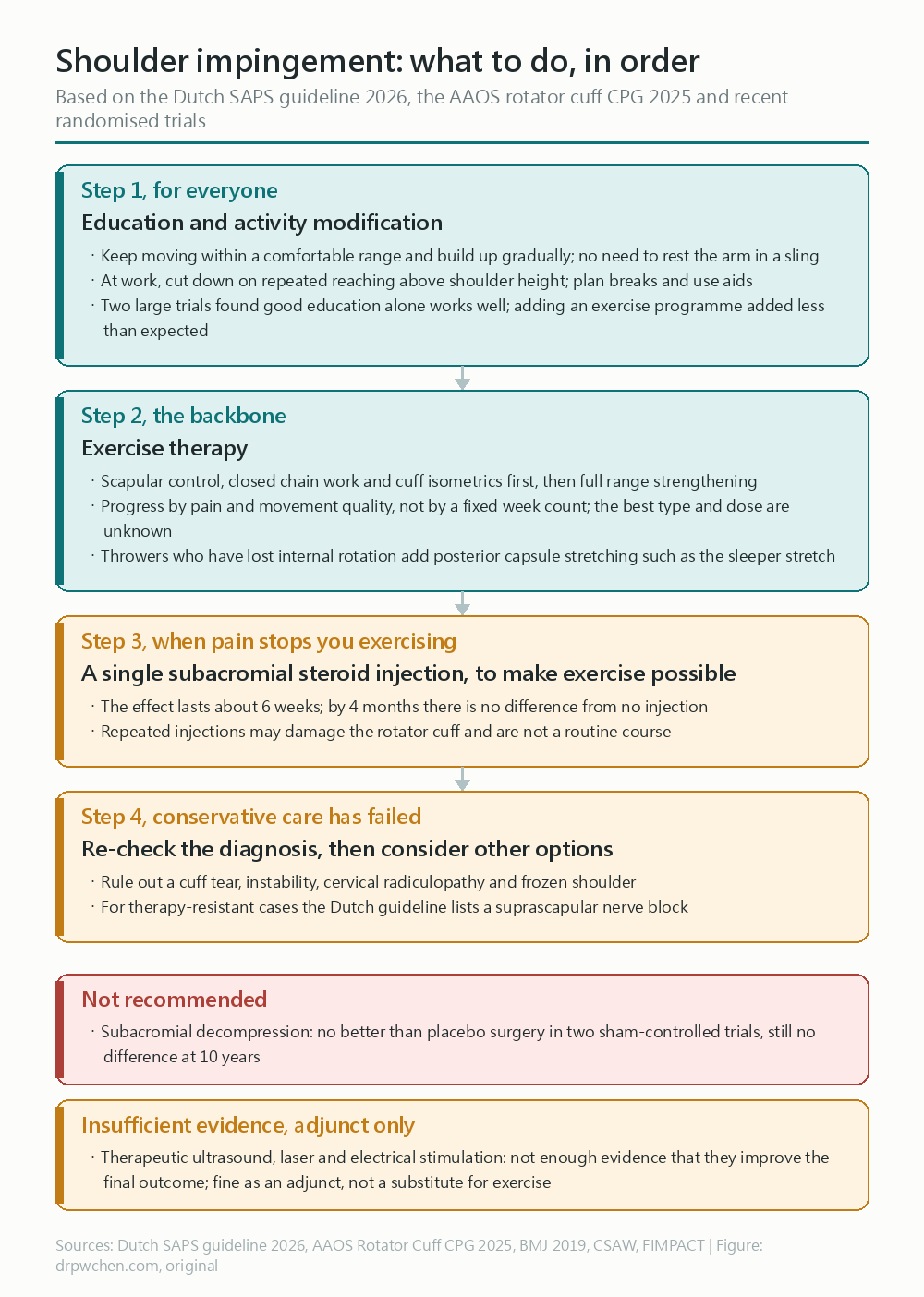
Step one: understand it, modify your activities, but don’t stop moving entirely
- Keep moving within a comfortable range, slowly increasing the amount. You don’t need a sling to rest it
- Reduce jobs or movements that involve repeatedly raising your arm above your shoulder, schedule breaks at work, and use a stool or reaching tool for high things
- Good news: a 708-patient randomized controlled trial in the UK found that having a physical therapist explain things well once and teach you how to move on your own worked about as well as up to 6 progressive exercise sessions at one year, and another trial found that adding exercise sessions on top of education makes less difference than people think
This doesn’t mean exercise is useless. It tells us that understanding your condition, not being afraid to move, and continuing to move is itself a large part of the treatment.
Step two: exercise is the mainstay of treatment
The general direction for exercise:
- Train the small deep shoulder muscles (the rotator cuff): start with your arm at your side, exerting force without moving the joint, then slowly add angle, resistance bands and weight
- Train the muscles around the shoulder blade and stretch the small chest muscle (pectoralis minor): the shoulder blade is the base for your arm, and when the base moves smoothly, raising your arm catches less
- Your pace depends on pain and movement quality, not on a “what to do in week X” protocol
The old explanation was that these exercises “open up the space” between the bone and the tendon. A better explanation now is: when tendons and muscles are loaded a little at a time, they gradually become more resilient. Exercises aimed specifically at the shoulder blade were only slightly better in the first few weeks and no different from general shoulder exercise by three months, so there’s no need to fixate on one set of “correct moves”. What matters more is that you can keep doing it and keep adding load.
If it hurts more and more as you go, go back and adjust the plan with your therapist. Don’t push through it.
Steroid injections: a short-term rescue, not a routine
- A steroid and anesthetic shot under the acromion can decrease pain in the short term, with the goal of allowing you to start exercising
- One trial showed the effect lasts about 6 weeks and is no longer clear by 4 months; the same 708-patient UK trial found no difference at one year between those who got the shot and those who didn’t
- So a steroid is appropriate to use once when it hurts too much to exercise at all, but don’t treat it as a routine you get every week or month. Repeated steroid injections can weaken the tendon
For platelet-rich plasma (PRP), prolotherapy (dextrose) and hyaluronic acid, the evidence is not yet consistent, and the AAOS currently does not support routine use of PRP; in clinical experience some patients improve noticeably after these injections, so it is worth discussing with your doctor whether they suit you.
Do heat packs, ultrasound, and lasers work?
- Heat or ice packs can make you more comfortable and make it easier to move
- Therapeutic ultrasound, lasers, electrical stimulation: there is currently not enough evidence that they improve the final outcome
- These can be used as adjuncts, but they can’t replace exercise
Does surgery to shave the bone work?
This is the most important thing to know about this condition, and it’s where the old “impingement” explanation was actually put to the test.
Subacromial decompression uses an arthroscope to shave away some of the bone and soft tissue under the acromion to make more space. If the pain really came from bone pinching the tendon, this operation should work very well, and it used to be a very common procedure.
The UK and Finland each ran a very rigorous study: patients were randomized, one group actually had the bone shaved, the other only had a camera inserted with nothing removed (sham surgery), and the patients didn’t know which group they were in. The results:
- Both groups improved by the same amount
- The Finnish study followed patients up to 10 years, and the two groups were still the same
- The rate of returning to work was also the same
So guidelines in several countries now recommend against decompression surgery for subacromial pain. If someone recommends surgery, ask clearly what problem it’s meant to treat. A clear tendon tear or joint instability is a different matter.
Throwers with pain at the “back” of the shoulder: also called impingement, but a different problem
Athletes in baseball, volleyball or tennis, who cock the arm back and then whip it forward, can get “internal impingement”. The name also contains “impingement”, but it is a different problem from the subacromial pain described above:
- The pain is at the back of the shoulder, at the moment the arm is cocked all the way back, just before the throw
- It happens inside the joint: when the arm is pulled back to the extreme, the underside of the rotator cuff touches the rim of the socket. this contact is common in throwers and, up to a point, a normal adaptation; problems come from repeated compression when you throw too much or the shoulder blade can’t keep up with the arm
- Some of the changes seen on imaging of a pitcher’s shoulder may just be a normal adaptation to years of throwing, not disease
The emphasis used to be on the throwing side having less “inward rotation” than the other side, which was considered the main cause of injury. A later study that followed 296 professional pitchers over 8 seasons found that reduced inward rotation by itself did not predict shoulder injury; instead, pitchers whose throwing side did not have at least 5 degrees more “outward rotation” than the other side were 2.2 times as likely to be injured. So today both inward and outward rotation are measured together, not just one number.
Treatment focus:
- Stop throwing for 4 to 6 weeks, with formal physical therapy
- Posterior capsule stretching, shoulder blade control, core strength
- Check throwing mechanics and return to competition gradually; standardized rehab takes about 20 weeks before returning to sport-specific training
When should you go back to the clinic?
Have a doctor take another look in these situations, because it may not be simple subacromial pain:
- Your arm is clearly weak and you can’t lift it (not just because of pain)
- It suddenly started hurting after a fall or a forceful effort
- Pain or numbness runs all the way down your arm to your fingers
- Even someone else can’t lift it for you; the joint is completely stuck
- You’ve diligently done your exercises for a few months and there’s still no improvement
Key points
- “Shoulder impingement” is an old name that comes from the old idea of bone pinching the tendon; it’s now mostly called subacromial pain syndrome and understood as a tendon that temporarily can’t handle its current load
- The core of treatment is understanding it, not being afraid to move, and keeping moving, with exercise load increased gradually according to pain
- A steroid injection is a one-time rescue when pain stops you from exercising, not a routine; surgery to shave the bone is no longer recommended
- Weakness, pain after an injury, numbness down to the fingers, or a shoulder that even someone else can’t lift: go back and look for another cause
—
Further reading: rotator cuff notes, shoulder dislocation notes, Milwaukee shoulder
Below is based on the clinical note in my vault, reorganized before publishing in the order “how the nomenclature evolved first, then current assessment and management”: the rest of the note uses the SAPS/RCRSP framework throughout, and where tests or classifications still use traditional impingement language they are labeled “traditional view” with the current evidence next to them. Internal links and copyrighted textbook images are removed; the verification process and tool descriptions are at the end.
Subacromial pain syndrome and internal impingement
Clinical Pearls
- “Impingement” is a name left over from Neer’s 1972 mechanistic hypothesis; it is now treated as a description of a symptom cluster, and nomenclature has shifted to SAPS/RCRSP
Neer 1972,Diercks 2014,Lewis 2016- Two inferences from the traditional hypothesis that do not hold up: acromion morphology → symptoms and decompression → treatment. ASD does not beat sham surgery: CSAW, FIMPACT (followed to 10 years) and Cochrane agree
Kanto 2025,Karjalainen 2019- Physical exam relies on combinations: 3 or more positive out of 5 (Neer, Hawkins, painful arc, Jobe, resisted ER) support the diagnosis
Michener 2009; but these tests provoke pain and cannot identify the anatomical source; in in-vivo MRI of 8 normal volunteers, no one’s cuff contacted the acromion in the Neer positionPappas 2006- Management is built on education and progressive exercise; a steroid injection = a single adjunct when pain prevents exercise, with no long-term benefit and not to be repeated
Lambers Heerspink 2026a,Hopewell 2021- Posterior pain in an overhead athlete suggests internal impingement, a different clinical entity; GIRD alone does not predict shoulder injury, so measure total rotation and ER as well
Wilk 2015
Abbreviations
| Abbreviation | Full name |
|---|---|
| SAPS | subacromial pain syndrome |
| SIS / SAIS | subacromial impingement syndrome (traditional name) |
| RCRSP | rotator cuff related shoulder pain |
| GIRD | glenohumeral internal rotation deficit |
| TROM | total rotational range of motion |
| ASD / SAD | arthroscopic subacromial decompression / subacromial decompression |
| CA ligament | coracoacromial ligament |
| AHD | acromiohumeral distance |
| SSNB | suprascapular nerve block |
| SAT / SRT | scapular assistance test / scapular retraction test |
| MID / MCID | minimal (clinically) important difference |
How the nomenclature evolved: from impingement to SAPS/RCRSP
The traditional framework: Neer’s mechanical impingement model
- Neer 1972 proposed the model of the anterior acromion striking the cuff, and performed anterior acromioplasty on that basis
Neer 1972- Neer’s three stages: I edema and inflammation → II fibrosis and tendinitis → III partial/complete tear
DeLee 5e Ch.47 - Neer later argued that almost all cuff lesions originated from impingement, starting the extrinsic vs intrinsic debate
DeLee 5e Ch.47
- Neer’s three stages: I edema and inflammation → II fibrosis and tendinitis → III partial/complete tear
- Traditional definition: a symptom cluster caused by soft tissue being impinged at specific locations, divided by site into external (subacromial) and internal
Brukner 5e Vol1 Ch.24 - Traditional classification (primary vs secondary)
Brukner 5e Vol1 Ch.24- Primary = structural lack of space: acromion morphology (Bigliani type I flat / II curved / III hooked), AC joint spurs, os acromiale
DeLee 5e Ch.38 - Secondary = functional: cuff dysfunction, scapular dyskinesis, GH instability, biceps/SLAP, GIRD causing transient narrowing during elevation
- Primary = structural lack of space: acromion morphology (Bigliani type I flat / II curved / III hooked), AC joint spurs, os acromiale
What the evidence has revised
- Cuff tendinopathy mostly starts on the articular (under) surface, which the acromion cannot reach
Brukner 5e Vol1 Ch.24 - Acromion morphology is not necessarily related to symptoms
Brukner 5e Vol1 Ch.24- Bigliani’s original cadaver study (140 shoulders, mean age 74.4): 73% of full-thickness tears had a type III acromion; but other studies found no significant association between morphology and cuff disease, type II/III becomes more common with age, and the association may be confounded by age
Magee Pathology 2e Ch.7 - Whether a hooked acromion is a cause or a consequence of cuff degeneration remains debated
DeLee 5e Ch.47
- Bigliani’s original cadaver study (140 shoulders, mean age 74.4): 73% of full-thickness tears had a type III acromion; but other studies found no significant association between morphology and cuff disease, type II/III becomes more common with age, and the association may be confounded by age
- An imaging abnormality is not the same as a pain source: in bilateral MRI of 123 people with unilateral shoulder pain, most abnormalities were equally frequent on the symptomatic and asymptomatic sides; only supraspinatus full-thickness tears and GH OA were about 10% more frequent on the painful side
Barreto 2019 - The “impingement” mechanism of the Neer/Hawkins tests does not hold up in vivo: in open MRI of 8 normal volunteers, no one had cuff contact with the acromion in the Neer position; 7/8 had subacromial contact in the Hawkins position; and everyone had intra-articular contact between the supraspinatus and the posterosuperior glenoid in both positions
Pappas 2006 - Surgery that removes bone and soft tissue is no better than sham surgery, directly weakening the inference that “mechanical compression is the main cause”
Beard 2018,Paavola 2018,Kanto 2025 - Neer staging: tendon pathology is now mostly understood through the tendinopathy continuum model (reactive → disrepair → degenerative), in which pathological stage and symptoms do not map one to one
Cook 2009 - Critical zone (a hypovascular area about 1 cm proximal to the supraspinatus insertion)
- Traditionally considered the starting point for degeneration and tearing
Cuccurullo 4e Ch.4,DeLee 5e Ch.47 - Intraoperative Doppler studies found no hypovascular critical zone in normal tendons, although overall blood flow decreases with age
DeLee 5e Ch.47
- Traditionally considered the starting point for degeneration and tearing
Current nomenclature
SAPS: the Dutch Orthopaedic Association
- The 2013 Dutch guideline (published in English in 2014) renamed it subacromial pain syndrome (SAPS), arguing that the anatomical explanation of “impingement” is insufficient to cover the pathology
Diercks 2014 - 2026 update definition: non-traumatic, non-rheumatic shoulder symptoms presenting mainly as pain when raising the arm
Lambers Heerspink 2026a- Includes supraspinatus tendinosis, calcific tendinitis and degenerative isolated supraspinatus full-thickness tears
Lambers Heerspink 2026a - Excludes frozen shoulder, isolated LHB (long head of biceps) pathology, GH/AC OA, multi-tendon or irreparable tears, intra-articular pathology and neurological disorders
Lambers Heerspink 2026a
- Includes supraspinatus tendinosis, calcific tendinitis and degenerative isolated supraspinatus full-thickness tears
RCRSP: Lewis’s umbrella term
- Lewis 2016 proposed RCRSP as an umbrella term covering SAPS, cuff tendinopathy and symptomatic partial and full-thickness tears
Lewis 2016- Rationale: neither clinical exam nor imaging can reliably identify a single pain source, and conservative management for this group is the same
Lewis 2016,Lewis 2025 - 2025 JOSPT editorial: RCRSP was the preferred term in a global clinician survey, and the editorial argues that “impingement” confuses patients
Lewis 2025 - An international physical therapist Delphi reached consensus on 18 RCRSP diagnostic descriptors; not a single item in the special tests domain reached consensus
Requejo-Salinas 2022
- Rationale: neither clinical exam nor imaging can reliably identify a single pain source, and conservative management for this group is the same
What is still debated
- A surgeon Delphi (37 from North America + Europe) still agreed: impingement is a clinical diagnosis, rehab is first line, and SAD is a good option when conservative care has failed for at least 6 months and there is evidence of mechanical impingement
Hohmann 2021- This is Level V expert opinion, a lower level of evidence than the RCTs and Cochrane review above
- Early repair of acute traumatic full-thickness tears is outside this debate
How this note uses the terms
- Diagnosis and management below follow SAPS (as defined by the Dutch guideline), with RCRSP as the umbrella term
- “Impingement” is kept in only three places: the names of original papers and tests (Neer impingement sign), the account of the traditional classification, and internal impingement (a different clinical entity, see below)
Disease background
Pathophysiology (current understanding)
- Multifactorial: intrinsic degeneration, extrinsic load, microtrauma and macrotrauma all contribute
DeLee 5e Ch.47- Extrinsic factors: scapular/humeral kinematics, posture, cuff and scapular muscle weakness, reduced extensibility of pectoralis minor or posterior tissues
Brukner 5e Vol1 Ch.24 - Intrinsic factors: changes in tendon biology, mechanical properties, morphology and vascularity, leading to degeneration under tensile/shear overload
Brukner 5e Vol1 Ch.24
- Extrinsic factors: scapular/humeral kinematics, posture, cuff and scapular muscle weakness, reduced extensibility of pectoralis minor or posterior tissues
- A practical clinical framework: load exceeding the tissue’s current capacity, so management adjusts load and gradually builds capacity
Lewis 2016 - The traditional “secondary impingement” list is now read as modifiable factors, not “causes of pinching”
Brukner 5e Vol1 Ch.24- Rotator cuff dysfunction: insufficient control of humeral head caudal glide during elevation
- Scapular dyskinesis: insufficient upward rotation, posterior tilt and ER
- GH instability: capsular laxity → excessive humeral head translation
- Biceps/SLAP lesions
- GIRD (see the internal impingement section)
- The traditional “primary (structural)” list: weakly related to symptoms, and surgery that removes the structure has no benefit, so these are no longer treatment targets
Magee Pathology 2e Ch.7,Karjalainen 2019
Epidemiology
- Pain on arm elevation is one of the most common shoulder problems in general practice and sports medicine
Brukner 5e Vol1 Ch.24 - In the Netherlands, more than 50,000 people a year consult an orthopedic surgeon for these problems
Lambers Heerspink 2026a - Lifetime prevalence of shoulder pain is about 30%; about half of people have at least one episode of shoulder pain each year
Lewis 2009
Prognosis
- 54% still have symptoms after 3 years (shoulder disorders overall)
Lewis 2009 - Exercise therapy can be as effective as surgery, but recovery may be incomplete and recurrence is possible
Lewis 2016 - Dutch guideline: the recurrence risk in the exercise-only group is possibly lower than in the exercise + steroid group (low-certainty evidence)
Lambers Heerspink 2026a
Complications
- Repeated steroid injections may compromise cuff integrity and affect later repair
AAOS Rotator Cuff 2025 - Surgery-related: CSAW reported 2 cases of frozen shoulder in each of the three groups; the BMJ guideline notes that frozen shoulder may be more common in the surgery group
Beard 2018,Vandvik 2019 - Serious adverse events within 30 days of shoulder arthroscopy are about 0.5–0.6% (deep infection, pulmonary embolism, nerve injury, death); data from observational surgical-registry studies that include other shoulder arthroscopies
Karjalainen 2019
SAPS and internal impingement: two different clinical entities
| SAPS (traditionally external/subacromial impingement) | Internal impingement (posterosuperior glenoid) | |
|---|---|---|
| Location | Subacromial space (between humeral head and acromial arch) | Inside the GH joint (between humeral head and glenoid rim) |
| Tissues involved | Bursa, rotator cuff tendons, LHB tendon | Undersurface of the rotator cuff (especially SS and IS, i.e. supraspinatus and infraspinatus), posterosuperior labrum |
| Provoking movement | Mid-range abduction (painful arc) | Late cocking phase (maximal ER + horizontal abduction + elevation) |
| Typical population | General population, middle age and older | Overhead athletes (throwers) |
| Pain location | Deltoid region, anterolateral | Posterior |
Source: Brukner 5e Vol1 Ch.24; typical age from Giangarra 4e Ch.33 (usually over 35); internal impingement also has an anterosuperior type, only the posterosuperior type is listed here
Internal impingement
- Walch 1992 described it arthroscopically in 17 athletes with pain on throwing (16 in throwing sports, 1 bodybuilder): in ABER (90° abduction + full external rotation) the undersurface of supraspinatus/infraspinatus contacted the posterosuperior glenoid, with partial cuff tears and posterosuperior labral lesions
Walch 1992 - Some contact is a normal adaptation to throwing: the cuff undersurface and labral changes seen on imaging or at surgery may only be a “thrower’s footprint”
DeLee 5e Ch.45; intra-articular contact is not limited to the throwing position either, since normal volunteers have supraspinatus contact with the posterosuperior glenoid in both the Neer and Hawkins positionsPappas 2006- The difficulty is telling normal adaptation from pathology, so a full course of conservative care comes first
DeLee 5e Ch.45
- The difficulty is telling normal adaptation from pathology, so a full course of conservative care comes first
- Hyperangulation (a mechanistic hypothesis): in normal throwing the scapula retracts in step with humeral horizontal abduction; insufficient scapular retraction → the humerus moves beyond the plane of the scapular body → the cuff is caught between the greater tubercle and the glenoid rim
Brukner 5e Vol1 Ch.24(Fig.24.4b); the etiology has not been establishedDeLee 5e Ch.45
GIRD and ROM deficits
- Many definitions
Giangarra 4e Ch.31- Burkhart 2003: 20° or more less internal rotation than the other side (Brukner uses this too)
- Others: 25° less (Shanley), 18° less (Wilk), 10% or more of the contralateral total arc (Tokish)
- Look at total rotation (TROM: IR + ER): throwers have increased humeral torsion, so less IR with more ER is a normal adaptation
Giangarra 4e Ch.31- Anatomic GIRD: IR loss <18° and TROM within 5°; pathologic GIRD: IR loss >18° and TROM loss >5°
Giangarra 4e Ch.31
- Anatomic GIRD: IR loss <18° and TROM within 5°; pathologic GIRD: IR loss >18° and TROM loss >5°
- How the evidence on injury prediction evolved
- Wilk 2011 (170 pitcher-seasons, Level 4): pitchers with GIRD were injured about twice as often, but not statistically significant (P = .17); pitchers with a TROM deficit >5° had a higher injury rate
Wilk 2011 - Wilk 2015 (same group, prospective cohort, 296 professional pitchers, 8 seasons, 505 exams): GIRD, TROM deficit and flexion deficit were not significantly related to shoulder injury or surgery; pitchers whose throwing shoulder had less than 5° more ER than the other side (ER insufficiency) were 2.2 times as likely to go on the disabled list and 4.0 times as likely to need shoulder surgery
Wilk 2015 - Interpretation: a single GIRD number is not enough for screening; measure IR, ER, TROM and flexion together
- Wilk 2011 (170 pitcher-seasons, Level 4): pitchers with GIRD were injured about twice as often, but not statistically significant (P = .17); pitchers with a TROM deficit >5° had a higher injury rate
- Three hypotheses for its cause: posterior capsule contracture, bony adaptation of humeral torsion, and increased tension from repeated eccentric loading of the external rotators
Brukner 5e Vol1 Ch.24
Clinical Evaluation
Clinical presentation
- Pain location: deltoid region (C5 dermatome), anterolateral; internal impingement mainly causes posterior pain
Brukner 5e Vol1 Ch.24 - Pain with overhead activities (throwing, swimming, racquet sports); activities below 90° of abduction are usually painless
Brukner 5e Vol1 Ch.24 - Pain when lying on the affected side, night pain
Kelley Ch.49 - Patients often raise the arm using abduction + external rotation to keep the greater tuberosity away from the acromion
Kelley Ch.49 - Painful arc: pain that appears in mid-range abduction and disappears beyond it; more marked actively than passively, and an ascending or descending arc both count
Ombregt Cyriax 3e Ch.12- Angles differ across texts: 60–120°
DeLee 5e Ch.47, 70–120°Brukner 5e Vol1 Ch.24, 70–110°Kelley Ch.49
- Angles differ across texts: 60–120°
Physical examination
Individual tests
- Neer test: stabilize the scapula, arm in IR → passive forward flexion to maximum
DeLee 5e Ch.47,Brukner 5e Vol1 Ch.24- Traditional view: the greater tuberosity strikes the anterior acromion
DeLee 5e Ch.47 - Now: in in-vivo MRI no one had cuff contact with the acromion in this position, but everyone had intra-articular contact
Pappas 2006
- Traditional view: the greater tuberosity strikes the anterior acromion
- Hawkins-Kennedy test: forward flexion to 90° then passive IR
DeLee 5e Ch.47- Traditional view: the anterosuperior cuff and biceps strike the coracoid and CA ligament
DeLee 5e Ch.47 - Now: this position does produce subacromial contact more often (7/8), but also intra-articular contact in everyone
Pappas 2006
- Traditional view: the anterosuperior cuff and biceps strike the coracoid and CA ligament
- Jobe (empty can): 90° in the scapular plane, thumb down, resist elevation → pain = tendinopathy, marked weakness = suspect a tear
DeLee 5e Ch.47 - Conclusion: these are pain provocation tests; a positive test means “this load hurts”, not “this is where something is pinched”
Pappas 2006,Salamh 2020
Combination interpretation (Michener 2009)
- 5 tests: Neer, Hawkins-Kennedy, painful arc, Jobe, resisted ER
Michener 2009- ≥3 positive support SAIS, <3 can rule it out (AUC .79)
Michener 2009 - 3/5 cutoff: sens 75%, spec 74%, LR+ 2.93, LR− 0.34
Brukner 5e Vol1 Ch.24(Table 24.2) - Most useful single tests: painful arc, resisted ER, Jobe (LR+ 2 or higher); Neer is useful for ruling out (LR− 0.35)
Michener 2009 - Neer and Hawkins have only fair inter-rater reliability (κ .39–.40)
Michener 2009
- ≥3 positive support SAIS, <3 can rule it out (AUC .79)
- Dutch 2026: combinations are only slightly better than single tests, with low-certainty evidence; doing several tests is mainly to rule out other pathology
Lambers Heerspink 2026a - The counterargument: Salamh & Lewis argue that special tests for RCRSP cannot identify the anatomical pain source, and combined with imaging they easily lead to unnecessary invasive procedures
Salamh 2020
Clinical reasoning flow: finding modifiable factors
This flow keeps the traditional vocabulary
The flow below comes from Cools et al. (reproduced in
Brukner 5e Vol1 Ch.24Fig.24.9, originally in BJSM) and still uses the external/internal and primary/secondary impingement split. Today it is read as two jobs: separating SAPS from internal impingement and finding modifiable factors such as instability, scapular control and GIRD, rather than finding which bone pinches which tendon. The figure is copyrighted and not reproduced; the text below gives its logic.
- Separating SAPS from internal
Brukner 5e Vol1 Ch.24- Jobe (+) + Hawkins (+) + Neer pain anterior + pain anterior in the apprehension position → SAPS (traditionally external)
- Jobe (−) + Hawkins (−) + Neer pain posterior + pain posterior in the apprehension position → Internal
- Is there an instability component
Brukner 5e Vol1 Ch.24- Relocation test (+): pain disappears when the humeral head is pushed posteriorly → excessive anterior translation contributes (traditionally secondary)
- Relocation test (−): traditionally read as primary (structural); in practice it means no obvious instability component
- Internal impingement is also often relocation (+), which helps distinguish it from SAPS
Bahr IOC Ch.7
- Finding modifiable factors
Brukner 5e Vol1 Ch.24- Full can (+) and empty can (+) → rotator cuff pathology present; pain only on empty can → pain on elevation but not mainly the cuff itself
- SAT/SRT improves symptoms → scapular involvement; but it has low diagnostic value and should be used as a symptom modification test
- Laxity/apprehension (+) → instability; O’Brien/Speed’s/biceps load II (+) → SLAP or biceps
- Reduced IR ROM → supine, shoulder abducted 90°, scapula stabilized, measure IR, and measure ER to calculate TROM
Giangarra 4e Ch.31
Subacromial anesthetic injection test (traditionally the Neer impingement test)
- Method: inject local anesthetic into the subacromial space → repeat the pain provocation tests
DeLee 5e Ch.47 - Traditional reading: clear pain reduction → impingement is at least part of the cause
DeLee 5e Ch.47 - Current reading: it only shows that the pain source is in the subacromial region (bursa/cuff); it does not prove mechanical impingement and is not an indication for surgery
- Note: subacromial anesthesia can mask pain from the AC joint or bicipital groove, so inject separately when needed; patients with and without an instability component can both test positive, so it is not specific
DeLee 5e Ch.47
Imaging
- Timing: per the Dutch 2014 guideline, imaging is only useful after 6 weeks of symptoms
Diercks 2014 - Ultrasound: the first choice when a partial/full-thickness supraspinatus tear is suspected; MRI if uncertain or to assess atrophy and fatty infiltration
Lambers Heerspink 2026a- Dynamic ultrasound can show the bursa bunching under the lateral acromion during abduction
Brukner 5e Vol1 Ch.24; this is a descriptive finding and must be matched to the clinical picture
- Dynamic ultrasound can show the bursa bunching under the lateral acromion during abduction
- X-ray: its main value is to rule out GH arthritis, calcific tendinitis and tumors
DeLee 5e Ch.47- X-rays are mostly normal in early tendinopathy
Kelley Ch.49 - Traditional use: the supraspinatus outlet view for acromion morphology and an anteroinferior spur, AP with 30° caudal tilt for the anterior acromion
DeLee 5e Ch.38,DeLee 5e Ch.47; since morphology is weakly related to symptoms and ASD is not recommended, these findings do not change conservative management - Axillary view to look for os acromiale
DeLee 5e Ch.38 - Late stage: sclerosis and cystic change of the greater tuberosity, superior migration of the humeral head; AHD <6 mm with a massive tear
DeLee 5e Ch.47
- X-rays are mostly normal in early tendinopathy
- MRI: internal impingement may show cystic change in the posterior humeral head, undersurface IS/SS tears and posterosuperior labral lesions
Helms 3e Ch.10 - Reading principle: MRI abnormalities are just as common on the asymptomatic side, so imaging findings must be matched back to the clinical picture
Barreto 2019
Differential diagnosis
- The Dutch guideline requires ruling out: intra-articular pathology (Bankart), MDI (multidirectional instability), AC OA, massive cuff tear, neurological disorders causing scapular dyskinesis, and tumors
Lambers Heerspink 2026a - Referred pain from the cervical and thoracic spine
Brukner 5e Vol1 Ch.24(Table 24.1) - Adhesive capsulitis: limited passive ER (tested with the elbow at the side and the scapula stabilized) is the distinguishing feature
Brukner 5e Vol1 Ch.24 - Cuff tear (especially weakness-predominant) and calcific tendinitis → see rotator cuff notes
- Proximal biceps tendinopathy, SLAP tear
- Suprascapular nerve injury, thoracic outlet syndrome
Brukner 5e Vol1 Ch.24(Table 24.1) - Visceral referred pain (diaphragm, gallbladder, heart, lung apex)
Brukner 5e Vol1 Ch.24(Table 24.1)
Clinical Management
Management algorithm
Stratified management for SAPS/RCRSP
Step 1: Education + activity modification (everyone)
- Explain the natural history, move within a comfortable range and load progressively; reduce repetitive overhead work
Lambers Heerspink 2026a- Education as the foundation: adding motor control or strengthening exercise did not beat education alone by more than the MCID
Dube 2023Step 2: Exercise therapy as the mainstay
- Active, task-oriented exercise + education
Lafrance 2022- With GIRD → posterior capsule stretching; with scapular dyskinesis → scapular control
Giangarra 4e Ch.33Step 3: Adjuncts when pain prevents exercise
- A single subacromial steroid + local anesthetic injection; the goal is to let the patient exercise
Lambers Heerspink 2026a,AAOS Rotator Cuff 2025- Short-term acetaminophen/NSAIDs
Lafrance 2022Step 4: Conservative care fails
- First reassess the diagnosis (cuff tear, instability, cervical spine)
- For treatment-resistant SAPS, consider SSNB
Lambers Heerspink 2026aDo NOT do
- Subacromial decompression
Vandvik 2019,Lafrance 2022,Lambers Heerspink 2026a- PRP is not recommended for routine use
AAOS Rotator Cuff 2025
Rehabilitation
Goals
- Pain relief, restoring ROM, and building neuromuscular control of the scapulothoracic joint and rotator cuff
Giangarra 4e Ch.33 - Addressing the patient’s own deficits is more likely to give good results than a generic protocol
Giangarra 4e Ch.33
Current evidence
- Exercise therapy is supported by systematic reviews
Brukner 5e Vol1 Ch.24 - But the best type and dose of exercise are unknown
Lambers Heerspink 2026a - GRASP (708 patients): up to 6 progressive exercise sessions vs 1 physical therapist advice session, no difference in SPADI (Shoulder Pain and Disability Index) at 12 months
Hopewell 2021 - Dubé 2023 (123 patients): education vs education + strengthening vs education + motor control; differences at 24 weeks did not reach the MCID
Dube 2023 - Exercise type: motor control exercise is probably slightly better than non-specific exercise (disability, moderate certainty); comparisons of eccentric, scapula-focused and exercise intensity have low to very low certainty
Lafrance 2024 - Scapula-focused approaches: slightly better than general exercise up to 6 weeks, no longer apparent at 3 months, with conflicting evidence on scapular position/movement
Bury 2016 - Interpretation: exercise is not useless, but good education + self-directed activity performs about as well as extra exercise sessions; the added value of specific exercise prescriptions in trials was smaller than expected
Contents
- Based on
Giangarra 4e Ch.33(Box 33.2) - ROM (1–2 times daily)
- Early on, AROM/AAROM within a pain-free range below 90°, avoiding shrug compensation
- Pectoralis minor stretching: to allow scapular posterior tilt
- With an instability component (traditionally secondary impingement), do NOT do anterior GH stretching
- With GIRD → cross-body and sleeper stretches (scapula stabilized)
- Strengthening (every other day, 3–4 days a week)
- Early: scapular control, closed chain, cuff isometrics, isotonics within 0–90° (1–3 sets × 10–15 reps)
- Intermediate: T/Y, push-up plus, IR/ER at 45–90° of abduction, plyometrics
- Late: individualized return to work or sport demands
- Progress by function and pain, not by fixed weeks
- Manual therapy: for restricted GH, scapulothoracic and thoracic spine mobility
- Eccentric training: reasonable for throwers; clinical improvement is established, but evidence for structural change is lacking
Brukner 5e Vol1 Ch.24 - Why exercise: the traditional rationale was “opening the subacromial space”; it is now explained as progressive loading that builds tissue capacity
Lewis 2016, and the added value of scapula-focused work is short-term onlyBury 2016
Physical modalities
- Therapeutic ultrasound and electrical stimulation are not supported for improving outcomes
Giangarra 4e Ch.33 - NSAIDs, ultrasound, interferential current, laser, magnetic fields and massage all lack level 2 evidence
Brukner 5e Vol1 Ch.24 - Heat, ice: lacking research support, but commonly used for pain relief
Giangarra 4e Ch.33
Posture
- Poor thoracic posture may affect SAPS treatment outcomes
Lambers Heerspink 2026a - Rounded shoulders: strengthen the scapular retractors, stretch pectoralis minor
Giangarra 4e Ch.33 - The FIMPACT trial’s exercise program is published in the online supplement of
Paavola 2021and can serve as a template for home exercise
Management of internal impingement
- Early, poorly localized pain: rest + NSAIDs
DeLee 5e Ch.45 - Well-localized posterior pain: stop throwing for 4–6 weeks + formal physical therapy
DeLee 5e Ch.45- Mainstays: posterior capsule stretching, correcting scapular dyskinesis, core strengthening
DeLee 5e Ch.45 - Because microinstability may be present, avoid anterior capsule stretching
DeLee 5e Ch.45 - Review throwing mechanics
DeLee 5e Ch.45
- Mainstays: posterior capsule stretching, correcting scapular dyskinesis, core strengthening
- Standardized rehab takes at least about 20 weeks before returning to sport-specific training
Bahr IOC Ch.7 - GIRD: the sleeper stretch is most commonly used; over 90% improve with stretching and mobilization (anecdotal/clinical experience)
Herring 6e Ch.40; but GIRD itself does not predict shoulder injury, so ER should be tracked as wellWilk 2015 - Surgery: only when conservative care has clearly failed, with the procedure matched to the lesion (labral repair, capsulorrhaphy, cuff undersurface debridement); the prognosis for returning to the previous level of sport is guarded
DeLee 5e Ch.45,Giangarra 4e Ch.33
Injection
Subacromial corticosteroids
- AAOS 2025: a single steroid + local anesthetic injection can be considered for short-term improvement in pain and function (Moderate)
AAOS Rotator Cuff 2025- One high-quality trial cited by AAOS (Moosmayer 2023, calcific tendinopathy, sham lavage with or without corticosteroid) showed better function scores at 1.5 months, no longer significant at 4 months
AAOS Rotator Cuff 2025 - Injections close to surgery may affect cuff repair healing
AAOS Rotator Cuff 2025
- One high-quality trial cited by AAOS (Moosmayer 2023, calcific tendinopathy, sham lavage with or without corticosteroid) showed better function scores at 1.5 months, no longer significant at 4 months
- GRASP: injection vs no injection, no long-term benefit at 12 months
Hopewell 2021 - Dutch 2026: exercise + injection vs exercise alone, no difference in pain and function at 6–12 months; recommendation: use it only when pain prevents participation in exercise, to make exercise possible
Lambers Heerspink 2026a - Reconciling the two positions: Brukner notes that “inject first so rehab can start” is not supported by randomized trials, and steroids may impair long-term recovery from tendinopathy
Brukner 5e Vol1 Ch.24; the Dutch recommendation narrows when to use it rather than claiming efficacy. In practice both land in the same place: not routine; consider a single injection only when pain blocks exercise - Repeat injections: may compromise cuff integrity (AAOS Limited)
AAOS Rotator Cuff 2025; repeated or long-term injections are not recommendedDeLee 5e Ch.47
Dose and technique
- Traditional practice (Cyriax school): 10 mg triamcinolone for supraspinatus tendinitis, review in 2 weeks, 1–3 injections usually sufficient; for recurrences do not keep infiltrating the tendon, switch to deep transverse friction and look for the root cause
Ombregt Cyriax 3e Ch.15- Current guidelines are more conservative on number: mainly a single injection, not repeated
AAOS Rotator Cuff 2025,Lambers Heerspink 2026a
- Current guidelines are more conservative on number: mainly a single injection, not repeated
- Acute subdeltoid bursitis (within 10 days): infiltrate the whole bursa with triamcinolone and a strong local anesthetic
Ombregt Cyriax 3e Ch.14 - Subacromial bursa injection: needle entry about 1 cm below the midpoint of the lateral edge of the acromion
連 Ch.29
Other injections
- Hyaluronic acid: can be considered for cuff disease without a tear (AAOS Limited)
AAOS Rotator Cuff 2025 - PRP: routine use is not supported for tendinopathy and partial tears (AAOS Limited)
AAOS Rotator Cuff 2025 - SSNB: can be considered for treatment-resistant SAPS (expert opinion extrapolated from cuff tear RCTs)
Lambers Heerspink 2026a - Injectable NSAIDs: an option for those who cannot have corticosteroids
AAOS Rotator Cuff 2025
Surgery
Arthroscopic subacromial decompression (ASD)
Current evidence: not recommended
Two sham-controlled RCTs, Cochrane, the BMJ Rapid Recommendation, and the Dutch and Canadian (Quebec) guidelines agree: ASD is no better than sham surgery
- CSAW (Lancet 2018, 32 UK hospitals, 313 patients)
Beard 2018- Inclusion: pain for 3 months or more, intact cuff, already had exercise therapy and at least one steroid injection
- Three groups: ASD, diagnostic arthroscopy only (sham surgery), no treatment
- 6-month Oxford Shoulder Score (a 0–48 shoulder pain and function questionnaire): ASD vs sham no difference (−1.3 points)
- Both surgical groups were 2.8–4.2 points better than no treatment, but below the clinically important difference, possibly a placebo effect or post-op rehab
- Limitation: non-adherence to the allocated treatment was 23% for ASD and 42% for sham
- FIMPACT (BMJ 2018, 3 Finnish hospitals, 210 patients, age 35–65, symptoms >3 months, double-blind)
Paavola 2018- Three groups: ASD, diagnostic arthroscopy (sham), exercise therapy
- 24-month VAS: ASD vs sham no clinically relevant difference (MID 15)
- ASD vs exercise: statistically significant but below the MID, and this comparison is open to bias
- 5-year follow-up: ASD vs sham and ASD vs exercise both no difference
Paavola 2021 - 10-year follow-up (87% completed): still no difference
Kanto 2025 - Return to work: 24-month rates ASD 88%, sham 88%, exercise 90%, no difference among the three groups
Back 2021
- Cochrane 2019 (8 RCTs, 1062 patients)
Karjalainen 2019- Versus sham surgery: no clinically important improvement in pain, function or quality of life (high certainty)
- Pain at 1 year (0–10) only 0.26 points better; function (0–100) 2.8 points better
- Guidelines
- BMJ Rapid Recommendation 2019: strong recommendation against ASD for SAPS
Vandvik 2019 - The Dutch 2021 surgical module was updated to a strong recommendation against it; since the 2013 guideline, referrals to orthopedics fell and acromioplasty decreased by 37% (cited secondhand in that paper)
Lambers Heerspink 2026a - Canada (JOSPT 2022): SAD is not recommended for cuff tendinopathy
Lafrance 2022 - AAOS 2025: routine acromioplasty is not recommended when repairing small to medium full-thickness tears (Moderate)
AAOS Rotator Cuff 2025
- BMJ Rapid Recommendation 2019: strong recommendation against ASD for SAPS
- Counterargument: the surgeon Delphi’s conditional support (see “What is still debated”), which is Level V expert opinion
Hohmann 2021 - Talking with patients: the CSAW authors suggest explicitly sharing these results during shared decision-making
Beard 2018
Other surgery
- With an instability component (traditionally secondary impingement): surgery should target the root cause, e.g. a stabilization procedure
Giangarra 4e Ch.33 - Partial-thickness tears: for low- to intermediate-grade tears, start with physical therapy and manage per subacromial pain guidelines; if pain and functional limitation persist after appropriate non-operative care, surgery can improve outcomes (AAOS Consensus); high-grade partial tears can be repaired if conservative care fails (AAOS Strong)
AAOS Rotator Cuff 2025 - Full-thickness tears and calcific tendinitis → see rotator cuff notes
How this note was produced
This note was originally my own shoulder pain reference that I compiled for clinic and teaching. I re-checked the evidence before publishing it on the site.
Materials used
- Society guidelines: the 2026 Dutch Orthopaedic Association subacromial pain syndrome guideline update (two parts) and the original 2014 version, the 2025 AAOS rotator cuff CPG, the BMJ 2019 rapid recommendation (subacromial decompression surgery), and the 2022 Quebec (Canada) rotator cuff disorders CPG (JOSPT)
- Textbooks: Brukner & Khan’s Clinical Sports Medicine 5e, DeLee’s Orthopaedic Sports Medicine 5e, Giangarra’s Clinical Orthopaedic Rehabilitation 4e, Magee’s Pathology and Intervention 2e, Kelley’s Textbook of Rheumatology 11e, Cyriax’s Orthopaedic Medicine (Ombregt 3e), Cuccurullo, Helms’ Musculoskeletal MRI, IOC Manual of Sports Injuries, Tachdjian’s Pediatric Orthopaedics, and 連倚南《復健醫學》 (Lien, Rehabilitation Medicine, Taiwanese textbook)
- Randomized trials and systematic reviews: CSAW, FIMPACT (2-year, 5-year, 10-year follow-up and return-to-work analysis), Cochrane 2019, GRASP, Dubé 2023, Lafrance 2024, Bury 2016
- Literature on nomenclature, mechanism and diagnosis: Neer 1972, Walch 1992, Pappas 2006, Cook 2009, Lewis 2009/2016/2025, Michener 2009, Barreto 2019, Salamh 2020, Requejo-Salinas 2022 Delphi, Hohmann 2021 surgeon Delphi, Wilk 2011/2015 prospective pitcher studies
Tools used
audit_note.py— a note-format audit script I wrote to check citation placement, images and heading structure- Textbook chapter cross-checking script — confirms that every “book title + chapter number” actually matches that chapter
- PubMed MCP — to find society guidelines and randomized trials, fill in volumes/issues/pages, DOIs and PMIDs, and read abstracts or full texts paper by paper to verify numbers
- textbook_search — semantic search over my local markdown index of textbooks
- OpenEvidence — an independent cross-search on the sham-controlled evidence for decompression surgery; claims in its answers were traced back and verified against the original texts before I used them
- Custom Python/PIL drawing script — for the treatment ladder diagram and the cover image (
scripts/figures/) - Hugo bilingual workflow
i18n_sync.py— the English version was first machine-translated, then the medical terminology was proofread by hand
This pipeline itself was written up as textbook-to-note. If you also have a Claude or Codex subscription, you can hand this kind of mechanical verification and compilation work to it and keep the judgment for yourself. You can start with Getting Started in AI: Installation and First Steps and How to Talk to AI Agents.
About this version
The pro version is taken from my own clinical notes and keeps my note citation style (book title + chapter, or author + year, with the full bibliography below). Copyrighted images from textbooks and journals are not included; the figures are redrawn by me.
If I’ve misunderstood anything, corrections are welcome.
Reference
Guidelines
- AAOS Rotator Cuff 2025 — Management of Rotator Cuff Injuries Clinical Practice Guideline. American Academy of Orthopaedic Surgeons; 2025
- Lambers Heerspink 2026a — Lambers Heerspink FO, Veen EJD, Dorrestijn O, et al. Update of guideline for diagnosis and treatment of subacromial pain syndrome: a multidisciplinary review by the Dutch Orthopedic Association. Part 1. Acta Orthop. 2026;97:91-98. doi:10.2340/17453674.2026.45365. PMID 41718640
- Lambers Heerspink 2026b — Lambers Heerspink FO, Veen EJD, Dorrestijn O, et al. Part 2: Operative considerations and treatment of various conditions related to subacromial pain syndrome. Acta Orthop. 2026;97:99-104. doi:10.2340/17453674.2026.45410. PMID 41718641
- Diercks 2014 — Diercks R, Bron C, Dorrestijn O, et al. Guideline for diagnosis and treatment of subacromial pain syndrome: a multidisciplinary review by the Dutch Orthopaedic Association. Acta Orthop. 2014;85(3):314-22. doi:10.3109/17453674.2014.920991. PMID 24847788
- Vandvik 2019 — Vandvik PO, Lähdeoja T, Ardern C, et al. Subacromial decompression surgery for adults with shoulder pain: a clinical practice guideline. BMJ. 2019;364:l294. doi:10.1136/bmj.l294. PMID 30728120
- Lafrance 2022 — Lafrance S, Charron M, Roy JS, et al. Diagnosing, Managing, and Supporting Return to Work of Adults With Rotator Cuff Disorders: A Clinical Practice Guideline. J Orthop Sports Phys Ther. 2022;52(10):647-664. doi:10.2519/jospt.2022.11306. PMID 35881707
Journals
- Neer 1972 — Neer CS. Anterior acromioplasty for the chronic impingement syndrome in the shoulder: a preliminary report. J Bone Joint Surg Am. 1972;54(1):41-50. PMID 5054450
- Walch 1992 — Walch G, Boileau P, Noel E, Donell ST. Impingement of the deep surface of the supraspinatus tendon on the posterosuperior glenoid rim: an arthroscopic study. J Shoulder Elbow Surg. 1992;1(5):238-45. doi:10.1016/S1058-2746(09)80065-7. PMID 22959196
- Pappas 2006 — Pappas GP, Blemker SS, Beaulieu CF, McAdams TR, Whalen ST, Gold GE. In vivo anatomy of the Neer and Hawkins sign positions for shoulder impingement. J Shoulder Elbow Surg. 2006;15(1):40-9. doi:10.1016/j.jse.2005.04.007. PMID 16414467
- Cook 2009 — Cook JL, Purdam CR. Is tendon pathology a continuum? A pathology model to explain the clinical presentation of load-induced tendinopathy. Br J Sports Med. 2009;43(6):409-16. doi:10.1136/bjsm.2008.051193. PMID 18812414
- Michener 2009 — Michener LA, Walsworth MK, Doukas WC, Murphy KP. Reliability and diagnostic accuracy of 5 physical examination tests and combination of tests for subacromial impingement. Arch Phys Med Rehabil. 2009;90(11):1898-903. doi:10.1016/j.apmr.2009.05.015. PMID 19887215
- Lewis 2009 — Lewis JS. Rotator cuff tendinopathy/subacromial impingement syndrome: is it time for a new method of assessment? Br J Sports Med. 2009;43(4):259-64. doi:10.1136/bjsm.2008.052183. PMID 18838403
- Wilk 2011 — Wilk KE, Macrina LC, Fleisig GS, et al. Correlation of glenohumeral internal rotation deficit and total rotational motion to shoulder injuries in professional baseball pitchers. Am J Sports Med. 2011;39(2):329-35. doi:10.1177/0363546510384223. PMID 21131681
- Wilk 2015 — Wilk KE, Macrina LC, Fleisig GS, et al. Deficits in glenohumeral passive range of motion increase risk of shoulder injury in professional baseball pitchers: a prospective study. Am J Sports Med. 2015;43(10):2379-85. doi:10.1177/0363546515594380. PMID 26272516
- Lewis 2016 — Lewis J. Rotator cuff related shoulder pain: Assessment, management and uncertainties. Man Ther. 2016;23:57-68. doi:10.1016/j.math.2016.03.009. PMID 27083390
- Bury 2016 — Bury J, West M, Chamorro-Moriana G, Littlewood C. Effectiveness of scapula-focused approaches in patients with rotator cuff related shoulder pain: a systematic review and meta-analysis. Man Ther. 2016;25:35-42. doi:10.1016/j.math.2016.05.337. PMID 27422595
- Barreto 2019 — Barreto RPG, Braman JP, Ludewig PM, Ribeiro LP, Camargo PR. Bilateral magnetic resonance imaging findings in individuals with unilateral shoulder pain. J Shoulder Elbow Surg. 2019;28(9):1699-1706. doi:10.1016/j.jse.2019.04.001. PMID 31279721
- Lewis 2025 — Lewis J, Mintken PE, McDevitt AW. What’s in a Name? The Case for Using “Rotator Cuff-Related Shoulder Pain” in Clinical Practice. J Orthop Sports Phys Ther. 2025;55(7):1-3. doi:10.2519/jospt.2025.13405. PMID 40536259
- Salamh 2020 — Salamh P, Lewis J. It Is Time to Put Special Tests for Rotator Cuff-Related Shoulder Pain out to Pasture. J Orthop Sports Phys Ther. 2020;50(5):222-225. doi:10.2519/jospt.2020.0606. PMID 32272031
- Requejo-Salinas 2022 — Requejo-Salinas N, Lewis J, Michener LA, et al. International physical therapists consensus on clinical descriptors for diagnosing rotator cuff related shoulder pain: A Delphi study. Braz J Phys Ther. 2022;26(2):100395. doi:10.1016/j.bjpt.2022.100395. PMID 35366589
- Beard 2018 — Beard DJ, Rees JL, Cook JA, et al. Arthroscopic subacromial decompression for subacromial shoulder pain (CSAW): a multicentre, pragmatic, parallel group, placebo-controlled, three-group, randomised surgical trial. Lancet. 2018;391(10118):329-338. doi:10.1016/S0140-6736(17)32457-1. PMID 29169668
- Paavola 2018 — Paavola M, Malmivaara A, Taimela S, et al. Subacromial decompression versus diagnostic arthroscopy for shoulder impingement: randomised, placebo surgery controlled clinical trial. BMJ. 2018;362:k2860. doi:10.1136/bmj.k2860. PMID 30026230
- Paavola 2021 — Paavola M, Kanto K, Ranstam J, et al. Subacromial decompression versus diagnostic arthroscopy for shoulder impingement: a 5-year follow-up of a randomised, placebo surgery controlled clinical trial. Br J Sports Med. 2021;55(2):99-107. doi:10.1136/bjsports-2020-102216. PMID 33020137
- Kanto 2025 — Kanto K, Bäck M, Ibounig T, et al. Arthroscopic subacromial decompression versus placebo surgery for subacromial pain syndrome: 10 year follow-up of the FIMPACT randomised, placebo surgery controlled trial. BMJ. 2025;391:e086201. doi:10.1136/bmj-2025-086201. PMID 41330610
- Back 2021 — Bäck M, Paavola M, Aronen P, Järvinen TLN, Taimela S. Return to work after subacromial decompression, diagnostic arthroscopy, or exercise therapy for shoulder impingement: a randomised, placebo-surgery controlled FIMPACT clinical trial with five-year follow-up. BMC Musculoskelet Disord. 2021;22(1):889. doi:10.1186/s12891-021-04768-7. PMID 34666734
- Karjalainen 2019 — Karjalainen TV, Jain NB, Page CM, et al. Subacromial decompression surgery for rotator cuff disease. Cochrane Database Syst Rev. 2019;1(1):CD005619. doi:10.1002/14651858.CD005619.pub3. PMID 30707445
- Hohmann 2021 — Hohmann E, Glatt V, Tetsworth K, et al. Subacromial Decompression in Patients With Shoulder Impingement With an Intact Rotator Cuff: An Expert Consensus Statement Using the Modified Delphi Technique Comparing North American to European Shoulder Surgeons. Arthroscopy. 2022;38(4):1051-1065. Epub 2021. doi:10.1016/j.arthro.2021.09.031. PMID 34655764
- Hopewell 2021 — Hopewell S, Keene DJ, Marian IR, et al. Progressive exercise compared with best practice advice, with or without corticosteroid injection, for the treatment of patients with rotator cuff disorders (GRASP): a multicentre, pragmatic, 2 × 2 factorial, randomised controlled trial. Lancet. 2021;398(10298):416-428. doi:10.1016/S0140-6736(21)00846-1. PMID 34265255
- Dube 2023 — Dubé MO, Desmeules F, Lewis JS, Roy JS. Does the addition of motor control or strengthening exercises to education result in better outcomes for rotator cuff-related shoulder pain? A multiarm randomised controlled trial. Br J Sports Med. 2023;57(8):457-463. doi:10.1136/bjsports-2021-105027. PMID 36796859
- Lafrance 2024 — Lafrance S, Charron M, Dubé MO, et al. The Efficacy of Exercise Therapy for Rotator Cuff-Related Shoulder Pain According to the FITT Principle: A Systematic Review With Meta-analyses. J Orthop Sports Phys Ther. 2024;54(8):499-512. doi:10.2519/jospt.2024.12453. PMID 38848304
Textbooks
- Brukner 5e Vol1 Ch.24 — Brukner P, Khan K. Clinical Sports Medicine. 5th ed. Vol 1. McGraw-Hill; 2017. Shoulder pain (Cools AMJ)
- DeLee 5e Ch.38 / Ch.45 / Ch.47 — Miller MD, Thompson SR. DeLee, Drez & Miller’s Orthopaedic Sports Medicine. 5th ed. Elsevier; 2020. Glenohumeral Joint Imaging / The Thrower’s Shoulder / Rotator Cuff and Impingement Lesions
- Giangarra 4e Ch.31 / Ch.33 — Giangarra CE, Manske RC. Clinical Orthopaedic Rehabilitation. 4th ed. Elsevier; 2018. Glenohumeral Internal Rotation Deficiency / Impingement Syndrome
- Magee Pathology 2e Ch.7 — Magee DJ, Zachazewski JE, Quillen WS, Manske RC. Pathology and Intervention in Musculoskeletal Rehabilitation. 2nd ed. Elsevier; 2016. Rotator Cuff Pathology
- Kelley Ch.49 — Firestein GS, et al. Firestein & Kelley’s Textbook of Rheumatology. 11th ed. Elsevier; 2021. Shoulder Pain
- Ombregt Cyriax 3e Ch.12 / Ch.14 / Ch.15 — Ombregt L. A System of Orthopaedic Medicine. 3rd ed. Elsevier; 2013. Clinical examination of the shoulder / Disorders of the inert / contractile structures (shoulder)
- Cuccurullo 4e Ch.4 — Cuccurullo SJ. Physical Medicine and Rehabilitation Board Review. 4th ed. Demos; 2020. Musculoskeletal Medicine
- Helms 3e Ch.10 — Helms CA, Major NM, Anderson MW, et al. Musculoskeletal MRI. 3rd ed. Elsevier; 2020. Shoulder
- Bahr IOC Ch.7 — Bahr R. The IOC Manual of Sports Injuries. Wiley-Blackwell; 2012. Shoulder
- Herring 6e Ch.40 — Herring JA. Tachdjian’s Pediatric Orthopaedics. 6th ed. Elsevier; 2022. Pediatric Sports Medicine
- 連 Ch.29 — 連倚南 主編. 復健醫學 基礎篇. 第 2 版. 合記; 2020. 骨骼肌肉系統之注射手法