
Let me say the most important thing first: sarcopenia is not “just what happens when you get old.” It’s a disease that can be detected—and one that actually improves with exercise and diet.
This post is written for two kinds of people: you, if an older adult at home has recently started walking slower or can’t open jars; and you, if you’re past fifty and starting to feel your stamina isn’t what it used to be. The second group is actually more important, because the latest 2025 Asian consensus pulled the age to start paying attention forward to fifty.
What is sarcopenia
Literally, it means “muscle loss.” But what truly defines it isn’t just mass, it’s also strength.
Human muscle mass peaks around age thirty, and after fifty, it drops by one to two percent every year; strength drops even faster, and after seventy, both accelerate. This process is inherently natural. The problem is that once it drops to a certain point, it starts affecting daily life: you can’t lift things, you can’t get up from a chair, you walk slower, and you fall easily.
Here’s one thing many people don’t know: what aging drains away is “fast-twitch muscle," the kind responsible for generating burst power. So the earliest warning sign often isn’t “I can’t lift heavy things,” but rather “my reactions are slower,” like your body not bracing in time when you’re about to fall.
Three self-checks you can do at home
- Calf circumference: Use a tape measure on the thickest part of your calf. Men under 34 cm and women under 33 cm should pay attention.
- Yubi-wakka (finger-ring) test: Form a ring with the thumbs and index fingers of both hands, and wrap it around the thickest part of your calf. Not being able to enclose it is a good thing; if it wraps around easily with room to spare, your muscle mass might be low.
- Five-times sit-to-stand: Cross your arms over your chest, stand up from a chair, and sit back down, repeating five times. Over 12 seconds is considered slow for those over sixty-five.
Why does it drop so fast once you lie down
This is the situation I see most often in the hospital: an older adult who originally walked in on their own to see the doctor gets admitted for a week due to pneumonia, and needs help walking after discharge.
The reason is that when you’re bedridden, muscle loss happens at dozens of times the normal rate. And strength drops faster than muscle mass: muscle mass drops by about half a percent a day, but strength can drop by one to one-point-five percent a day. In a week, you’ve lost ten percent.
What’s more troublesome is that older adults are particularly sensitive to bed rest. One study had young and old people lie in bed for five days alike; the young people’s lower limb muscle mass barely changed, but the older adults lost four percent.
So when you’re hospitalized, as long as your medical condition allows, sit if you can instead of lying down, stand if you can instead of sitting, walk if you can instead of standing. This isn’t just a platitude; it truly determines whether you can live independently after discharge.
How to confirm if you have it
A formal diagnosis requires two things: low muscle mass and low strength.
- Strength is measured with a handgrip dynamometer. For those over sixty-five, men under 28 kg and women under 18 kg are considered low.
- Muscle mass must be measured using DXA (the same machine used for bone density) or a body composition analyzer like an InBody.
The new 2025 consensus has two changes that the general public will really feel:
The two biggest shifts in the new edition
- Walking speed is no longer a diagnostic criterion; it’s now used to track whether treatment is effective. There are just too many reasons for walking slow—joint pain, dizziness, or fear of falling will all slow you down.
- As long as grip strength is low, you can start exercising and supplementing protein right away, without waiting to be scheduled for an instrument scan. This category is called “possible sarcopenia,” and intervention shouldn’t wait.
There’s also one “cancellation” worth knowing: it used to be graded into general and severe, but the new edition removed the severe grade. The reason is very practical—the management is the same anyway, so the grading didn’t change any decisions.
Only two things are truly effective
Bottom line first: to this day, there is not a single drug approved anywhere in the world to treat sarcopenia. Those supplements on the market touting muscle growth are merely aids at best.
The things with real evidence are two-fold, and they have to be done together:
First is resistance exercise. Not taking a walk, but the kind with a load: squats, resistance bands, dumbbells, or gym equipment all work.
- Twice a week is enough to be effective, with at least one day in between for muscle recovery.
- Do two to three sets per session, six to twelve reps per set.
- The weight should be chosen so that “the last two reps feel a bit strenuous”; too light is useless.
- You have to do it for at least three full months to see results, so please be mentally prepared for that.
If the older adult rarely moves to begin with, or has heart or joint issues, it’s safer to see PM&R or a physical therapist first for an exercise prescription.
Second is eating enough protein. This is severely underestimated.
- For those over sixty-five, you need 1.2 to 1.6 grams per kilogram of body weight per day. A 60 kg older adult needs about 72 to 96 grams of protein a day.
- Spreading it evenly across three meals is better than cramming it all into dinner, about 25 to 30 grams per meal.
- Translated into food: a palm-sized portion of meat or fish, an egg, a glass of milk—each is around 20 grams.
What about those health supplements? Whey protein and soy protein are well-absorbed choices; BCAA and HMB have some positive studies but aren’t consistent enough yet; the evidence for vitamin D is actually flat, with multiple studies showing no clear benefit for muscle mass and grip strength (supplementing for vitamin D deficiency is another matter).
One last reminder: if you only supplement nutrition without exercising, the improvement in strength is very limited. Exercise is the main character; nutrition is just the condition that allows exercise to take effect.
When should you see a doctor
If you have any of the following conditions, I recommend booking an appointment with PM&R or Geriatrics for an evaluation:
- Unintentionally losing more than three kilograms in a year
- Recently starting to need to hold onto things to stand up
- Having fallen in the past year
- Having diabetes, heart failure, or chronic kidney disease, which all accelerate muscle loss
—
Further reading: Automated Cross-Textbook Note Generation Workflow (How this note was made)
Clinical Pearls
- AWGS 2025 update: Diagnosis simplified to muscle mass ↓ + strength ↓ (concurrent, aligned with GLIS); physical performance is now an outcome, no longer a diagnostic criterion; the “severe sarcopenia” grading is cancelled (
AWGS 2025)- Cutoffs (≥65y): Grip strength Men <28 / Women <18 kg, ASM/height² DXA Men <7.0 / Women <5.4; added middle-aged 50 to 64 cutoffs plus BMI-adjusted cutoffs (
AWGS 2025)- New three classifications: at risk / possible / sarcopenia; possible = low grip strength alone (without measuring muscle mass) is enough to initiate intervention (
AWGS 2025)- Selective atrophy of Type II fibers → power declines earlier than strength, exercise should train high-speed and high-resistance (
NSCA 2018 Ch.3)- Core treatment = multimodal exercise (resistance plus aerobic) plus adequate protein (≥65y 1.2 to 1.59 g/kg/d), can add BCAA or HMB; no approved medications (
AWGS 2025)
Glossary
| Abbreviation | Full name | Note |
|---|---|---|
| ASM | appendicular skeletal muscle mass | Muscle mass of the four limbs, the quantity used for diagnosis |
| AWGS | Asian Working Group for Sarcopenia | The Asian consensus; current version 2025 |
| EWGSOP | European Working Group on Sarcopenia in Older People | The European consensus; current version EWGSOP2 2019 |
| GLIS | Global Leadership Initiative in Sarcopenia | Drafting a single international operational definition |
| SPPB | Short Physical Performance Battery | Composite performance score, 0 to 12 |
| TUG | Timed Up and Go | Stand, walk 3 m, turn, sit; timed in seconds |
| RE | resistance exercise | The mainstay of treatment |
| 1RM | one-repetition maximum | The load that can be lifted exactly once; used to set intensity |
| BIA | bioelectrical impedance analysis | Cheap and portable, but less accurate than DXA |
| DXA | dual-energy X-ray absorptiometry | Gold standard for muscle mass in clinical practice |
| HMB | β-hydroxy-β-methylbutyrate | Leucine metabolite sold as a muscle supplement |
| ICOPE | Integrated Care for Older People | WHO care pathway built on intrinsic capacity |
Background
Definition
- Sarcopenia (Greek sarx muscle plus penia deficiency), proposed by Rosenberg in 1989, originally referred to age-related reduction in muscle mass (
Lien Ch.9) - Modern definition: a progressive, systemic skeletal muscle disease, accompanied by a decline in muscle mass and muscle function (strength, physical performance), increasing the risk of falls, fractures, disability, and mortality (
Braddom 7e Ch.31) - Mentioning muscle mass alone is not enough, muscle mass and strength have a non-linear relationship, so low muscle mass plus low strength or physical performance is the core of diagnosis (
Masiero 2017 Ch.4)
Epidemiology
- Community 1 to 29%, Men > Women; nursing home 14 to 33%; hospital 10% (
Braddom 7e Ch.31) - Local Taiwanese studies (
Lien Ch.9)- Studies: Men 5.4%, Women 2.5%
- Older adults in Tianliao District, Kaohsiung: Men 8.2%, Women 9.7%
- Asian meta-analysis (AWGS 2019 criteria, 140 studies / 156,325 people) (
AWGS 2025)- Community ≥60 years old sarcopenia 16.5%, possible sarcopenia 28.7%, severe 4.4%
- 3-year incidence rate 11.5%; diabetics 20.5% (associated with metabolic diseases)
- By country: Korea 19.9% > China 18.4% > Taiwan 17.6% > Japan 13.2%
- Divergent assessment methods: 52.1% used BIA, only 10% used gold standard DXA
- Economic impact: in the UK, an extra £2707 is spent per person annually due to muscle weakness; inpatient care costs for those with sarcopenia are 5 times that of those without sarcopenia (
Braddom 7e Ch.31)
Mechanisms
- Multifactorial, complex; aging muscle changes in mass, viscoelasticity, fiber type, and innervation (
Masiero 2017 Ch.4) - Aging → satellite cell ↓, selective atrophy of type II myofibers, motor unit dysfunction (
Lien Ch.9)- Especially power decline
- Loss of muscle fiber, esp. type 2 myosin heavy chain isoform
- Reduced muscle fiber size, both type 1 and 2
- Loss of sensitivity to anabolic stimuli (anabolic resistance)
- Loss of strength ← reduction of actin-myosin cross bridges
- Loss of performance ← strength ↓, stiffness ↑
- Muscle CSA reduction: both slow and fast motor units are lost, fast MU loss accelerates (
Masiero 2017 Ch.4) - Myosteatosis: fat accumulation inside and outside the muscle and within myocytes
- Fat ↑ → adipokines ↑ → inflammation ↑, muscle loss, insulin resistance
- Fat ↑ → muscle quality deteriorates (even if quantity is unchanged)
- Neuronal pathway: motor control deteriorates (
Masiero 2017 Ch.4)- Spinal α-motor neurons decrease, peripheral nerve fibers and myelin sheaths change, neuromuscular junctions and synaptic vesicles degenerate
- Axonal degeneration, hypoexcitability, loss of α-motorneurons
- Other systemic factors: mitochondrial metabolic dysfunction, chronic inflammation, apoptosis, sestrins dysregulation (
Braddom 7e Ch.31)- Evidence shows sarcopenia might originate in early life (the decline of grip strength across the life course)
- Comorbidities accelerate it: HF, CKD, cancer
Decline rate of muscle mass and strength
- Strength peaks before age 30, maintained until 50 in men, then ↓12 to 15% every 10 years; women decline earlier but more gradually (
Lien Ch.9) - Muscle mass: ↓1 to 2% annually after age 50; strength ↓1 to 3% annually after age 40 to 50, both accelerate after age 70 (
Means 2012 Ch.37) - Inpatient bed rest (activity ↓ → protein synthesis ↓, degradation ↑)
- Muscle mass ↓0.5 to 0.6%/day; predominantly lower limb anti-gravity muscles, ankle plantar flexors (gastrocnemius / soleus) lose the most (
DeLisa 6e Ch.38) - Strength drops faster than muscle mass: even in young men, ↓1 to 1.5%/day (10% per week) (
Mitra 2019 Ch.144) - Older adults are more sensitive to bed rest: 7 days of bed rest loses 1.6 kg of total body lean mass; 5 days of bed rest lower limb muscle mass ↓4%, with no change in young people over the same period (
DeLisa 6e Ch.38)
- Muscle mass ↓0.5 to 0.6%/day; predominantly lower limb anti-gravity muscles, ankle plantar flexors (gastrocnemius / soleus) lose the most (
Here is a number that’s very easily conflated
“Losing 1 to 1.5% a day in bed” refers to strength, not muscle mass. The rate of muscle mass loss is 0.5 to 0.6% a day. The two differ by a factor of two to three; be sure to keep them straight before writing them into medical records or patient education leaflets.
Classification
- Etiological classification (
Lien Ch.9,Masiero 2017 Ch.4)- Primary (age-related): no other causes besides age
- Secondary: other causes can be identified
- Secondary causes (
Lien Ch.9Table 9-3)- Senescence: sex hormones ↓, satellite cell dysfunction, motor neurons ↓, mitochondrial abnormalities
- Disuse: immobility, immobilization, sedentary lifestyle
- Endocrine: growth hormone and IGF-1 deficiency, insulin resistance
- Starvation: anorexia, malabsorption, protein catabolism
- Vitamin D deficiency
- Inflammation: e.g., elevated IL-6
- Severity grading (EWGSOP 2010, AWGS 2025 has abolished this grading) (
Masiero 2017 Ch.4)
| Stage | Muscle Mass | Strength | Physical Performance |
|---|---|---|---|
| Pre-sarcopenia | ↓ | Normal | Normal |
| Sarcopenia | ↓ | ↓ (or) | ↓ |
| Severe sarcopenia | ↓ | ↓ | ↓ |
Complications and prognosis
- Falls, fractures, ADLs ↓, cardiopulmonary function ↓, cognitive function ↓, mobility ↓, hospitalizations and institutionalization and mortality ↑ (
Braddom 7e Ch.31) - Sarcopenia itself is not directly fatal, but it drives the overall functional decline of aging (
Means 2012 Ch.37) - It is a predictor of poor prognosis, and is responsive to treatment (preventable, delayable, even reversible), so active screening and intervention are valuable (
Braddom 7e Ch.31)
Comorbidities: Sarcopenia and cardiovascular diseases
- Source for this section:
Circulation 2023 - Sarcopenia and HF: more prone to shortness of breath, fatigue, VO2max ↓↓; among HF patients, those with sarcopenia have fall risk ↑
- Sarcopenia and atherosclerosis: both are low-grade chronic systemic inflammation; sarcopenia is a risk factor for CVD
- Sarcopenia and cardiac surgery: pre-op sarcopenia → complications and long-term prognosis are worse, should undergo prehabilitation
- Sarcopenia and stroke: prone to sarcopenia after stroke, some already had it to begin with, hard to distinguish primary / secondary
- Challenge: diagnosis can be difficult to assess due to stroke-induced functional decline, and prognostic evaluation is also affected
Evaluation
Diagnostic criteria
- Taiwan and Asia adopt AWGS (currently 2025), Europe adopts EWGSOP2 2019; in 2024 GLIS proposed an internationally unified operational definition, and AWGS 2025 aligns with it (
AWGS 2025)
AWGS 2025 (current, shift towards muscle health)
- Diagnosis = low muscle mass plus low strength (concurrent, aligned with GLIS); physical performance is now an outcome, not a diagnostic criterion
- Rationale: strength predicts mortality and disability better than muscle mass; but requiring “concurrently low muscle mass” ensures that the weakness stems from muscle pathology (increases specificity)
- Cancelled severity grading (no more severe sarcopenia)
- New three classifications
| Classification | Definition | Management |
|---|---|---|
| At risk for sarcopenia | Normal strength, but has risk factors or positive self-assessment | Annual strength tracking plus intervention for improvement |
| Possible sarcopenia | Low strength, but muscle mass not measured | Initiate muscle health intervention immediately; recommend measuring muscle mass to confirm diagnosis |
| Sarcopenia | Low muscle mass plus low strength | Confirmed diagnosis, full intervention |
- Expanded to middle-aged 50 to 64 years: established separate cutoffs to facilitate early intervention
- Cutoff table (≥65 years plus middle-aged 50 to 64 years; includes BMI adjustment)
| Measurement | Adjustment | 50–64 Men | 50–64 Women | ≥65 Men | ≥65 Women |
|---|---|---|---|---|---|
| Grip strength (kg) | — | <34.0 | <20.0 | <28.0 | <18.0 |
| Muscle mass DXA | ASM/height² | <7.2 | <5.5 | <7.0 | <5.4 |
| Muscle mass BIA | ASM/height² | <7.6 | <5.7 | <7.0 | <5.7 |
| Muscle mass DXA | ASM/BMI | <0.80 | <0.55 | <0.73 | <0.52 |
| Muscle mass BIA | ASM/BMI | <0.90 | <0.63 | <0.83 | <0.57 |
| Physical performance 5-times sit-to-stand (s) | outcome | ≥10.0 | ≥10.0 | ≥12.0 | ≥12.0 |
| Physical performance 6m gait speed (m/s) | outcome | <1.2 | <1.2 | <1.0 | <1.0 |
- Muscle health framework: skeletal muscle is an endocrine organ (secretes myokines), cross-talks with brain, bone, fat, immunity; integrated into WHO ICOPE (intrinsic capacity) for early life-course case-finding
AWGS version evolution 2014 → 2019 → 2025
| Dimension | AWGS 2014 | AWGS 2019 | AWGS 2025 |
|---|---|---|---|
| Definition | Muscle mass ↓ plus (strength ↓ and/or performance ↓) | Same as 2014 | Muscle mass ↓ plus strength ↓ |
| Grip strength | Men <26 / Women <18 | Men <28 / Women <18 | ≥65 same as 2019; 50–64 Men <34 / Women <20 |
| Muscle mass DXA | Men <7.0 / Women <5.4 | Same as 2014 | Same; added BMI adjustment; added middle-aged cutoffs |
| Performance | Gait speed <0.8 | Gait speed <1.0 / sit-to-stand ≥12s / SPPB ≤9 | Same as 2019, but now listed as outcome |
| Classification | Normal / sarcopenia | Normal / possible / sarcopenia / severe | at risk / possible / sarcopenia (cancelled severe) |
| Case-finding | Not mentioned | Calf circumference / SARC-F / SARC-CalF | Added Yubi-wakka finger-ring test |
| Conceptual framework | Diagnosis | Diagnosis plus early identification | Life-course muscle health plus WHO ICOPE |
EWGSOP2 2019 (Europe)
- Centered around muscle function (strength), strength predicts poor prognosis better than muscle mass (
Braddom 7e Ch.31) - Probable: low strength (grip strength Men <27 / Women <16 kg, or 5-times sit-to-stand >15 s)
- Confirmed diagnosis: then add low muscle mass (ASM or ASM/height²)
- Severity: then look at physical performance (gait, SPPB, TUG, 400 m walk)
Other society definitions
- SDOC 2019 (Sarcopenia Definitions and Outcomes Consortium)
- ICFSR 2018, ESPEN 2014, IWGS, etc., cutoffs for muscle mass and gait speed vary slightly among groups (
Masiero 2017 Ch.4) - GLIS (Global Leadership Initiative in Sarcopenia, founded in 2019) is currently drafting an internationally unified operational definition (
Braddom 7e Ch.31)
Assessment tools
Screening
- Calf circumference: in Taiwan, Men <34 / Women <33 cm is abnormal
- SARC-F: 5 items, 2 points each, ≥4 points is abnormal (
Braddom 7e Ch.31)- Strength (lifting), Assistance walking (walking), Rise from chair (getting up), Climb stairs (stairs), Falls (falling)
- SARC-CalF: SARC-F plus calf (abnormal calf circumference adds 10 points), ≥11 points is abnormal
- Yubi-wakka (finger-ring test): wrap thumbs and index fingers of both hands around the thickest part of the calf (
AWGS 2025)- Can’t enclose it (fingers don’t touch) = sufficient muscle mass; encloses with room to spare = possible low muscle mass
- Simple, high cultural acceptance in Asia, predicts disability and mortality (Japanese community study)
- For comparison of other scales (SARC-F / SARC-CalF / Ishii / MSRA / SarSA-Mod), see the original table in
Circulation 2023; that image is copyrighted and not reproduced here
Muscle mass
- The gold standard theoretically is direct measurement of each component in a cadaver; clinically, indirect methods are always used (
Lien Ch.9) - ASM (appendicular skeletal muscle mass): only looks at limb muscles, adjusted by dividing by height²
| Tool | Advantages | Disadvantages |
|---|---|---|
| Anthropometry | Low cost | Accuracy is only fair |
| BIA | Cheap, portable, no radiation | Accuracy needs improvement, affected by operator and subject |
| CT | High muscle resolution, commonly used in cancer patients | High cost, radiation |
| MRI | High muscle resolution | Very expensive |
| DXA | Gold standard, less radiation than CT | Trace radiation, not portable |
| Ultrasound | No radiation, cheap, portable | Under development |
Muscle strength
- Primarily handgrip; Taiwan cutoffs Men 28 / Women 18 kg (AWGS), international Men 27 / Women 16 kg (EWGSOP2)
- 5-times sit-to-stand can also serve as a surrogate marker for strength
Physical performance (AWGS 2025 now lists as outcome, not diagnostic criterion)
- 6-meter gait speed <1.0 m/s (≥65y Taiwan cutoff; 50 to 64y <1.2)
- 5-times sit-to-stand ≥12 s (≥65y; 50 to 64y ≥10 s)
- SPPB ≤9, TUG ≥20 s, 400 m walk test ≥6 min
- Usage: monitor intervention efficacy and prognosis (mobility, falls, hospitalizations, mortality) (
AWGS 2025)
Measurements in development
- Lab
- D3-creatine dilution method: oral intake then monitor urine excretion, correlates with MRI, superior to DXA
- Sarcopenia index = creatinine / cystatin C: correlates with MRI, predicts medium-term mortality
- Ultrasound (
Wang 2021 Life)- Early studies had high coefficients of variation, but high similarity to gold standards like DXA
- Recommended to measure thigh muscles, such as the rectus femoris
- Measurement parameters
- Thickness: easy to measure with cheap machines, but unidimensional
- Cross-sectional area: bidimensional, but panoramic view is affected by hand movement speed
- Pennation angle: correlates with muscle size and strength, but affected by positioning and contraction
- Echogenicity: looks at the degree of infiltration (steatosis), but affected by machine brand and central tendon
- Sonoelastography: shear wave has high reproducibility, or apply pressure to observe changes; affected by scanning plane and muscle orientation
- Contrast-enhanced: good results, but requires contrast agent
- Muscle texture: computer analysis of subtle pattern differences
Differential diagnosis
| Condition | Core Features | Relationship with Sarcopenia |
|---|---|---|
| Sarcopenia | Muscle mass ↓ plus strength or performance ↓ | — |
| Frailty | Multisystem reserve ↓, resilience ↓ (Fried 5 criteria) | Sarcopenia is the muscle dimension of frailty; overlaps but frailty includes cognitive and social |
| Cachexia | Severe weight ↓ accompanying severe illness (e.g., cancer) | Often complicated by sarcopenia |
| Malnutrition | Insufficient protein or calorie intake | One of the causes of secondary sarcopenia |
| Sarcopenic obesity | Overweight but low muscle mass, fat infiltration in muscle | Obese older adults with low physical activity |
- Fried frailty phenotype 5 items: unintentional weight ↓ (≥10 lbs in a year), self-reported exhaustion, weak grip, slow gait speed, low physical activity; 0 robust, 1 to 2 prefrail, ≥3 frail (
Braddom 7e Ch.31)
Management
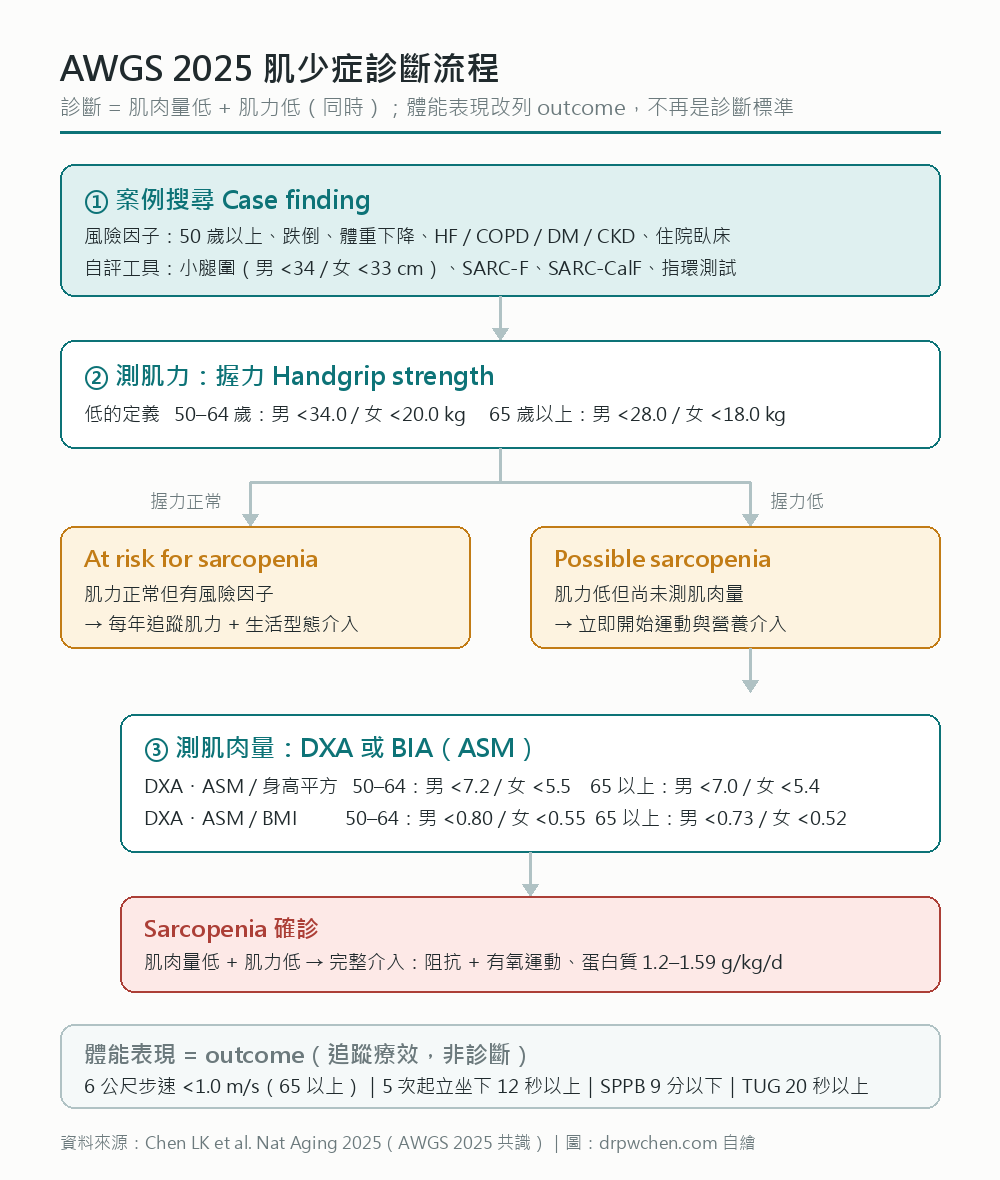
Management workflow
AWGS 2025 management axes
- Case-finding: risk factors (HF, COPD, DM, CKD, falls, weight ↓) or self-assessment (calf circumference / SARC-F ≥4 / SARC-CalF ≥11 / abnormal Yubi-wakka)
- Measure grip strength
- Normal but at risk → At risk → Annual tracking plus intervention
- Low, muscle mass unmeasured → Possible sarcopenia → Initiate muscle health intervention immediately, and refer to measure muscle mass
- Measure muscle mass (DXA / BIA) → low muscle mass plus low strength = Confirmed sarcopenia
- Physical performance (gait speed, sit-to-stand, SPPB) = outcome monitoring, not diagnostic
- Investigate reversible or degenerative causes (
Circulation 2023): inflammation (CVD risk), nutrition, metabolism, physical activity level- Core intervention: multimodal exercise (resistance plus aerobic) plus adequate protein; no approved medications
Treatment goals
- Improve mobility, reduce falls and hospitalizations and mortality; preventable, delayable, even reversible (
Braddom 7e Ch.31) - AWGS 2025 core: multimodal exercise plus nutritional optimization as the cornerstone, integrated into the WHO ICOPE care pathway (
AWGS 2025)
Exercise
- Resistance exercise (RE) is the mainstay, AWGS 2025 emphasizes that mixed exercise (resistance plus aerobic) is best for muscle gain (
AWGS 2025,Braddom 7e Ch.31)- Network meta-analysis: RE significantly increases grip strength; RE plus nutrition improves 5-times sit-to-stand; RE plus nutrition is best for TUG (
AWGS 2025) - Prescription principles: specificity, overload, progression
- Frequency: 2 times per week (those with low fitness can start with 1 time per week), interval ≥48 h
- 2 to 3 sets per session, 6 to 12 reps per set (upper and lower limb large muscle groups)
- Intensity: initial 30 to 60% 1RM → advanced 50 to 70% 1RM or higher
- Monitoring: RPE (0 to 10) starting from 3 to 5, progressing to 6 to 8
- Course must be at least 12 weeks to see clinical benefits
- Another version (
Means 2012 Ch.37): 8 to 10 exercises, 2 to 3 sets, 8 to 12 reps, 70 to 80% 1RM, RPE 14 to 15/20
- Network meta-analysis: RE significantly increases grip strength; RE plus nutrition improves 5-times sit-to-stand; RE plus nutrition is best for TUG (
- Targeting Type II fibers: due to selective atrophy of fast-twitch muscles, one should train high-speed, high-resistance (peak power occurs at 80 to 90% max) (
NSCA 2018 Ch.3) - Aerobic exercise: does not increase muscle hypertrophy, but enhances mitochondria function
- Reduce bed rest
- Special populations (mobility limited, frail, institutionalized, unaccustomed to exercise) → refer to PM&R or a physical therapist for an exercise prescription
Nutrition
- Protein is highly correlated with muscle mass; recommended intake during resistance training periods (
AWGS 2025,Means 2012 Ch.37)- ≥65 years: 1.2 to 1.59 g/kg/day; <65 years: ≥1.6 g/kg/day
- 0.8 g/kg/day is the minimum requirement for all ages; an even amount across three meals (about 25 to 30 g per meal) is better than cramming into one meal
- Types: whey and soy protein are better; leucine boosts muscle protein synthesis
- BCAA (branched-chain amino acids): meta-analysis (35 RCTs) shows positive effects on strength, muscle mass, and physical performance (
AWGS 2025) - HMB (β-hydroxy-β-methylbutyrate): can improve muscle mass and grip strength, but effects on physical performance (gait speed) are unclear; umbrella review evidence is still inconsistent (
AWGS 2025) - Omega-3 (>2.5 g/day), probiotics: positive reports regarding muscle mass and strength
- Vitamin D: evidence equivocal, no clear benefit for ASM, grip strength, or physical performance (multiple meta-analyses) (
AWGS 2025) - Exercise plus nutrition > either alone, strength improvement is limited with nutritional supplementation alone without exercise (
NSCA 2018 Ch.3)
Cardiac rehabilitation
- Not a primary treatment for sarcopenia, but potentially an important intervention for those with comorbid CVD (
Circulation 2023)
Medications
- There are currently no approved medications for treating sarcopenia (AWGS 2025 explicitly points this out); the following are all in the research stage (
AWGS 2025,NSCA 2018 Ch.3)
| Medication / Target | Effect | Limitations and Side Effects |
|---|---|---|
| Testosterone, DHEA | May increase muscle mass and satellite cells | Mixed effects on strength and function; prostate ↑, fluid retention, polycythemia, sleep apnea, CVD risk ↑ |
| Enobosarm (SARM) | Increases lean body mass and physical performance | Acute liver damage |
| ACEI | 3-year observational study: HTN patients using ACEIs had a slower decline in strength and gait speed | Theoretically effective but lacks empirical evidence (Circulation 2023) |
| Growth hormone / IGF-1 | Increases muscle mass and satellite cells | Mixed results, many side effects (fluid retention, orthostatic hypotension, carpal tunnel syndrome) (NSCA 2018 Ch.3) |
| Myostatin neutralizing antibodies, activin IIb receptor blockade | Can increase muscle mass | Functional improvement is not superior to exercise alone (AWGS 2025) |
| Losartan (ARB) | Animal studies show reduced muscle fibrosis, promoted recovery of atrophied muscles | Animal level only |
- Others under research: ghrelin receptor agonist, troponin activator, irisin, apelin, cell-based or gene therapy (
AWGS 2025) - Digital intervention: exergames or motion-sensing dance games can improve grip strength, gait speed, and sit-to-stand, but certainty of evidence is low (
AWGS 2025)
The production workflow of this note
This note had been sitting in my vault for nearly ten years; it was originally a lecture record from a geriatrics symposium in 2016, re-verified before going on the site.
Materials used
- Guidelines: the AWGS 2025 Asian sarcopenia consensus (the source the cutoff table was checked against cell by cell), the definition changes aligning with GLIS, and the WHO ICOPE framework
- Textbooks: DeLisa 6e, Means 2012, Braddom, and the strength-training physiology chapters of NSCA 2018
- Primary literature: the Circulation 2023 review of frailty scales in older cardiovascular patients, plus the population studies behind each cutoff
Tools used
audit_note.py— my own note-format audit script- textbook_search — semantic search over a local markdown index of my textbooks, used to trace early handout-sourced numbers back to textbook originals
- PubMed MCP — completing journal bibliography entries with DOI and PMID
- Custom Python/PIL plotting scripts — the AWGS 2025 diagnostic algorithm and the cover image (
scripts/figures/). The published flowchart is copyrighted, so it was redrawn from the text description; the data itself is not protected by copyright - Hugo’s bilingual pipeline
i18n_sync.py— the English version is machine-translated first, then medical terminology is proofread by hand
This workflow itself was written up as textbook-to-note. If you also have a Claude or Codex subscription, this kind of mechanical labor of verification and organization can be handed over to it, leaving the judgment to yourself. You can start with Getting Started with AI: Installation and First Steps and How to Talk to AI Agents.
About this version
The pro version is taken directly from my own clinical notes, not rewritten for the blog, keeping my original citation style (book + chapter, or author + year; full bibliography below). Copyrighted figures from textbooks and journals are not included here — every figure is one I redrew myself.
If there are any misunderstandings, corrections are also welcome.
Reference
Books
- Braddom 7e Ch.31 — Physical Medicine and Rehabilitation, 7th ed, 2021 (Geriatrics)
- DeLisa 6e Ch.38 — Physical Medicine and Rehabilitation, 6th ed, 2015
- Lien I-Nan Ch.9 — 復健及物理醫學臨床篇 (Clinical Physical Medicine and Rehabilitation, in Chinese), 2e, 2020 (Rehabilitation of Osteoporosis and Sarcopenia)
- Masiero Ch.4 — Rehabilitation Medicine for Elderly Patients, 1st ed, 2017 (Sarcopenia and Aging)
- Means Ch.37 — Geriatrics Rehabilitation Medicine Quick Reference, 1st ed, 2012 (Functional Decline: Sarcopenia)
- Mitra Ch.144 — Principles of Rehabilitation Medicine, 1st ed, 2019 (Deconditioning Associated with Bed Rest and Hospitalization)
- NSCA Ch.3 — Essentials of Training Special Populations, 1st ed, 2018 (Musculoskeletal Conditions)
Papers
- Chen LK, et al. A focus shift from sarcopenia to muscle health in the Asian Working Group for Sarcopenia 2025 Consensus Update. Nat Aging. 2025. doi:10.1038/s43587-025-01004-y
- Chen LK, et al. Asian Working Group for Sarcopenia: 2019 Consensus Update on Sarcopenia Diagnosis and Treatment. J Am Med Dir Assoc. 2020;21(3):300-307
- Chen LK, et al. Sarcopenia in Asia: Consensus Report of the Asian Working Group for Sarcopenia. J Am Med Dir Assoc. 2014;15(2):95-101
- Cruz-Jentoft AJ, et al. Sarcopenia: revised European consensus on definition and diagnosis (EWGSOP2). Age Ageing. 2019;48(1):16-31
- Wang JC, Wu WT, Chang KV, et al. Ultrasound Imaging for the Diagnosis and Evaluation of Sarcopenia: An Umbrella Review. Life (Basel). 2021;12(1):9. doi:10.3390/life12010009
- Damluji AA, Alfaraidhy M, AlHajri N, et al. Sarcopenia and Cardiovascular Diseases. Circulation. 2023;147(20):1534-1553. doi:10.1161/CIRCULATIONAHA.123.064071. PMID: 37186680