First things first: most people with biceps tendinitis causing anterior shoulder pain improve with rehab, though it often takes weeks to months, and longer if there is a rotator cuff problem too; for a biceps rupture that leaves a bulge in your arm, most people don’t need surgery either.
This post is for people whose shoulders hurt in the front, who feel pain when lifting their arms or carrying things, or who heard a “pop” after exerting themselves one day and found a bulge on their arm.
Why is anterior shoulder pain related to the biceps?
The biceps is that muscle in the front of your arm that you “flex.” It has two tendons at the top, and the longer one (the long head) runs through a bony groove in the front of the shoulder all the way into the shoulder joint.
This tendon rubs inside the groove every day as the shoulder moves. As we age or do a lot of overhead and lifting motions, it’s prone to wear and tear. In medicine, this is called “biceps tendinopathy,” but the term you’ll usually hear is “biceps tendinitis.”
What it usually looks like
- Pain in the front of the shoulder; pressing the groove in the front hurts, sometimes radiating down the upper arm.
- It hurts more when reaching overhead, lifting heavy things, or bending the elbow against resistance; it might also hurt at night.
- Pitchers or volleyball players might feel a “catch” in the front of the shoulder when swinging their arms.
Why does it wear out? Is it inflammation?
In most cases, biceps tendon problems are not just simple inflammation, but degeneration from long-term wear and tear.
And it rarely acts up alone: most people also have rotator cuff issues or shoulder impingement at the same time. So when a physician evaluates your biceps, they usually check the rotator cuff too, and treatment has to address both. Treating just the biceps often won’t fix it.
How does a physician tell if it’s the biceps?
- Tenderness: Pressing the groove in the front of the shoulder and comparing it with the other side.
- A few specific movements: Like giving resistance when you lift your straight arm forward, or when you bend your elbow and turn your palm up, to see if it triggers pain in that exact spot.
- Ultrasound: The physician can look directly to see if the tendon is thickened, if there’s fluid around it, or if it has slipped out of the groove. It can also show the tendon’s position as the shoulder rotates.
- MRIs are only ordered when necessary, especially if we suspect other structures (like the labrum) are injured too.
None of these tests are perfect on their own, so the physician puts the history, physical exam, and imaging together to make a call.
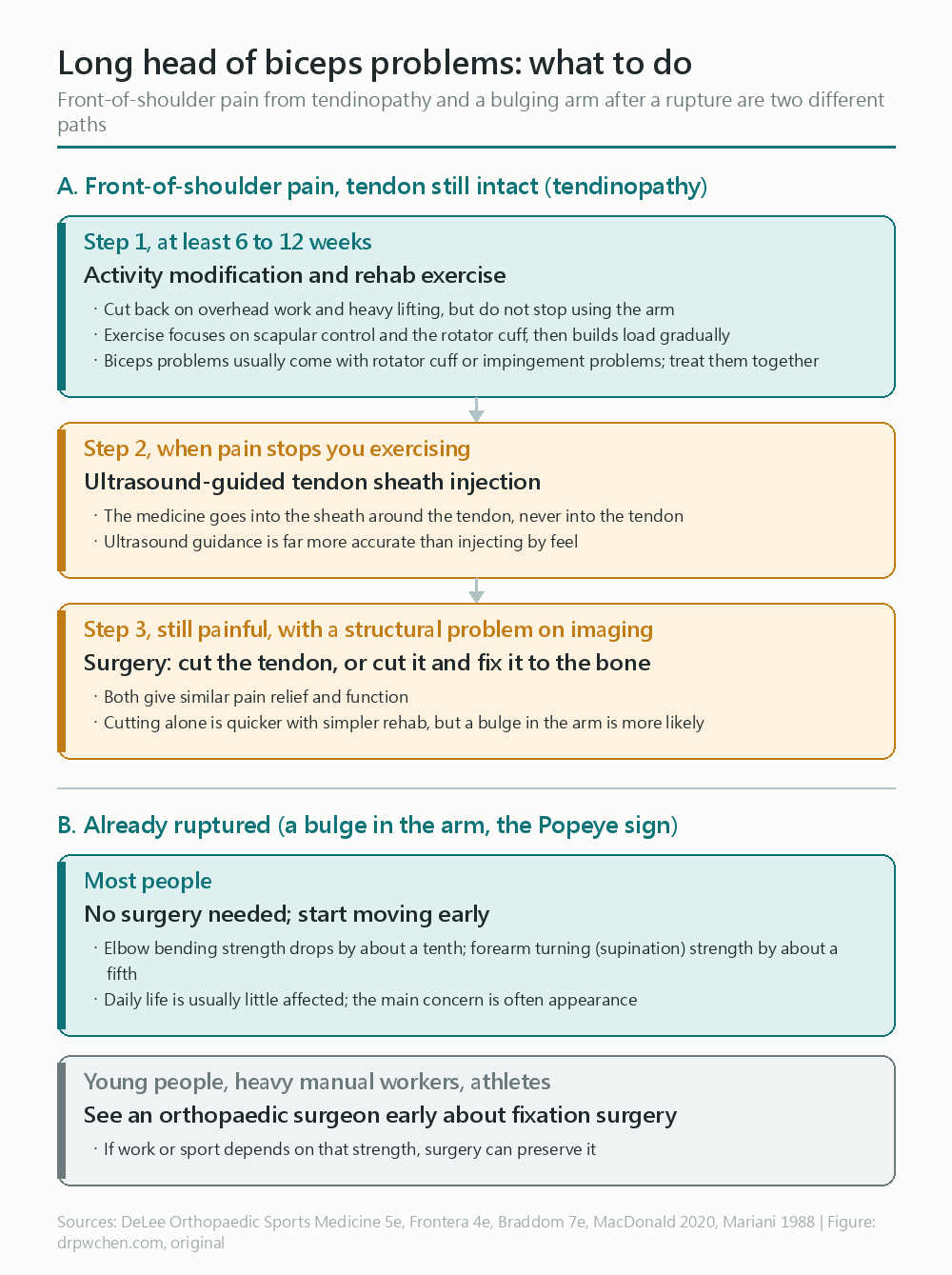
How do you treat tendinitis?
The first step is activity modification plus rehab exercises, giving it at least 6 to 12 weeks.
- First, cut back on overhead and heavy lifting, but don’t just put your arm in a sling and stop moving it.
- Rehab focuses on scapular control and rotator cuff strength. Once you regain your pain-free range of motion, slowly add weight.
- Painkillers can offer short-term relief, but tendon problems are mainly degenerative; you can’t cure them just by taking medication.
Do I need an injection?
If it hurts too much to do rehab, you can consider an ultrasound-guided tendon sheath injection.
- The steroid goes into the sheath outside the tendon, not into the tendon itself. Injecting a steroid into the tendon can make it fragile.
- Ultrasound is used to guide the needle; studies show the rate of hitting the right spot is much higher than going by feel.
- The goal of the steroid sheath injection is to let you continue your rehab, not to replace it.
Some people ask about PRP (platelet-rich plasma) or prolotherapy. These have some research behind them for other tendons, but studies specifically on the biceps tendon are still sparse. You can discuss them with your physician as an option after trying rehab and standard injections.
What if a bulge suddenly appears on my arm (Popeye arm)?
If you hear a “pop” while exerting yourself and a lump appears on the front of your upper arm, like Popeye’s arm, it usually means the long head of the biceps tendon has ruptured and the muscle has recoiled downward into a ball.
It sounds scary, but for most people, this doesn’t really affect daily life:
- The biceps still has another tendon (the short head) attached, and other muscles around the elbow help bend it.
- Studies measuring the change in strength show: elbow flexion strength drops by about 10–15%, and the strength to turn your palm up (like turning a doorknob or driving a screw) drops by about 10–20% (two small studies report somewhat different numbers).
- For most people, the main issue is cosmetic, not functional.
Most people just need to start gentle activities early on to keep the shoulder and elbow from getting stiff.
The exceptions are younger people, heavy laborers, or athletes who really need that specific strength. These folks should get evaluated by an orthopedic surgeon early on to discuss whether to surgically reattach the tendon to the bone.
What does surgery actually do?
There are two main types of surgery for the biceps tendon:
- Tenotomy: Cutting the frayed part inside the shoulder joint and letting the tendon recoil down. It’s a quick surgery, with almost no activity restrictions afterward. The downside is that you’re more likely to get that Popeye bulge.
- Tenodesis: After cutting it, the tendon is fixed to the bone of the upper arm. It looks better cosmetically, but you have to protect it for a while after surgery—you can’t put heavy loads on the biceps for about three months.
Studies comparing the two show similar pain relief and shoulder function. The main difference is the cosmetic outcome and the pace of recovery. Which one to choose usually depends on your age, work demands, how much you care about the appearance, and a shared decision with your physician.
When should you see a doctor?
- Anterior shoulder pain that lasts for weeks and affects your work, sports, or sleep.
- A sudden bulge in your arm, or bruising after hearing a “pop”.
- You are young, a heavy laborer, or an athlete, and you have a bulge in your arm.
- You’re on blood thinners, and your upper arm gets very swollen and painful after a rupture.
- Along with pain, your arm feels numb or weak.
—
Further reading: Rotator Cuff Tears and Calcific Tendinitis, Shoulder Impingement (the two most common “companions” to biceps problems)
Below is the raw note exactly as it lives in my vault, with only the internal links and copyrighted textbook figures removed. The verification process and tool breakdown are at the end.
Proximal biceps tendinopathy
Clinical Pearls
- Proximal ruptures make up 90–97% of all biceps ruptures, and are almost all the long head; distal biceps pathology is outside the scope of this note
Frontera 4e Ch.13- LHBT pathology rarely happens alone: up to 95% of patients with biceps tendinosis have concomitant rotator cuff disease, and SLAP/subscapularis tears are also common
Frontera 4e Ch.12,Kahn Ch.17→ you have to work up comorbidities together- No single great physical test: Speed’s and Yergason’s have low Se, higher Sp; the 3-Pack (O’Brien + resisted throwing + bicipital tunnel palpation) has Se 73–98%, Sp 46–79%, and a negative bicipital tunnel palpation or O’Brien test has an NPV of 93–96% for hidden bicipital tunnel lesions
DeLee 5e Ch.46,Taylor 2017- “Tendon in the groove” in neutral does not rule out a pulley lesion: dynamic scanning with external rotation is required to see whether it displaces; conversely, a tendon dislocated in neutral can snap back into the groove with internal rotation, causing a painful snap
Jacobson 3e Ch.3- Conservative management for at least 6–12 weeks is first-line; when choosing surgery, tenotomy and tenodesis yield similar pain and function, differing mainly in the Popeye deformity (33% vs 10%) (RCT)
DeLee 5e Ch.46,MacDonald 2020- Proximal ruptures are mostly treated conservatively: strength loss is small (elbow flexion about 8–16%, supination about 11–21%; two small studies disagree); the general public mainly complains about the cosmetic appearance, while only heavy manual laborers usually mind the strength deficit
Braddom 7e Ch.36,Mariani 1988,Sturzenegger 1986,Frontera 4e Ch.13
Abbreviations
| Abbreviation | Full Term |
|---|---|
| LHB / LHBT | Long head of biceps (tendon) |
| SHB | Short head of biceps |
| BLC | Biceps-labrum complex |
| SLAP | Superior labrum anterior to posterior |
| RC / RCT | Rotator cuff (tear) |
| SASD | Subacromial-subdeltoid |
| ABER | Abduction–external rotation |
| CHL / SGHL | Coracohumeral / superior glenohumeral lig. |
| MRA | Magnetic resonance arthrography |
| FABS | Flexed elbow, abducted shoulder, supinated forearm |
| PRP / LR-PRP | (Leukocyte-rich) platelet-rich plasma |
| NTG | Nitroglycerin |
| SMD | Standardized mean difference |
| ASES | American Shoulder and Elbow Surgeons score |
| WORC | Western Ontario Rotator Cuff index |
| Constant | Constant-Murley score |
| SST | Simple Shoulder Test |
| Se / Sp / NPV / PPV | Sensitivity / specificity / negative / positive predictive value |
| OR / RR / MD / ES | Odds ratio / risk ratio / mean difference / effect size |
| NMA | Network meta-analysis |
| GH / AC | Glenohumeral / acromioclavicular |
| IR / ER | Internal / external rotation |
| PROM / AAROM / AROM | Passive / active-assisted / active range of motion |
| TOS / CRPS | Thoracic outlet syndrome / complex regional pain syndrome |
Disease Background
Definition
- Pathological spectrum of the long head of the biceps (LHB) tendon in the shoulder; distal (radial tuberosity) pathology is outside the scope of this note
- A continuum: tendinopathy/tenosynovitis → partial tear → complete rupture; subluxation/dislocation is a separate independent axis
DeLee 5e Ch.46,Giangarra 4e Ch.26 - Tendinitis ≠ tendinosis
Kahn Ch.17- Tendinosis = histological noninflammatory degeneration of collagen; tendinopathy = clinical term for symptomatic tendons
- Most outpatient biceps complaints are caused by tendinosis, not inflammation
- Histopathologic studies: Most symptomatic biceps tendons show almost no signs of inflammation, presenting predominantly with chronic degeneration
Frontera 4e Ch.12
- Primary vs secondary
Kahn Ch.17- Primary tendinitis: isolated inflammation of the tendon within the intertubercular groove, rare
- Secondary: degeneration concurrent with RC impingement / SLAP / GH degeneration, accounting for the vast majority
- Some authors state that >90% of patients diagnosed with biceps tendinitis actually have a primary diagnosis of impingement or scapular instability
Magee Pathology 2e Ch.5
Anatomy
- Long head: Originates from the supraglenoid tubercle + superior labrum, intra-articular but extrasynovial
Kahn Ch.17,Magee Pathology 2e Ch.5- High variability in origin: Vangsness classified 105 cadavers into 4 types (entirely posterior 22%, predominantly posterior, equal anterior/posterior 37%, predominantly anterior 8%)
Magee Pathology 2e Ch.5
- High variability in origin: Vangsness classified 105 cadavers into 4 types (entirely posterior 22%, predominantly posterior, equal anterior/posterior 37%, predominantly anterior 8%)
- Short head: Originates from the coracoid process, both heads merge in the distal upper arm and insert onto the radial tuberosity
Kahn Ch.17 - Course: Crosses the humeral head obliquely at 30–45° within the joint → exits the joint via the rotator interval → enters the bicipital groove, covered by the transverse humeral ligament (containing subscapularis fibers)
Giangarra 4e Ch.26- During shoulder movement, the humerus glides on a fixed tendon, and the groove can move up to 4 cm along the tendon
Magee Pathology 2e Ch.5
- During shoulder movement, the humerus glides on a fixed tendon, and the groove can move up to 4 cm along the tendon
- Function
Kahn Ch.17,Giangarra 4e Ch.26- Strong supinator, relatively weak elbow flexor (more active when flexing in supination); assists in shoulder flexion
- LHB restricts anterior translation and excessive external rotation of the humeral head; its role as a humeral head depressor/stabilizer remains controversial
Magee Pathology 2e Ch.5
- Blood supply: Textbooks differ, both presented
- Primarily from branches of the anterior circumflex humeral artery
DeLee 5e Ch.46 - Primarily supplied via osteotendinous and musculotendinous junctions, ACHA branches via the mesotenon are “uncommon”; there is a hypovascular watershed zone 1.2–3 cm from the origin, extending to the proximal groove
Frontera 4e Ch.13
- Primarily from branches of the anterior circumflex humeral artery
- Pulley/sling: The CHL + SGHL + superior border of the subscapularis (+ anterior fibers of the supraspinatus) stabilize the LHBT at the entrance of the groove
DeLee 5e Ch.46,Jacobson 3e Ch.3 - The distal groove is stabilized by the fascial expansion (falciform ligament) of the pectoralis major
Magee Pathology 2e Ch.5
Epidemiology
- Proximal ruptures account for 90–97% of all biceps ruptures
Frontera 4e Ch.13 - Biceps tendinosis is more common in older populations (athletes >35 years, non-athletes >65 years), and is more common than primary tendinitis
Frontera 4e Ch.12 - Isolated biceps tendinitis usually affects young or middle-aged individuals; common in those doing overhead throwing or repetitive pulling/lifting
Kahn Ch.17 - Typical patient for an atraumatic rupture: older, with a history of chronic RC disease
Braddom 7e Ch.36
Mechanism
- Degenerative mechanism: The tendon is subjected to repetitive traction, friction, and pressure/shear from GH rotation within the narrow intertubercular groove
Kahn Ch.17- Biceps activity is highest during the late cocking phase in throwers; repetitive eccentric loading in elbow flexion does the same
Kahn Ch.17 - During abduction, the intracapsular segment is compressed by the humeral head, forming an avascular zone (wringing-out effect)
Magee Pathology 2e Ch.5
- Biceps activity is highest during the late cocking phase in throwers; repetitive eccentric loading in elbow flexion does the same
- Comorbidities with RC/pulley
DeLee 5e Ch.46,Giangarra 4e Ch.26- Subscapularis tear disrupts the pulley → LHBT medial subluxation/dislocation; nearly all instability goes medially
- When you see an unstable biceps, you must rule out a subscapularis tear, and vice versa
- Histology: Changes in the extra-articular LHBT and tendon sheath are chronic and degenerative, similar to de Quervain tenosynovitis
Frontera 4e Ch.13 - Complete rupture
Frontera 4e Ch.13,DeLee 5e Ch.46- A degenerated tendon can rupture from a seemingly trivial event, often avulsing from the superior labrum → acute “pop”
- Traumatic: eccentric force from catching a heavy object with a flexed elbow
- The tendon sheath communicates with the GH joint
Jacobson 3e Ch.3- Normally, without an effusion, fluid in the sheath is <1 mm or absent
- A GH effusion of ≥5 mL will flow into and distend the sheath; ≥8 mL distends it by an average of 2 mm
Complications
- Progression from partial → complete rupture
Frontera 4e Ch.13 - Popeye deformity (muscle belly retracts distally)
Braddom 7e Ch.36 - Progression of tendinopathy can lead to decreased activity, RC pathology, adhesive capsulitis, and myofascial pain of the shoulder girdle
Frontera 4e Ch.12 - Compartment syndrome following proximal rupture in patients on anticoagulants (case reports)
Frontera 4e Ch.13 - Rare: Neuropathy of the lateral antebrachial cutaneous nerve caused by traction after LHB rupture (case report, resolved after tenodesis)
Frontera 4e Ch.13 - Regardless of surgery: stiffness, contracture, progression of OA
Frontera 4e Ch.13
Prognosis
- Proximal ruptures managed conservatively: Functional limitations are usually minor, patients mostly care about the cosmetics
Frontera 4e Ch.13- Elbow flexion strength only drops by about 10% (brachialis and brachioradialis compensate); tenodesis is only considered for jobs or sports that require heavy lifting
Braddom 7e Ch.36 - Dynamometer-controlled study (strength tested in only a subset: 13 conservative, 10 surgical; mean follow-up 4.6 years conservative vs 13 years surgical): the conservative group showed a 21% drop in supination and an 8% drop in flexion, with grip/pronation/extension unaffected; the surgical repair group had no strength loss
Mariani 1988- Subjective elbow weakness: 20/30 in conservative vs 4/27 in surgical; unable to return to full workload 11 vs 2; residual arm pain was rare in both groups
- Another Cybex study found the opposite: conservative (n=10) flexion −16%, supination −11% (surgical n=5: −8%, −7%)
Sturzenegger 1986; both are small, so which deficit is larger remains inconsistent
- Following tenotomy, peak torque in supination also drops (compared to the contralateral side and to tenodesis), with no difference in flexion or endurance
Wittstein 2011 - Most affected groups: heavy manual laborers, powerlifters (where that last 10% of strength matters), and those who care about a symmetrical appearance
Frontera 4e Ch.13
- Elbow flexion strength only drops by about 10% (brachialis and brachioradialis compensate); tenodesis is only considered for jobs or sports that require heavy lifting
- Shoulder MRI studies: The degree of disability has no statistical correlation with biceps rupture or tendinopathy, but correlates with supraspinatus lesions and bursitis
Frontera 4e Ch.13 - Most tendinopathies improve with rest, activity modification, NSAIDs, and rehab
DeLee 5e Ch.46,Giangarra 4e Ch.26
Clinical Evaluation
Diagnostic Criteria
- No formal criteria, it is a clinical diagnosis combining history / PE / imaging
Frontera 4e Ch.12 - Proximal LHBT tendinopathy: Anterior shoulder pain at the bicipital groove + provocative test (+) + imaging to rule out comorbidities
Braddom 7e Ch.36,DeLee 5e Ch.46 - Proximal LHB rupture: Can be diagnosed as soon as the Popeye sign appears; however, many LHB lesions do not have a Popeye sign, still requiring a complete PE
DeLee 5e Ch.46
Assessment Tools
History
- Typical: Progressive anterior shoulder pain, functional decline, mostly due to chronic overuse and repetitive overhead motions
DeLee 5e Ch.46- Pain is anteromedial, along the bicipital groove, and can radiate down to the muscle belly
DeLee 5e Ch.46 - Patients often point directly to the bicipital groove with one finger
Frontera 4e Ch.13 - Aggravated by elbow flexion activities; night pain is possible
Frontera 4e Ch.12
- Pain is anteromedial, along the bicipital groove, and can radiate down to the muscle belly
- Throwing athletes: pain during follow-through, a “snap” during subluxation within the groove
Frontera 4e Ch.12 - In older adults with concomitant RC tears, pain appears anterolaterally
DeLee 5e Ch.46 - Differentiating from SLAP: biceps pain is anterior shoulder, more superficial, usually without mechanical symptoms; SLAP is “deep” pain, accompanied by popping and a sense of instability
Braddom 7e Ch.36,Giangarra 4e Ch.26 - Rupture: Acute “pop” + swelling, bruising; a proximal rupture is usually less painful than a distal one, often only prompting a doctor visit after noticing the muscle belly has dropped
Frontera 4e Ch.13 - Ask about medications: Weigh whether to stop drugs associated with tendon rupture (chronic steroids, quinolones); anticoagulants
Frontera 4e Ch.13
PE
- Bicipital groove tenderness: up to Se 90%, but not specific (deep pressure on a normal tendon also hurts) → must always compare to the contralateral side
DeLee 5e Ch.46- Location: Arm at 10° IR, 3–6 cm below the acromion
Kahn Ch.17; DeLee text says 5–7 cm, but its table says 3–6 cm, internal inconsistency in the textbook - The point of tenderness moves laterally with external rotation → supports a tendon source
DeLee 5e Ch.46 - ⚠️ US validation study: The accuracy of residents and fellows manually palpating the LHB was only 5.3%
Frontera 4e Ch.12
- Location: Arm at 10° IR, 3–6 cm below the acromion
- Speed test: Elbow extended, forearm supinated, shoulder flexed 90°, resist shoulder flexion → groove pain; can also be positive for SLAP
DeLee 5e Ch.46 - Yergason test: Elbow flexed 90°, forearm pronated, patient resists supination → groove pain
DeLee 5e Ch.46 - Accuracy of Speed/Yergason: Numbers vary between the two books, presented side-by-side
- Both: Se 27–40%, Sp 80–100%
DeLee 5e Ch.46 - Meta-analysis: Speed Se 50–63% / Sp 60–85%; Yergason Se 14–32% / Sp 70–89%
Frontera 4e Ch.12(citingHegedus 2012)
- Both: Se 27–40%, Sp 80–100%
- O’Brien active compression test: Shoulder flexed 90° + adducted 10–15° + elbow extended, resist in pronation (thumb down) → deep pain; more sensitive but not specific, can be positive for LHB / SLAP / AC joint
DeLee 5e Ch.46 - 3-Pack examination: active compression + resisted throwing + bicipital tunnel palpation
Taylor 2017- Individual 3-Pack tests Se 73–98%, Sp 46–79%; traditional tests (Speed, Yergason, full/empty can) Se 20–67%, Sp 83–100%
- For hidden lesions in the bicipital tunnel: palpation Se 97.8%, O’Brien Se 95.7%, NPV 93–96% when negative
- Inter-rater κ: 0.70–0.85 for 3-Pack, 0.25–0.56 for traditional tests
- Upper-cut test: Shoulder neutral, elbow flexed 90°, fist supinated, resist an upper-cut motion toward the chin → anterior shoulder pain
DeLee 5e Ch.46 - Subpectoral biceps test: Palpate the tendon medially under the pec major + resist internal rotation → pain
DeLee 5e Ch.46 - Biceps instability: Palpable “click” when pressing the groove in full abduction + external rotation; a complete dislocation can be felt rolling anterior to the lesser tuberosity
DeLee 5e Ch.46 - Ludington test: Clasp hands behind the head and relax, alternately contract the biceps; no contraction felt on the side with a complete rupture
Frontera 4e Ch.13 - Isolated biceps tendinopathy does not restrict ROM; if ROM is restricted, think of comorbidities (OA, impingement, adhesive capsulitis)
Frontera 4e Ch.12 - Selective injection: Relief with subacromial lidocaine → RC / impingement; relief with groove/sheath injection → LHB; GH injection used when suspecting SLAP
DeLee 5e Ch.46,Giangarra 4e Ch.26
X-ray
- Mostly normal; useful for ruling out GH degeneration, calcific tendinitis, and fractures
DeLee 5e Ch.46 - Fisk view: To look for groove osteophytes or narrowing
DeLee 5e Ch.46; short and narrow groove borders are more prone to recurrent subluxationFrontera 4e Ch.12 - Chronic degeneration can show hypertrophic bone formation
Frontera 4e Ch.13 - If MRI is contraindicated, plain/CT arthrogram can be used, but up to 30% of biceps pathology is negative
DeLee 5e Ch.46
Sono
- Positioning: Sitting, forearm resting on the thigh, palm up
- Bicipital groove short axis (SAX)
- The anterior circumflex humeral artery branch lies lateral to the groove, don’t mistake normal flow for hyperemia; use color Doppler to check the needle path before injection
Jacobson 3e Ch.3,Jacobson 3e Ch.9 - The aponeurotic expansion of the supraspinatus is a normal variant in up to 50% of people, looking like a thin tendon anterior to the LHB, don’t mistake it for a longitudinal split
Jacobson 3e Ch.3
- The anterior circumflex humeral artery branch lies lateral to the groove, don’t mistake normal flow for hyperemia; use color Doppler to check the needle path before injection
- Tendinosis: hypoechoic, can be thickened, loss of fibrillar pattern, no fiber disruption; power Doppler may show increased flow
Kahn Ch.17,Jacobson 3e Ch.3- Pathology is most common within 3.5 cm of the origin, including the segment above the groove → must use the modified Crass position to check the rotator interval
Jacobson 3e Ch.3
- Pathology is most common within 3.5 cm of the origin, including the segment above the groove → must use the modified Crass position to check the rotator interval
- Partial tear: anechoic cleft or irregular surface, especially with a groove osteophyte
Jacobson 3e Ch.3- US sensitivity for partial-thickness biceps tears is only 49%; it is accurate for full-thickness tears and instability
DeLee 5e Ch.46
- US sensitivity for partial-thickness biceps tears is only 49%; it is accurate for full-thickness tears and instability
- Full-thickness tear: empty groove; search distally at the pec major for the retracted stump (lateral to the short head, has a refraction shadow)
Jacobson 3e Ch.3 - Effusion vs tenosynovitis
Jacobson 3e Ch.3- Fluid in the tendon sheath + other GH recesses distended, asymptomatic → GH effusion
- Localized, with hyperemia, probe tenderness, fluid doesn’t displace from the groove → tenosynovitis
- Isolated tendon sheath fluid has a 60% PPV for an RC tear; if SASD bursa fluid is also present → PPV is 95%
- A distended SASD bursa often lies superficial to the tendon, don’t mistake it for tendon sheath pathology
- Subluxation/dislocation dynamic scanning
Jacobson 3e Ch.3- Can subluxate over the lesser tuberosity, completely dislocate over or medial to it, dislocate into a subscapularis tear, or enter the GH joint through the tear
- Evaluation must include external rotation to see tendon displacement; conversely, a tendon dislocated in neutral can snap back into the groove with internal rotation, with a painful snap
- Scanning pitfall: The wall of the SASD bursa draping over an empty groove can be mistaken for the tendon still being in place (Fig 3.90C-D)
- The pulley is made of the CHL + SGHL; tears in these structures cause instability and can be seen on US
MRI
- MRI is the modality of choice for the biceps and surrounding soft tissues; axial + sagittal oblique give the clearest view
DeLee 5e Ch.46 - MRI for partial biceps tears: Se 27%, Sp 86% (compared to arthroscopy)
DeLee 5e Ch.46 - MRA is more sensitive than plain MRI, but agreement with arthroscopy is still only 34.9%; MRA is the first choice for evaluating SLAP
DeLee 5e Ch.46 - When suspecting a subscapularis tear, specifically look for LHB subluxation/dislocation on axial/sagittal oblique slices
DeLee 5e Ch.46 - For partial tears, the FABS position is recommended to obtain a true long-axis image
Frontera 4e Ch.13 - Over-reading in community MRIs: Up to 35% are read as a labral tear or “possible labral tear,” while the true incidence is about 3–5%
Giangarra 4e Ch.26
Classification — Proximal LHBT pathology spectrum
- Based on pathology
DeLee 5e Ch.46,Giangarra 4e Ch.26- Tendinopathy / tenosynovitis (degenerative / inflammatory)
- Partial tear (>25–50% is an indication for surgery)
- Complete rupture
- Subluxation / dislocation (concomitant with subscapularis tear, pulley lesion)
- Hourglass biceps (intra-articular hypertrophy, seen intraoperatively)
- Comorbid with SLAP — see SLAP tear
- Slätis & Aalto 3 Types
Magee Pathology 2e Ch.5- Type A: impingement tendinitis (RC pathology exposes the biceps to the coracoacromial arch), most common
- Type B: subluxation / dislocation (CHL lesion causes the tendon to gradually slip medially)
- Type C: attrition tendinitis (primary lesion in the groove, often with osteophytes and fraying)
Differential Diagnosis
| DDx | Key Distinctions | Source |
|---|---|---|
| Rotator cuff tear / tendinopathy | Older adults with anterolateral pain; lateral tenderness suggests bursitis/RC; supraspinatus test (+) | DeLee 5e Ch.46, Frontera 4e Ch.12 |
| Subacromial impingement | Neer / Hawkins (+); relieved by subacromial lidocaine | DeLee 5e Ch.46 |
| SLAP lesion | Deep pain + mechanical symptoms; O’Brien (+); confirmed by MRA | Braddom 7e Ch.36, DeLee 5e Ch.46 |
| Snapping shoulder | SASD bursa anterior recess snapping (2025 dynamic US 9-case series) | Delafontaine 2025 |
| AC joint pathology | Scarf / cross-arm adduction (+) | Frontera 4e Ch.12 |
| Adhesive capsulitis | Restricted ROM; isolated biceps pathology doesn’t restrict ROM | Frontera 4e Ch.12 |
| Cervical radiculopathy (C5–C6) | Neurologic deficits, provoked by neck movements | Kahn Ch.17 |
| Brachial plexopathy / TOS / Pectoralis minor strain | Neurovascular symptoms, provoked by posture | Kahn Ch.17 |
| Pectoralis major rupture | Asymmetry in the anterior axillary fold, weakness in adduction and internal rotation | Frontera 4e Ch.13 |
| Musculocutaneous neuropathy / Parsonage-Turner | Weakness distribution can’t be explained by pain → electrodiagnostics | Frontera 4e Ch.13 |
| Distal biceps tendinopathy | Pain at the radial tuberosity, aggravated by elbow flexion/supination | Kahn Ch.17 |
| Visceral referred pain | Acute coronary syndrome, gallbladder disease | Kahn Ch.17 |
Red Flags and Referrals
- Proximal ruptures in young, high-demand, heavy laborers, or competitive athletes → early surgical evaluation; these patients need the strength lost after rupture
Frontera 4e Ch.13- If done, surgery yields the best results within 4 weeks of injury
Frontera 4e Ch.13
- If done, surgery yields the best results within 4 weeks of injury
- Acute rupture + on anticoagulants → watch for compartment syndrome
Frontera 4e Ch.13 - No improvement after 6–12 weeks of conservative treatment, AND >25–50% partial tear, subluxation, or concomitant subscapularis tear → surgical consult
DeLee 5e Ch.46,Kahn Ch.17 - Bilateral or spontaneous ruptures → think of systemic factors (chronic steroids, quinolones)
Frontera 4e Ch.13 - Weakness or paresthesia suggesting plexopathy/radiculopathy → referral
Kahn Ch.17
Clinical Management
Management Algorithm
Treatment axes: completeness × stability × age/activity demands
- Tendinopathy / <25% partial tear
- Conservative for at least 6–12 weeks: rest + activity modification + NSAIDs + PT (scapular/RC/kinetic chain)
DeLee 5e Ch.46- Fails or severe night pain → US-guided sheath injection (do not inject into tendon)
DeLee 5e Ch.46,Kahn Ch.17- Still refractory → PRP can be considered, evidence extrapolated from other tendons
Frontera 4e Ch.12- Still refractory with structural lesions on imaging → tenotomy/tenodesis
Braddom 7e Ch.36- Partial tear >25–50% / subluxation / concomitant subscapularis tear (Absolute); type IV SLAP, symptomatic type II SLAP in patients >35–40, failed SLAP repair (Relative)
DeLee 5e Ch.46
- Tenodesis: manual laborers, active, young, cosmetically concerned
DeLee 5e Ch.46- Tenotomy: traditionally for those over 60; newer research argues for deciding based on patient preference (cosmetics, implants, postoperative restrictions)
DeLee 5e Ch.46- Pain and function are comparable for both; Popeye OR is 0.29 for tenodesis, which takes about 15 minutes longer
Hartland 2022- Complete rupture
- Mostly conservative: minimal functional loss, cosmetics usually acceptable
Frontera 4e Ch.13,Braddom 7e Ch.36- Young high-demand laborers/athletes → surgical evaluation within 4 weeks
Frontera 4e Ch.13
Treatment Goals
- Tendinopathy: relieve pain, restore movement, treat all coexisting shoulder pathologies (instability, impingement)
Frontera 4e Ch.12 - Rupture: prevent elbow/shoulder contracture; restore flexion and supination strength in high-demand individuals
Frontera 4e Ch.13
Conservative Treatment
Acute Phase / Symptom Control
- Activity modification: initially avoid overhead and heavy lifting
Frontera 4e Ch.12,Kahn Ch.17 - NSAIDs: relieve pain and inflammation in tendinitis, but have no role in tendinosis; the use of NSAIDs for chronic tendinopathy is controversial
Frontera 4e Ch.12,Kahn Ch.17 - Ice is used post-exercise for pain; heat can be used pre-activity
Frontera 4e Ch.12 - Iontophoresis, electrical stimulation: commonly used but not supported by clinical trials
Frontera 4e Ch.12
Physical Therapy
- Principles are the same as for RC tendinopathy; biceps pathology rarely exists in isolation, so you must rehab all coexisting shoulder pathologies together
Frontera 4e Ch.12 - Content: ROM (including posterior capsule stretch) → only after pain-free full AROM is achieved do you start progressive resistance training (static → dynamic) → sport-specific functional training
Frontera 4e Ch.12- Core: scapular stabilization + RC strengthening + biceps loading
Kahn Ch.17,Braddom 7e Ch.36 - Four phases: pain relief and PROM → AROM and early strengthening → RC/scapular dynamic stability → sport-specific power
Giangarra 4e Ch.26
- Core: scapular stabilization + RC strengthening + biceps loading
- Eccentric loading: might help the biceps itself but evidence is insufficient
Frontera 4e Ch.12- RC tendinopathy RCT: At 26 weeks, both isolated eccentric and conventional exercise improved after 12 weeks of therapy, no difference between groups
Dejaco 2017 - Subacromial impingement meta: eccentrics dropped pain slightly more than other exercises, but didn’t reach clinical significance (low certainty)
Larsson 2019 - Synthesizing evidence across tendinopathies: combining concentric + eccentric strengthening might be best; exercises combined with other conservative therapies yield greater effects (low-quality evidence)
Cooper 2023
- RC tendinopathy RCT: At 26 weeks, both isolated eccentric and conventional exercise improved after 12 weeks of therapy, no difference between groups
- LHBT-specific evidence
McDevitt 2022,McDevitt 2023- Scoping review: Very little evidence for conservative treatment of LHBT tendinopathy; most quantitative studies are on physical modalities
- International Delphi (29 PT experts): 61 consensus recommendations, 9 non-recommendations, with the main pillars being exercise + manual therapy + education
- Return to sports: Gradual return to play after achieving pain-free full ROM + full strength
Kahn Ch.17 - Conservative management for ruptures
Frontera 4e Ch.13- Start gentle elbow and shoulder ROM almost immediately to prevent contracture and adhesive capsulitis
- Gentle strength training can start after the acute phase of a complete rupture passes
- Avoid electrical stimulation for partial tears (risk of becoming a complete tear); overly aggressive strengthening or passive stretching can enlarge the tear
Medications
- Topical NTG: OR 4.44 for improvement in activity pain in chronic tendinopathies, and increases tendon force; headache OR 1.73
Gambito 2010- No specific trial for biceps, evidence is extrapolated from tendinopathies at other sites; textbooks include it as a viable option
Kahn Ch.17,Frontera 4e Ch.12
- No specific trial for biceps, evidence is extrapolated from tendinopathies at other sites; textbooks include it as a viable option
Injections
- US-guided sheath corticosteroid (+ local anesthetic)
- The goal is to infiltrate the tendon sheath; do NOT inject into the tendon, as it may cause a spontaneous rupture
Kahn Ch.17,Frontera 4e Ch.12 - Accuracy RCT (n=30, CT-confirmed): 86.7% strictly within the sheath with US guidance, vs 26.7% blind
Hashiuchi 2011 - US guidance is more accurate than blind or fluoroscopic guidance, with fewer complications of injecting into the tendon
Frontera 4e Ch.12 - Can facilitate rehab when used for tendinitis; best avoided in tendinosis
Frontera 4e Ch.12 - Histology shows chronic degeneration (like de Quervain), supporting the traditional view to “not inject local steroids”
Frontera 4e Ch.13 - Avoid heavy lifting and strenuous exercise for 48–72 hours post-injection
Frontera 4e Ch.12 - Injection volume ≥5 mL will overflow into the GH joint
Jacobson 3e Ch.9
- The goal is to infiltrate the tendon sheath; do NOT inject into the tendon, as it may cause a spontaneous rupture
- Subacromial / GH joint injections: When the pain source is a comorbidity (RC, GH)
Kahn Ch.17,DeLee 5e Ch.46 - PRP
- Textbook: Autologous blood and PRP show potential, more research needed
Frontera 4e Ch.12 - Lacking specific RCTs for proximal biceps; evidence is extrapolated
- RC tendinopathy NMA: long-term (>24 weeks) functional improvement SMD 0.44 vs placebo for PRP
Lin MT 2019 - Chronic tendinopathies at various sites, failed conservative treatment (9 RCTs, comparators mostly corticosteroid or dry needling): PRP 6-month pain MD −0.83, 12-month −1.11 (0–10 scale); no difference between upper and lower limbs
Nadeau-Vallée 2025 - Tendinopathy meta: LR-PRP, US-guided, single injection had the largest effect size
Fitzpatrick 2017
- RC tendinopathy NMA: long-term (>24 weeks) functional improvement SMD 0.44 vs placebo for PRP
- Textbook: Autologous blood and PRP show potential, more research needed
- Prolotherapy (hyperosmolar dextrose)
- No direct evidence for the biceps tendon; a few RCTs exist for RC tendinopathy
- 3 monthly enthesis dextrose injections + PT: At 9 months, 59% maintained a VAS improvement ≥2.8, vs 27% for superficial saline (P=.017); non-significant vs 37% for enthesis saline
Bertrand 2016 - NMA: long-term pain SMD 2.63 for prolotherapy vs placebo
Lin MT 2019; another NMA (shoulder subgroup, >8 months) ES 2.08 vs placebo, but no significant pain advantage overall compared to other therapiesGoh 2021 - US-guided supraspinatus 20% dextrose (single enthesis injection in 2019): effect lasted only to 2 weeks, gone by 6 weeks
Lin CL 2019,Lin CL 2022
- 3 monthly enthesis dextrose injections + PT: At 9 months, 59% maintained a VAS improvement ≥2.8, vs 27% for superficial saline (P=.017); non-significant vs 37% for enthesis saline
- No direct evidence for the biceps tendon; a few RCTs exist for RC tendinopathy
Surgery
Indications and Surgical Options
- Considered only after conservative treatment fails
DeLee 5e Ch.46 - Absolute: partial tear >25–50%, subluxation (±subscapularis tear); Relative: type IV SLAP, symptomatic type II SLAP in >35–40 age group, failed SLAP repair, chronic bicipital tendinitis
DeLee 5e Ch.46,Kahn Ch.17 - Reasons to add on during surgery: hyperemic tenosynovium, hourglass hypertrophy, superior subscapularis tear, humeral head chondromalacia
DeLee 5e Ch.46 - Simple débridement is not enough to relieve pain or prevent rupture; most authors move to tenotomy/tenodesis
Giangarra 4e Ch.26 - Expert Consensus (NEER Circle, 92-expert Delphi)
Verma 2025- Age is the primary factor in surgical decision-making
- Low-demand, over 30 years old prefers addressing the biceps (tenotomy/tenodesis); young active patients with unstable anchors prefer SLAP repair
- Older, with concomitant RC tear, or previously failed SLAP repair → usually don’t do SLAP repair
- Related Consensus in AAOS Guidelines
- Irreparable RC tears (without arthropathy): biceps tenotomy/tenodesis is one option that can improve patient-reported outcomes (Consensus)
AAOS Rotator Cuff 2025 - During shoulder arthroplasty, performing tenodesis or tenotomy at the same time can be considered (Consensus, lacking reliable evidence)
AAOS Glenohumeral OA 2020
- Irreparable RC tears (without arthropathy): biceps tenotomy/tenodesis is one option that can improve patient-reported outcomes (Consensus)
Tenotomy (LHB Release)
- Technique: arthroscopic, cut at the supraglenoid tubercle / superior labrum using a punch biter or electrocautery, careful not to damage the labrum
DeLee 5e Ch.46 - Pros: low technical barrier, no post-op immobilization or restrictions needed
DeLee 5e Ch.46 - Cons: Popeye, cramping, fatigue discomfort with repetitive use
DeLee 5e Ch.46- Case series: Popeye 70% (82.7% men, 36.5% women), 38% had biceps fatigue discomfort
Kelly 2005 - The Popeye is almost exclusively a cosmetic issue with no proven functional consequences
Giangarra 4e Ch.26
- Case series: Popeye 70% (82.7% men, 36.5% women), 38% had biceps fatigue discomfort
- 30-case series: 90% returned to previous sports, 97% returned to previous work
Giangarra 4e Ch.26
Tenodesis (LHB Fixation)
- Technique: fixated to the humerus after tenotomy (interference screw, cortical button, suture anchor, bone tunnel, keyhole, soft tissue)
DeLee 5e Ch.46- Interference screws have the highest load to failure
DeLee 5e Ch.46 - Regardless of location, restoring the length-tension relationship is key
DeLee 5e Ch.46
- Interference screws have the highest load to failure
- The location debate: groove entrance (chondral junction) vs suprapectoral vs subpectoral
DeLee 5e Ch.46- Chondral junction: screw can double as an RC repair anchor, preserves length for revision; 0.4% revision rate in 1083 cases; but doesn’t address the bicipital tunnel, may leave residual groove pain
- Arthroscopic suprapectoral: avoids infection risks of an axillary incision; more early stiffness, no difference compared to open subpectoral at 2 years
- Open subpectoral: technically simpler, removes most of the LHBT and tendon sheath; axillary incision wound issues, less length for revision, higher risk of humeral fracture
- 353 cases of open subpectoral + interference screw: 2.0% complications (persistent pain, fixation failure, infection, musculocutaneous neuropathy, fracture, CRPS)
- The musculocutaneous nerve is on average only 2.6 cm from the LHB musculotendinous junction, so be careful when retracting
DeLee 5e Ch.46
- Tenodesis combined with bicipital tunnel decompression yields slightly better results
Frontera 4e Ch.12 - Trend: From 2008–2011 in the US, the incidence of tenodesis increased 1.7-fold, with arthroscopic growing faster than open
Werner 2014,DeLee 5e Ch.46
Tenotomy vs. Tenodesis Evidence
- RCT (n=114, mean age 57.7)
MacDonald 2020- No difference between groups in ASES, WORC, or pain over 24 months
- Popeye: 33% tenotomy vs 10% tenodesis (RR 3.5)
- No difference in cramping, elbow flexion, and supination strength; all tenodesis MRIs were intact at 1 year
- Meta-analysis (11 RCTs, 860 patients): Comparable function and pain; tenodesis Popeye OR 0.29; tenotomy surgical time was 15.2 minutes shorter
Hartland 2022 - Meta-analysis (8 RCTs, 615 patients): No difference in pain or Constant score; tenotomy Popeye OR 4.70
Pozzetti Daou 2021 - Meta-analysis (10 RCTs, 787 patients): tenodesis had higher Constant by 1.24, SST by 0.73 (statistically significant, but small magnitude); tenotomy had cramping OR 3.36, Popeye OR 3.34; no difference in pain, ASES, or strength
Zhang 2023 - Evidence on cramping is inconsistent: A single RCT showed no difference, while a meta-analysis shows more with tenotomy
MacDonald 2020,Zhang 2023 - Textbook-level conclusion: very little difference in postoperative function between the two
Frontera 4e Ch.13,Kahn Ch.17
Postoperative Rehabilitation
- Tenotomy
DeLee 5e Ch.46- Sling for comfort only, discontinued within 1–2 weeks
- Immediate RC isometrics + scapular exercises post-op, no ROM restrictions
- Isotonics from week 2; machine weights from week 6 → free weights
- Tenodesis (same protocol for arthroscopic or open): protect tendon-bone healing
DeLee 5e Ch.46- No biceps loading for the first 12 weeks; throwing and overhead sports after 20 weeks
- Phase I (0–6 weeks): ultrasling for 6 weeks; PROM/AAROM limited to 90° flexion/scaption, 30° ER, 45° IR for the first 4 weeks; starting week 5, full flexion, 50° ER, 60° IR
- Phase II (7–12 weeks): discontinue sling, progressive AROM, achieving full ROM by week 10; submaximal isometrics starting at week 10
- Phase III (13–20 weeks): isotonic elbow flexion and supination, light plyometrics
- Phase IV (21–26 weeks): return to play, overhead athletes begin sport-specific training
- An alternative, more aggressive open subpectoral tenodesis protocol: sling for a maximum of 3 weeks, avoid active elbow flexion and supination for 4–6 weeks, return to most sports at 12–16 weeks, full-speed throwing at 4 months
Giangarra 4e Ch.26 - Rehab for tenotomy can be faster than tenodesis; the main risk is a Popeye deformity
Giangarra 4e Ch.26
Developing Therapies
Proliferative Therapies (PRP / Prolotherapy / Autologous Blood)
- Direct RCTs are lacking for PRP/prolotherapy in the biceps tendon; evidence for RC and other tendinopathies is summarized in the Injections section above
- Applicable scenario: after failed conservative treatment and sheath injections for proximal LHBT tendinopathy
- Operational key points: based on best available evidence for tendinopathy, go with US-guided + LR-PRP + single injection
Fitzpatrick 2017
Topical Nitroglycerin
- Supported by meta-analysis for chronic tendinopathies (OR 4.44); no direct trial for the biceps
Gambito 2010
Evidence × Setting Matrix
| Intervention / Setting | Evidence | Conclusion | Primary Source |
|---|---|---|---|
| Conservative PT (proximal LHBT tendinopathy) | Textbook consensus; extremely few LHBT-specific trials | First-line for at least 6–12 weeks | DeLee 5e Ch.46, McDevitt 2023 |
| US-guided sheath corticosteroid | RCT (accuracy) | 86.7% vs 26.7% within sheath for guided vs blind; do not inject into tendon | Hashiuchi 2011 |
| Eccentric vs conventional exercise (RC tendinopathy) | RCT + meta (low certainty) | No clinical difference | Dejaco 2017, Larsson 2019 |
| Topical NTG (tendinopathies generally) | Meta (7 RCTs) | Activity pain improvement OR 4.44; extrapolated for biceps | Gambito 2010 |
| PRP (proximal LHB specific) | No direct RCTs | Extrapolated from RC and other sites; generally positive but highly heterogeneous | Lin MT 2019, Nadeau-Vallée 2025 |
| Prolotherapy (RC tendinopathy) | RCT + NMA | Multiple enthesis injections + PT effective long-term; single injection only works short-term | Bertrand 2016, Lin MT 2019, Goh 2021 |
| Tenotomy vs Tenodesis (functional) | RCT + multiple metas | Function and pain are comparable; tenodesis has fewer Popeye deformities (OR 0.29) | MacDonald 2020, Hartland 2022, Zhang 2023 |
| Tenotomy/tenodesis during irreparable RC tear or joint arthroplasty | Consensus (AAOS) | Can be considered | AAOS Rotator Cuff 2025, AAOS Glenohumeral OA 2020 |
How This Note Was Produced
This note serves as my reference for managing anterior shoulder pain in the clinic, and I reorganized it for posting on the blog this time.
Materials used
- PM&R, Orthopedics, and Sports Medicine Textbooks: Frontera Essentials of PM&R 4e, DeLee Orthopaedic Sports Medicine 5e, Braddom 7e, Giangarra Clinical Orthopaedic Rehabilitation 4e, Kahn Musculoskeletal Sports and Spine Disorders, Magee Pathology and Intervention in Musculoskeletal Rehabilitation 2e
- Specialized Ultrasound Book: Jacobson Fundamentals of MSK Ultrasound 3e
- Society Guidelines and Consensus: Biceps-related clauses in the 2025 AAOS Rotator Cuff Injury Guidelines and 2020 Glenohumeral Osteoarthritis Guidelines, NEER Circle 2025 Expert Consensus on the Superior Labrum and Biceps Complex, International Delphi Consensus on Physical Therapy
- Primary Literature: Randomized trials and four meta-analyses comparing tenotomy and tenodesis, dynamometer-controlled study on strength loss post-rupture, accuracy trials of ultrasound-guided tendon sheath injections, 3-Pack physical exam research, and meta-analyses on PRP and prolotherapy
Tools used
audit_note.py— A custom note format auditing script I wrote to check citation placements, images, and heading structure- Textbook chapter backtracking script — Ensuring every “book name + chapter number” matches the original text, rather than relying on memory for chapter numbers
- PubMed MCP — Grabbing literature abstracts to fill in volume, issue, pages, DOI, and PMID for the bibliography, and cross-checking numbers paper by paper
- textbook_search — Running semantic searches against local markdown indexes of textbooks
- OpenEvidence — Running an independent cross-search on strength loss after rupture, making sure to match claims in the answers back to the original PubMed papers before adopting them
- Custom Python/PIL drawing scripts — For the management pathway flowchart and the cover image (
scripts/figures/) - Hugo’s bilingual workflow
i18n_sync.py— Machine translating the English version first, then manually proofreading the medical terms
This workflow itself is documented in textbook-to-note. If you also have a Claude or Codex subscription, this kind of mechanical labor of verification and synthesis can be handed off to it, leaving the judgment to you. You can start with Getting Started with AI: Installation and First Steps and How to Talk to AI Agents.
About this version
The pro version is taken directly from my own clinical notes and wasn’t rewritten for the blog, so the citation format follows my note conventions (book title + chapter, or author + year, with the full bibliography below). Copyrighted textbook and journal figures are excluded here; the diagrams are redrawn by me.
If I’ve misunderstood anything, feel free to correct me.
Reference
Textbooks
- Frontera 4e Ch.12 — Krabak BJ, Patel SA. Biceps Tendinopathy. In Frontera WR, ed. Essentials of Physical Medicine and Rehabilitation, 4e, 2019
- Frontera 4e Ch.13 — Stretanski MF. Biceps Tendon Rupture. In Frontera WR, ed. Essentials of Physical Medicine and Rehabilitation, 4e, 2019
- DeLee 5e Ch.46 — Steiner SRH, Awowale JT, Brockmeier SF. Proximal Biceps Tendon Pathology. DeLee, Drez & Miller’s Orthopaedic Sports Medicine, 5e, 2020
- Kahn Ch.17 — Drakeley MT, Helm ER. Biceps Tendinitis (Proximal and Distal). In Kahn SB, Xu RY, eds. Musculoskeletal Sports and Spine Disorders, 1e, 2018
- Braddom 7e Ch.36 — Baria M, Laskowski E. Upper Limb Pain and Dysfunction. Braddom’s Physical Medicine and Rehabilitation, 7e, 2026
- Giangarra 4e Ch.26 — Van Thiel GS, Bhatia S, Ghodadra NS, et al. Rehabilitation for Biceps Tendon Disorders and SLAP Lesions. Clinical Orthopaedic Rehabilitation, 4e, 2018
- Magee Pathology 2e Ch.5 — Shoulder Trauma and Hypomobility (Biceps tendon and superior labral lesions section). Magee DJ, et al. Pathology and Intervention in Musculoskeletal Rehabilitation, 2e, 2009
- Jacobson 3e Ch.3 / Ch.9 — Jacobson JA. Shoulder Ultrasound; Interventional Techniques. Fundamentals of Musculoskeletal Ultrasound, 3e, 2018
Guidelines and Consensus
- AAOS Rotator Cuff 2025 — Management of Rotator Cuff Injuries Clinical Practice Guideline. American Academy of Orthopaedic Surgeons, 2025
- AAOS Glenohumeral OA 2020 — Management of Glenohumeral Joint Osteoarthritis Clinical Practice Guideline. American Academy of Orthopaedic Surgeons, 2020
- Verma 2025 — Verma NN, Hoenecke H, MacDonald P, et al. Principles of the superior labrum and biceps complex: an expert consensus from the NEER Circle. J Shoulder Elbow Surg. 2025;34(6):1543-1557. doi:10.1016/j.jse.2024.09.040. PMID: 39622358
- McDevitt 2022 — McDevitt AW, Cleland JA, Addison S, Calderon L, Snodgrass S. Physical Therapy Interventions for the Management of Biceps Tendinopathy: An International Delphi Study. Int J Sports Phys Ther. 2022;17(4):677-694. doi:10.26603/001c.35256. PMID: 35693861
Journal Articles
- MacDonald 2020 — MacDonald P, Verhulst F, McRae S, et al. Biceps Tenodesis Versus Tenotomy in the Treatment of Lesions of the Long Head of the Biceps Tendon in Patients Undergoing Arthroscopic Shoulder Surgery: A Prospective Double-Blinded Randomized Controlled Trial. Am J Sports Med. 2020;48(6):1439-1449. doi:10.1177/0363546520912212. PMID: 32223645
- Hartland 2022 — Hartland AW, Islam R, Teoh KH, Rashid MS. Clinical effectiveness of tenotomy versus tenodesis for long head of biceps pathology: a systematic review and meta-analysis. BMJ Open. 2022;12(10):e061954. doi:10.1136/bmjopen-2022-061954. PMID: 36220319
- Pozzetti Daou 2021 — Pozzetti Daou J, Nagaya DY, Matsunaga FT, Sugawara Tamaoki MJ. Does Biceps Tenotomy or Tenodesis Have Better Results After Surgery? A Systematic Review and Meta-analysis. Clin Orthop Relat Res. 2021;479(7):1561-1573. doi:10.1097/CORR.0000000000001672. PMID: 33617158
- Zhang 2023 — Zhang C, Yang G, Li T, et al. Biceps Tenodesis Better Improves the Shoulder Function Compared with Tenotomy for Long Head of the Biceps Tendon Lesions: A Meta-Analysis of Randomised Controlled Trials. J Clin Med. 2023;12(5):1754. doi:10.3390/jcm12051754. PMID: 36902540
- Mariani 1988 — Mariani EM, Cofield RH, Askew LJ, Li GP, Chao EY. Rupture of the tendon of the long head of the biceps brachii. Surgical versus nonsurgical treatment. Clin Orthop Relat Res. 1988;(228):233-239. PMID: 3342572
- Sturzenegger 1986 — Sturzenegger M, Béguin D, Grünig B, Jakob RP. Muscular strength after rupture of the long head of the biceps. Arch Orthop Trauma Surg. 1986;105(1):18-23. doi:10.1007/BF00625654. PMID: 3707303
- Wittstein 2011 — Wittstein JR, Queen R, Abbey A, Toth A, Moorman CT. Isokinetic strength, endurance, and subjective outcomes after biceps tenotomy versus tenodesis: a postoperative study. Am J Sports Med. 2011;39(4):857-865. doi:10.1177/0363546510387512. PMID: 21189355
- Kelly 2005 — Kelly AM, Drakos MC, Fealy S, Taylor SA, O’Brien SJ. Arthroscopic release of the long head of the biceps tendon: functional outcome and clinical results. Am J Sports Med. 2005;33(2):208-213. doi:10.1177/0363546504269555. PMID: 15701606
- Werner 2014 — Werner BC, Brockmeier SF, Gwathmey FW. Trends in long head biceps tenodesis. Am J Sports Med. 2015;43(3):570-578. doi:10.1177/0363546514560155. PMID: 25497144
- Taylor 2017 — Taylor SA, Newman AM, Dawson C, et al. The “3-Pack” Examination Is Critical for Comprehensive Evaluation of the Biceps-Labrum Complex and the Bicipital Tunnel: A Prospective Study. Arthroscopy. 2017;33(1):28-38. doi:10.1016/j.arthro.2016.05.015. PMID: 27450901
- Hegedus 2012 — Hegedus EJ, Goode AP, Cook CE, et al. Which physical examination tests provide clinicians with the most value when examining the shoulder? Update of a systematic review with meta-analysis of individual tests. Br J Sports Med. 2012;46(14):964-978. doi:10.1136/bjsports-2012-091066. PMID: 22773322
- Hashiuchi 2011 — Hashiuchi T, Sakurai G, Morimoto M, et al. Accuracy of the biceps tendon sheath injection: ultrasound-guided or unguided injection? A randomized controlled trial. J Shoulder Elbow Surg. 2011;20(7):1069-1073. doi:10.1016/j.jse.2011.04.004. PMID: 21782470
- Gambito 2010 — Gambito ED, Gonzalez-Suarez CB, Oquiñena TI, Agbayani RB. Evidence on the effectiveness of topical nitroglycerin in the treatment of tendinopathies: a systematic review and meta-analysis. Arch Phys Med Rehabil. 2010;91(8):1291-1305. doi:10.1016/j.apmr.2010.02.008. PMID: 20684913
- Dejaco 2017 — Dejaco B, Habets B, van Loon C, van Grinsven S, van Cingel R. Eccentric versus conventional exercise therapy in patients with rotator cuff tendinopathy: a randomized, single blinded, clinical trial. Knee Surg Sports Traumatol Arthrosc. 2017;25(7):2051-2059. doi:10.1007/s00167-016-4223-x. PMID: 27351548
- Larsson 2019 — Larsson R, Bernhardsson S, Nordeman L. Effects of eccentric exercise in patients with subacromial impingement syndrome: a systematic review and meta-analysis. BMC Musculoskelet Disord. 2019;20(1):446. doi:10.1186/s12891-019-2796-5. PMID: 31610787
- Cooper 2023 — Cooper K, Alexander L, Brandie D, et al. Exercise therapy for tendinopathy: a mixed-methods evidence synthesis exploring feasibility, acceptability and effectiveness. Health Technol Assess. 2023;27(24):1-389. doi:10.3310/TFWS2748. PMID: 37929629
- McDevitt 2023 — McDevitt AW, Young JL, Cleland JA, Hiefield P, Snodgrass SJ. Physical therapy interventions used to treat individuals with biceps tendinopathy: a scoping review. Braz J Phys Ther. 2024;28(1):100586. doi:10.1016/j.bjpt.2023.100586. PMID: 38219522
- Fitzpatrick 2017 — Fitzpatrick J, Bulsara M, Zheng MH. The Effectiveness of Platelet-Rich Plasma in the Treatment of Tendinopathy: A Meta-analysis of Randomized Controlled Clinical Trials. Am J Sports Med. 2017;45(1):226-233. doi:10.1177/0363546516643716. PMID: 27268111
- Nadeau-Vallée 2025 — Nadeau-Vallée M, Ellassraoui S, Brulotte V. Platelet-rich plasma injections as a second-line treatment in patients with tendinopathy-related chronic pain and failure of conservative treatment: a systematic review and meta-analysis. Pain Med. 2025;26(7):407-419. doi:10.1093/pm/pnaf022. PMID: 40073277
- Bertrand 2016 — Bertrand H, Reeves KD, Bennett CJ, Bicknell S, Cheng AL. Dextrose Prolotherapy Versus Control Injections in Painful Rotator Cuff Tendinopathy. Arch Phys Med Rehabil. 2016;97(1):17-25. doi:10.1016/j.apmr.2015.08.412. PMID: 26301385
- Lin MT 2019 — Lin MT, Chiang CF, Wu CH, et al. Comparative Effectiveness of Injection Therapies in Rotator Cuff Tendinopathy: A Systematic Review, Pairwise and Network Meta-analysis of Randomized Controlled Trials. Arch Phys Med Rehabil. 2019;100(2):336-349.e15. doi:10.1016/j.apmr.2018.06.028. PMID: 30076801
- Goh 2021 — Goh SL, Jaafar Z, Gan YN, et al. Efficacy of prolotherapy in comparison to other therapies for chronic soft tissue injuries: A systematic review and network meta-analysis. PLoS One. 2021;16(5):e0252204. doi:10.1371/journal.pone.0252204. PMID: 34038486
- Lin CL 2019 — Lin CL, Huang CC, Huang SW. Effects of hypertonic dextrose injection in chronic supraspinatus tendinopathy of the shoulder: a randomized placebo-controlled trial. Eur J Phys Rehabil Med. 2019;55(4):480-487. doi:10.23736/S1973-9087.18.05379-0. PMID: 30543266
- Lin CL 2022 — Lin CL, Chen YW, Wu CW, Liou TH, Huang SW. Effect of Hypertonic Dextrose Injection on Pain and Shoulder Disability in Patients with Chronic Supraspinatus Tendinosis: A Randomized Double-Blind Controlled Study. Arch Phys Med Rehabil. 2022;103(2):237-244. doi:10.1016/j.apmr.2021.07.812. PMID: 34610286
- Delafontaine 2025 — Delafontaine A, Guillin R, Ropars M, Collin P. Snapping of the Subacromial Bursa: A New Cause of Shoulder Pain Demonstrated with Dynamic Ultrasound. Biomedicines. 2025;13(4):766. doi:10.3390/biomedicines13040766. PMID: 40299355
- Frank 2018 — Frank RM, Cotter EJ, Strauss EJ, Jazrawi LM, Romeo AA. Management of Biceps Tendon Pathology: From the Glenoid to the Radial Tuberosity. J Am Acad Orthop Surg. 2018;26(4):e77-e89. doi:10.5435/JAAOS-D-17-00085. PMID: 29337716