Let me start with the one thing you need to remember most: osteoporosis has almost no symptoms before a fracture.
It doesn’t ache, it doesn’t hurt, and it isn’t uncomfortable. The bones hollow out bit by bit. By the time you have symptoms, you’ve usually already crushed a vertebra just bending over to lift something, or fractured your hip slipping in the bathroom.
So the phrase “I’m perfectly healthy, I don’t feel anything wrong” is completely useless when it comes to osteoporosis.
I’m writing this for postmenopausal women and anyone with elderly family members at home.
When do your bones start to go bad?
Bone mass peaks around your twenties, and it’s all downhill from there.
For women, the critical time point is menopause. Once estrogen drops, the brakes on bone remodeling come off, leading to a four-to-ten-year period of accelerated bone loss. During this time, the sponge-like inner layer of bone can lose 20 to 30 percent of its mass.
Men don’t have this cliff, but after age 70, they also slowly lose bone because vitamin D production worsens, calcium absorption worsens, and physical activity drops.
The numbers in Taiwan look like this: for people over 50 getting bone density scans, 23.9% of men and 38.3% of women already meet the criteria for osteoporosis. For elderly women in rural areas, it even hits 60%.
And here’s a comparison many people haven’t thought about: for women, the risk of a hip fracture is higher than the combined risk of breast, ovarian, and uterine cancer.
Three warning signs you can measure at home
You don’t have to wait for a scan. There are three things you can measure right now.
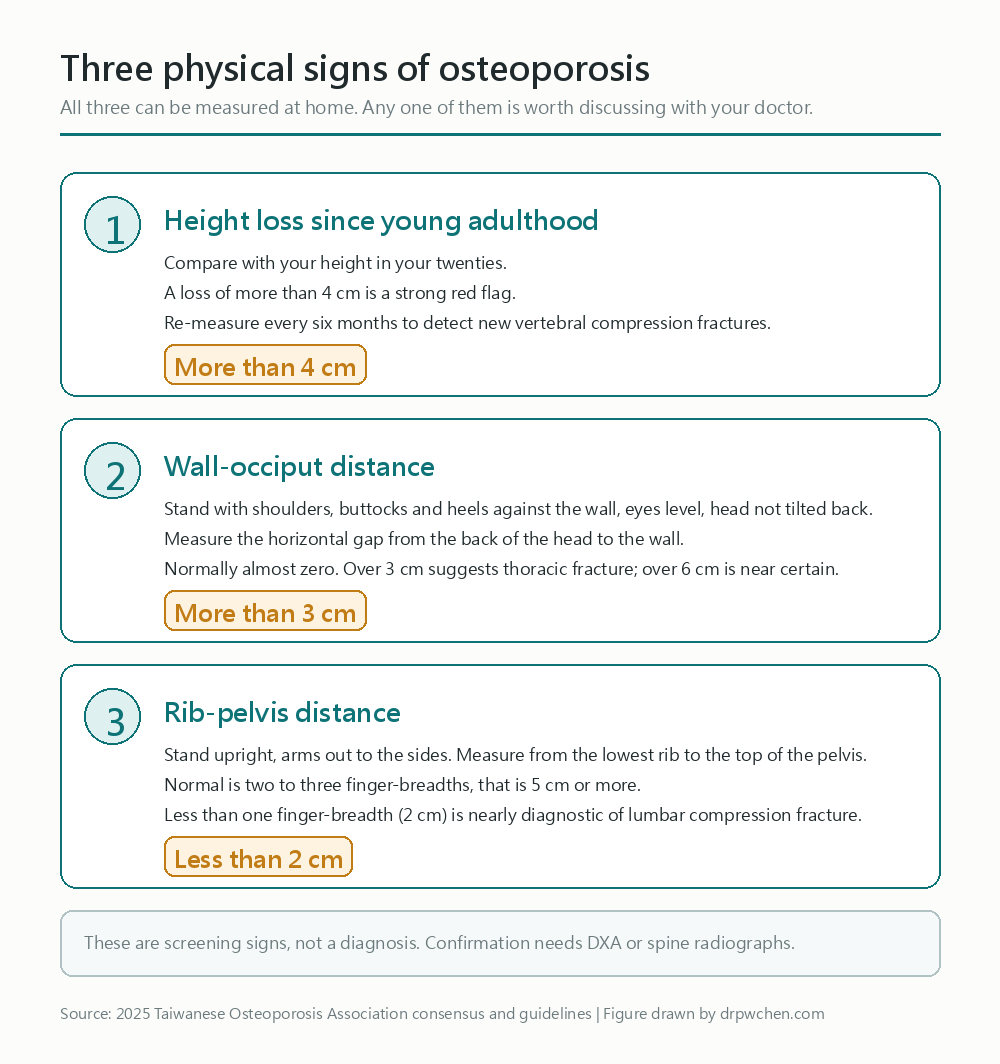
The first one is the most useful: if you are more than 4 cm shorter than you were in your twenties, strongly suspect osteoporosis. A lot of people think it’s normal to get a bit shorter as you age, but shrinking by 4 cm usually means you’ve already crushed more than one vertebra.
After that, measuring your height every six months can show you if you’ve crushed a new one.
The second is standing against a wall. Keep your shoulders, buttocks, and heels against the wall, look straight ahead, don’t intentionally tilt your head back, and measure how far the back of your head is from the wall. For normal people, it’s almost zero. Suspect an issue if it’s over 3 cm, and it’s almost certain if it’s over 6 cm that you have a thoracic compression fracture.
The third is measuring the distance between your ribs and pelvis. Stand straight, raise both arms to the sides, and measure from the lowest rib to the top of your pelvis. Normally, it’s two or three finger widths, meaning over 5 cm. Less than one finger width (2 cm) almost always means a lumbar vertebra has collapsed.
None of these are diagnoses. They are signals that it’s time to make a doctor’s appointment.
Who should get a bone density scan?
The recommendations in Taiwan are roughly these groups:
- Women over 65 and men over 70. Once you hit this age, you should get one.
- Women under 65 who are postmenopausal with risk factors.
- Men between 50 and 70 with risk factors.
- Anyone who fractures a bone from a “light fall," regardless of age.
That last point is the most important and the most frequently missed. After 50, fractures of the wrist, shoulder, hip, or spine—as long as they aren’t from high-impact trauma like a car crash—should be treated as a red flag for osteoporosis, not just “bad luck from a fall.”
Because after your first fracture, your risk of breaking another bone in the short term goes way up. Half the people who suffer an osteoporotic fracture will have a second one.
“My T-score isn’t -2.5” doesn’t mean you’re fine
Your scan report will have a T-score. Anything at or below -2.5 is osteoporosis, and between -1 and -2.5 is osteopenia.
But many people don’t know that there are three paths to a diagnosis, and meeting any one of them counts as osteoporosis:
- A T-score of -2.5 or lower.
- Having a low-trauma fragility fracture (forearm, hip, or spinal compression), regardless of your T-score.
- More than 20% height deformation in any vertebra, even if your T-score is above -2.5.
In other words, if you’ve had a fracture, even if your report says “osteopenia,” it is still osteoporosis, and it still requires treatment. I have to explain this in clinic all the time.
Calcium and Vitamin D: Take them together, and they don’t replace meds
Let’s talk amounts first:
- Postmenopausal women need a total of 1200 mg of calcium daily; men over 50 need 1000 mg. This amount includes both food and supplements.
- Vitamin D should be 800 to 1000 IU daily, aiming for a blood 25(OH)D level of 30 ng/ml or higher.
Now for three common misunderstandings.
First, if you take more than 500 mg of calcium at once, absorption drops off, so it’s better to split it into a morning and evening dose. Also, don’t take it with iron supplements.
Second, taking only calcium or only vitamin D doesn’t have enough evidence to show it lowers fracture risk. You need to take both together for it to work. A 2019 meta-analysis showed combining them reduces fractures by 6% and hip fractures by 16%.
Third, and most importantly: calcium and vitamin D cannot replace medications. For people already diagnosed with osteoporosis or who have already fractured a bone, the rule is “take your meds AND supplement calcium and D,” not pick one or the other.
More isn’t better either. Taking over 1200 to 1500 mg of calcium daily won’t give you extra benefits and might actually increase your risk of kidney stones and cardiovascular issues.
As for getting sunlight, it actually doesn’t work well for most people. Sunscreen, air pollution, and being behind glass all cut down the effectiveness, so supplementing is much more practical.
What should you do for exercise?
It’s not just about taking casual walks; you need to do all three of these:
- Weight-bearing cardio: Brisk walking, jogging, climbing stairs, dancing, tai chi. Moderate intensity, 3 to 5 times a week, 30 minutes each time.
- Strength training: At least twice a week, working large muscle groups like legs, back, and core, 8 to 12 reps per set, for 2 to 3 sets.
- Balance training: Tai chi, standing on one leg, 2 to 3 times a week.
Among these three, balance training often gets skipped, but it’s what dictates whether you fall or not. For someone who already has osteoporosis, preventing falls is actually more directly useful than increasing bone density.
Protein intake needs to keep up too. 1.0 grams per kilogram of body weight a day, or 1.2 grams for older adults, evenly split across three meals, not crammed into dinner. Protein combined with strength training is the only way to maintain muscle; this is tied into the same set of issues as sarcopenia.
If you already have a spinal compression fracture, note this: avoid fast bending, twisting, and heavy lifting. Exercise for this group is best done under the evaluation and guidance of a professional, but I want to emphasize that exercise itself does not increase the risk of fracture; not moving is far worse.
Before you start meds, see a dentist
This is the easiest thing to overlook in this whole post, but the consequences are the most troublesome.
Osteoporosis injections and oral meds have a very small chance of causing osteonecrosis of the jaw. The odds are very low, but once it happens, it’s incredibly hard to treat.
So the right sequence is:
- Before starting meds, go to a dentist or oral and maxillofacial surgeon for a checkup, a thorough cleaning, and tartar removal.
- Any teeth with a poor prognosis that can’t be saved should be pulled before you start the meds.
- After the extraction, wait 3 to 4 weeks for the wound to heal before starting osteoporosis drugs.
For those already on meds, you should know: routine cleanings, fillings, root canals, and dentures can all be done as usual without stopping your meds. What you really have to be careful about are surgeries that involve the jawbone, like extractions and implants.
If you absolutely must get a tooth pulled while on meds, the recommendation is to stop oral meds 3 months prior, or injections 3 to 6 months prior, and resume after the bone heals. But this decision absolutely must be discussed with the prescribing physician, because the risk of a fracture while off the meds is also very real; stopping doesn’t mean you’re in the clear.
Also, while on meds, get a dental exam at least every six months.
The most important part: You can’t just stop every osteoporosis drug on a whim
I really hope you remember this part.
Osteoporosis drugs roughly fall into two categories, and the rules for stopping them are completely different:
Bisphosphonates (oral Fosamax, Reosteo; injectable Aclasta, Bonviva)
These drugs accumulate in the bone and have a residual effect after you stop taking them, which is why “drug holidays” exist. After 5 years of oral meds, or 3 years of injections, if your risk has dropped, you can pause them for a while under a doctor’s evaluation and follow up regularly.
Prolia (denosumab), Forteo, Evenity
You absolutely cannot stop these on your own.
Prolia is a subcutaneous injection given every six months. Many people take it for a few years, think “that should be enough,” and stop coming back to clinic. But it doesn’t stay in your bones. Once you stop, your bone density drops rapidly, and you’ll get rebound multiple vertebral fractures.
How bad is it? In studies, the rate of vertebral fractures while on the drug was 1.2 per 100 person-years; after stopping, it jumped to 7.1, happening as early as seven months after the last dose. And it’s rarely just one vertebra crushed; it’s usually several at once.
So the rule is: if you take Prolia, you can’t quit cold turkey; you must follow it up with a bisphosphonate before stopping. The same goes for Forteo and Evenity. After the course of treatment finishes, you have to relay to an antiresorptive drug, otherwise the bone density you worked so hard to build up over a year or two will be lost.
If you or your family members are on a twice-a-year osteoporosis injection, please don’t decide to just stop taking it on your own. If you want to stop, go back to the clinic to arrange the follow-up meds.
NHI coverage loosened up starting March 2025
In the past, National Health Insurance (NHI) coverage for osteoporosis meds almost always required you to have “already fractured.” Starting March 1, 2025, there are two changes:
- The covered fracture sites have been expanded to the distal radius (wrist) and proximal humerus (upper arm), no longer just the spine and hip.
- For the first time, they’ve opened up preventive coverage before a fracture: if your T-score is -2.5 or lower, plus you have rheumatoid arthritis, are diabetic using insulin, or take more than 5 mg of steroids daily for over three months, you can get meds before a fracture even happens.
This is a turning point for Taiwan’s osteoporosis treatment policy, shifting from “treat after the break” to “prevent before the break.” If you meet the criteria, it’s worth bringing it up with your doctor proactively.
The definition of treatment success isn’t getting your T-score back to normal
Let me leave you with one last concept.
Many people take meds for a year or two, look at their report, see their T-score only went from -3.0 to -2.8, think “these meds are useless,” and give up.
But the definition of treatment success for osteoporosis is: no more fractures, and no significant drop in bone density. It’s not about trying to get your T-score back to normal.
And you have to take the meds long enough for it to count. It takes at least a year, ideally three or more to really see the fracture-lowering effects; if you take less than half of what you were supposed to cumulatively, it’s almost the same as having no protection at all. Osteoporosis is a chronic disease just like hypertension; it requires long-term, uninterrupted management.
When to definitely see a doctor
- You’re over 4 cm shorter than you were in your youth, or you’ve lost height again in the last six months.
- A fracture happening without significant external force, anywhere in the body.
- Sudden severe back pain, or pain especially when bending or rolling over in bed, which could be a new compression fracture.
- People on long-term osteoporosis meds developing a dull ache in one or both thighs. This could be a precursor to an atypical femoral fracture, which will ache for weeks to months before fully breaking. Checking it early can prevent a complete fracture.
- You’re on osteoporosis injections but are past due for your follow-up.
Clinical Pearls
- Three diagnostic paths: central DXA T-score ≤ -2.5 (postmenopausal women/men ≥50), or low-trauma fragility fracture (forearm, hip, spine), or any vertebral height deformation >20%, valid even if T > -2.5.
- High-suspicion signals: height loss >4 cm vs youth, wall-occiput distance (WOD) >3 cm, rib-pelvis distance (RPD) <2 cm, BMI <18.5, fragility fracture of hip/spine/forearm/proximal humerus at age ≥50.
- Pre-treatment checklist: serum Ca, P, renal function; replete Ca and Vit D; dental exam (extract poor prognosis teeth first, wait 3-4 weeks to heal before starting meds); rule out secondary osteoporosis.
- Drug holidays only apply to bisphosphonates (after 5 years oral / 3 years IV, depending on risk); denosumab and anabolics cause rebound fractures when stopped and are strictly contraindicated for cold turkey cessation; they require sequential therapy bridging to antiresorptive agents.
- NHI (effective Mar 1, 2025): antiresorptive coverage expanded to distal radius, proximal humerus, and first-time pre-fracture preventive coverage for high-risk (RA/diabetics on insulin/steroids >5 mg/day) using Prolia or Alendronate Sandoz 70mg.
- Teriparatide’s osteosarcoma boxed warning was removed in 2020 (15 years of human monitoring showed no increase), and the label permits use >2 years in high-risk patients; however, Taiwan NHI is still limited to 18 pens / used within 2 years.
Abbreviations
| Abbreviation | Full Name |
|---|---|
| DXA | Dual-energy X-ray Absorptiometry |
| BMD | Bone Mineral Density |
| FRAX | Fracture Risk Assessment Tool |
| TBS | Trabecular Bone Score |
| BTM | Bone Turnover Marker |
| LSC | Least Significant Change |
| ONJ | Osteonecrosis of the Jaw |
| AFF | Atypical Femoral Fracture |
| GIOP | Glucocorticoid-Induced Osteoporosis |
| SERM | Selective Estrogen Receptor Modulator |
| FLS | Fracture Liaison Service |
| WOD | Wall-Occiput Distance |
| RPD | Rib-Pelvis Distance |
Disease Background
Definition
- WHO/NIH: A disease characterized by low bone mass and microarchitectural deterioration of bone tissue leading to decreased bone strength and increased fracture risk
TOA 2025- Bone strength = Bone density (measurable) + Bone quality (architecture/turnover/damage accumulation/mineralization, not measurable)
- Differential concept: Osteomalacia has the bone matrix scaffolding but lacks minerals (Ca, PO4).
Epidemiology (Taiwan)
- Hip fracture incidence is #1 in Asia, #9 globally; Taiwan enters a super-aged society in 2025 with >4.5 million people ≥65
TOA 2025 - Prevalence (DXA, 2005-2008 NAHSIT, ≥50 y/o): men 23.9%, women 38.3%; hits up to 63% in elderly women in rural areas
- Approx. 21,000–23,000 new hip fractures annually in those ≥50 (men 7,500–9,000, women 13,000–14,000)
- Lifetime fracture risk: roughly 1/3 of women and 1/5 of men will suffer a spine/hip/wrist fracture in their lifetime
- Average medical costs one year post-hip fracture is NT$142,521 (year two NT$95,932, year three NT$93,476)
- Hip fracture types: femoral neck 48.4%, intertrochanteric 51.6%
Mechanisms and Physiology
- Bone density peaks in the 20s, then declines yearly
- Remodeling homeostasis
- Osteoclasts resorb bone, Osteoblasts build bone
- RANK ligand (from osteoblasts) stimulates osteoclasts to resorb bone
- Stimulates RANKL: PTH, cortisol, inflammation
- Inhibits RANKL: Estrogen, OPG
- Triad of aging changes: sarcopenia, osteoporosis, obesity (all associated with insufficient physical activity)
Etiology and Classification
- Primary
- Type 1 (postmenopausal, ~50–65 y/o): Estrogen ↓ → increased bone remodeling activation rate, entering a 4–10 year accelerated loss phase, cumulatively losing 5–10% of cortical bone and 20–30% of trabecular bone during this period
NSCA Special Populations Ch.3- Rough annual rate: ~1%/year from middle age, ~2%/year for the first 5 years post-menopause
Magee Scientific Foundations Ch.14
- Rough annual rate: ~1%/year from middle age, ~2%/year for the first 5 years post-menopause
- Type 2 (senile, >70 y/o): Driven by ↓ renal Vit. D production, ↓ calcium absorption, ↓ physical activity, ↓ sex hormones; both men and women lose another ~20–25% each of cortical and trabecular bone during this phase
NSCA Special Populations Ch.3
- Type 1 (postmenopausal, ~50–65 y/o): Estrogen ↓ → increased bone remodeling activation rate, entering a 4–10 year accelerated loss phase, cumulatively losing 5–10% of cortical bone and 20–30% of trabecular bone during this period
- Secondary (accounts for ~30% of postmenopausal women, >50% of premenopausal women, and 2/3 of men)
TOA 2025- Endocrine/Metabolic: DM, acromegaly, GH deficiency, Cushing’s, hyperparathyroidism, hyperthyroidism, hypogonadism, hypophosphatemia
- Nutrition/GI: alcoholism, anorexia nervosa, hypocalcemia, chronic liver disease, celiac disease, gastrectomy/bypass, TPN, Vit. D deficiency
- Meds: steroids, antiepileptics, aromatase inhibitors, chemo/immunosuppressants, GnRH agonists, heparin, lithium, PPIs, SSRIs, SGLT2 inhibitors, TZDs, supraphysiologic thyroxine
- Other: homocysteinemia, Marfan, osteogenesis imperfecta, AIDS, AS, COPD, RA, multiple myeloma, cancer, organ transplant, renal insufficiency, RTA, thalassemia, disuse/immobility
Complications
- Fragility fracture (fracture from low-energy trauma)
- ~40% of osteoporosis patients will suffer a fragility fracture in their lifetime
TOA 2025 - For women, hip fracture risk is higher than breast + ovarian + uterine cancer combined (for men, higher than prostate cancer)
TOA 2025 - Fracture sites: typically wrists in the 50s, shifting to hips later on
- ~40% of osteoporosis patients will suffer a fragility fracture in their lifetime
- Compression fracture (vertebral collapse) → kyphosis, commonly T8–L2
- Taiwan prevalence of ≥1 vertebral compression fracture in ≥65 y/o: men 12.5%, women 19.8% (1993 epi survey)
TOA 2025 - ⚠️ For postmenopausal women, 30% is the “lifetime fracture risk”, not the vertebral compression fracture prevalence (the T ≤ -2.5 cutoff was set based on this percentage)
TOA 2025 - After one osteoporotic fracture, the chance of a second fracture hits 50%
TOA 2025
- Taiwan prevalence of ≥1 vertebral compression fracture in ≥65 y/o: men 12.5%, women 19.8% (1993 epi survey)
- ⚠️ Re-fracture risk rises exponentially with each subsequent fracture
Prognosis
- Hip fracture 1-year mortality rate (NHIA data): In 1999, men 22%, women 15%; by 2009, dropped to men 18%, women 11.2%, but the standardized mortality rate in the matched control group dropped even more (men 3.6%, women 2.8%), meaning the gap actually widened instead of narrowing
TOA 2025- Cause of death is primarily infections from prolonged bedrest
- Only about half recover to their pre-fracture functional level after a hip fracture; 1 in 10 remain bedridden a year later
TOA 2025 - Hip fracture risk is further elevated with these comorbidities: DM, RA, stroke, Parkinson’s, organ transplant, cancer, hemodialysis
Clinical Assessment
Diagnostic Criteria
Use T-score for postmenopausal women / men ≥50 TOA 2025
- Osteoporosis: diagnosed if ANY of the following are met
- Central DXA (L-spine + at least one hip; if both unmeasurable, use distal 1/3 of non-dominant forearm radius) lowest T-score ≤ -2.5
- T-score -1 to -2.5 → osteopenia
- T-score reference standard: young Caucasian women (NHANES III) for both men and women, for international comparability
- Low-trauma fragility fracture (forearm, hip, vertebral compression) → direct diagnosis regardless of BMD
20% height deformation in any vertebra (even if T > -2.5)
- Central DXA (L-spine + at least one hip; if both unmeasurable, use distal 1/3 of non-dominant forearm radius) lowest T-score ≤ -2.5
- Severe (established): Osteoporosis + fragility fracture
- Premenopausal women / men <50: Use Z-score with local population reference database
- Z ≤ -2.0 = below expected range for age
- Z ≤ -2.0 + fragility fracture = osteoporosis
History Taking
- Fall history, fragility fracture history, family history of hip fracture, age of menopause, secondary causes and medication history
- Track height every 6 months (to estimate if there are new lumbar compression fractures)
TOA 2025
Physical Examination
- Height loss >4 cm vs youth (strong suspicion)
TOA 2025 - Wall-Occiput Distance (WOD): stand against wall, shoulders/buttocks/heels touching, look straight ahead, measure horizontal distance from occiput to wall
- Normal <1 cm; >3 cm strong suspicion, >6 cm (three finger widths) almost certain → silent thoracic compression fracture
- Rib-Pelvis Distance (RPD): stand straight with arms raised laterally, measure vertical distance from lowest rib margin to upper pelvic rim
- Normal 2–3 finger widths (>5 cm); <2 cm (one finger width) → lumbar compression fracture
Radiography
- Requires at least 30% bone loss to be visible; vertebral compression fractures are often asymptomatic and easily missed
- Genant semiquantitative classification (1993): ≥50 y/o, anterior/middle/posterior height difference >20% or wedge/biconcave height difference ≥4 mm = mild deformity
- Compression fracture definition: Grade 1 deformity (20–25%) + endplate/cortical fracture, or Grade 2 (>25%) and above
- Must rule out TB, metastases, multiple myeloma (especially in upper thoracic spine) before treatment
- Morphology interpretation
- Wedge: anterior vs posterior of same vertebra
- Biconcave: central vs anterior/posterior of same vertebra
- Crush: compared to adjacent upper/lower vertebrae
DXA Scan
- Gold standard; measure L-spine + at least one hip (to avoid false negatives from L-spine degenerative arthritis)
- Inaccurate when: compression fracture, post-OP
- VFA (Vertebral Fracture Assessment) can be added, but a lateral thoracolumbar X-ray is still recommended to rule out other etiologies
- Not recommended to repeat within a year (except GIOP), generally follow up after 2 years
- QUS / peripheral bone densitometry: Currently not recommended as a diagnostic or monitoring tool, only for initial screening, abnormal results need DXA confirmation; if discordant, DXA prevails
Laboratory Tests
- Basic workup to rule out secondary causes: CBC, liver/renal function, serum Ca, P, 25(OH)D, PTH, thyroid function, sex hormones
TOA 2025,BHOF 2022 - If T < -3.0 or multiple fractures at initial diagnosis → add special tests for rare causes
Bone Turnover Markers (BTMs)
- Resorption: CTX, NTX
- Formation: bone-specific ALP, P1NP, osteocalcin
- Utility: short-term monitoring (reflects changes in ~3 months, earlier than DXA), evaluating compliance and efficacy; not for diagnosis
- Antiresorptives: baseline, 3, 6, 12 months
- Anabolics: monitor with P1NP, at baseline, 1–3, 6, 12 months
Trabecular Bone Score (TBS)
- Software analysis of L-spine cancellous bone texture, indirectly evaluating trabecular microarchitecture; can be integrated into FRAX
- Limited to BMI 15–37, L-spine only, cannot diagnose independently, cannot be used to monitor antiresorptive efficacy
- Osteopenia but TBS <1.2 may warrant aggressive treatment
- Particularly useful in populations where DXA interpretation is difficult: Type 2 DM, long-term steroids, CKD, parathyroid dysfunction
Risk Assessment Tools
- Clinical Risk Factors (CRF): age, sex, low BMI, fracture history (hip/spine/wrist/proximal humerus), height loss >4 cm, parental hip fracture, smoking, excessive alcohol, secondary causes/meds, prolonged bedrest/frailty
- OSTAi (postmenopausal women): [Weight (kg) − Age] × 0.2, < -1 is high risk
- MOSTAi (men ≥50): 0.3 × Weight − 0.1 × Age, ≤11 is high risk
- FRAX (can be calculated with or without DXA, computes 10-year risk, must select “Asia - Taiwan”)
- Moderate risk: Major osteoporotic fracture (MOF) >10% or Hip >1.5%
- High risk: MOF >20% or Hip >3% → requires proactive treatment
- Very high risk: MOF >30% or Hip >4.5%
- Limitations: doesn’t account for multiple fractures, fall history, L-spine BMD, hip axis length; cannot be used to track treatment efficacy
- Taiwan local thresholds (men/women): For cost-effectiveness MOF >12.5%/15.0% or Hip >6.0%/7.0%; considering actual fracture risk >9.5%/10.0% or >3.0%/4.0%
- Applicable for ages 40–90 treatment-naive; <40 calculated as 40, >90 calculated as 90; the final field should use femoral neck raw BMD value and machine type, try not to enter T-score
Indications for Screening and Referral
- Recommended DXA screening populations
TOA 2025- Women ≥65 or men ≥70
- Women <65 who are postmenopausal with risk factors; perimenopausal women with fracture risk factors
- Men 50–70 with risk factors
- Those with a fragility fracture (low-impact fracture)
- Users of disease/medications that cause low bone mass; FRAX moderate risk and above
- High suspicion fragility fracture sites: Fractures of the hip, spine, forearm (distal radius), proximal humerus at age ≥50 are highly indicative of osteoporosis unless ruled out by tests
BHOF 2022- ⚠️ Any adult fracture should be seen as a red flag, short-term re-fracture risk spikes after the first one
BHOF 2022
- ⚠️ Any adult fracture should be seen as a red flag, short-term re-fracture risk spikes after the first one
Differential Diagnosis
| Disease | Key Differentiating Features |
|---|---|
| Osteomalacia | Bone matrix formed but poorly mineralized; low serum Ca/P, high ALP, Looser zones |
| Multiple Myeloma | Osteolytic lesions, M-protein, anemia, hypercalcemia, ↑ ESR |
| Bone Metastases | Known primary cancer, mixed lytic/blastic, upper thoracic compression fractures |
| Hyperparathyroidism | Hypercalcemia, ↑ PTH, subperiosteal resorption |
| Paget’s Disease | Markedly ↑ ALP, enlarged deformed bones |
Red Flags and Specialist Referral
- Very high fracture risk (meeting any one criterion qualifies)
TOA 2025- Fragility fracture within the past 12 months
- Fracture occurring while on osteoporosis treatment
- Multiple fragility fractures
- Fracture after bone-harming meds (long-term steroids)
- Extremely low T-score (< -3.0)
- High fall risk or history of injurious falls
- Very high FRAX (MOF >30%, Hip >4.5%)
- When to refer to an osteoporosis specialist
TOA 2025- Multiple/rare site fractures despite non-low BMD
- Extremely low BMD
- Recurrent fracture or significant BMD decline after one year of treatment
- Multiple/complex comorbidities (renal failure, difficulty medicating)
Clinical Management
Treatment Algorithm
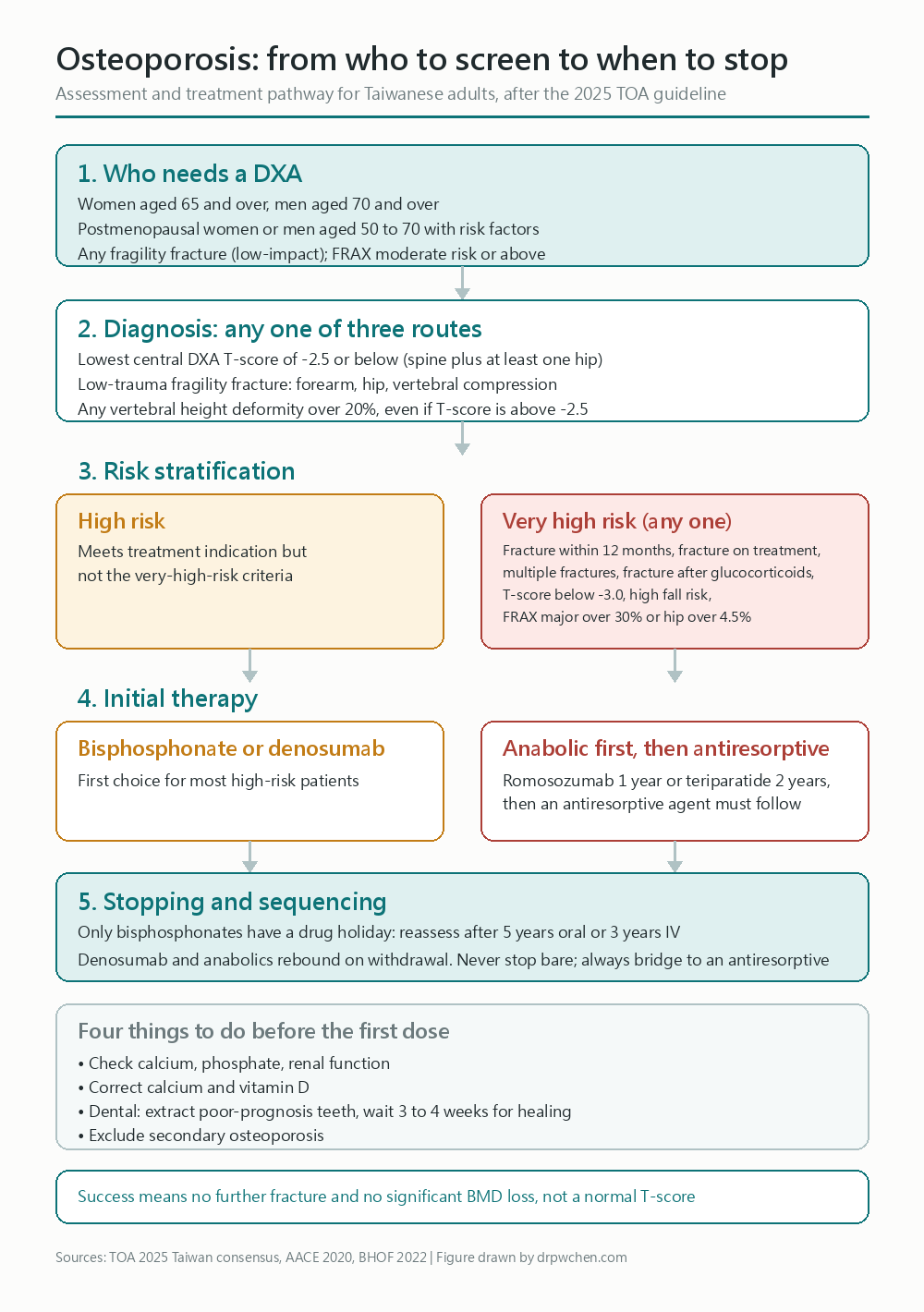
Taiwan Adult Osteoporosis Assessment and Treatment Algorithm
TOA 2025,AACE 2020
- Step 1 Screening targets: Reached target age / fragility fracture / high risk factors / height loss >4 cm
- Step 2 Establish treatment indications (Any one of the following)
- Fragility fracture (low-energy fracture)
- DXA T ≤ -2.5
- Osteopenia (-2.5 < T < -1.0) + FRAX moderate or above (MOF >20% / Hip >3%)
- Step 3 Initial medication (By risk stratification; complete pre-treatment checklist first)
- General high risk → Bisphosphonate or denosumab (first choice for most)
- Very high risk → Prioritize romosozumab for 1 yr or teriparatide for 2 yrs, then relay to an antiresorptive (anabolic-first strategy, AACE/BHOF)
- Postmenopausal women unsuitable for BP/denosumab → SERM / STEAR / Estrogen
- Do not co-administer two antiresorptives, or an antiresorptive + anabolic (no additive benefit except teriparatide+denosumab or +zoledronate)
- Step 4 Individual considerations: Renal function, sex, age, compliance, NHI coverage
- Step 5 Follow-up and stop/switch: See drug holiday and sequential therapy below
- Definition of treatment success = No more fractures, no significant BMD decline (not striving to normalize T-score)
Goals of Therapy
- Reduce incidence of fragility fractures (Primary prevention = low bone mass without prior fracture; Secondary prevention = prior fracture or T ≤ -2.5)
- Chronic disease concept: Requires long-term continuous and sequential medication; taking less than half the cumulative dose offers almost no fracture protection
Non-pharmacological: Calcium
- Supplementation principles: Diet + calcium tablets, total daily for postmenopausal women 1200 mg, men ≥50 1000 mg
TOA 2025- Poor absorption if single dose >500 mg, divide into morning and evening; avoid taking with iron
- ⚠️ Total daily >1200–1500 mg provides no added benefit and increases kidney stone/cardiovascular risk
- High calcium diet: cheese, beans, dark green vegetables, sesame, daylily, seaweed, kelp, shiitake, dried anchovies, nuts
- Vitamin C-rich fruits aid collagen synthesis; magnesium, vitamin K2, milk basic protein (MBP) evidence remains inconclusive
Non-pharmacological: Vitamin D
- Dose: <50 y/o 400–800 IU, ≥50 y/o 800–1000 IU, target serum 25(OH)D of 30 ng/ml (75 nmol/L) or higher
TOA 2025- Some patients need higher doses to reach target, should monitor 25(OH)D regularly to determine dose, avoid self-administering high doses
- Sun exposure is ineffective for most (sunscreen, pollution, skin cancer concerns) → exogenous supplementation is more important
- ⚠️ Evidence is insufficient for supplementing only calcium or only D; both are needed to effectively lower fracture risk (2019 meta-analysis: combined use drops fractures 6%, hip fractures 16%)
TOA 2025- Calcium + D cannot replace osteoporosis meds, they must be given concurrently
Non-pharmacological: Protein
- Daily at least 1.0 g/kg (elderly 1.2 g/kg), evenly distributed across three meals
TOA 2025- Combined with strength training maintains muscle, prevents falls
- Adequate protein post-fracture reduces medical complications, shortens inpatient rehab time
Non-pharmacological: Exercise
- Types: Weight-bearing cardio (brisk walking, jogging, tai chi, stair climbing, jump rope, dancing), resistance, posture, flexibility, balance
TOA 2025- Weight-bearing cardio: Moderate intensity, 3–5 times/week, 30 mins each
- Resistance: At least twice a week, large muscle groups 8–12 reps × 2–3 sets
- Balance/fall prevention: Tai chi / single-leg stand, 2–3 times/week
- Population differences: Premenopausal women and younger people can use weight training and high-impact training; postmenopausal and older adults should stick primarily to regular cardio, resistance, and balance training
- ⚠️ For those with known vertebral compression fractures: Avoid fast spinal flexion, twisting, and excessive loading
Non-pharmacological: Fall Prevention
- Home grab bars/lighting/anti-slip, clear hallway clutter, appropriate assistive devices (canes, walkers, hip protectors)
- Three key fall questions (Fell in the past year? Feel unsteady standing/walking? Worried about falling?) If any is “yes” → gait and balance assessment
TOA 2025 - Supplement Vit D >800 IU/day (evidence on fall prevention is mixed but side effects are low)
Pre-treatment Checklist
- Before ALL osteoporosis meds: Check serum Ca, P, renal function to evaluate for hypocalcemia or renal impairment
TOA 2025 - Rule out secondary osteoporosis: CBC, liver/renal function, Ca/P/25(OH)D/PTH, thyroid, sex hormones (osteomalacia, CKD, hyperparathyroidism etc. cannot use standard osteoporosis meds, must treat underlying cause first)
BHOF 2022 - Replete calcium and vitamin D (correct hypocalcemia first, especially for denosumab/anabolics)
- Dental prerequisite (ONJ prevention)
TOA 2025- Visit dentist / oral surgeon before meds: Oral hygiene education, exam, thorough scaling/tartar removal
- Untreatable teeth with poor prognosis → extract before starting meds; wait 3–4 weeks for healing before initiating medication
- Scaling, fillings, root canals, dentures, and other non-jaw-invasive treatments can be done while on meds
- Bisphosphonates: Must test serum creatinine beforehand to ensure label compliance
NHI Drug Reimbursement Regulations 5.6.1 - Denosumab / Anabolics: Confirm normocalcemia, educate on hypocalcemia symptoms
- DXA baseline; consider BTM baseline for future compliance monitoring
Pharmacotherapy Overview
Quick guide to dosing frequencies
TOA 2025 Table 4
- Teriparatide, Raloxifene/Estrogen: Daily
- Alendronate/Risedronate: Weekly (risedronate also has a monthly formulation)
- Romosozumab: Monthly
- Ibandronate: Quarterly
- Denosumab: Every 6 months
- Zoledronate: Yearly
- Usage and fracture efficacy grading
TOA 2025 Table 4; Renal cutoffs and side effectsAACE 2020,BHOF 2022 - ⚠️ Regardless of the osteoporosis drug, must concurrently supplement Calcium 1200 mg + Vitamin D3 800 IU daily
TOA 2025
| Category | Drug Name | Dosing | Advantages | Disadvantages |
|---|---|---|---|---|
| Oral SERM | Evista (Raloxifene) | PO QD | No estrogen-related breast/uterine side effects; less ONJ association; can be used in renal impairment; also lowers breast cancer risk | Only partial indirect evidence for non-vertebral fractures, not suitable for hip fractures; hot flushes, leg cramps; very rare VTE; not indicated in men |
| Oral BP | Fosamax / Alendronate Sandoz (Alendronate) | PO QW | Robust evidence for vertebral/non-vertebral/men/GIOP; Fosamax also contains Vit D3 | Upper GI irritation (must fast, sit upright 30 mins); avoid if GFR <35 mL/min; very rare ONJ / AFF |
| Oral BP | Reosteo (Risedronate) | PO QW (also QM) | Robust evidence for vertebral/non-vertebral/men/GIOP; more lenient renal cutoff than alendronate | Avoid if GFR <30 mL/min; upper GI irritation; very rare ONJ / AFF |
| IV BP | Bonviva (Ibandronate) | IV Q3M | Negligible GI side effects; GFR cutoff <30 mL/min (more lenient than zoledronate) | Only partial indirect evidence for non-vertebral fractures, no evidence for men/GIOP; acute phase reaction; very rare ONJ / AFF |
| SC RANKL | Prolia (Denosumab) | SC Q6M | Robust evidence for vertebral/non-vertebral/men; negligible GI side effects; no dose adjustment needed for renal impairment | Rebound fractures on withdrawal; must never be stopped without a bridging agent; elevated hypocalcemia risk in poor renal function; rare infections/constipation/rash; very rare ONJ / AFF |
| IV BP | Aclasta (Zoledronic acid) | IV QY | Robust evidence for vertebral/non-vertebral/men/GIOP; best compliance with once-yearly dosing | First-dose acute phase reaction up to 30% (fever/myalgia, mitigated by acetaminophen 1–2 hrs prior); contraindicated if CrCl <35 mL/min, recalculate CrCl before every dose; infusion must run for at least 15 minutes |
| SC Anabolic | Forteo (Teriparatide) | SC QD | Robust evidence for vertebral/non-vertebral/men; builds bone; can be used in renal impairment | Daily injection, low compliance; NHI limited to 18 pens/2 yrs; orthostatic hypotension, cramps, nausea, transient hypercalcemia; must relay to antiresorptive after stopping |
| SC Mixed | Evenity (Romosozumab) | SC QM | Robust evidence for vertebral/non-vertebral; simultaneous bone formation + antiresorption; can be used in renal impairment | Limited to 12 months; rare arthralgia/headache; very rare ONJ / AFF; contraindicated if MI/stroke within 1 yr, requires evaluation for CVD history; must relay to antiresorptive after stopping |
Antiresorptive Agents
- Common side effects
- Osteonecrosis of the jaw (ONJ): See ONJ section below
- Atypical femoral fracture (AFF): See AFF section below
- Rebound effect upon cessation: SERMs, estrogen, denosumab (bisphosphonates are less prone due to bone retention)
Bisphosphonates
- Mechanism
- Structurally similar to pyrophosphate, binds to hydroxyapatite and concentrates at active bone remodeling sites
- After osteoclast phagocytosis, inhibits FPPS → disrupts mevalonate pathway → apoptosis
- Drugs and Administration
- PO Alendronate 70 mg QW / 10 mg QD
- Poor oral absorption (~2%), requires fasting with plain water, sitting upright for 30 mins, drinking plenty of water (to prevent pill esophagitis)
AACE 2020 - Contraindications: allergy, hypocalcemia, inability to sit/stand upright for 30 mins, esophageal stricture or achalasia
Stubblefield Ch.59
- Poor oral absorption (~2%), requires fasting with plain water, sitting upright for 30 mins, drinking plenty of water (to prevent pill esophagitis)
- Zoledronic acid: Once a year; single dose must not exceed 5 mg, infusion must not be shorter than 15 mins (rapid infusion causes transient/permanent renal decline, high risk for elderly, dehydrated, or those on diuretics/nephrotoxic meds)
Kelley 11e Ch.70,AACE 2020- First-dose acute phase reaction up to 30% (fever + myalgia, resolves in days); giving acetaminophen 1–2 hrs before lowers incidence
AACE 2020
- First-dose acute phase reaction up to 30% (fever + myalgia, resolves in days); giving acetaminophen 1–2 hrs before lowers incidence
- Ibandronate once every quarter
- PO Alendronate 70 mg QW / 10 mg QD
- Renal Cutoffs (per label, NHI also requires testing serum creatinine before use)
AACE 2020,BHOF 2022,NHI Drug Reimbursement Regulations 5.6.1- Alendronate: Avoid if GFR <35 mL/min
- Risedronate, Ibandronate: Avoid if GFR <30 mL/min
- Zoledronate: Contraindicated if CrCl <35 mL/min or AKI, must recalculate CrCl via Cockcroft-Gault before EVERY dose
- ESRD with adynamic bone disease is an absolute contraindication
Stubblefield Ch.59
- Evidence: Sufficient for vertebral, non-vertebral, and hip fractures (postmenopausal)
TOA 2025 Table 4,Masiero 2017
SERM / STEAR / Estrogen
- Raloxifene (SERM): Daily, for postmenopausal women; lowers vertebral fractures
- Ideal for: those with low DVT risk or high breast cancer risk
- Side effects: hot flushes, VTE
- ⚠️ Contraindicated in men, not suitable for hip fractures
- STEAR (Tibolone), Estrogen: Restricted to specific perimenopausal women (<60 y/o or <10 yrs postmenopause, low VTE risk, prominent menopausal symptoms, no contraindications, no history of MI/stroke/breast cancer)
TOA 2025 - Phased out options
TOA 2025- Calcitonin nasal spray: Osteoporosis indication was withdrawn in Taiwan in 2013
- Strontium ranelate: Withdrawn globally in 2018; bazedoxifene withdrawn from Taiwan market
Denosumab (Prolia, RANKL inhibitor)
- Mechanism: directly inhibits RANK ligand, preventing osteoclast activation
- Dosing: 60 mg SC Q6M, with calcium and vitamin D supplementation
- Efficacy comparable to bisphosphonates; does not accumulate in bone
- Side effects: hypocalcemia (markedly increased risk in renal impairment), ONJ, AFF, skin reactions, infections
- ⚠️ Rapid BMD decline and rebound multiple vertebral fractures upon discontinuation; cold turkey is strictly contraindicated
Anabolic Agents
Teriparatide (Forteo)
- Mechanism: Synthetic PTH (1-34; human is 1-84)
- Pulsatile low-dose daily administration → stimulates osteoblasts; continuous infusion paradoxically activates both osteoblasts and osteoclasts
- Dosing: 20 µg SC QD
- Side effects: transient orthostatic hypotension, cramps, nausea; transient hypercalcemia (caution in active/recent kidney stones or hypercalcemia; may induce digitalis toxicity)
BHOF 2022 - ⚠️ The rationale for the “lifetime 2-year maximum” has changed, but Taiwan’s 2-year limit remains
- Old rationale: rat carcinogenicity studies showed osteosarcoma → FDA added boxed warning, label restricted to 24 months
- FDA removed the osteosarcoma boxed warning in Nov 2020: 15 years of post-market surveillance showed no increase in human osteosarcoma; label updated to “Use for more than 2 years during a patient’s lifetime can be considered if a patient remains at or has returned to having a high risk for fracture”
BHOF 2022 - But 2 years is still the practical cap: efficacy and safety data beyond 24 months is limited
- Endocrine Society 2019 and AACE 2020 still recommend transitioning to antiresorptives after 2 years
Eastell 2019,AACE 2020 - Taiwan NHI still strictly limits to 18 pens, to be used within 2 years
TOA 2025,NHI Drug Reimbursement Regulations 5.6.2
- Endocrine Society 2019 and AACE 2020 still recommend transitioning to antiresorptives after 2 years
- Still avoid in those at high risk for osteosarcoma
BHOF 2022- Paget’s disease, prior skeletal radiation, open epiphyses (children/young adults)
- Bone metastases or history of skeletal malignancies, unexplained ALP elevation, hereditary predisposition to osteosarcoma
- ⚠️ BMD is lost almost entirely upon cessation → must relay to an antiresorptive agent
Romosozumab (Evenity)
- Mechanism: Monoclonal antibody inhibiting sclerostin, simultaneously increases bone formation + decreases resorption
- Used for very high risk (AACE/BHOF first-line), treatment max 1 year
- ⚠️ Cardiovascular event warning; cessation also requires relaying to an antiresorptive agent
Post-treatment Monitoring
- Meds need at least 1 year (ideally >2–3 years) to truly lower fractures; taking <50% cumulative dose is practically ineffective
TOA 2025 - DXA follow-up: same machine, changes exceeding the LSC (hip 3–6% / L-spine 2–4%) are considered significant
- Track raw values in g/cm², to prevent misguided discontinuation and subsequent rebound just because the T-score returned to normal
- BTM: monitor at 3, 6, 12 months for compliance and response
- Maintenance counseling (up to half drop out due to poor compliance): integrate into daily routine, diaries, family support, patient groups
- Taiwan FLS achievements: 82.7% of enrollees completed DXA within 8 weeks (vs national average 23.5%), 78.8% started meds within 3 months (vs 24.9%), and 92.2% achieved >75% medication compliance at one year
TOA 2025
Drug Holidays (Bisphosphonates Only)
- Principle: Bisphosphonates accumulate and persist in bone, maintaining residual efficacy post-discontinuation, making a pause feasible
TOA 2025,DeLisa Ch.31 - Oral bisphosphonates
- After 5 years of treatment, if T > -2.5 and no new fractures → can pause and track BMD regularly
- High/Very high risk → continue to 6–10 years before reassessing (e.g., T > -2.0)
- IV bisphosphonates (zoledronate)
- High risk: reassess after 3 years
- Very high risk: continue to 6 years before reassessing
- When to re-evaluate after starting holiday
DeLisa Ch.31: risedronate ~1 yr, alendronate 1–2 yrs, zoledronate 2–3 yrs (measure BMD ± BTM) - Indicators to end holiday (resume meds): increased fracture risk, BMD decline exceeding LSC, significant BTM changes
- ⚠️ Denosumab and Anabolics (teriparatide / romosozumab) do NOT have drug holidays
- Stopping triggers accelerated BMD loss and rebound fractures
- Post-denosumab vertebral fracture incidence rises from 1.2 to 7.1 per 100 person-years; multiple vertebral fractures 3.4% vs 2.2%, occurring as early as 7 months off-drug
Walker 2023 NEJM,Tsourdi 2020 ECTS
Sequential Therapy
- After anabolics (teriparatide) / mixed (romosozumab) → MUST relay to an antiresorptive (BP, denosumab, raloxifene) to lock in gains
TOA 2025,Tsourdi 2020 ECTS - Denosumab discontinuation → bridge to bisphosphonate to prevent rebound
- Alendronate: start weekly dosing 6 months after the last denosumab dose
- Zoledronate: give 6–7 months after the last dose, may need a second dose 3–6 months later if needed (guided by BTMs)
Tsourdi 2020 - Rebound is harder to prevent for denosumab use >2 years; referral to an osteoporosis specialist is recommended
- After bisphosphonates/SERMs → can transition to anabolics (transitioning denosumab to anabolics causes transient hip BMD loss before recovering)
- Antiresorptives can be swapped; re-evaluate after 1–2+ years post-transition
Osteonecrosis of the Jaw (ONJ) and Dental Issues
- Mechanism and Epidemiology: Antiresorptives (BPs, denosumab) can cause osteomyelitis/osteonecrosis of the maxilla/mandible, mostly discovered after 3 years of use
TOA 2025- 94% of ONJ cases occur in cancer patients receiving multiple IV BP doses; the risk at osteoporosis doses is low
DeLisa Ch.31 - Symptoms: classic pain + exposed bone; also oral pain/swelling, lower lip numbness, gingival tearing, suppuration, extra-oral fistulas, loose teeth
- 94% of ONJ cases occur in cancer patients receiving multiple IV BP doses; the risk at osteoporosis doses is low
- Pre-medication prep: extract poor prognosis teeth, scale tartar, heal before starting (see Pre-treatment Checklist)
- Jaw-invasive procedures (extractions, implants) while on meds
TOA 2025- If possible, stop oral BPs 3 months pre-op, or injectables 3–6 months pre-op
- Resume meds only after post-op bone healing is complete (this still doesn’t completely eliminate risk)
- Scaling/fillings/root canals/dentures (non-invasive) → can continue while on meds
- Maintain oral hygiene throughout, oral exam + scaling at least every 6 months
- International perspectives (presented alongside Taiwan guidelines)
- ADA does not routinely recommend stopping BPs for dental procedures; AAOMS recommends stopping for 2 months if used >4 years + risk factors present
Ruggiero 2014 AAOMS,Eastell 2019 - Denosumab: short half-life, the 5th month after the last dose is the window for bone remodeling recovery, scheduling elective surgery here is optimal
Goulden 2023 - ⚠️ Any decision to stop meds must weigh ONJ risk vs fracture risk off-meds with the prescribing physician
- ADA does not routinely recommend stopping BPs for dental procedures; AAOMS recommends stopping for 2 months if used >4 years + risk factors present
Atypical Femoral Fractures (AFF)
- Mechanism: Prolonged antiresorptives (mainly BPs/denosumab) severely suppress remodeling → micro-fractures cannot repair → transverse/oblique fracture at mid-shaft or subtrochanteric femur
TOA 2025,DeLisa Ch.31 - Warning sign: weeks to months of dull aching in one or both thighs prior to fracture; imaging shows focal cortical thickening, callus formation, recurrent microcracks
- Incidence is extremely low
Glucocorticoid-Induced Osteoporosis (GIOP)
- ~50% of those using steroids >6 months suffer some degree of osteoporosis; Mechanism: shortens osteoblast/osteocyte lifespan, prolongs osteoclast lifespan, reduces bone vascularity
TOA 2025 - ⚠️ The fracture risk of a T-score of -1 on long-term steroids equals a T-score of -2.5 in typical postmenopausal women
- Evaluation: usage >3 months → DXA or FRAX (weighting adjusted by daily prednisolone dose)
- Dose weighting (hip fracture): <2.5 mg → ×0.65; 2.5–7.5 mg → no adjustment; >7.5 mg → ×1.20
ACR 2022 - TBS may reflect fracture risk better than T-score in GIOP
TOA 2025
- Dose weighting (hip fracture): <2.5 mg → ×0.65; 2.5–7.5 mg → no adjustment; >7.5 mg → ×1.20
- Management: prioritize stopping/tapering steroids or switching to alternatives; proven GIOP treatments = alendronate, risedronate, zoledronate, teriparatide, denosumab
- Preventive measures: taper steroids, Ca + Vit D, regular weight-bearing exercise, quit smoking/limit alcohol, assess fall risk
SCI-Related Osteoporosis
Source PVA-CSCM 2022 (Consortium for Spinal Cord Medicine clinical practice guideline on bone health)
- ⚠️ The key difference from ordinary osteoporosis is the fracture site
- Fragility fractures after SCI cluster at the distal femur and proximal tibia (the knee region), not the hip and spine
- Standard central DXA alone misses this population entirely
- The usual mechanism is a transfer or a fall, sometimes fracture during routine daily activity with no identifiable trauma
- Epidemiology
- Lifetime fracture risk after SCI is 20–46%
- Fracture rate per 100 patient-years: SCI women 3.17, SCI men 2.66; non-SCI women 0.85, non-SCI men 0.21
- Bone densitometry
- Every adult with SCI causing permanent motor or sensory dysfunction should have a DXA as soon as medically stable, covering total hip plus distal femur plus proximal tibia (Rec 3.2, evidence 1A)
- Diagnosis, lower-limb fracture risk prediction and treatment monitoring all use these three sites (Rec 3.3)
- Follow-up: after at least 12 months of therapy, at 1- to 2-year intervals; ⚠️ sub-region analysis from a whole-body scan must not be used for treatment monitoring (Rec 3.4)
- Alternatives: pQCT / QCT can monitor lower-limb bone health; QCT of the hip can diagnose osteoporosis per ISCD positions (Rec 4.1, 4.3)
- Knee-region BMD cutoffs (the usual T-score does not apply here)
- Fracture threshold 0.78 g/cm² or below: fractures begin to occur below this value
- Fracture breakpoint below 0.49 g/cm²: most fractures occur below this value
- Timing and drug choice
- The first 12–18 months after injury is when hip and knee aBMD falls fastest; for those expected to become primary wheelchair users, discuss the risk-benefit of drug therapy during the acute phase (Rec 7.2)
- Options: alendronate (oral), zoledronic acid (IV), or denosumab (SC), with adequate calcium and vitamin D3 (Rec 7.3, 7.4)
- Judge response by LSC; if there is significant bone loss for 2 consecutive years despite good adherence, reassess whether to stop, continue or switch (Rec 7.5, 7.6)
- The single most useful point for rehabilitation: no BMD value is an absolute contraindication to weight-bearing (Rec 3.5)
- Decide on weight-bearing activity from BMD together with clinical risk factors, not from a low number alone
NHI Regulations (Taiwan)
Source: NHI Drug Reimbursement Regulations Section 5.6 (Mar 1, 2025 version)
5.6.1 Antiresorptive Agents
- Drugs: BPs (alendronate, zoledronate 5 mg, risedronate, ibandronate), SERMs (raloxifene, bazedoxifene), denosumab (Prolia)
- Condition I — Post-fracture coverage
- Restricted to postmenopausal women (Men restricted to alendronate / zoledronate / denosumab / risedronate 35 mg; risedronate 150 mg cannot be used for men)
- Osteoporotic (DXA T ≤ -2.5) fracture of the spine or hip
- Or osteopenia (-2.5 < T < -1.0) with 2 or more fractures of the spine or hip
- Prolia and Alendronate Sandoz 70 mg specifically can be used for osteoporotic fractures of the distal radius or proximal humerus (or 2+ fractures of these sites from osteopenia) → expanded coverage Mar 1, 2025
- Condition II — Pre-fracture preventive coverage (New Mar 1, 2025)
- Osteoporosis (T ≤ -2.5) + at least one high-risk factor, restricted to Prolia and Alendronate Sandoz 70 mg, medical record must document:
- Rheumatoid arthritis
- Diabetes mellitus using insulin
- Use of glucocorticoids (>5 mg/day) for >3 months
- Osteoporosis (T ≤ -2.5) + at least one high-risk factor, restricted to Prolia and Alendronate Sandoz 70 mg, medical record must document:
- Limited to one agent at a time, do not co-administer with other osteoporosis drugs
- BP use requires prior serum creatinine testing matching the label
5.6.2 Parathyroid Hormone Analogues — Teriparatide
- Restricted to postmenopausal osteoporotic women, or primary/hypogonadal secondary osteoporotic men
- Must meet: ≥2 fractures of the spine or hip, AND intolerant to antiresorptive side effects OR experienced ≥1 new fracture despite continuous compliance with an antiresorptive for ≥12 months
- Osteoporosis severity T ≤ -3.0
- Max 18 pens, to be used within 2 years; do not co-administer with other osteoporosis drugs; mutually exclusive with romosozumab (cannot swap unless intolerant)
5.6.3 Romosozumab (Evenity)
- Restricted to postmenopausal osteoporotic women
- Must meet: ≥2 fractures of the distal radius / proximal humerus / spine / hip, AND intolerant OR experienced ≥1 new fracture despite an antiresorptive for ≥12 months
- T ≤ -3.0
- Max 24 syringes, to be used within 1 year; do not co-administer with other osteoporosis drugs during use; mutually exclusive with teriparatide
Post-fracture Rehabilitation
Source: TOA 2025
Vertebral Compression Fractures
- Acute phase: early mobilization after short bedrest, analgesics, rehab (ultrasound/electrical stimulation/hydrotherapy/hot-cold packs), spinal orthoses
- Orthoses: Rigid (Taylor), soft (Corset), semi-rigid (Spinomed), elastic (weighted kypho-orthosis); rigid and soft are both effective acutely, no evidence favoring one
- Semi-rigid (Spinomed) offers added benefits for gait, stability, and posture
- ⚠️ Long-term use of rigid orthoses is not recommended (no better outcomes, prone to cause pain, inhibit respiration, and muscle atrophy)
- Weighted kypho-orthosis has no evidence for pain/function improvement, but improves balance, and is lightweight, cheap, with few side effects
- Chronic phase: supervised multicomponent exercise (resistance + balance) is superior to home exercise; avoid rapid spinal flexion/twisting/loading
- Home exercise has poor compliance and no significant benefit for fall or fracture prevention
- Exercise interventions do NOT increase the risk of fractures, falls, or adverse events (those with multiple compression fractures need professional evaluation and guidance)
- Manual therapy (soft tissue massage, thoracic mobilization) paired with therapeutic exercise can relieve pain, improve walking endurance and balance
Exercise Prescription for High Fragility Fracture Risk TOA 2025 Table 8 (IOF)
| Type | Frequency | Dose | Notes |
|---|---|---|---|
| Progressive Resistance Training | ≥2 days/week | ≥2 sets × 8–12 reps, 1–3 min rest between sets; ≥8 exercises targeting large muscles and fracture-prone areas | Progress intensity gradually, emphasize proper form; be especially careful with spinal twisting and flexion |
| Weight-bearing Impact Exercise | ≥4–7 days/week | 5–50 jumps per session; 5 sets × 1–10 reps, 1–2 min rest between sets | Gradually increase jump/step height, change directions; consider comorbidities (incontinence, arthritic pain) |
| Balance, Agility, and Coordination | 4 days/week | 30 mins per session; weight shifting, single-leg stands, stepping over objects | Progress from static to dynamic balance; alter vision/speed/direction/multi-tasking to increase difficulty |
Hip Fractures
- Classification and surgery: non-displaced femoral neck fractures mostly use internal fixation; displaced <60 y/o use internal fixation, >60 y/o use internal fixation or arthroplasty; subtrochanteric mostly internal fixation
- Post-op rehab (Arthroplasty vs Internal fixation differs mainly on weight-bearing advice)
- Acute (Post-op Days 1–7): ankle pumps, quad/glute isometric exercises, bedside transfer training; arthroplasty requires education on dislocation precautions
- Subacute (Weeks 2–8): progressive resistance training (add based on progress at 5–8 weeks), trunk stability, uneven terrain walking; NHI Post-Acute Care (PAC) provides an extra 1–2 weeks (up to 3 weeks) of inpatient rehab after the acute phase
- Chronic (Weeks 8+): hip flexor/abductor strength, balance gait, task-oriented training; assistive devices still recommended for 2–3 months post-op
- Maximum functional recovery happens in the first 6 months post-op, progress slows afterward → rehab resources should be concentrated in this window
TOA 2025
Surgical Interventions
- Compression fracture: Vertebroplasty or kyphoplasty
The Knowledge Workflow Behind This Note
This note started from my orthopedic study notes in 2018, and I’ve been adding to it ever since to get to this outpatient clinic version. Before posting this time, I cross-checked it against current guidelines.
Materials Used
- Society Guidelines: 2025 Consensus and Guidelines for the Prevention and Treatment of Adult Osteoporosis in Taiwan (Taiwan Osteoporosis Association, Oct 2025 Edition, the backbone of this post), BHOF 2022 clinical guide, AACE/ACE 2020 postmenopausal osteoporosis guidelines, ACR 2022 GIOP guidelines, PVA/CSCM 2022 spinal cord injury bone health guideline, AAOMS 2014 ONJ position paper, Endocrine Society 2019 pharmacological management guidelines.
- Taiwan Regulations: NHI Drug Reimbursement Regulations Section 5.6 (Mar 1, 2025 version), verified line-by-line against the original text.
- PM&R and Internal Medicine Textbooks: DeLisa 6e, Masiero Rehabilitation Medicine for Elderly Patients, Firestein & Kelley’s Textbook of Rheumatology 11e, Stubblefield Cancer Rehabilitation, NSCA’s Essentials of Training Special Populations, Magee Scientific Foundations.
- Original Literature: Walker 2023 NEJM postmenopausal osteoporosis review, Tsourdi 2020 ECTS position statement on denosumab discontinuation, Goulden 2023 on when and how to stop denosumab therapy.
Tools Used
audit_note.py: My own script to audit note formatting, checking citation placements, images, and heading structures.- NHI Reimbursement Rules MCP query interface: pulled the exact text of sections 5.6.1 to 5.6.3 directly for verification.
- textbook_search: semantic search against my local markdown textbook indices.
- PubMed MCP: filled in the bibliography.
- OpenEvidence: independent cross-reference on drug label changes.
- Self-written Python/PIL drawing scripts: for self-checking diagrams and decision trees (
scripts/figures/). - Hugo’s bilingual workflow
i18n_sync.py: machine translation for the English version first, then manual proofreading for the medical terminology.
I’ve written about this workflow itself in textbook-to-note. If you have a Claude or Codex subscription, you can offload all this mechanical searching and collating work to it, leaving the judgment calls to yourself. You can start with Getting Started in AI: Installation and First Steps and How to Talk to AI Agents.
About this version
The professional section is taken directly from my own clinical notes, not rewritten for the blog, so it retains my note-taking citation style (book title + chapter, or author + year; full bibliography below). Copyrighted images from textbooks and journals are not included here; the diagrams are my own redraws. In-house self-pay prices are internal information and are omitted.
If I’ve misunderstood anything, corrections are welcome.
Reference
Guidelines and Regulations
- TOA 2025 — 2025 台灣成人骨質疏鬆症防治之共識及指引 (2025 Taiwanese Guidelines for the Prevention and Treatment of Osteoporosis in Adults). Taiwanese Osteoporosis Association; October 2025. Chinese title kept so readers can locate the original.
- BHOF 2022 — LeBoff MS, Greenspan SL, Insogna KL, et al. The Clinician’s Guide to Prevention and Treatment of Osteoporosis. Osteoporos Int. 2022;33(10):2049-2102. doi:10.1007/s00198-021-05900-y. PMID 35478046
- AACE 2020 — Camacho PM, Petak SM, Binkley N, et al. American Association of Clinical Endocrinologists/American College of Endocrinology Clinical Practice Guidelines for the Diagnosis and Treatment of Postmenopausal Osteoporosis — 2020 Update. Endocr Pract. 2020;26(Suppl 1):1-46. doi:10.4158/GL-2020-0524SUPPL
- ACR 2022 — Humphrey MB, Russell L, Danila MI, et al. 2022 American College of Rheumatology Guideline for the Prevention and Treatment of Glucocorticoid-Induced Osteoporosis. Arthritis Rheumatol. 2023;75(12):2088-2102. doi:10.1002/art.42646
- Ruggiero 2014 AAOMS — Ruggiero SL, Dodson TB, Fantasia J, et al. American Association of Oral and Maxillofacial Surgeons Position Paper on Medication-Related Osteonecrosis of the Jaw — 2014 Update. J Oral Maxillofac Surg. 2014;72(10):1938-1956. PMID 25234529
- Eastell 2019 — Eastell R, Rosen CJ, Black DM, Cheung AM, Murad MH, Shoback D. Pharmacological Management of Osteoporosis in Postmenopausal Women: An Endocrine Society Clinical Practice Guideline. J Clin Endocrinol Metab. 2019;104(5):1595-1622. PMID 30907953
- PVA-CSCM 2022 — Bone Health and Osteoporosis Management in Individuals with Spinal Cord Injury. Consortium for Spinal Cord Medicine / Paralyzed Veterans of America; 2022.
- 健保藥品給付規定第 5.6 節「骨質疏鬆症治療藥物」 (Taiwan NHI Drug Reimbursement Regulations, Section 5.6, Osteoporosis Drugs), version effective 2025-03-01.
Journals
- Walker MD, Shane E. Postmenopausal Osteoporosis. N Engl J Med. 2023;389(21):1979-1991. PMID 37991856
- Tsourdi E, Zillikens MC, Meier C, et al. Fracture Risk and Management of Discontinuation of Denosumab Therapy: A Systematic Review and Position Statement by ECTS. J Clin Endocrinol Metab. 2020;106(1):264-281. PMID 33103722
- Goulden EL, Crowley RK. When and how to stop denosumab therapy in a patient with osteoporosis. Clin Endocrinol (Oxf). 2023;98(2):145-149. PMID 35470448
Textbooks
- DeLisa Ch.31 — Physical Medicine and Rehabilitation: Principles and Practice. 6th ed. Wolters Kluwer; 2015.
- Masiero Ch.27 — Rehabilitation Medicine for Elderly Patients. 1st ed. Springer; 2017.
- Kelley 11e Ch.70 — Firestein & Kelley’s Textbook of Rheumatology. 11th ed. Elsevier; 2021. Bisphosphonates.
- Stubblefield Ch.59 — Cancer Rehabilitation: Principles and Practice. 1st ed. Demos Medical; 2009. Osteoporosis in Cancer.
- NSCA Special Populations Ch.3 — NSCA’s Essentials of Training Special Populations. 1st ed. Human Kinetics; 2018.
- Magee Scientific Foundations Ch.14 — Scientific Foundations and Principles of Practice in Musculoskeletal Rehabilitation. Elsevier; 2007.