Let me open with a sentence that makes a lot of people relax: knee osteoarthritis is not a one-way street where the cartilage grinds away and that is the end of it.
It is closer to an imbalance — the body’s rate of repairing the joint has fallen behind the rate of wear. That gap can be narrowed, and the things that narrow it happen to be the cheapest things on the list.
This is written for people whose knees have started to hurt, who have been told “it’s degeneration”, and who would like to avoid surgery if at all possible.
The x-ray looks terrible, but the person may not be in pain
The most common conversation in my clinic starts with a patient holding a report and saying “doctor, my cartilage is all gone.”
Here is the counterintuitive part: how degenerated the x-ray looks is not as tightly linked to pain as people assume.
- Plenty of older adults have obvious joint space narrowing and bone spurs on film and are completely pain free
- And some people have a nearly normal film yet hurt too much to walk
The European rheumatology society goes as far as saying that a patient with typical symptoms can be diagnosed without imaging at all. Films are mainly there to exclude other diagnoses, or when things deteriorate unexpectedly fast.
So please put your attention on what you can do, how far you can walk, how long it hurts, rather than the grade printed on the report. The film does not decide your quality of life. Function does.
The three things that actually work, and they are all free
I laid the three main international guidelines side by side (the American College of Rheumatology, the Osteoarthritis Research Society International, and the American Academy of Orthopaedic Surgeons). The result is clear:
They disagree about a great deal, but three things get the highest grade from all three: exercise, weight loss, and understanding your own disease.
Everything else — glucosamine, hyaluronic acid, insoles, shockwave, PRP — is graded differently by each of them, and sometimes in flatly opposite directions.
That fact is worth remembering on its own: when somebody tells you “this really works for degeneration”, it is fair to ask which society said so.
Weight loss: you do not have to reach an “ideal” weight
Before you switch off at the word weight loss, the point is that the threshold is far lower than you think.
- Losing 5% of your body weight already produces visible improvement. For someone at 70 kg that is 3.5 kg
- The more you lose the better it gets (5–10%, 10–20% all keep adding benefit)
In other words, you do not have to reach a “normal” weight before you are allowed any benefit. Drop three or four kilos and your knee will tell you the difference.
The reason is intuitive: the force through the knee when walking is several times body weight, so every kilogram you remove gets multiplied.
Exercise: avoiding movement because it hurts is the worst option
This is the thing most people get backwards.
Many people stop moving as soon as it hurts. The thigh muscle then wastes faster, the joint gets less stable, and it hurts more — a loop that tightens on itself.
The quadriceps at the front of the thigh is the knee’s shock absorber and stabiliser, and weakness there is an independent risk factor for degeneration in its own right.
A few practical points:
- No type of exercise outranks another. Aerobic work, strength training, water-based exercise, tai chi — the guidelines do not rank them
- But supervised programmes do better than training alone. The guidelines specifically call this out
- Tai chi has solid evidence in knee osteoarthritis and gets the American College of Rheumatology’s strongest recommendation
- Water-based exercise is especially kind to people who are afraid of pain or carrying more weight, because buoyancy unloads the joint
- Lower impact, shorter sessions, more often is easier to sustain than one long session
The single most important line: some aching is normal, but pain that stops you getting up the next day means you overdid it. That calls for adjusting the dose, not stopping.
How to use the drugs: rub it on before you swallow it
- Topical anti-inflammatory gel: should come before oral. Very little is absorbed systemically, so the gut and cardiovascular risks are far smaller. Suitable for knee, ankle, foot and hand
- But it does not work for the hip, which sits too deep for the gel to reach
- Oral anti-inflammatories: effective, still the mainstay, but watch three areas of risk — gut, heart, kidney
- For older adults with cardiovascular disease or who are already frail, the international osteoarthritis society advises avoiding all oral anti-inflammatories
- Best used only when you need it rather than fixed daily dosing
- Acetaminophen (paracetamol): its standing has slipped in recent years. The three societies disagree, but the shared message is that the effect is smaller than people assume. It now looks more like a short-term fallback for when anti-inflammatories cannot be used, rather than an automatic long-term first line
Do injections work? Three different injections, three different answers
This is the most-asked and most-misunderstood part of the clinic visit.
Corticosteroid: excellent rescue, but not a routine course
- Pain relief usually lasts about three months
- But one important trial had patients injected every three months for two years, and the result was more cartilage loss than the untreated group, with no less pain
- No guideline anywhere sets a number for “maximum injections per year” (the “four a year” figure people quote is not from any guideline)
So the sensible use is: short-term rescue during a flare, or to get through something that matters (a wedding, a trip) — not a standing appointment every three months.
Hyaluronic acid: genuinely contested, and it depends where you inject
- In the knee: the American Academy of Orthopaedic Surgeons advises against routine use. On average 17 people have to be injected for 1 to notice a real difference
- The American College of Rheumatology also leans against it; the international osteoarthritis society conditionally allows it
- In the hip: all three guidelines agree against it, because it does no better than saline
- If you are going to have it, the people more likely to benefit are younger (under 65), heavier, earlier-stage degeneration, and more symptomatic
Which means the worse the degeneration, the less hyaluronic acid tends to do — the opposite of most people’s intuition.
PRP (platelet-rich plasma): the position is actively changing
Pay attention to the year on this one:
- The two 2019 guidelines (rheumatology and the international osteoarthritis society) were explicitly against it
- But the 2026 American Academy of Physical Medicine and Rehabilitation statement shifted to supportive: reasonable to consider in mild to moderate degeneration that has not responded to conservative care
Disagreement like this means the evidence is still accumulating. If a doctor suggests paying out of pocket for PRP, a fair question is: given my degree of degeneration and my age, how much improvement should I expect?
Should I keep taking glucosamine?
This answer has become clearer than it was a few years ago.
In 2019 the American College of Rheumatology moved glucosamine and chondroitin from “not really recommended” up to “strongly recommended against” for the knee and hip.
The reason is not that it is harmful, but this: industry-funded studies tend to find an effect, and independently funded studies do not. Once study quality improved and bias fell, the effect approached zero.
To be fair, its safety is good and taking it rarely causes problems. But “safe” and “effective” are different questions. If you have taken it for a long time and feel it helps, that is your call. Just do not treat it as the main therapy, and certainly do not let it replace exercise and weight loss.
Do insoles and knee braces help?
- Lateral wedge insoles (the kind meant to shift load outward in bow-legged knees): the American Academy of Orthopaedic Surgeons listed these in 2021 as strongly recommended against for routine use. Elegant theory, but high-quality trials found no benefit
- Ordinary cushioned insoles with some thickness and give: reasonable, they reduce the impact of the ground on the foot
- Knee braces: here the societies are in direct opposition — the American College of Rheumatology strongly recommends them, the international osteoarthritis society advises against. In practice an elastic sleeve is cheap, comfortable, warm and helps proprioception, so use one if you like it; unloader braces (the ones with uprights) work but are bulky and most people cannot tolerate them
The walking stick, a badly underrated tool
Many people resist a cane because it feels like admitting to getting old. But it is one of the items the American College of Rheumatology strongly recommends, with solid effects on pain and walking.
One detail people get wrong: hold the cane on the side that does not hurt (the opposite hand). Right knee hurts, cane in the left hand. That is what actually transfers load off the bad side.
If a cane feels unappealing, trekking poles are a perfectly acceptable substitute and look like you are out exercising.
When should I think about a joint replacement?
Two things first that are not recommended:
- For plain osteoarthritis, arthroscopic “washout and debridement” is not recommended. Sham-surgery controlled trials have shown no lasting benefit
- Arthroscopy only has a role when there is a meniscal tear with genuine mechanical symptoms (catching, locking) that has not settled with rehabilitation
As for replacement: total joint replacement is currently the only operation proven effective for osteoarthritis.
Whether to do it is judged on your life, not on the x-ray grade:
- Conservative care (exercise, weight loss, medication) genuinely tried and genuinely failed
- Pain that disturbs sleep, or pain walking on the flat
- Clear restriction of daily life: shopping, using the toilet, stairs
One specific warning about night pain: if it hurts enough at night to keep you awake, that is medically a sign of raised pressure inside the bone, and it indicates the damage is already fairly advanced. That deserves a serious conversation about surgery rather than more endurance.
One sentence to take away
If you remember only one thing from this post:
Exercise, weight loss, and understanding your own disease are the only treatments every guideline agrees on, and all three are in your own hands.
Every injection, drug, insole and supplement is a bonus on top of those three, not a substitute for them.
Clinical Pearls
- OA is not simple wear and tear but a whole-joint disease of imbalance between breakdown and repair (cartilage, subchondral bone, meniscus and synovium all participate)
- Imaging and symptoms are dissociated: radiographic change can be completely asymptomatic, and KL Grade 0 can be very painful. EULAR 2017 accepts diagnosis on typical symptoms without imaging
- The backbone all three CPGs agree on is exercise + weight loss + self-management education, the only set given the strongest grade by all three
- Glucosamine/chondroitin: ACR 2019 upgraded these to strongly recommended against (knee, hip). No longer a “worth a try”
- Night pain reflects raised intraosseous pressure and indicates severe damage, not ordinary nocturnal discomfort
- Repeated IA corticosteroid accelerates cartilage loss without reducing pain (q3mo × 2 yr RCT), and no CPG sets a ceiling on injections per year
Abbreviations
| Abbreviation | Full term |
|---|---|
| OA | Osteoarthritis |
| KL | Kellgren-Lawrence |
| WOMAC | Western Ontario and McMaster Universities Osteoarthritis Index |
| IA | Intraarticular |
| IACS | Intraarticular corticosteroid |
| IAHA | Intraarticular hyaluronic acid |
| HA | Hyaluronic acid |
| MW | Molecular weight |
| PRP | Platelet-rich plasma |
| TKA | Total knee arthroplasty |
| UKA | Unicompartmental knee arthroplasty |
| CR | Cruciate-retaining |
| PS | Posterior-stabilized |
| MID | Minimal important difference |
| NNT | Number needed to treat |
Disease background
Definition and nature
- The most common joint disease worldwide
Braddom Ch.31 - Not merely “wear and tear” but the end result of an imbalance between breakdown and repair
Braddom Ch.30 - Involves the whole joint: cartilage degradation, subchondral bone alteration, meniscal degeneration, synovial inflammation, periarticular bone response
Braddom Ch.31
Epidemiology
- Knee OA prevalence: 12.5% worldwide
Braddom Ch.31- Lifetime risk of symptomatic knee OA 7–17%, highest in obese women; peak incidence age 55–64
DeLisa 6e Ch.30
- Lifetime risk of symptomatic knee OA 7–17%, highest in obese women; peak incidence age 55–64
- Hip OA: symptomatic 5–10%
DeLisa 6e Ch.30 - Ankle OA: about 1% of the world population; 70–80% relate to prior fracture, osteochondral injury or ligament sprain
DeLisa 6e Ch.30 - Over age 65: 50% carry a diagnosis of arthritis, 44% have activity limitations
Braddom Ch.30 - Population differences: Chinese women have higher knee OA prevalence than Western populations, and lower hip OA
DeLisa 6e Ch.30、Kelley 11e Ch.105
Pathogenesis
- Degenerative sequence
DeLisa 6e Ch.30- Small tears in superficial cartilage (fibrillations), accelerated enzymatic breakdown
- Full-thickness cartilage loss exposing subchondral bone
- Chondrocytes lose replicative capacity, cartilage composition changes
- Osteophytes develop at joint margins and capsular insertions
- Subchondral cysts form within bone (containing myxoid/fibrous/cartilaginous tissue)
- Synovial fluid water content rises, hyaluronate concentration falls, inflammatory mediators rise
- Progression is usually slow
- Mechanically, malalignment (such as genu varum) concentrates load on the medial compartment and accelerates degeneration on that side
Braddom Ch.31
Prognosis
- Knee OA progresses slowly, but untreated it can end in disability (rising, walking, stairs, housework)
Braddom Ch.31 - Poor prognosis factors: varus deformity, early onset, female gender
Braddom Ch.31 - Persistent knee pain >1 yr leads to accelerated cartilage loss and faster radiographic progression
Braddom Ch.31
Classification
- Primary (idiopathic)
DeLisa 6e Ch.30- Hip, knee and 1st MTP are predominantly primary OA
- Higher prevalence in women, and radiographic OA is more often symptomatic in them
Braddom Ch.31
- Secondary: consider first when multiple joints are involved
- RA, crystalline deposition disease
- Type II collagen disease
- Posttraumatic: same pathology as primary OA but with an identifiable antecedent cause
DeLisa 6e Ch.30- Ankle and midfoot OA are predominantly posttraumatic so always take a trauma history, including minor sprains
DeLisa 6e Ch.30
- Ankle and midfoot OA are predominantly posttraumatic so always take a trauma history, including minor sprains
Risk factors
| Factor | Comment | Source |
|---|---|---|
| Age | The single most important risk factor; ageing predisposes chondrocytes to death and impairs matrix repair | Braddom Ch.31 |
| Female sex | Higher prevalence, and radiographic knee OA more often symptomatic | Braddom Ch.31 |
| Obesity | The commonest modifiable risk factor; BMI >30 gives 3-fold risk of early OA | Braddom Ch.31 |
| Weakness | Quadriceps weakness is an independent risk factor, from disuse or arthrogenous inhibition | Braddom Ch.31 |
| Prior knee injury | ACL/meniscal injury leads to joint degeneration | Braddom Ch.31 |
| Malalignment | Accelerates degeneration | Braddom Ch.31 |
| Joint loading | Repetitive overload raises OA risk, but moderate cyclic loading benefits joint health | DeLisa 6e Ch.30 |
| Genetics | Genetic contribution to hip OA about 60% (twin studies) | Braddom Ch.31 |
- Site-specific risk factors
- Ankle OA: trauma history is the dominant risk factor
DeLisa 6e Ch.30 - Foot OA: long 2nd toe, wide 1st metatarsal, wide proximal phalanx, long sesamoids, pes planus, pes cavus, high-heeled shoes
DeLisa 6e Ch.30
- Ankle OA: trauma history is the dominant risk factor
Clinical evaluation
Symptoms
- Morning stiffness <30 minutes (vs RA >1 hr)
Braddom Ch.31 - Worse with use, better with rest
- What the pain pattern means
Braddom Ch.31- Usage pain: faulty mechanical loading or enthesopathy
- Rest pain: inflammation
- Night pain: increased intraosseous pressure, indicating severe damage
- Persistent rest + night pain is an advanced OA indicator
- Three symptoms + three signs (core features of knee OA)
Braddom Ch.31- Symptoms: persistent knee pain, limited morning stiffness, reduced function
- Signs: crepitus, restricted movement, bony enlargement
Physical examination
- Inspection: joint swelling without warmth/erythema
- Palpation: bony enlargement and tenderness
- Movement: crepitus, reduced ROM (if severe)
- Hand: Heberden nodes (DIP), Bouchard nodes (PIP)
- Other: deformity, instability, periarticular/joint-line tenderness, muscle weakness and wasting
Braddom Ch.31
Differential diagnosis
- Age at onset: OA > RA = gout
- Joint distribution
- OA: knee > hip > 1st CMC
- RA: symmetrical polyarthritis, spares the DIP
- Psoriatic arthritis: DIP > PIP & MCP
- Gout: 1st MTP, ankle, knee
- Number of joints
- Monoarticular: gout, infectious, AVN, OA
- 2–4 joints, asymmetrical: seronegative, OA
- Polyarticular, symmetrical: RA, OA
- Inflammatory or not
- Arthritis (red, hot, swollen, painful): RA, gout, AVN, infection, seronegative — check UA, RF, HLA-B27, ESR
- Arthrosis (swelling and pain predominate): OA
| Disease | Radiographic features |
|---|---|
| OA | LOSS (below) |
| RA | Marginal erosion, subluxation, deformity |
| Psoriatic arthritis | Sausage digit, pencil-in-cup |
| Gout | Punched-out erosion, joint narrowing, swelling |
| Infectious arthritis | Erosion, rapid progression |
Imaging
- LOSS (the four plain film features)
- Loss of joint space
- Osteophytes
- Subarticular sclerosis
- Subchondral cysts
- Imaging is not symptoms: older adults commonly show joint space narrowing and osteophytes without symptoms, while symptoms can occur at Grade 0
Braddom Ch.31 - EULAR 2017: typical symptoms allow a diagnosis of OA without imaging; imaging is for unexpected rapid deterioration or to exclude other diagnoses
Braddom Ch.31
Radiographic views
- At minimum AP + lateral, and weight-bearing
DeLisa 6e Ch.30 - Add for the knee
DeLisa 6e Ch.30- Skyline/sunrise (Merchant) view: assesses patellar fracture/subluxation and the patellofemoral joint
- Rosenberg/notch view (PA, knee flexion 45°): more sensitive for joint space narrowing
- Add mortise view for the ankle
DeLisa 6e Ch.30
KL grade (knee) Braddom Ch.31
| Grade | Description |
|---|---|
| 0 | No radiographic findings |
| 1 | Doubtful narrowing, possible osteophytic lipping |
| 2 | Definite osteophytes, possible narrowed joint space |
| 3 | Moderate joint space narrowing, some sclerosis |
| 4 | Severe joint space narrowing, subchondral sclerosis, definite bone contour deformity |
Synovial fluid and outcome measures
- Clear fluid usually needs no analysis; OA typically shows WBC <2000/mL with no urate or CPPD crystals
- WOMAC: the commonest symptom measure in knee/hip OA
- Likert pain subscale runs 0 (no pain) to 20 (extreme pain), with a minimal clinically important improvement of 3.94 points
McAlindon 2017 JAMA
- Likert pain subscale runs 0 (no pain) to 20 (extreme pain), with a minimal clinically important improvement of 3.94 points
Management
Treatment algorithm
Severity-based approach
Braddom Ch.31
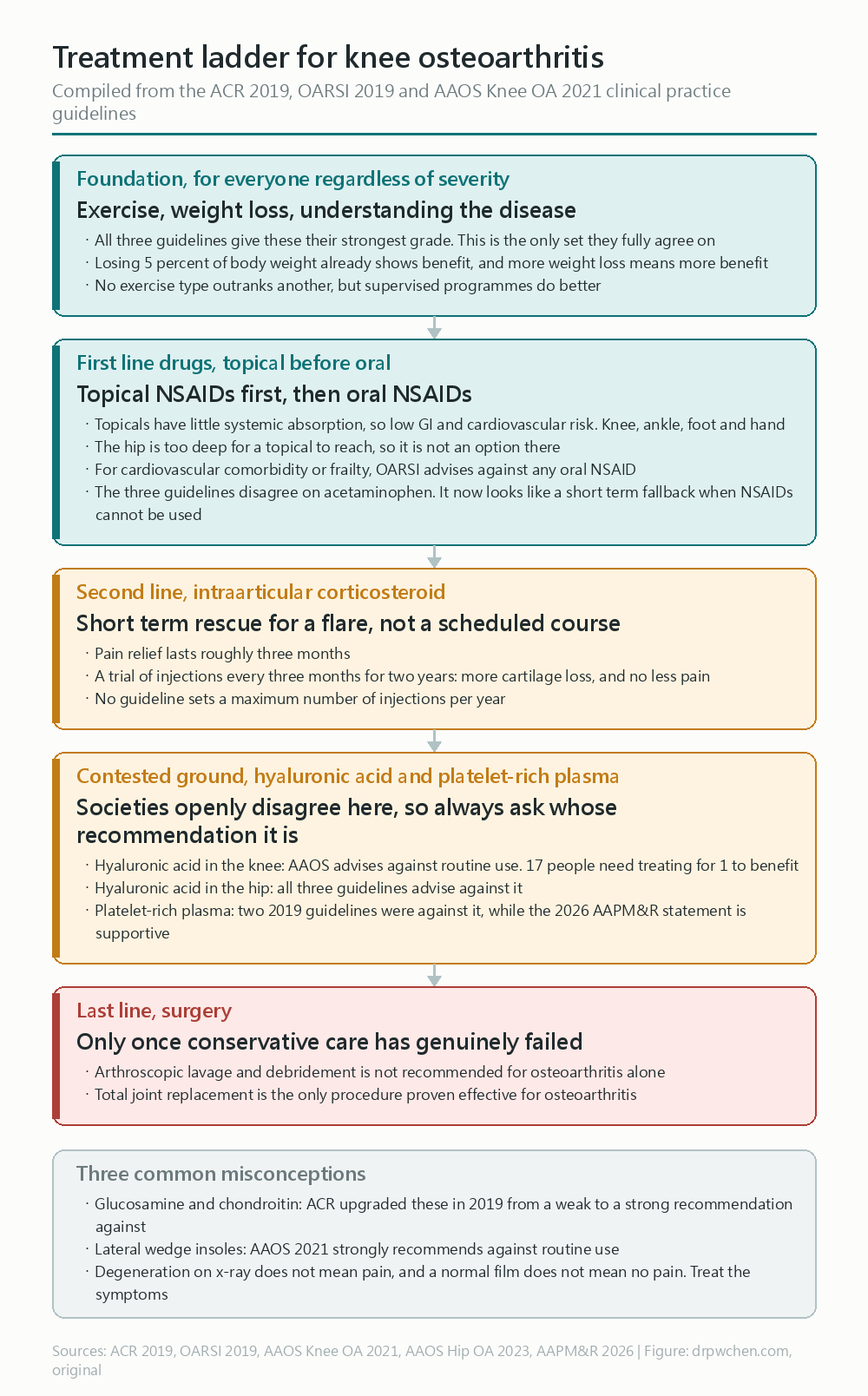
- Foundation for every patient, regardless of severity: exercise + weight loss + self-management education — the strongest recommendation shared by all three CPGs
- Mild/intermittent pain: add topical NSAIDs, oral analgesics, IA injection if needed
- Frequent pain + functional limitations: add oral NSAIDs, duloxetine, bracing
- Prolonged moderate-to-severe pain + ADL limitations: stronger analgesia or consider surgery
Surgery only after conservative treatment fails, and only total joint replacement is proven effective for OA
Braddom Ch.31
What the current guidelines say (ACR 2019 / OARSI 2019 / AAOS 2021)
- The three guidelines agree completely on the backbone and diverge sharply on injections and adjunctive therapies — name the society when citing, do not average them
- Given the strongest grade by all three: exercise, weight loss (in the overweight/obese), self-management and education
ACR 2019、OARSI 2019、AAOS Knee OA 2021- ACR 2019 calls exercise strongly recommended, with no hierarchy among exercise types, but supervised programmes do better
ACR 2019 - Benefit scales with the amount lost: ≥5% body weight already changes clinical and mechanistic outcomes, and benefit keeps increasing across 5–10%, 10–20% and >20%
ACR 2019 - OARSI 2019 designates arthritis education + structured land-based exercise (plus dietary weight management for the knee) as Core Treatment, ranked above all Level 1A items
OARSI 2019
- ACR 2019 calls exercise strongly recommended, with no hierarchy among exercise types, but supervised programmes do better
Where they diverge
| Treatment | ACR 2019 | OARSI 2019 | AAOS Knee 2021 |
|---|---|---|---|
| Acetaminophen | Conditional for (very small effect size) | Conditionally not recommended (little efficacy plus a hepatotoxicity signal) | Strong for |
| Topical NSAIDs | Strong for (knee) | Level 1A strong for (including GI/CV comorbidity and frailty) | Strong for |
| Oral NSAIDs | Strong for | Stratified by comorbidity (no oral NSAID for CV comorbidity or frailty) | Strong for |
| Tramadol/opioids | Tramadol conditional for; non-tramadol opioid conditional against | Strongly against (Level 5) | Strong against (ineffective and significantly more adverse events) |
| Glucosamine/chondroitin | Strongly against (knee, hip) | — | Limited (inconsistent evidence, permissive wording) |
| IA corticosteroid | Strong for (knee, hip) | Level 1B conditional | Moderate (short-term relief) |
| IA hyaluronic acid | Knee conditional against; hip strongly against | Level 1B conditional for (knee); not recommended for hip/polyarticular | Not recommended for routine use |
| PRP | Strongly against | Strongly against | Limited (may reduce pain) |
| Tibiofemoral brace | Strong for | Recommended against (very poor quality evidence) | Moderate for |
| Lateral wedge insole | Conditional against | — | Strong against |
| TENS | Conditional against | — | Limited for |
- The same treatment can run from strong for to strong against across societies (bracing, TENS and acetaminophen are the clearest cases). What to convey clinically is “the evidence does not settle this”, not “society X says it works”
Non-pharmacological treatment
Education and self-management
- Discuss aetiology, natural history and prognosis
- ACR 2019: self-efficacy and self-management programmes are strongly recommended
ACR 2019 - AAOS 2021: both self-management and patient education programmes are Strong
AAOS Knee OA 2021 - Environmental modification: raised toilet seat, grab rails, walk-in shower, raised seating (hip & knee OA)
連 Ch.7
Weight loss
- Applies to everyone overweight or obese, improving both pain and disability
- Target magnitude: start at ≥5%, more is better
ACR 2019
Exercise
- Aerobic + strengthening in parallel, targeting periarticular muscles which are commonly weak in OA
Braddom Ch.31 - Both land- and water-based exercise work; lower impact and shorter sessions are better tolerated
- Tai chi is strongly recommended for knee OA by ACR 2019
ACR 2019- Yoga is conditional (knee only, no hip data); balance exercise is conditional
ACR 2019
- Yoga is conditional (knee only, no hip data); balance exercise is conditional
- Neuromuscular training (balance, agility, coordination) combined with conventional exercise improves performance-based function and walking speed
AAOS Knee OA 2021
Assistive devices and orthoses
- Cane: for hip & knee OA hold it in the contralateral hand to reduce pain and improve function
Braddom Ch.13、連 Ch.7- ACR 2019 rates cane use strongly recommended
ACR 2019 - A walking stick or trekking poles are acceptable for appearance; a walker when one cane is insufficient or OA is bilateral
- ACR 2019 rates cane use strongly recommended
- Braces
- Elastic/neoprene braces: well tolerated, give compression and warmth
- Patellar stabilizing brace/patellar taping: helpful in patellofemoral OA
- Unloader knee brace: effective but bulky and poorly tolerated long term
- Guidelines diverge: ACR strong for, AAOS moderate for, OARSI against
- Insoles
- Lateral wedge insoles are no longer recommended for routine use: Strong against in AAOS 2021 and conditional against in ACR 2019
AAOS Knee OA 2021、ACR 2019 - A cushioned insole of appropriate thickness and resilience reduces ground impact on the foot
連 Ch.7
- Lateral wedge insoles are no longer recommended for routine use: Strong against in AAOS 2021 and conditional against in ACR 2019
- Ankle/foot OA
- Ankle OA: high-top boot, plastic AFO, or a patellar-tendon-bearing short leg brace; a rocker-bottom sole can be added
連 Ch.7 - Foot OA: custom foot orthosis to control subtalar motion and distribute pressure
連 Ch.7
- Ankle OA: high-top boot, plastic AFO, or a patellar-tendon-bearing short leg brace; a rocker-bottom sole can be added
Pharmacological treatment
Acetaminophen
- Traditionally the first-line oral analgesic, with a ceiling of 3 g/d in divided doses
Frontera Ch.140 - But the current guidelines diverge sharply: ACR 2019 conditional for while stating the effect size is very small and monotherapy may be ineffective; OARSI 2019 conditionally not recommended (little efficacy plus a hepatotoxicity signal); AAOS 2021 still Strong
ACR 2019、OARSI 2019、AAOS Knee OA 2021 - Practical position: short-term, episodic use when NSAIDs are not tolerated or contraindicated, not an automatic long-term first line
ACR 2019
NSAIDs
- Topical NSAIDs
- Minimal systemic absorption means lower GI and CV risk; OARSI 2019 grades them Level 1A and recommends them equally strongly with GI/CV comorbidity and frailty
OARSI 2019 - Limited penetration means deep joints such as the hip are unsuitable; appropriate for knee, ankle, foot and hand
Kelley 11e Ch.106 - ACR 2019: should be considered before oral NSAIDs
ACR 2019
- Minimal systemic absorption means lower GI and CV risk; OARSI 2019 grades them Level 1A and recommends them equally strongly with GI/CV comorbidity and frailty
- Oral NSAIDs
- Still the mainstay of OA pharmacotherapy; ACR 2019 calls them the initial oral medication of choice
ACR 2019 - Use as-needed first, or try topical first
Braddom Ch.31 - Different NSAIDs are broadly equivalent but individual response varies, so switching agents is reasonable
- To reduce GI effects use a COX-2 inhibitor or add misoprostol/PPI; the main risk of COX-2 inhibitors is thrombosis
Braddom Ch.31 - OARSI 2019 recommends no oral NSAID at all for CV comorbidity or frailty; with GI comorbidity COX-2 is Level 1B and NSAID+PPI is Level 2
OARSI 2019
- Still the mainstay of OA pharmacotherapy; ACR 2019 calls them the initial oral medication of choice
Duloxetine
- Conditionally recommended by ACR 2019; the only antidepressant with adequate evidence in OA, though tolerability and side effects are an issue
ACR 2019 - Particularly suited to OA with pain sensitization or chronic widespread pain
Braddom Ch.31 - OARSI 2019 lists it as Level 2 only for knee OA with depression/widespread pain
OARSI 2019
Tramadol / opioids
- Pain-reducing effect is modest with frequent side effects, so the role in OA is limited; particularly unsuitable in older adults
Braddom Ch.31、Braddom Ch.30 - The three guidelines have grown steadily stricter on opioids
- ACR 2019: tramadol conditional for; non-tramadol opioid conditional against
ACR 2019 - OARSI 2019: oral and transdermal opioids both strongly recommended against (Level 5)
OARSI 2019 - AAOS 2021: Strong against — oral narcotics including tramadol significantly increase adverse events without improving pain or function
AAOS Knee OA 2021
- ACR 2019: tramadol conditional for; non-tramadol opioid conditional against
Glucosamine & chondroitin
- ACR 2019 upgraded both to strongly recommended against for knee and hip, including combination products
ACR 2019- Reasoning: industry-sponsored and publicly funded studies diverge, and the data at lowest risk of bias show no important benefit over placebo. This is an explicit upgrade from the conditional-against position of 2012
ACR 2019 - Exception: chondroitin sulfate is conditional for in hand OA
ACR 2019
- Reasoning: industry-sponsored and publicly funded studies diverge, and the data at lowest risk of bias show no important benefit over placebo. This is an explicit upgrade from the conditional-against position of 2012
- AAOS 2021 uses more permissive wording (Limited), clearly out of step with ACR
AAOS Knee OA 2021 - The ESCEO algorithm places prescription-grade crystalline glucosamine sulfate + chondroitin sulfate as step 1 background therapy
Bruyère 2016 ESCEO - Safety is good overall, but “safe” is not “effective” and the distinction matters when counselling
Intraarticular injection
Corticosteroid (IACS)
- ACR 2019: strongly recommended for knee and hip OA; conditional for hand OA
ACR 2019- Ultrasound guidance is recommended for hip injection (ACR strong)
ACR 2019 - IACS over other intraarticular injections including HA is a conditional recommendation
ACR 2019
- Ultrasound guidance is recommended for hip injection (ACR strong)
- Effect is predominantly short term, within about 3 months
AAOS Knee OA 2021 - There is now RCT evidence of a structural cost to repeated injection
- Triamcinolone 40 mg every 3 months for 2 years (n=140, KL 2–3) vs saline produced significantly greater cartilage thickness loss (−0.21 mm vs −0.10 mm, between-group difference −0.11 mm, 95% CI −0.20 to −0.03) with no significant difference in pain
McAlindon 2017 JAMA - AAOS 2021 downgraded its recommendation by one level precisely because repeated injection may accelerate OA progression
AAOS Knee OA 2021
- Triamcinolone 40 mg every 3 months for 2 years (n=140, KL 2–3) vs saline produced significantly greater cartilage thickness loss (−0.21 mm vs −0.10 mm, between-group difference −0.11 mm, 95% CI −0.20 to −0.03) with no significant difference in pain
- No CPG sets a numerical ceiling on injections per year; ACR 2019 states the clinical significance of injection frequency and cartilage loss remains uncertain
ACR 2019- Practical conclusion: use for short-term relief of a flare or ahead of a specific life event, not as a fixed scheduled course
Hyaluronic acid (viscosupplementation)
- This is the single most contested area in the topic
- ACR 2019: conditionally against for knee and 1st CMC; strongly against for hip. Restricted to low risk-of-bias trials, the effect size of HA versus saline approaches zero
ACR 2019 - AAOS Knee 2021: not recommended for routine use (Moderate). The effect is under 0.5 MID units with an NNT of 17, and benefit is most evident at 6 weeks and 3 months
AAOS Knee OA 2021 - AAOS Hip 2023: strongly against (High quality) — no better than placebo
AAOS Hip OA 2023 - OARSI 2019: Level 1B conditional for in knee OA; not recommended for hip or polyarticular OA
OARSI 2019 - ESCEO: positioned as the next step when symptoms persist after oral NSAIDs, with benefit lasting up to 6 months after a short weekly course
Bruyère 2016 ESCEO
- ACR 2019: conditionally against for knee and 1st CMC; strongly against for hip. Restricted to low risk-of-bias trials, the effect size of HA versus saline approaches zero
- OARSI good clinical practice statement: IACS gives short-term relief while IAHA may still benefit beyond 12 weeks with a better long-term safety profile than repeated IACS
OARSI 2019 - Time course: a model-based meta-analysis shows the effect plateaus at about 2 months
Cao 2025 - If used and the patient improves, repeat at 6-month intervals
Braddom Ch.31
HA product classes Altman 2016、Hunter 2022 STEP、Lu 2023
| Class | MW | Example products | Dosing | Comment |
|---|---|---|---|---|
| LMW sodium hyaluronate | <1,500 kDa | Supartz, Euflexxa | 3–5 weekly injections | Most common |
| HMW sodium hyaluronate | 1,500–3,000+ kDa | Orthovisc | 3–4 weekly injections | |
| Cross-linked (Hylan G-F 20) | ~6,000 kDa | Synvisc / Synvisc-One | 3 weekly (2 mL) or single (6 mL) | Chemical cross-linking extends residence time |
| Cross-linked (others) | >3,000 kDa | HYA-JOINT Plus, HMDA-cross-linked | Usually single injection | BDDE or HMDA cross-linked |
Comparisons between products
- Products with MW ≥3,000 kDa performed better and had fewer discontinuations than the ≤1,500 kDa group
Altman 2016 - However AAOS 2021, based on 2 high-quality RCTs, found no significant difference between high and low MW and none between cross-linked and non-cross-linked
AAOS Knee OA 2021 - Hylan G-F 20 vs sodium hyaluronate: meta-analysis (21 RCTs, n=3,058) found neither statistical nor clinical difference, and the authors discourage hylan given its higher cost
Dai 2019 - Single vs multiple injection: no clear superiority, single may be more cost-effective
Hunter 2022 STEP
Who is more likely to benefit
- Age under 65, BMI ≥25, KL grade ≤2, and more severe baseline symptoms
Cao 2025、Migliorini 2025 - KL grade IV responds worst; existing trials concentrate on KL I–III
AAOS Knee OA 2021
Safety
- Good overall; the commonest adverse event is injection site pain/flare, and high molecular weight products have the highest rate of injection site flare
Altman 2016 - Biological fermentation-derived HA causes fewer acute flares and less effusion than avian-derived product
Altman 2016 - Crystal arthropathy, pseudoseptic joint, pain flaring
Braddom Ch.31
Contraindications
- Absolute: fracture site, overlying skin infection, severely compromised immune status, suspected or confirmed bacteremia/infectious arthritis, hypersensitivity to prior HA or avian products, pediatric patients
- Relative: diagnosed coagulopathies, joint prosthesis, poorly controlled DM
PRP & stem cells
- Society positions are actively shifting, so this is the section that most needs its year attached
- ACR 2019: PRP and stem cell injection both strongly recommended against
ACR 2019 - OARSI 2019: likewise strongly against (very low quality evidence, unstandardised formulations)
OARSI 2019 - AAOS Knee 2021: PRP may reduce pain and improve function (Limited)
AAOS Knee OA 2021 - AAPM&R 2026 PRP guidance statement: clearly shifted toward support
AAPMR 2026 PRP- Consider IA PRP in mild to moderate knee OA with persistent symptoms despite conservative treatment (Grade A)
- LP-PRP and LR-PRP both show long-term clinical benefit, with superiority unresolved (Grade B)
- A total platelet dose of at least 10 billion is recommended for better long-term outcomes (Grade B)
- Subsequent injections should be guided by the individual response to the first injection (Grade B)
- In severe knee OA involving subchondral bone on MRI, intraosseous PRP can be added to intraarticular administration (Grade A)
- AAPM&R itself notes that society guidance on PRP remains conflicted
AAPMR 2026 PRP
- ACR 2019: PRP and stem cell injection both strongly recommended against
- A model-based meta-analysis found HA+CS or HA+PRP achieved the best WOMAC pain effect
Cao 2025
Prolotherapy
- Injection of hypertonic dextrose (15% soft tissue, 25% joints) or PRP/stem cells improves pain and function in both short and long term, but most OA guidelines have yet to recommend it
Braddom Ch.31
Rehabilitation
- Acute phase
連 Ch.7- Ice or electrical stimulation for analgesia first
- Aspirate an effusion before applying an elastic sleeve to limit swelling
- Heat or massage to relieve pain from muscle spasm
- Positioning and joint movement to prevent contracture
- Strengthening
- Begin with isometric contraction, then progress to isotonic training
DeLisa 6e Ch.32、連 Ch.7 - Quadriceps strengthening is the key intervention in knee OA, acting as shock absorber and stabiliser
Braddom Ch.31
- Begin with isometric contraction, then progress to isotonic training
- Chronic phase: for contracture use hydrotherapy, heat, ultrasound + stretching
連 Ch.7 - Bracing for severe weakness
連 Ch.7、DeLisa 6e Ch.32- Severe quadriceps weakness: short leg brace with the ankle in 5° plantarflexion
- If the short leg brace fails: consider a long leg brace
- Severe pain with complete inability to stand or walk: long leg brace + ischial weight bearing pad
Surgical treatment
Arthroscopy
- Indications
- Loose body or osteochondritis dissecans
- Meniscal tear with OA plus genuine mechanical symptoms such as locking or instability
- AAOS 2021: arthroscopic partial meniscectomy can be used for meniscal tears with concomitant mild to moderate OA that have failed physical therapy or other nonsurgical treatment (Moderate)
AAOS Knee OA 2021
- Not recommended
- Arthroscopic lavage/debridement is not recommended when knee OA is the primary diagnosis (AAOS 2021 Moderate against)
AAOS Knee OA 2021 - Arthroscopy should not be performed without mechanical symptoms; sham-surgery RCTs have shown no long-term benefit
DeLee ch223
- Arthroscopic lavage/debridement is not recommended when knee OA is the primary diagnosis (AAOS 2021 Moderate against)
Other surgical options
- Cartilage repair: cartilage lacks vascular, neural and lymphatic components and heals extremely poorly; the treatable lesion size varies by technique (microfracture, ACI and OATS each have their own range) and is not a single fixed ceiling
DeLee ch207 - Osteotomy: realigns the limb to shift load off the damaged compartment
- UKA: replaces a single compartment; requires adequate ligamentous stability (AP instability ≤ Grade II, ML instability none), and ACL insufficiency is a traditional contraindication
DeLee ch223 - Only total joint replacement is proven effective for OA
Braddom Ch.31
Total knee arthroplasty (TKA)
- Alignment targets
AAOS Postop Rehab 2018 ch43- Mechanical axis: centre of the femoral head to the centre of the knee (intercondylar notch) to the centre of the ankle
- The weight-bearing axis should pass just medial to the tibial spine, and the distal femoral and proximal tibial cuts should each sit at 90° to their respective mechanical axis
- CR vs PS design
- CR: retains the PCL
- PS: substitutes PCL function with a post-cam mechanism and removes more bone than CR
- PS is not the more durable option: the evidence cited by AAOS 2022 shows a higher revision rate for PS than CR
AAOS Knee OA Surgical 2022
- Postoperative range: stair negotiation requires about 115–117° of knee flexion
Giangarra 4e ch79 - Prosthetic joint infection
Kelley 11e Prosthetic Joint Infections- Staging: early (<3 months)/delayed (3–24 months)/late (>24 months)
- DAIR (debridement, antibiotics, implant retention) is indicated for symptoms lasting <3 weeks, not by a cut-off in months after surgery
- S. aureus accounts for most early and late infections
- TKA revision: younger age is a risk factor for revision
Braddom Ch.30
How this note was made
This note started as clinic patient-education and personal revision material, and was re-verified for publication.
Material used
- Society guidelines: ACR 2019 (American College of Rheumatology/Arthritis Foundation), OARSI 2019 (Osteoarthritis Research Society International), AAOS knee OA non-arthroplasty 2021, AAOS knee OA surgical 2022, AAOS hip OA 2023, the AAPM&R 2026 PRP guidance statement, and the ESCEO algorithm consensus
- Rehabilitation and orthopaedic textbooks: Braddom 7e, DeLisa 6e, Frontera, Firestein & Kelley Rheumatology 11e, DeLee & Drez, Giangarra Clinical Orthopaedic Rehabilitation, AAOS Postoperative Orthopaedic Rehabilitation, and 連倚南《復健醫學:臨床篇》
- Primary literature: the two-year randomised trial of intraarticular corticosteroid and cartilage (McAlindon 2017 JAMA), the meta-analysis of hyaluronic acid product differences (Altman 2016), the hylan versus sodium hyaluronate comparison (Dai 2019), and the model-based meta-analysis of hyaluronic acid efficacy and responders (Cao 2025)
Tools used
audit_note.py— my own note format audit script, checking citation placement, figures and heading structure- PubMed MCP — verifying primary sources and completing volume, issue, page, DOI and PMID
- textbook_search over a local textbook markdown index — going back to the original textbook wording
- OpenEvidence — an independent cross-search on intraarticular corticosteroid injection frequency
- My own Python/PIL drawing scripts — the treatment ladder and cover images (
scripts/figures/) - Hugo’s bilingual workflow
i18n_sync.py— machine translation first, then a manual pass over the medical terminology
The workflow itself is written up in textbook-to-note. If you have a Claude or Codex subscription, this kind of mechanical verification and tidying can be handed over, leaving the judgement to you. Getting started with AI and how to talk to agents are reasonable starting points.
About this version
The professional version is taken directly from my own clinical notes and was not rewritten for the blog. Citation style follows my note convention (book plus chapter, or author plus year, with full references below). Copyrighted textbook and journal figures are not reproduced here; all figures are redrawn by me.
Corrections are welcome if I have misunderstood something.
Reference
Guidelines / society documents
- ACR 2019 — Kolasinski SL, Neogi T, Hochberg MC, et al. 2019 American College of Rheumatology/Arthritis Foundation Guideline for the Management of Osteoarthritis of the Hand, Hip, and Knee. Arthritis Care Res (Hoboken). 2020;72(2):149-162. doi:10.1002/acr.24131. PMID 31908149
- OARSI 2019 — Bannuru RR, Osani MC, Vaysbrot EE, et al. OARSI guidelines for the non-surgical management of knee, hip, and polyarticular osteoarthritis. Osteoarthritis Cartilage. 2019;27(11):1578-1589. doi:10.1016/j.joca.2019.06.011. PMID 31278997
- AAOS Knee OA 2021 — American Academy of Orthopaedic Surgeons. Management of Osteoarthritis of the Knee (Non-Arthroplasty) Evidence-Based Clinical Practice Guideline. Published 2021-08-31.
- AAOS Knee OA Surgical 2022 — American Academy of Orthopaedic Surgeons. Surgical Management of Osteoarthritis of the Knee Evidence-Based Clinical Practice Guideline. 2022.
- AAOS Hip OA 2023 — American Academy of Orthopaedic Surgeons. Management of Osteoarthritis of the Hip Evidence-Based Clinical Practice Guideline. Published 2023-12-01.
- AAPMR 2026 PRP — Borg-Stein J, Jayaram P, Colorado BS, et al. AAPM&R guidance statement on platelet rich plasma for knee osteoarthritis. PM&R. 2026;18:S20-S35. doi:10.1002/pmrj.70144
Journals
- McAlindon 2017 JAMA — McAlindon TE, LaValley MP, Harvey WF, et al. Effect of Intra-articular Triamcinolone vs Saline on Knee Cartilage Volume and Pain in Patients With Knee Osteoarthritis: A Randomized Clinical Trial. JAMA. 2017;317(19):1967-1975. doi:10.1001/jama.2017.5283. PMID 28510679
- Altman 2016 — Altman RD, Bedi A, Karlsson J, Sancheti P, Schemitsch E. Product Differences in Intra-articular Hyaluronic Acids for Osteoarthritis of the Knee. Am J Sports Med. 2016;44(8):2158-2165. doi:10.1177/0363546515609599. PMID 26578719
- Dai 2019 — Dai WL, Lin ZM, Guo DH, Shi ZJ, Wang J. Efficacy and Safety of Hylan versus Hyaluronic Acid in the Treatment of Knee Osteoarthritis. J Knee Surg. 2019;32(3):259-268. doi:10.1055/s-0038-1641142. PMID 29618143
- Cao 2025 — Cao Y, Cai R, Han S, et al. Quantitative analysis of the efficacy and associated factors of intra-articular hyaluronic acid with respect to osteoarthritis symptoms: A systematic review of randomized trials and model-based meta-analysis. Osteoarthritis Cartilage. 2025;33(6):666-679. doi:10.1016/j.joca.2025.01.008. PMID 40222628
- Bruyère 2016 ESCEO — Bruyère O, Cooper C, Pelletier JP, et al. A consensus statement on the ESCEO algorithm for the management of knee osteoarthritis. Semin Arthritis Rheum. 2016;45(4 Suppl):S3-S11. doi:10.1016/j.semarthrit.2015.11.010. PMID 26806188
Textbooks
- Braddom Ch.13 / Ch.30 / Ch.31 — Braddom’s Physical Medicine and Rehabilitation. 7th ed. Elsevier; 2021.
- DeLisa 6e Ch.30 / Ch.32 — DeLisa’s Physical Medicine and Rehabilitation. 6th ed. Wolters Kluwer; 2015.
- Frontera Ch.140 — Essentials of Physical Medicine and Rehabilitation.
- Kelley 11e Ch.105 / Ch.106 — Firestein & Kelley’s Textbook of Rheumatology. 11th ed. Elsevier.
- DeLee ch207 / ch223 — DeLee, Drez, & Miller’s Orthopaedic Sports Medicine. Elsevier.
- Giangarra 4e ch79 — Clinical Orthopaedic Rehabilitation. 4th ed. Elsevier.
- AAOS Postop Rehab 2018 ch43 — AAOS Postoperative Orthopaedic Rehabilitation. AAOS; 2018.
- 連 Ch.7 — 連倚南《復健醫學:臨床篇》2nd ed, 2020, Ch.7 Rehabilitation of joint disease