Let me say the most important thing first: when older folks walk slower, complain of being tired, and lose their strength, it’s not “just getting older." It has a name—frailty—it has clear diagnostic criteria, and the earlier you deal with it, the better you can stop it.
I’m writing this for anyone with older relatives at home.
What is frailty, exactly?
Frailty isn’t a disease; it’s more like your body’s savings account running low.
When you’re young, you catch a cold, sleep for two days, and you’re fine. But at a certain stage, that same cold might land you in the hospital. After that, you walk slower, you need help getting around, and you never quite get back to how you were.
The difference isn’t how bad the cold was. It’s about how much capital your body has left to weather it. That capital is what we mean by frailty.
Crucially, frailty and disability are two different things. Nearly three-quarters of older adults who are considered frail can still manage their activities of daily living. So thinking, “He can still bathe and eat on his own, he must be fine,” doesn’t hold up. Frailty is what’s happening before the disability sets in.
Five criteria you can check at home
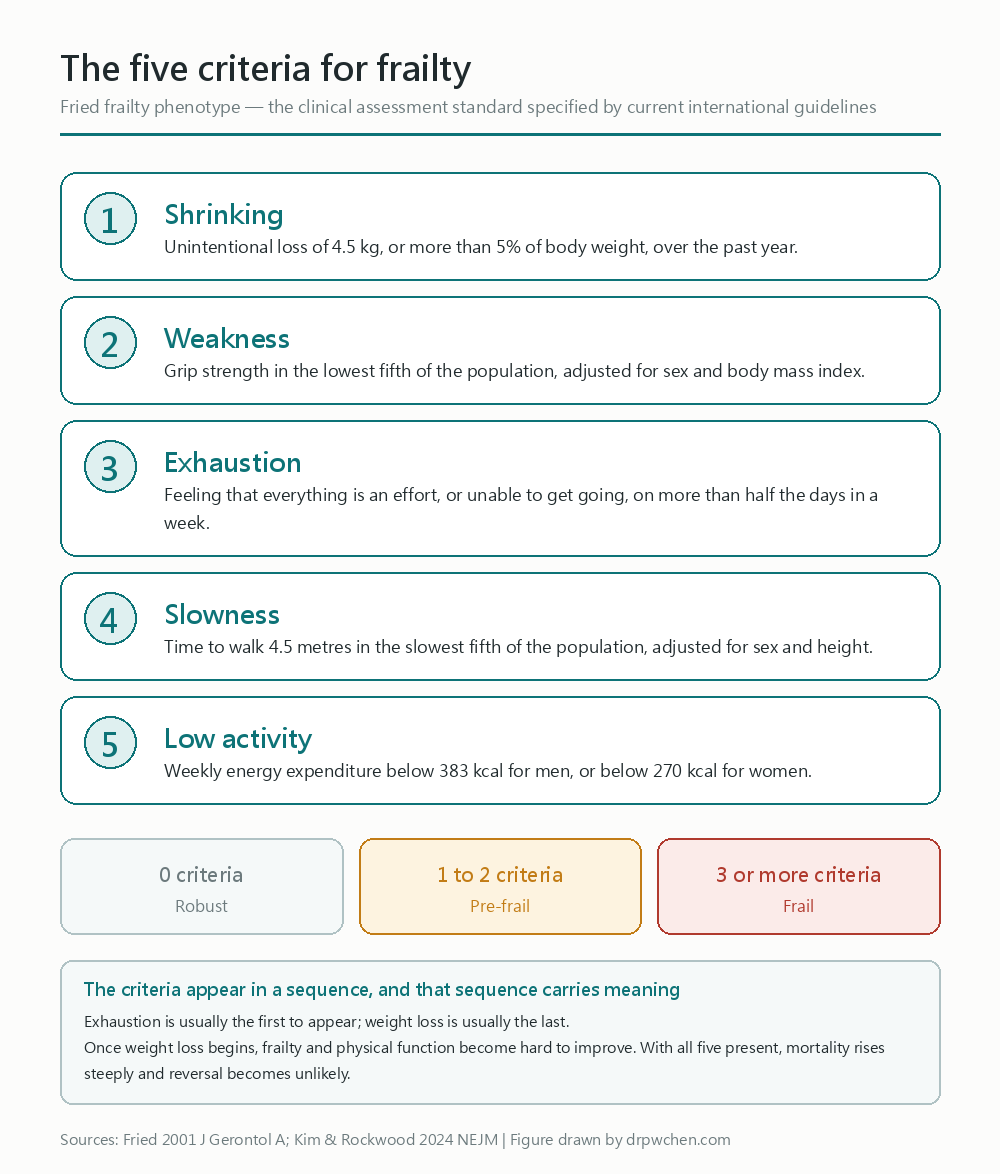
The most widely used international criteria are these five. Meeting three or more means you’re frail; one or two is called pre-frailty.
If you don’t want to remember all that, there’s one shortcut: walking speed.
Walking slower than 0.8 meters per second is roughly the speed where you can’t make it across the street before the little green man stops flashing. This single metric has a 99% sensitivity for catching frailty. If your older relative has to start jogging to cross the street, or just can’t finish before the light changes, that’s your signal.
Watch out for “getting tired,” not “getting thin”
This is the one thing I think is most worth remembering in this whole post.
The five criteria don’t show up all at once. They happen in a sequence: the first to appear is usually “feeling tired,” and the very last is “weight loss."
Most families only start to panic when the older adult has visibly lost weight. But by then, you’re already at the final stop. The research is very clear: once weight starts dropping, it’s incredibly hard to pull frailty and physical function back. For someone who hits all five criteria, mortality spikes, and it’s almost impossible to get them back to where they were.
So the signal you really need to look out for is the most subtle one:
The older person starts saying things like “I don’t feel like doing anything” or “I just don’t have the energy,” and this happens more than half the days of the week.
That sounds like a mood problem, but it might be the very first sign of frailty.
Many causes of “tiredness” are highly treatable
When you hear an older relative complain of fatigue, don’t just reply, “Get some rest.” Behind that exhaustion is a whole list of causes that can be checked—and treated:
- Depression
- Anemia
- Low blood pressure
- Hypothyroidism
- Vitamin B12 deficiency
- Medication side effects
These can all be checked with a blood draw or a simple evaluation. International guidelines list them as mandatory items to check in a frailty care plan, because if you find them, you have a direct shot at fixing them.
Only two things actually work: exercise and fewer meds
Right about here, most people ask: so what supplement should I buy for them?
The answer might surprise you.
Exercise is the first line of defense, and resistance training is key
International guidelines list a multicomponent exercise program that includes resistance training as the first-line treatment, and it’s the recommendation with the highest level of evidence.
Multicomponent means doing three things together: strength, cardio, and balance. Of those, strength (resistance training) is the non-negotiable core.
The dose looks roughly like this:
- One to four times a week, 30 to 60 minutes each time
- A common textbook prescription is three times a week for three to six months
- Even just two sessions of resistance training a week will show results
Resistance training doesn’t mean you have to go to a gym. Resistance bands, water bottles, or just repeatedly standing up from a chair and sitting back down all count. People in their nineties can still build back muscle strength with resistance training; age is never an excuse not to train.
Tai chi and yoga are just as effective as traditional exercise. If an older relative balks at the word “exercise,” these are great entry points.
A Spanish study implemented exercise and nutritional advice in primary care clinics. After 32 weeks, 80% of the older adults saw improvements in their frailty or physical function, compared to just 50% in the control group. That translates to one in every three or four people benefiting from this—a pretty fantastic return on investment for an intervention.
(To be perfectly honest: most participants in that study were pre-frail, so the results mainly support the idea of “starting early.” It doesn’t mean you can necessarily pull someone back when things are already severe.)
Check if they’re taking too many meds
This gets overlooked a lot, but it carries serious weight.
Nearly 60% of frail older adults are taking five or more medications at once. The more meds they’re on, the higher the risk of falls, confusion, and side effects piling on top of each other.
Having a doctor systematically review and stop or taper unnecessary meds has been proven to lower mortality and functional decline. For nursing home residents, it also cuts down on falls and hospitalizations.
The classes of meds you really need to watch out for: sleeping pills, antipsychotics, muscle relaxants, and anticholinergics (which include a lot of cold medicines, motion sickness pills, anti-vertigo meds, and overactive bladder treatments). These are the most common culprits when an older person suddenly becomes confused.
Please do not stop any meds on your own. Bring all their medication bags to the clinic and ask the doctor to review them, including supplements and meds prescribed by other hospitals.
Don’t waste your money on these
Guidelines explicitly list these as not recommended for treating frailty:
- Any kind of drug. There is currently no medication approved to treat frailty, and neither European nor US regulatory agencies even recognize frailty as an indication for drug approval yet.
- Vitamin D, unless a deficiency has actually been confirmed by a test. Furthermore, megadosing—like the “once a month” pill or “once a year” injection—actually increases the risk of falls in frail older adults.
- Hormones (including growth hormone and sex hormones).
- Fish oil.
- Nutritional supplements like protein powder, unless the older person has visibly lost weight or been diagnosed with malnutrition. If they haven’t lost weight and aren’t malnourished, the benefits are questionable.
There’s a common logic here: frailty is multiple systems in the body breaking down at once, so anything that only hits a single target isn’t going to work. The things that do work are the interventions that affect many systems simultaneously—namely exercise, nutrition, and holistic care.
If the older person really is losing weight, then supplementing makes sense, but it has to be paired with exercise to work well. Supplementing nutrition alone is usually too little, too late.
When it comes to dietary patterns, the Mediterranean diet (high in veggies, fruits, legumes, nuts, olive oil, and fish; low in red meat) is associated with a lower incidence of frailty in studies, so it’s a good direction to aim for.
By the way: frailty, sarcopenia, and osteoporosis are all the same crowd
These three frequently show up together, and how you manage them overlaps heavily.
Sarcopenia is specifically about the muscles, so it’s narrower in scope, but it’s one of the core drivers of frailty. Osteoporosis is about the bones.
The good news is that the exact same resistance training improves all three. So if your older relative is already getting treated for one of these, it’s highly worthwhile to get the other two evaluated at the same time.
When should you specifically bring up “frailty”?
There are a few scenarios where proactively bringing up your older relative’s frailty status to the doctor is especially valuable:
- Before surgery. Assessing frailty pre-op and tailoring the surgical approach and prep accordingly has been proven to lower post-op mortality. This is one of the clearest use cases for a frailty assessment.
- Before chemotherapy. Research similarly shows that when oncologists are provided with an older patient’s functional assessment, severe chemo side effects decrease, and the treatment efficacy isn’t compromised.
- When they’re hospitalized. A hospital stay itself can turn an otherwise hardy older adult frail.
- When they’re seeing multiple specialists and taking a lot of medications.
One last thing you absolutely need to know
The word “frailty” runs the risk of being misused.
Sometimes it’s used as an excuse for == “they’re old, let’s just skip this treatment."==
The international consensus is unequivocal: frailty should not be used as a convenient excuse to withhold effective treatments. Its purpose is to help gauge risks, adjust the approach, figure out what the patient actually cares about, and make a decision that fits them better.
You still treat what needs treating, you just do it in a way that respects their current state. Those are two very different things.
So what can you do today?
If you want to do just one thing after reading this, I’d suggest this:
Find an excuse to watch your older relative walk a short distance, and casually ask, “Have you been feeling really tired or drained lately?”
If they’re walking slow and complaining of fatigue, it’s worth taking them to the clinic for a chat. Don’t wait until they lose weight.
Clinical Pearls
- Frailty = A syndrome of decreased physiological reserve and reduced resistance to stressors; not yet disabled, but at elevated risk for adverse outcomes like hospitalization and mortality.
- Two major conceptual models: Fried’s frailty phenotype (5 phenotypic criteria) vs. Rockwood/Mitnitski’s deficit accumulation (frailty index).
- The emergence sequence of Fried’s five criteria matters: exhaustion comes first, weight loss comes last. Meeting all five marks a critical transition, where mortality spikes and reversibility plummets.
- Clinical rapid screening: gait speed <0.8 m/s (99% sensitivity for detecting Fried phenotype), TUG >10 s, PRISMA-7 ≥3.
- ICFSR 2019 first-line treatment = multicomponent exercise program with progressive resistance training (strong / moderate certainty); pharmacotherapy is universally not recommended.
- A comprehensive care plan must check four things: polypharmacy, sarcopenia, treatable weight loss, and treatable causes of exhaustion (depression, anemia, hypotension, hypothyroidism, B12 deficiency).
- Whether routine screening improves outcomes remains unproven (Dutch integrated care model meta-analysis was negative); the most definitive settings for benefit are oncology and pre-op.
Abbreviations
| Abbreviation | Full Name |
|---|---|
| CFS | Clinical Frailty Scale |
| FI | Frailty index |
| FI-CGA | Frailty index derived from CGA |
| CGA | Comprehensive geriatric assessment |
| CHS | Cardiovascular Health Study |
| SOF | Study of Osteoporotic Fractures |
| EFS | Edmonton Frail Scale |
| SPPB | Short Physical Performance Battery |
| TUG | Timed Up and Go |
| ADL / IADL | (Instrumental) activities of daily living |
| GEM | Geriatric evaluation and management |
| ACE | Acute Care for Elders |
| PACE | Program of All-inclusive Care for the Elderly |
| STOPP | Screening Tool of Older Person’s Prescriptions |
| ICFSR | International Conference of Frailty and Sarcopenia Research |
| BGS | British Geriatrics Society |
Disease Background
Definitions
- Not yet disabled, but increased susceptibility to disease and impaired resilience → prone to hospitalization and mortality (49% higher).
- AGS/NIA 2004 consensus definition: An age-related decline in physiologic reserve across neuromuscular, metabolic, and immune systems, resulting in increased vulnerability to stressors.
Poduri Ch.7 - 2013 consensus: “A medical syndrome with multiple causes and contributors that is characterized by diminished strength, endurance, and reduced physiologic function that increases an individual’s vulnerability for developing increased dependency and/or death.”
Walston 2018 - ICFSR definition: A clinical state in which there is an increase in an individual’s vulnerability for developing increased dependency and/or mortality when exposed to a stressor.
ICFSR 2019 - Associated factors: chronic diseases, aging, nutrition, sarcopenia, cognition, reduced physical activity.
- Frailty is a diagnosis of exclusion: must first rule out CHF cachexia, cancer, neurodegenerative wasting, Parkinson’s, PMR, and infections.
Poduri Ch.7
Frailty vs. Sarcopenia Comparison
ACSM 12e Ch.6 Kauffman Ch.65
| Aspect | Frailty | Sarcopenia |
|---|---|---|
| Scope | Multisystem, multidimensional decline in physiologic reserve | Limited to skeletal muscle (muscle mass + strength/function) |
| Nature | Clinical syndrome (no single diagnostic code) | Diagnosable muscle disease (has ICD codes, AWGS/EWGSOP2 criteria) |
| Assessment | Fried phenotype / CFS / FRAIL / FI | AWGS 2019: Grip strength + ASM + Gait speed |
| Coverage | Includes cognition, mood, nutrition, physical activity | Purely muscular metrics |
| Relationship | Sarcopenia is a core driver of frailty; frailty is broader | Can exist independently, or progress to frailty |
Differentiating from Disability and Comorbidity
- The three overlap but are not equivalent; their management differs, and they must be distinguished clinically.
Fried 2001ICFSR 2019- Only 28% of disabled older adults are frail.
Poduri Ch.7 - Nearly 75% of frail older adults can still perform ADLs independently, and 40% have no difficulty even with IADLs.
Poduri Ch.7 - MUNS study: 29.1% of frail individuals have ADL disability, 81.8% have comorbidities.
ICFSR 2019
- Only 28% of disabled older adults are frail.
- Comorbidity is an etiologic risk factor for frailty; disability is an outcome of frailty.
Fried 2001
Epidemiology
- CHS cohort (Fried’s original data): Community prevalence ≥65 years 6.9%, >80 years roughly 30%, 4-year incidence 7.2%.
Fried 2001Braddom 6e Ch.27 - Prevalence varies wildly with definitions and populations (4–60%); when citing a single number, always specify the source cohort.
Braddom 7e Ch.28- 62-country review: 50–59 years 11% → ≥90 years 51%.
Kim 2024 - European community-dwelling older adults meta-analysis: ≥65 years ~15%, >85 years >25%.
ICFSR 2019
- 62-country review: 50–59 years 11% → ≥90 years 51%.
- Higher in females than males; higher in low-education, low-SES, and minority groups.
Fried 2001ICFSR 2019 - Prevalence and clinical significance by subspecialty.
Walston 2018
| Subspecialty | Prevalence | Significance |
|---|---|---|
| Cardiology | 10–60% (older adults with CVD) | 2x mortality; patient selection for invasive treatments |
| HIV | 10–15% | Earlier onset of frailty phenotype |
| Oncology | Median 42% (6–86%) | Predicts mortality, chemo intolerance, post-op complications; guides treatment intensity |
| Surgery | 41.8–50.3% (elective cardiac/non-cardiac) | Pre-op risk, trauma triage, prehabilitation, delirium prevention |
Mechanisms
- Dysregulation of three major systems
Poduri Ch.7Kauffman Ch.65- Neuromuscular: sarcopenia (RSMI ↓), loss of muscle strength and mass.
- Neuroendocrine: IGF-1 ↓, growth hormone ↓, DHEA-S ↓, afternoon cortisol elevated, flattened diurnal rhythm.
- Immune: elevated inflammatory markers like IL-6, CRP (inflammaging); synergistic effect of IGF-1 ↓ and IL-6 ↑ multiplies the risk of disability and mortality.
- Frailty is systemic; grasping these three systems explains most of its clinical manifestations.
- Accelerated aging mechanisms at the cellular level (research is evolving, mostly animal evidence)
Kim 2024- Chronic inflammation, cellular senescence, mitochondrial dysfunction, dysregulated nutrient-sensing.
- Whether intervening in these pathways can reverse frailty is currently unknown.
- Coagulation system activation: fibrinogen, d-dimer, factor VIII elevated.
Poduri Ch.7 - It is still unclear whether neuroendocrine abnormalities are a “cause” or an “effect”, which may be why hormone therapy is ineffective.
Poduri Ch.7
Related Geriatric Syndromes
- Frailty intertwines with other geriatric syndromes and must be managed concurrently in practice (holistic care).
- The relationship between depression and frailty is not yet fully understood; they shouldn’t be casually labeled as causing each other.
Poduri Ch.7- But depression is the leading treatable cause of exhaustion; it should be assessed as soon as frailty is screened.
ICFSR 2019Kim 2024
- But depression is the leading treatable cause of exhaustion; it should be assessed as soon as frailty is screened.
- Osteoporosis and frailty commonly co-occur; exercise improves both simultaneously.
Kauffman Ch.65 - Cognitive function: Frailty is a risk factor for mild cognitive impairment; when they coexist, the prognosis is worse.
Poduri Ch.7 - Oral health: Tooth loss and decreased bite force are associated with frailty incidence (mostly cross-sectional evidence).
ICFSR 2019
Complications and Prognosis
- Adverse outcomes: Falls, delirium, hospitalization (mortality risk elevated by 49%), disability, institutionalization.
Walston 2018Kauffman Ch.65 - After adjusting for age, race, and comorbidities, mortality risk is still 1.2–2.5 times higher.
Poduri Ch.7 - Pre-frailty also carries elevated risks of falls, institutionalization, and mortality (though less than frailty).
Poduri Ch.7 - Frail individuals have poorer antibody responses to influenza vaccines, and worse prognoses for kidney transplants and general surgery.
Poduri Ch.7 - Reversibility depends on severity; you can’t just gloss over it by saying “it’s reversible.”
- Early stage (pre-frail/mild): Exercise + nutrition interventions can return them to pre-frail/robust status.
Kauffman Ch.65 - Meeting all five Fried criteria marks a critical transition: mortality spikes, and the chance of reversal drops dramatically.
Kim 2024 - Once weight loss appears, frailty and physical function are very hard to improve.
ICFSR 2019 - The textbook stance is more conservative: Fully established frailty is generally considered irreversible; the window for reversibility is mainly in the pre-frail stage.
Poduri Ch.7
- Early stage (pre-frail/mild): Exercise + nutrition interventions can return them to pre-frail/robust status.
Clinical Assessment
Diagnostic Criteria
- Frailty is a clinical syndrome with no single gold standard; it is determined by two major operational definitions.
Walston 2018- Frailty phenotype (Fried): Based primarily on motor and activity metrics. Among 5 criteria, ≥3 indicates frail, 1–2 pre-frail, 0 robust.
- Frailty index / deficit accumulation (Mitnitski & Rockwood): Accumulates diseases, comorbidities, functional and cognitive deficits. More deficits = higher score.
- Agreement between the two varies greatly; there is no single best tool.
- The clinical assessment standard designated by ICFSR is the Fried phenotype (moderate certainty).
ICFSR 2019 - ⚠️ Different tools identify “overlapping but distinct” populations; you must specify which one was used when writing or making comparisons.
Kim 2024
Screening Tools Comparison
| Category | Tool | Content | Interpretation |
|---|---|---|---|
| Phenotypic | Fried phenotype | Weight loss, weakness, exhaustion, slow gait, low physical activity | ≥3 criteria = frail; 1–2 = pre-frail; 0 = robust |
| Clinical Judgment | CFS (Rockwood) | Global clinical assessment, currently 1–9 scale | Higher score = more frail (see below) |
| Self-Reported Screen | FRAIL scale | Fatigue, Resistance (climb 1 flight), Ambulation (walk 1 block), Illness (>5), Loss of weight (>5%) | 0–5 points; ≥3 = frail, 1–2 = intermediate |
| Physician Questionnaire | Gérontopôle | 6 questions (lives alone, weight loss, exhaustion, memory, mobility, gait speed <1 m/s) | Any yes → physician clinical judgment if frail |
| Single Metric | Gait speed (4 m walk) | Gait speed | <0.8 m/s elevated risk; <0.2 m/s extremely frail |
| Functional | TUG | Stand up, walk 10 feet, sit back down | >10 s is frail (some use >15 s) |
| Self-Reported Questionnaire | PRISMA-7 | 7 questions (age, sex, limited activity, needs help, confined to home, has someone to depend on, uses walking aid) | ≥3 yes → possible disability/frailty |
| Multidimensional | EFS (Edmonton) | 9 domains: cognition, general health status, functional independence, social support, medication use, nutrition, mood, continence, functional performance | Most commonly used in inpatient settings |
- The three screening tools recommended by ICFSR: CFS, FRAIL scale, EFS.
ICFSR 2019 - SOF index (3 items): 5% weight loss, inability to rise from a chair 5 times without arms, and poor energy. Meeting 2 criteria is frail.
Poduri Ch.7 - Gait speed <0.8 m/s has 99% sensitivity for detecting the Fried phenotype, making it the most time-efficient single screening tool.
Kim 2024
Details of the Fried Phenotype 5 Criteria (CHS Tool)
Fried 2001 Poduri Ch.7
- Unintentional weight loss: Lost 10 lbs or >5% of body weight in the past year.
- Self-reported exhaustion: CES-D, feeling that everything is an effort, more than 50% of the time.
- Low physical activity: Minnesota Leisure Time Physical Activity Questionnaire kilocalories per week; Men <383 kcal/week, Women <270 kcal/week.
- Slow walking speed: 15-foot walk, bottom 20th percentile (adjusted for gender and height).
- Poor grip strength: Bottom 20th percentile (adjusted for gender and BMI; approx. <26/18 kg).
- Interpretation: 1–2 criteria = pre-frailty, 3–5 criteria = frailty.
- Emergence sequence: exhaustion comes first, weight loss comes last. This sequence has prognostic implications.
Kim 2024ICFSR 2019
Clinical Frailty Scale (CFS)
- ⚠️ You must specify the version: The original
Rockwood 2005CMAJ publication was a 7-point scale (very fit → severely frail).Rockwood 2005Braddom 6e Ch.27- It was later expanded to a 9-point scale (adding very severely frail and terminally ill), which is the most commonly used version today.
- CFS 2.0 (2020) rewrote the category names: e.g., vulnerable → living with very mild frailty.
Rockwood 2020 - State the version when citing, otherwise the levels and terminology won’t match up.
- Current 9-level scale (level 4 shown with its CFS 2.0 renaming):
- Very fit: Robust, active, energetic.
- Well: No active disease symptoms but less fit than category 1.
- Managing well: Medical problems are well controlled, but are not regularly active beyond routine walking.
- Vulnerable (2.0: very mild frailty): While not dependent on others for daily help, often symptoms limit activities.
- Mildly frail: More evident slowing, and need help in high order IADLs (finances, transportation, heavy housework).
- Moderately frail: Need help with all outside activities and with keeping house. Inside, they often have problems with stairs and need help with bathing.
- Severely frail: Completely dependent for personal care, from whatever cause (physical or cognitive).
- Very severely frail: Completely dependent, approaching the end of life. Typically, they could not recover even from a minor illness.
- Terminally ill: Approaching the end of life. This category applies to people with a life expectancy <6 months.
- CFS >6 should be considered ADL disability, not just frailty.
ICFSR 2019 - Limitations: It evaluates the pre-illness baseline state, and has not been fully validated in younger adults or those with stable single-system disabilities.
Rockwood 2020
Prognostic Cutoffs for Single Performance Metrics
Kauffman Ch.65
- gait speed <0.65 m/s → frailty risk approx. 20x
- grip strength <25 kg → approx. 6x
- chair stand <7 reps/30 s → approx. 14x
The Two Scoring Methods of the Frailty Index (Easily Confused)
- Standard FI: Number of deficits ÷ total number of items evaluated, resulting in a ratio from 0–1. It’s recommended to include at least 30 deficits.
Kim 2024- In most studies, less than 1% of people have an FI >0.70; that burden is already life-threatening.
- One of the criteria for end-stage frailty is an FI approaching 0.70.
Kim 2024
- FI-CGA count version: Directly counts the number of deficits. Mild = 0–7, moderate = 7–13, severe = >13.
Kauffman Ch.65 - ⚠️ These two are not on the same scale and cannot be cited interchangeably.
Physical Performance Tests
ACSM 12e Ch.6
- SPPB (Short Physical Performance Battery): Gait speed + balance + chair stand. 0–12 points; predicts disability, institutionalization, and mortality.
- Gait speed is recommended to be listed as a vital sign; a change of 0.10 m/s is considered a clinically meaningful change.
- SARC-F (5-item self-reported questionnaire for sarcopenia): ≥4 points suggests sarcopenia and warrants further muscle function assessment.
- ⚠️ Phenotypic tests are affected by acute illness and are often unfeasible during hospitalization; in these settings, switch to tools that do not require performance testing.
Kim 2024 - ⚠️ Assessments should ask about the recent baseline state (e.g., two weeks ago) to avoid misattributing acute symptoms to frailty.
Kim 2024
Red Flags and Referrals
- Clinical presentations like falls, delirium, and sudden disability also hint at frailty.
Turner 2014 - BGS: All community/outpatient encounters should evaluate for frailty, and those screened positive should undergo a holistic medical review based on CGA principles.
Turner 2014 - ⚠️ CGA is not a “diagnostic tool” for frailty: It was designed before the concept of frailty matured. It leans heavily toward disability and might miss frailty entirely.
ICFSR 2019- Proper positioning: CGA is used to identify correctable causes and generate a management plan, not to make the diagnosis of frailty.
- A streamlined, adapted CGA can be used to identify potential underlying causes of frailty.
ICFSR 2019
- It is recommended to refer severely frail individuals to a geriatric specialist.
ICFSR 2019
Evidence Strength for Screening
- Three authoritative documents take different stances; they aren’t saying the same thing:
- ICFSR 2019: Recommends opportunistic screening for all adults ≥65 years (strong recommendation, but low certainty).
ICFSR 2019 - BGS 2014: Does not recommend population-wide screening using current tools, advocating instead for assessment during existing healthcare encounters.
Turner 2014 - Most tools can predict adverse outcomes, but there is insufficient evidence that “screening improves outcomes."
ICFSR 2019Kim 2024
- ICFSR 2019: Recommends opportunistic screening for all adults ≥65 years (strong recommendation, but low certainty).
- Negative results at the implementation level:
Kim 2024- Dutch meta-analysis of 6 RCTs + 2 controlled studies: Primary care integrated models (routine screening + CGA + tailored interventions) at 1 year did not improve function, quality of life, or clinical outcomes.
- English quality improvement program for CGA within 72 hours of acute admission: No reduction in length of stay, in-hospital mortality, 30-day readmissions, or institutionalization.
- Possible reasons: Differences in enrolled populations, control group standard of care, intervention fidelity, and compliance.
- The two settings where benefits are clearest (evidence here is positive):
Kim 2024- Oncology: A cluster RCT of 40 US oncology practices, providing CGA domain summaries and recommendations → Severe chemotherapy toxicity decreased without compromising treatment efficacy.
- Pre-op: Routine pre-op frailty screening + discussing prognosis with surgeons + palliative care consults + modifying surgical approach → Post-op mortality decreased.
- 🔴 Frailty must not be used as a convenient excuse to “withhold effective treatments”; its role is to facilitate patient-centered decision-making.
Kim 2024
Clinical Management
Management Algorithm
Decision-making based on clinical context after screening positive for frailty
- Positive screen (gait <0.8 m/s / TUG >10 s / PRISMA-7 ≥3) → Confirm with clinical assessment using the Fried phenotype.
- Follow with medical review / adapted CGA: Identify precipitants and correctable causes (not for making the diagnosis).
- Comprehensive care plan must include four things: polypharmacy, sarcopenia, treatable weight loss, and causes of exhaustion.
- First-line treatment: Multicomponent exercise program with progressive resistance training (strong / moderate certainty).
- Add protein/caloric supplementation only if there is weight loss or malnutrition (conditional).
- General internal medicine / diabetes: individualized glycemic targets; relax targets for the frail, avoid hypoglycemia.
- Surgery: Pre-op risk assessment + prehabilitation + PAC.
- Severe frailty → Refer to geriatrics; end-stage frailty → palliative care/hospice.
Pharmacotherapy, vitamin D (in the absence of deficiency), hormones, and cognitive training are universally not recommended.
Summary of ICFSR 2019 Recommendations
ICFSR 2019 (GRADE; CBR = consensus-based recommendation)
| # | Recommendation | Strength | Certainty of Evidence |
|---|---|---|---|
| 1 | Adults ≥65 years should be offered opportunistic screening for frailty using a validated tool suitable for the setting. | Strong | Low |
| 2 | Persons who screen positive for frailty (including pre-frail) should receive a clinical assessment. | Strong | Low |
| 3 | A comprehensive care plan should address polypharmacy, sarcopenia, treatable causes of weight loss, and causes of exhaustion. | Strong | Very low |
| 4 | Persons with severe frailty should be referred to a geriatric specialist. | CBR | No data |
| 5 | Multicomponent physical activity program should be offered (as prevention for the pre-frail). | Strong | Moderate |
| 6 | Referral to an exercise program with a progressive resistance training component is recommended. | Strong | Moderate |
| 7 | Protein/caloric supplementation should be considered only when weight loss or undernutrition is present. | Conditional | Very low |
| 8 | Nutritional supplementation may be given in combination with an exercise prescription. | Conditional | Low |
| 9 | Provide oral health education. | CBR | No data |
| 10 | No current pharmacological treatments are recommended for the treatment of frailty. | CBR | Very low |
| 11 | Vitamin D supplementation is not recommended unless a deficiency is present. | CBR | Very low |
| 12 | Cognitive or problem-solving therapy is not routinely recommended. | CBR | Very low |
| 13 | Hormone therapy is not recommended. | CBR | Very low |
| 14 | Social support should be offered based on need. | Strong | Very low |
| 15 | Home-based exercise programs may be considered as a referral option. | Conditional | Low |
Exercise (First-Line)
ICFSR 2019 Walston 2018
- Principle of progression: Flexibility/balance → resistance → endurance; ACSM recommends prioritizing resistance/balance training over aerobic exercise. LIFE-P trial: 12 months of physical activity reduced frailty prevalence by 9%.
- Multicomponent exercise (resistance + aerobic + balance) is the first-line treatment, and the resistance component is the key.
ICFSR 2019 - Resistance training: 80% 1RM is more effective than 40% 1RM; even nonagenarians can reverse muscle strength loss.
Kauffman Ch.65 - Aerobic: 9 months of walking + strength training increased VO2 peak by 14% and increased appendicular muscle mass.
Kauffman Ch.65 - Balance / Tai chi: FICSIT reduced falls by 13–47.5%; multicomponent exercise reduced fall injuries by 32–40% and fractures by 40–66%.
Kauffman Ch.65ACSM 12e Ch.6 - Power training: Declines the fastest during aging; improvements in gait speed / TUG are > traditional resistance training. Cluster sets (≤4 reps per set) are recommended.
ACSM 12e Ch.6 - Yoga and Tai Chi are as effective as standard exercise (improving mobility, strength, ADLs, and falls).
Kim 2024
Exercise Dose
- General dosage: Aerobic + strength, 1–4 times a week, 30–60 minutes per session.
Kim 2024 - Textbook dosage: 30–60 minutes per session, 3 times a week, lasting 3–6 months can improve frailty metrics.
Poduri Ch.7- Even just twice a week of resistance training has shown benefits.
Poduri Ch.7
- Even just twice a week of resistance training has shown benefits.
- ⚠️ ICFSR explicitly states: Evidence is insufficient for an optimal FITT combination, so they cannot specify frequency, intensity, time, or type.
ICFSR 2019- We only know it requires sufficient intensity + sufficient program duration. Group classes may be more effective than individual ones (based on just 2 small trials).
- Refer to a physiatrist or physical therapist for an exercise prescription.
- Special populations (mobility impaired, frail, institutionalized residents, individuals unaccustomed to exercise) may have an increased risk of falls.
Exercise Prescription FITT (ACSM Older Adults)
ACSM 12e Ch.6
| Type | Frequency | Intensity | Time | Type |
|---|---|---|---|---|
| Aerobic | Moderate ≥5 d/wk; Vigorous ≥3 d/wk | RPE 12–13 → 14–17 (Borg 6–20); Moderate = 3–4 / Vigorous ≥5 (CR10) | Moderate 150 min/wk or Vigorous 75 min/wk | Does not impose excessive orthopedic stress (walking, aquatic exercise, stationary cycle) |
| Resistance | ≥2 d/wk | Beginners 40–50% 1RM → Progress to 60–80% 1RM | 8–10 exercises involving major muscle groups; Beginners ≥1 set of 10–15 reps → 1–3 sets of 8–12 reps | Progressive weight training / weight-bearing calisthenics, stair climbing |
| Power | Incorporate into resistance days | 30–60% 1RM, high velocity | 3 sets of 6–10 reps, or cluster sets (≤4 reps per set) | Medicine balls, kettlebells, or other high-velocity movements |
| Flexibility | ≥2 d/wk | Stretch to the point of feeling tightness or slight discomfort | Hold 30–60 s | Slow static stretching (not ballistic) |
| Balance | 2–3 d/wk | Progressively narrow the base of support | Can be done daily (low fatigue) | Tandem stand/walk, single-leg stand, Tai chi |
Exercise Testing Considerations (Older Adults)
ACSM 12e Ch.6
- Most older adults do not require an exercise test prior to initiating a moderate-intensity exercise program, unless they have symptomatic CVD or uncontrolled diabetes.
- When testing is required: Initial workload <3 METs, increments of 0.5–1.0 MET per stage; use a cycle ergometer for those with poor balance.
- Exercise ECG has high sensitivity (~84%) but low specificity (~70%) for CAD in older adults → high rate of false positives.
- (220 − age) underestimates HRmax in older adults; use alternative equations.
Nutrition
- Protein/caloric supplementation is recommended only when weight loss or undernutrition is already present (conditional, very low certainty).
ICFSR 2019- In the absence of weight loss, malnutrition, or sarcopenia, the benefits of supplementation are questionable.
- It is recommended to first establish a formal diagnosis of malnutrition before prescribing supplements.
- Nutritional supplementation is more effective when paired with exercise (the two have synergistic effects).
ICFSR 2019 - Isolated nutritional interventions are often of limited effect (“too little, too late”).
Walston 2018 - Dietary patterns: The Mediterranean diet can lower frailty incidence (OR 0.47–0.82 in a 2018 meta-analysis; evidence from cohort studies).
ICFSR 2019- ⚠️ Studies on diet quality mostly target prevention; their therapeutic effect on established frailty is unknown.
- Treatable causes of weight loss can be remembered with the MEALS-ON-WHEELS mnemonic (medications, depression, swallowing issues, oral problems, infections, poverty, dementia, endocrine issues, malabsorption, etc.).
ICFSR 2019
Multicomponent Interventions
- Combined exercise + nutrition (+ behavioral) interventions yield the best results; a 6-month combined trial improved frailty, and the benefits were maintained for 6 months post-intervention.
Walston 2018 - FRAILMERIT multicenter cluster RCT (Spanish primary care, n=273, mean age 78.1 years).
Abizanda 2025- Intervention = exercise program + nutritional advice + primary care staff frailty training.
- Primary outcome (improvement of one frailty category or 1-point increase in SPPB) at 12 weeks: 70.4% vs. 49.5%, ARR 20.9%, NNT 4.8.
- At 32 weeks: 81.7% vs. 51.9%, ARR 29.8%, NNT 3.4.
- ⚠️ 74.3% of participants were pre-frail or had slow gait speed; only 25.7% were frail. Thus, this result primarily supports early intervention; it doesn’t prove established frailty is reversible.
- ⚠️ Single-target interventions (hormones, growth hormone, sex hormones, omega-3, vitamin D) have virtually no effect on frailty—because frailty is a multisystem issue.
Kim 2024ICFSR 2019
CGA-Tailored Interventions
- Individualized interventions based on CGA, utilizing multidisciplinary teams (PT, geriatrics, PM&R, nursing, nutrition).
Walston 2018 - Community: CGA can reduce unplanned hospital admissions, but has no effect on institutionalization or mortality.
Kim 2024 - Inpatient: CGA reduces institutionalization and in-hospital falls, prevents post-op delirium and mortality, and improves mobility after hip fractures.
Kim 2024
Deprescribing
- 59% of frail older adults are on ≥5 medications (2019 meta-analysis of 37 studies).
ICFSR 2019 - Deprescribing should be guided by standard tools: STOPP/START, Beers criteria; there is also a frailty-specific tool, STOPPFrail (27 criteria).
ICFSR 2019Turner 2014 - Specifically avoid sedatives/hypnotics, psychotropics, muscle relaxants, and anticholinergics (the most common culprit for AMS in the elderly).
Poduri Ch.13 - Empirical benefits of medication optimization:
Kim 2024- Community: may reduce mortality and functional decline.
- Inpatient: may reduce ED visits.
- Nursing home residents: reduces falls, mortality, and hospitalization.
- ⚠️ The evidence base for deprescribing is limited: The ICFSR acknowledges the risk-benefit ratio is unclear, and one RCT showed no significant effect on mortality.
ICFSR 2019
Prevention
Walston 2018 (Buchner & Wagner)
- Monitor physiologic reserve.
- Regular exercise prevents chronic decline; vaccines prevent acute/subacute decline.
- Increase reserve before expected losses (prehabilitation).
- Typical components: exercise, education, nutritional supplementation, smoking cessation; duration is approx. 4 weeks.
Kim 2024 - ⚠️ Efficacy remains uncertain for frail populations and for surgeries other than orthopedic or colorectal.
Kim 2024
- Typical components: exercise, education, nutritional supplementation, smoking cessation; duration is approx. 4 weeks.
- Remove barriers to recovery (geriatric evaluation & management).
- Home environment modifications and vaccinations are key to avoiding preventable stressors.
Kim 2024 - Exercise very likely has a preventive effect on frailty, but this has not yet been directly proven by prospective studies.
Poduri Ch.7
Spectrum of Interventions (by Frailty Severity)
- The intervention intensity corresponds to the transition from robust → increasingly frail → end-stage.
Walston 2018Poduri Ch.7- Robust / Pre-frail: Healthy lifestyle, chronic disease management, preventive care.
- Mild to moderate frailty: Multicomponent exercise, nutrition, deprescribing, CGA, GEM.
- Severe: ACE units (inpatient), PACE (long-term care integration).
- End-stage (meeting all five criteria / FI approaching 0.70 / totally dependent): palliative care, hospice, confirming advance directives.
Kim 2024Poduri Ch.7
How this note was produced
I accumulated this note while organizing assessment tools for the older adult population in the PM&R clinic. To put it up on the site, I did another pass through the guidelines and primary literature.
Materials used
- Society guidelines and consensus statements: The ICFSR 2019 International Clinical Practice Guidelines for Physical Frailty (the most comprehensive document on the topic, full text available on PMC), and the BGS / Age UK / RCGP “Fit for Frailty” best practice guidelines.
- Review articles: The 2024 NEJM frailty review by Kim & Rockwood.
- Primary literature: Fried’s 2001 original CHS phenotype paper, Rockwood’s 2005 original CMAJ publication of the Clinical Frailty Scale and the 2020 CFS 2.0 update paper, Morley’s 2012 FRAIL scale validation study, and Abizanda’s 2025 FRAILMERIT multicenter RCT.
- Textbooks: Poduri’s Geriatric Rehabilitation (the chapters on frailty and polypharmacy), Kauffman’s A Comprehensive Guide to Geriatric Rehabilitation, ACSM’s Guidelines for Exercise Testing and Prescription (12th ed.), and Braddom’s Physical Medicine and Rehabilitation (6th/7th ed.).
Tools used
audit_note.py— A note-formatting audit script I wrote myself, checking citation placement, images, and heading structure.- PubMed MCP — Used to look up society guidelines and review articles, and to fill in the volume, issue, pages, DOIs, and PMIDs for the bibliography.
- textbook_search — For semantic search across my local textbook markdown indices.
- OpenEvidence — Used for independent cross-referencing on the specific controversy of “whether frailty is reversible.”
- Custom Python/PIL drawing script — For the five-criteria diagram and cover image (
scripts/figures/). - Hugo’s bilingual workflow
i18n_sync.py— Machine translating the English version first, then manually proofreading the medical terminology.
The workflow itself is documented in textbook-to-note. If you also have a Claude or Codex subscription, you can hand off all this mechanical labor of fact-checking and formatting to it, while keeping the clinical judgment for yourself. You can start with Getting Started with AI and How to Talk to AI Agents.
About this version
The professional section is pulled straight from my own clinical notes. It wasn’t rewritten for the blog, and it retains my note-taking citation style (Book + Chapter, or Author + Year, with the full bibliography at the bottom). Copyrighted figures from textbooks and journals are not included here; all diagrams were redrawn by me.
If I’ve misunderstood anything here, I always welcome corrections.
Related Notes
- Sarcopenia
- Osteoporosis
Reference
Guidelines / Society Documents
- ICFSR 2019 — Dent E, Morley JE, Cruz-Jentoft AJ, et al. Physical Frailty: ICFSR International Clinical Practice Guidelines for Identification and Management. J Nutr Health Aging. 2019;23(9):771-787. doi:10.1007/s12603-019-1273-z. PMID 31641726
- Turner 2014 — Turner G, Clegg A. Best practice guidelines for the management of frailty: a British Geriatrics Society, Age UK and Royal College of General Practitioners report. Age Ageing. 2014;43(6):744-747. doi:10.1093/ageing/afu138. PMID 25336440
Journals
- Kim 2024 — Kim DH, Rockwood K. Frailty in Older Adults. N Engl J Med. 2024;391(6):538-548. doi:10.1056/NEJMra2301292. PMID 39115063
- Fried 2001 — Fried LP, Tangen CM, Walston J, et al. Frailty in older adults: evidence for a phenotype. J Gerontol A Biol Sci Med Sci. 2001;56(3):M146-56. doi:10.1093/gerona/56.3.m146. PMID 11253156
- Rockwood 2005 — Rockwood K, Song X, MacKnight C, et al. A global clinical measure of fitness and frailty in elderly people. CMAJ. 2005;173(5):489-495. doi:10.1503/cmaj.050051. PMID 16129869
- Rockwood 2020 — Rockwood K, Theou O. Using the Clinical Frailty Scale in Allocating Scarce Health Care Resources. Can Geriatr J. 2020;23(3):210-215. doi:10.5770/cgj.23.463. PMID 32904824
- Walston 2018 — Walston J, Buta B, Xue QL. Frailty Screening and Interventions: Considerations for Clinical Practice. Clin Geriatr Med. 2018;34(1):25-38. doi:10.1016/j.cger.2017.09.004. PMID 29129215
- Morley 2012 — Morley JE, Malmstrom TK, Miller DK. A simple frailty questionnaire (FRAIL) predicts outcomes in middle aged African Americans. J Nutr Health Aging. 2012;16(7):601-608. doi:10.1007/s12603-012-0084-2. PMID 22836700
- Abizanda 2025 — Abizanda Saro A, García Molina R, Alcantud Córcoles R, et al. Efficacy of a Multicomponent Intervention for Frailty or Physical Function in Prefrail or Frail Older Adults: FRAILMERIT Multicenter Clinical Trial. J Am Geriatr Soc. 2025;74(3):658-668. doi:10.1111/jgs.70266. PMID 41456342
Textbooks
- Poduri Ch.7 / Ch.13 — Poduri KR (ed). Geriatric Rehabilitation: From Bedside to Curbside. CRC Press; 2017 (Ch.7 Frailty; Ch.13 Polypharmacy and Rational Prescribing)
- Kauffman Ch.65 — A Comprehensive Guide to Geriatric Rehabilitation. 1st ed. 2014 (Frailty in older persons)
- ACSM 12e Ch.6 — ACSM’s Guidelines for Exercise Testing and Prescription. 12th ed. Wolters Kluwer; 2025 (Older Adults)
- Braddom 6e Ch.27 / Braddom 7e Ch.28 — Braddom’s Physical Medicine and Rehabilitation (Acute Medical Conditions: Cardiopulmonary Disease, Medical Frailty, and Renal Failure)