At the sidelines of track meets, road races, and ball games, the most common accident isn’t a fracture. It’s someone collapsing.
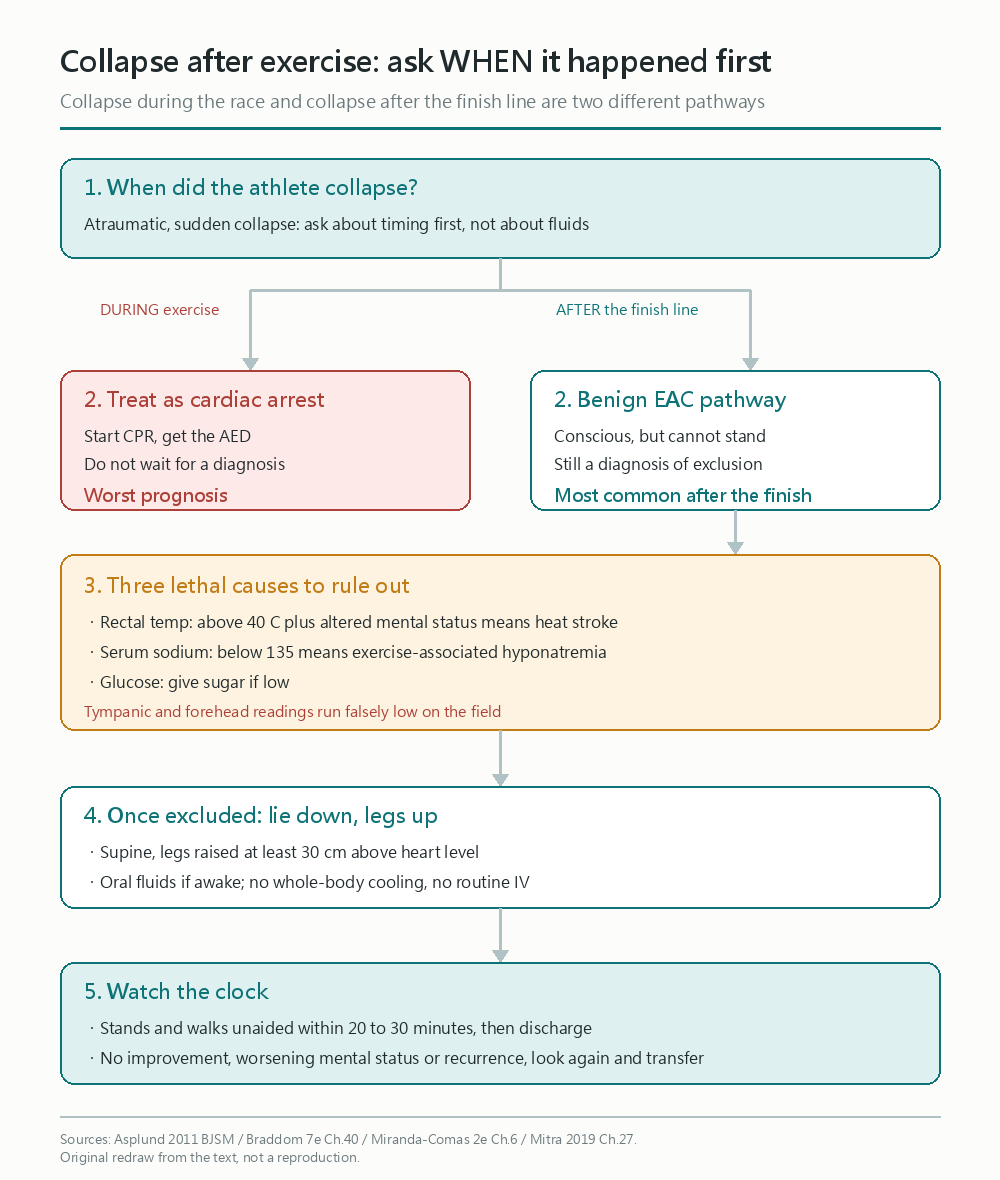
And the first question to ask on the scene isn’t “Are they dehydrated?” but “When did they collapse?"
The answer to this question splits the situation into two different worlds: collapsing during the race, and collapsing after crossing the finish line.
Collapsing during the race: Treat as the worst-case scenario first
If a person suddenly falls to the ground while running, playing, or competing, and wasn’t hit by anything, the correct response is to first treat it as cardiac arrest: call for help, call an ambulance, grab an AED, and start CPR.
It sounds extreme, but this is the international consensus. The reason is simple: among people who collapse without trauma during exercise, the proportion with fatal causes is much higher, and survival drops with every minute cardiac arrest is delayed. If it turns out not to be, great, it was just a false alarm. If it is, this is the only way to save them.
So don’t take their temperature first, don’t feed them water first, and don’t debate whether they’re just too tired on the sidelines.
Collapsing after the finish line: Mostly benign
Conversely, if they only become unsteady, squat down, or need help walking after crossing the finish line, it is overwhelmingly benign.
The reason isn’t that they’re too weak, but a very simple mechanical problem:
When running, every contraction of the leg muscles pushes blood back to the heart, like a set of pumps. At the same time, to dissipate heat, the skin’s blood vessels are dilated and resistance in the lower limbs is low.
Then they cross the finish line and stop.
The pumps stop, but the vessels are still open. Blood pools heavily in the legs, the volume returning to the heart drops instantly, and the blood sent to the brain drops with it—vision goes black, legs give out, and they can’t stand.
This happens more easily when it’s hot because heat dissipation opens the skin vessels even wider.
This is actually so common it’s practically a physiological norm: if you hold healthy people in an upright position for fifteen minutes after exercise, an estimated 50 to 80 percent will show signs of fainting. So weak legs after the finish line don’t mean there’s something wrong with the person’s body.
Four things you can do on-site
- Have them lie down and elevate their legs—at least 30 centimeters above the heart. This is the most effective step; the blood will return on its own. The key is elevating the legs, not lowering the entire head of the bed: the effect of lowering the head of the bed starts to fade after one minute, while simply elevating the legs lasts longer.
- If they are conscious and can swallow, give them water—sports drinks with a little salt are better than pure water.
- Watch the clock—if they can stand up and walk on their own within 20 to 30 minutes, they’re fine.
- Don’t rush to prop them up and make them walk—propping them upright right after they collapse just forces the blood back down into their legs.
But three things must be ruled out first
Benign is a conclusion you can only draw “after ruling out the dangerous.” The ones that really go wrong are when these three are treated as simply collapsing from exhaustion:
- Exertional heat stroke—body temperature over 40 degrees Celsius, and the person is not acting right (answering nonsensically, cursing randomly, can’t be woken up). This requires immediate on-site cooling; details are in the heat illness post.
- Exercise-associated hyponatremia—drank too much water during the race, diluting serum sodium. Features include headache, nausea, and actual weight gain. For these people, giving more water makes it worse.
- Hypoglycemia—cold sweats, shivering; checking blood sugar will tell you.
So the on-site sequence is: first check consciousness, then take their temperature, test sodium and blood sugar if you can, and only treat it comfortably as benign once those are all clear.
Do you need an IV for post-exercise fainting?
This is counterintuitive: fainting after the finish line is not caused by dehydration.
One study measured the blood pressure of 31 runners before and after an 80-kilometer ultramarathon. After the race, 68% had a drop in blood pressure when sitting up from a lying position, but most had absolutely no symptoms and didn’t collapse. More crucially, how much their blood pressure dropped had absolutely no correlation with how many kilograms they lost or how much their plasma volume decreased.
So the real problem isn’t a lack of water; it’s that blood hasn’t returned to where it belongs. Lying down and elevating the legs solves this problem, and an IV doesn’t.
Of course, if they’re vomiting too much to drink, or already unconscious, that’s a different story.
Prevention: Don’t stop in those last few dozen meters
- Keep walking after crossing the finish line—this is what veterans do to keep the leg pumps running. Event organizers can actually actively ask finishers to keep moving and not let them sit down on the ground immediately.
- Slow down breathing—getting first place is too exciting, not getting it is too frustrating, and coupled with feeling unwell, it’s easy to hyperventilate and make your head dizzier. This isn’t the main cause, but it adds up.
- When it’s hot, the finish area must have shade and a medical station.
When to send to the hospital
- Collapsed during the race (regardless of whether they woke up later)
- Unconscious, answering nonsensically, seizing, can’t be woken up
- Still can’t stand up after 20 to 30 minutes of lying down with legs elevated
- Persistent vomiting, severe headache, or collapsing repeatedly
If they recover and walk away after 20 to 30 minutes, they usually don’t need follow-up. But if the same person keeps experiencing this, or if it’s unclear why they collapsed that one time, it’s worth coming to the clinic for a complete evaluation.
Clinical Pearls
- EAC = Benign postural hypotension with inability to stand or walk independently after stopping exercise; consciousness is mostly preserved, and it is a diagnosis of exclusion
- The most common cause of collapse after the finish line is EAC (roughly 60% of chief complaints in marathon medical tents); atraumatic collapse “during” exercise is universally treated as cardiac arrest
- The mechanism is lower extremity venous pooling + sympathoinhibition / histaminergic vasodilation / baroreflex downregulation; dehydration and hyperthermia are merely compounding factors
- When healthy individuals undergo 15 minutes of head-up tilt after exercise, 50–80% will develop presyncope—this is a physiological norm, not a pathology
- Three mandatory checks: rectal temperature (rule out EHS, >40°C), serum Na (rule out EAH, <135), and blood glucose
- Treatment: Trendelenburg / supine with leg elevation; most recover spontaneously within 20–30 minutes, send to ER if no improvement
- Total body cooling, routine IV fluids, and advanced management are generally not needed in uncomplicated EAC
Abbreviations
| Abbreviation | Full Term |
|---|---|
| EAC | Exercise-associated collapse |
| EAH | Exercise-associated hyponatremia |
| EAMC | Exercise-associated muscle cramps |
| EHS | Exertional heat stroke |
| ECAST | Exertional collapse associated with sickle cell trait |
| SCT | Sickle cell trait |
| AMS | Altered mental status |
| SBP | Systolic blood pressure |
| CK | Creatine kinase |
Disease background
Definition
- Exercise-associated collapse (EAC): Occurs after completing an endurance event (most common) or upon stopping exercise, where the athlete experiences light-headedness, dizziness, faintness, or syncope, and is unable to stand or walk without assistance
Miranda-Comas 2e Ch.6- Consciousness is mostly preserved; a minority have transient loss of consciousness (falling under the heat syncope category)
- Atraumatic collapse during exercise is not considered benign EAC, and must first be treated as cardiac arrest until proven otherwise
Miranda-Comas 2e Ch.6,Braddom 7e Ch.40
Epidemiology
- A 12-year review showed that about 60% of marathon medical encounters had a chief complaint of EAC, making it the most common presentation in medical tents
Miranda-Comas 2e Ch.6 - Post-exercise postural hypotension is extremely prevalent, and mostly asymptomatic
Holtzhausen 1995- 31 runners in an 80km ultramarathon: 7% pre-race, 68% post-race had asymptomatic postural hypotension
- Defined as a supine-to-erect SBP drop of over 20 mmHg without syncope symptoms
Pathophysiology
- During exercise: lower limb muscle contractions act as a secondary muscle pump, maintaining venous return; concurrently, peripheral resistance in the lower limbs decreases
Mitra 2019 Ch.27 - Sudden cessation of exercise: the muscle pump is lost, but resistance remains low → blood pools in the lower limbs → venous return decreases → preload and cardiac output decrease → cerebral perfusion decreases → presyncope/syncope
- The mechanisms of post-exercise hypotension are divided into two categories; this framework works best
Christou 2018- Obligatory (always present): sympathoinhibition, histaminergic vasodilation, and downregulation of the cardiovagal baroreflex
- Situational (merely compounding): dehydration, hyperthermia, and gravitational stress
- Clinical significance: Dehydration and hyperthermia are compounding factors that lower the threshold for collapse; they are not the main drivers
Asplund 2011 BJSM
- Addendum on the baroreflex: well-trained athletes already have blunted responses to baroreceptor stimulation, thus relying even more on maintaining venous return post-exercise
Mitra 2019 Ch.27 - Post-exercise orthostatic intolerance is itself a physiological norm
Halliwill 2013- When healthy individuals undergo 15 minutes of head-up tilt after exercise, an estimated 50–80% will develop signs of presyncope
- An effective counter-maneuver is simply driving the muscle pump and increasing venous return
- Pharmacological strategies targeting the respiratory pump and histamine receptors are currently only at the “potential” stage, not established treatments
- The amplifying effect of a hot environment: skin blood flow shunting for heat dissipation → further reducing effective circulating volume
Braddom 7e Ch.40 - Where the evidence on dehydration lands
Holtzhausen 1995: orthostatic blood pressure changes do not correlate with weight loss or decreased plasma volume; this cohort of runners averaged 4.6% dehydration (range 1–7%), yet their circulatory status while supine was not significantly compromised - Hypocapnia is the second cerebral pathway
Christou 2018- Two sources: recovery-phase hyperventilation, and orthostatic hypocapnia caused by the upright posture itself
- Low CO2 causes cerebral vasoconstriction;
Ropper 12e Ch.14states that faintness is common, but true syncope is rare
- Syncope occurring “during” exercise highly points to a cardiac etiology
Christou 2018
Classification
Categorized by timeline (dictates management strategy):
| Category | Timing | Management Principles |
|---|---|---|
| Collapse during exercise | Collapses “during” exercise | Treat as cardiac arrest, initiate BLS/AED; poor prognosis |
| Benign EAC | After finish line / after stopping | Postural hypotension pathway: positioning + ruling out dangerous DDx |
| Heat syncope | Prolonged standing in hot environment / sudden position change | Same category as EAC, must rule out EHS |
Categorized by core temperature (the original classification from Roberts 1989, still useful on-site at events):
- Hyperthermic / Normothermic / Hypothermic, each further divided into mild / moderate / severe
- The intent is to measure temperature first before deciding to cool or warm, as the two treatments are completely opposite
- Hot: place ice packs (wrapped in wet towels) on the neck, axillae, and groin
- Cold: remove wet clothes, dry the skin, and use woolen blankets to keep warm
Complications and prognosis
- Inherently benign and self-limiting; most recover spontaneously within 20–30 minutes
- The risk comes from misdiagnosis: treating cardiac arrest, EHS, or EAH as benign EAC → fatal
- The prognosis for collapse during the race is significantly worse (higher proportions of cardiac issues, severe EHS, EAH)
Braddom 7e Ch.40
Clinical assessment
Presentation
- Light-headedness, dizziness, or faintness after crossing the finish line
- Unable to stand up, or falling again after standing; requires assistance to walk
- Consciousness is mostly preserved, but may have transient syncope
- Vital signs: slightly elevated heart rate and respiratory rate, pale skin
- Postural hypotension: SBP drops by >20 mmHg when moving from supine to sitting
On-site investigations
Mandatory:
- Rectal temperature: to rule out EHS (>40°C)
- Serum sodium (using a portable analyzer like i-STAT): to rule out EAH (<135 mEq/L)
- Capillary blood glucose: to rule out hypoglycemia
- Heart rate, blood pressure (once supine, once erect), and SpO2
As indicated:
- ECG: if arrhythmia is suspected, or for collapse during exercise
- Basic metabolic panel: for severe or recurrent cases
Confirmatory diagnosis = diagnosis of exclusion
You must rule out the following conditions before labeling it benign EAC:
- Cardiac arrest (atraumatic collapse during exercise)
- Brain / cervical spine trauma
- Exertional heat stroke (>40°C + CNS dysfunction)
- Exercise-associated hyponatremia (Na <135)
- Anaphylaxis
- Hypoglycemia
- Hypothermia
- Exercise-associated muscle cramps
- ECAST (exertional collapse associated with sickle cell trait)
⚠️ Collapsing just before or near the finish line, even if they wake up briefly, could still be a fatal etiology. A published case report: a 61-year-old runner collapsed before the finish line and had a PEA arrest; after ruling out common causes via algorithms and being admitted, the final diagnosis was pituitary apoplexy combined with coronary artery disease Carenzo 2023.
Differential diagnoses
| DDx | Key Features | Differentiating Point |
|---|---|---|
| Cardiac arrest | Sudden collapse “during” exercise, unresponsive | Immediate BLS, don’t wait for a diagnosis |
| Exertional heat stroke | >40°C + AMS (confusion / coma / seizure) | Check rectal temp |
| Exercise-associated hyponatremia | Na <135; weight gain; nausea/vomiting, headache, AMS | Draw blood for Na |
| Heat exhaustion | 37–40°C, exhaustion, weakness, heat intolerance | Moderate temp elevation without AMS |
| Hypoglycemia | Hx of diabetes; cold sweats, tremor | Capillary blood glucose |
| Hypothermia | Cold, wet environment | Check rectal temp (<35°C) |
| Seizure / postictal | Hx of seizures, tongue biting, urinary incontinence | History, EEG |
| Head / cervical trauma | Hx of blunt trauma | Imaging |
| ECAST (sickle cell trait) | Early collapse during exercise, conscious without neuro symptoms, muscle pain/weakness but no cramping, mild temp elevation | History / SCT status, CK |
| Hyperventilation | Post-race emotional distress, tingling hands/perioral, tachypnea | Mostly dizziness rather than syncope |
The EAH item has a guideline-level document WMS 2019:
- Defined as serum / plasma Na below 135 mmol/L during or within 24 hours post-exercise
- EAH overlaps most in symptoms with heat exhaustion / EHS, and the inability to differentiate them is a known cause of worsened prognosis and mortality
ECAST supplement O'Connor 2012 ACSM/CHAMP, Newman 2021:
- Mechanism: acidosis → sickling and vascular occlusion → rhabdomyolysis, arrhythmias → organ failure
- The distinction from EAMC is “muscle pain but no cramping”; the distinction from EHS is only a mild temperature elevation
- Early aggressive management plus evacuation can reverse it
- ⚠️ Sickle cell trait is extremely rare in the Taiwanese population, so the pretest probability for this is very low in local races; however, it holds substantial clinical significance in international events where African or Caribbean teams are competing
Medical management
EAC On-site Management Decision Tree
- Step 1 — Differentiate timing
- Atraumatic collapse during exercise → treat as cardiac arrest, initiate BLS/AED
- Collapse after exercise → enter benign EAC pathway
- Step 2 — Concurrently rule out fatal DDx (ABC → consciousness → core signs)
- Check rectal temp: >40°C + AMS → EHS (cold-water immersion, target below 39°C)
- Check serum Na: <135 → EAH (if severe with AMS → 3% hypertonic saline 100 mL bolus)
- Capillary blood glucose: low → give glucose
- Assess mental status: confusion / unresponsive → escalate alert level
- Step 3 — Supportive care (after DDx ruled out)
- Trendelenburg or supine + legs elevated (>12 inches above the heart)
- Oral rehydration (if conscious and can swallow); IV NS only for severe dehydration or loss of consciousness
- Continuous monitoring of vital signs, rectal temp, and Na
- Step 4 — Disposition
- Able to stand and walk independently within 20–30 minutes → discharge from medical tent
- Mental status deteriorates, no improvement, or recurs → send to ER
Treatment goals
- Restore cerebral perfusion while ruling out life-threatening DDx
- Do not delay the critical management windows for EHS, EAH, and cardiac arrest
Positioning (first-line)
- Trendelenburg: supine, lower extremities elevated >12 inches (about 30 cm) above the heart
Miranda-Comas 2e Ch.6 - Alternative: supine + legs elevated; crossing legs tightly and squeezing along with clenching fists can increase venous return
- Mechanism: restores venous return → restores cerebral perfusion
- The effect of passive leg raising (PLR) lasts longer than head-down Trendelenburg
Geerts 2012- Trendelenburg: at 1 minute, CO increases by 9% (0.35 L/min); at 2–10 minutes, it decays to just 4% (0.14 L/min)
- PLR: at 1 minute, increases by 6% (0.19 L/min); after 1 minute, it maintains at 6% (0.17 L/min)
- ⚠️ This meta-analysis included hypovolemic and normovolemic patients, not the EAC population, so it’s an extrapolation. Both are reasonable on-site, but for a longer-lasting effect, elevate the legs.
Hydration
- Conscious and able to swallow: oral rehydration (sodium-containing beverages or salty snacks)
- IV: give normal saline only for unconsciousness, severe dehydration, or inability to take PO
- Benign EAC is not caused by dehydration; routine IV is unnecessary
Miranda-Comas 2e Ch.6 - Na should be checked before giving fluids to avoid adding water to an unknown EAH
- Benign EAC is not caused by dehydration; routine IV is unnecessary
Interventions unnecessary for uncomplicated EAC Asplund 2011 BJSM
- Total body cooling
- Routine IV fluids—situations where marathon runners absolutely need an IV are actually rare
Braddom 7e Ch.40 - Various advanced management
- ⚠️ The premise is that life-threatening DDx have been ruled out. When temperature is truly over 40°C, cooling is still the top priority.
Monitoring and referral
- Continuous monitoring of vital signs, mental status, rectal temp, and serum Na
- If there is no improvement within 15–30 minutes, you must go back and look for more sinister etiologies, including orthostatics and electrolytes
Braddom 7e Ch.40 - When to refer: persistent, worsening, or recurrent AMS; >40°C (EHS); Na <135 (EAH); unresponsive to 20–30 minutes of supportive care; any suspected cardiac, CNS, or metabolic origin
- Uncomplicated benign EAC usually doesn’t require follow-up; but for recurrent episodes, or if the episode cannot be fully attributed, a complete outpatient evaluation should be arranged
Childress 2010
Prophylactic measures
- Keep walking after the finish line (a standard practice for veteran runners) to maintain the muscle pump
- Event organizers can proactively ask finishers to keep moving and not let them stop or sit down immediately
Mitra 2019 Ch.27
- Event organizers can proactively ask finishers to keep moving and not let them stop or sit down immediately
- Training: adequate fitness combined with heat acclimatization
- The shunting effect of hot environments is strong → set up shaded, well-ventilated areas and medical tents at the finish line
- Emotion and breathing: extreme excitement or frustration easily leads to hyperventilation, exacerbating dizziness
Ropper 12e Ch.14; what you can do on-site is have them slow their breathing, but this is a compounding factor rather than the main cause
How this note was produced
This note was originally written as pre-event preparation for medical coverage at the 2026 International Children’s Games (ICG), and I took the opportunity during the games to fact-check it all over again.
Materials used
- Sports medicine and PM&R textbooks: Miranda-Comas Essential Sports Medicine 2e, Braddom 7e, Mitra Principles of Rehabilitation Medicine, Brukner & Khan 5e, DeLee 5e, ACSM 12e, Adams & Victor’s Principles of Neurology 12e
- Primary literature: evidence-based review on EAC (Asplund 2011 BJSM), original study on post-exercise postural hypotension (Holtzhausen & Noakes 1995), original classification system for EAC (Roberts 1989), fieldside and office-based evaluation (Childress 2010), mechanism review of noncardiac syncope in athletes (Christou 2018), integrative physiology review of post-exercise syncope (Halliwill 2013), and hemodynamic meta-analysis of Trendelenburg vs. leg raising (Geerts 2012)
- Society documents: ACSM and CHAMP summit consensus on sickle cell trait (2012), Wilderness Medical Society clinical practice guidelines for exercise-associated hyponatremia (2019)
- Case literature: a case report of a pre-finish line collapse eventually diagnosed as pituitary apoplexy (Carenzo 2023)
Tools used
- Custom note format auditing script
audit_note.py— structure and formatting must have 0 FAILs to proceed - PubMed MCP — to look up primary literature and fill in volume/issue/page numbers, DOIs, and PMIDs
- OpenEvidence — for an independent round of cross-searching; every claim it made was verified against primary literature before being written in
- textbook_search — for semantic search against my local textbook markdown indices
- Custom Python/PIL drawing script — for the on-site triage diagram and cover art (
scripts/figures/) - Hugo’s bilingual workflow
i18n_sync.py— the English version was first machine-translated, then medical terms were manually proofread again
This workflow itself is documented in textbook-to-note. If you also have a Claude or Codex subscription, you can offload this kind of mechanical labor of fact-checking and organizing to it, saving the judgment calls for yourself. You can start with Getting Started with AI: Installation and First Steps and How to Talk to AI Agents.
About this version
The pro section is taken directly from my own clinical notes and wasn’t rewritten for the blog. The citation format follows my note-taking style (book title + chapter, or author + year, with full bibliography below). Copyrighted images from textbooks and journals are not included here; the diagrams are redrawn myself.
If I’ve misunderstood anything, corrections are welcome.
Reference
Consensus and guidelines
- WMS 2019 — Bennett BL, Hew-Butler T, Rosner MH, Myers T, Lipman GS. Wilderness Medical Society clinical practice guidelines for the management of exercise-associated hyponatremia: 2019 update. Wilderness Environ Med. 2020;31(1):50-62. doi:10.1016/j.wem.2019.11.003. PMID 32044213
- 2015 International Consensus — Hew-Butler T, Rosner MH, Fowkes-Godek S, et al. Statement of the Third International Exercise-Associated Hyponatremia Consensus Development Conference, Carlsbad, California, 2015. Clin J Sport Med. 2015;25(4):303-20. doi:10.1097/JSM.0000000000000221. PMID 26102445 (full text behind paywall, bibliography listed only)
- ACSM/CHAMP 2012 — O’Connor FG, Bergeron MF, Cantrell J, et al. ACSM and CHAMP summit on sickle cell trait: mitigating risks for warfighters and athletes. Med Sci Sports Exerc. 2012;44(11):2045-56. doi:10.1249/MSS.0b013e31826851c2. PMID 22811029
Journals
- Asplund CA, O’Connor FG, Noakes TD. Exercise-associated collapse: an evidence-based review and primer for clinicians. Br J Sports Med. 2011;45(14):1157-62. doi:10.1136/bjsports-2011-090378. PMID 21948122
- Holtzhausen LM, Noakes TD. The prevalence and significance of post-exercise (postural) hypotension in ultramarathon runners. Med Sci Sports Exerc. 1995;27(12):1595-601. PMID 8614313
- Roberts WO. Exercise-associated collapse in endurance events: a classification system. Phys Sportsmed. 1989;17(5):49-59. doi:10.1080/00913847.1989.11709782. PMID 27447266
- Childress MA, O’Connor FG, Levine BD. Exertional collapse in the runner: evaluation and management in fieldside and office-based settings. Clin Sports Med. 2010;29(3):459-76. doi:10.1016/j.csm.2010.03.007. PMID 20610033
- Newman C, Fields KB. Atypical presentations of exertional collapse. Pediatr Emerg Care. 2021;37(12):e1714-e1717. doi:10.1097/PEC.0000000000001794. PMID 33170571
- Carenzo L, Ghio FE, Mariani N, et al. An unusual case of marathon-related exercise associated collapse: case report and some considerations for medical care at endurance mass participation events. J Sci Med Sport. 2024;27(1):20-24. doi:10.1016/j.jsams.2023.10.010. PMID 37919145
- Christou GA, Christou KA, Kiortsis DN. Pathophysiology of noncardiac syncope in athletes. Sports Med. 2018;48(7):1561-1573. doi:10.1007/s40279-018-0911-7. PMID 29605837
- Halliwill JR, Sieck DC, Romero SA, Buck TM, Ely MR. Blood pressure regulation X: what happens when the muscle pump is lost? Post-exercise hypotension and syncope. Eur J Appl Physiol. 2013;114(3):561-78. doi:10.1007/s00421-013-2761-1. PMID 24197081 (PMC3944103, open access full text)
- Geerts BF, van den Bergh L, Stijnen T, Aarts LPHJ, Jansen JRC. Comprehensive review: is it better to use the Trendelenburg position or passive leg raising for the initial treatment of hypovolemia? J Clin Anesth. 2012;24(8):668-74. doi:10.1016/j.jclinane.2012.06.003. PMID 23228872
Textbooks
- Miranda-Comas 2e Ch.6 — Miranda-Comas G, et al. Essential Sports Medicine. 2nd ed. Springer; 2021. General Medical Problems in Athletes (Persaud & Cleary), pp.97–98.
- Braddom 7e Ch.40 — Cifu DX (ed). Braddom’s Physical Medicine and Rehabilitation. 7th ed. Elsevier; 2021. Sports Medicine and Adaptive Sports, p.864.
- Mitra 2019 Ch.27 — Mitra R (ed). Principles of Rehabilitation Medicine. McGraw-Hill; 2019. Emergency Assessment and Care of the Athlete, pp.428–429.
- Ropper 12e Ch.14 — Ropper AH, et al. Adams and Victor’s Principles of Neurology. 12th ed. McGraw-Hill; 2023. Faintness and Syncope, pp.388–392.
- Brukner 5e Ch.23 — Brukner P, Khan K. Clinical Sports Medicine. 5th ed. McGraw-Hill; 2019. Heat (Racinais), pp.338–339.
- ACSM 12e Ch.7 — ACSM’s Guidelines for Exercise Testing and Prescription. 12th ed. 2025. Environmental Considerations, pp.508–509.
- DeLee 5e Ch.21 — DeLee, Drez & Miller’s Orthopaedic Sports Medicine. 5th ed. Elsevier; 2020. Environmental Illness, pp.237–238.