Let me start with the most common misunderstanding: De Quervain’s is not “weak wrists,” nor is it “sore muscles from holding a baby too long." Instead, it’s about two tendons at the base of your thumb. The tunnel they share gets narrow and thick, and the tendons can’t glide through.
So resting makes it hurt less, but as soon as you go back to the original movement, the pain comes right back. It won’t resolve itself just because you sleep a few more days.
This post is for new parents, and for people who scroll their phones for hours a day. Both groups are actually hurting in the exact same spot.
Where Does It Have to Hurt to Be De Quervain’s?
Location is key. De Quervain’s pain is at “the base of the thumb connecting to the wrist” — specifically, the outer wrist near the bump under the thumb.
Not the center of your palm, not the inner wrist, and not your whole hand going numb.
Three typical presentations:
- A sudden, sharp pain when holding your baby, wringing a towel, or opening a jar
- Pain when spreading your thumb outward or giving a thumbs-up
- A pulling sensation at the base of the thumb when bending your wrist toward your pinky
If your symptoms are numb fingers, waking up numb in the middle of the night, and feeling a bit better after shaking your hand, that sounds more like carpal tunnel syndrome, which is a different story.
How Do You Test It at Home? And What If It’s Inaccurate?
The self-test floating around the internet goes like this: tuck your thumb into your fist, then bend your wrist toward your pinky. If it hurts, it’s De Quervain’s.
Here’s something very few people mention: this movement hurts in completely normal people, too.
In fact, everyone calls this test by the wrong name. It’s actually the Eichhoff test, not the Finkelstein test. The true Finkelstein test is when the physician pulls your thumb to move your wrist, while you don’t use any force. The guy who originally proposed the Finkelstein test warned us himself: if you have patients forcefully bend their wrists with a clenched fist, normal people will feel pain, and it might even repeatedly strain the tendon sheath.
So when a study asked college students to do this test, over half of them tested “positive." This obviously doesn’t mean half of all college students have De Quervain’s. It just means doing this test at home will scare you.
The practical advice is:
If it hurts when you test it yourself, treat it as a signal that it’s “worth getting checked out,” not as a diagnosis. True confirmation relies on a physician pressing that specific spot and ruling out arthritis at the base of the thumb.
Why Are You So Prone to Getting It After Having a Baby?
There are solid numbers for this. South Korea pulled its National Health Insurance claims records for 1.6 million pregnant and postpartum women. They found that about 2.1 out of every 100 people were diagnosed with De Quervain’s during pregnancy or postpartum.
The people most likely to get it are:
- Over 30 years old
- Carrying twins or more
- Having a C-section
- Having high blood pressure during pregnancy
- Already having rheumatoid arthritis
One finding is quite counterintuitive: neither gestational diabetes nor pre-existing diabetes is a risk factor.
So is it hormones to blame, or holding the baby?
In the past, everyone said it was hormones. But a US survey of newborn caregivers found that in the group testing positive, the babies were actually older (averaging over a year old, not newborns). If it really were caused by breastfeeding hormones, it should be more severe earlier on.
So the more accepted explanation now is: the mechanical load of holding a baby is the main cause. The heavier the baby and the longer you hold them, the more load your thumb bears.
This shift has two practical implications for you:
- It’s wrong to think “I won’t get it if I don’t breastfeed." Dads, grandmas, and nannies get it too.
- It’s also not entirely true that “it’ll go away when you stop breastfeeding." As long as you keep holding the baby in the same posture, the mechanical load is still there.
How Can You Change the Way You Hold Your Baby?
This is the one thing you can change today.
The painful movements share one thing in common: spreading the thumb and then using it to bear weight. Like supporting a baby’s head with your palm while spreading your thumb outward.
The alternative is:
- Shift the weight to your forearm and the base of your palm, don’t use your thumb as a wedge
- When picking them up, keep your four fingers together like a tray, and keep your thumb as close to your index finger as possible; don’t spread it out
- For prolonged fixed postures like feeding or burping, switch sides halfway through
It’s the Same for Phone Scrollers
This isn’t just a trendy claim, the data is there.
After aggregating multiple studies, researchers found that the more texts and messages you send, the higher the chance of getting De Quervain’s, with the risk being about 1.5 to 2.3 times higher. Browsing the internet and playing mobile games are also independently associated.
A survey of over 900 college students in China was even more detailed:
- For those using their phones over 8 hours a day, the risk was more than four times that of low-usage users
- Typing with both thumbs at the same time is a higher-risk posture
- Phones with larger screens also carry a higher risk
(A quick reminder again: these studies used that same misleading self-test mentioned earlier, so the direction of “how many times the risk” is useful for reference, but the absolute numbers of “how many people have the disease” shouldn’t be trusted.)
Practically, it comes down to three things: if you’re using it for a long time, take breaks; avoid typing with both thumbs for prolonged periods; and for large-screen phones, try to support it with both hands instead of propping it up with one hand.
Treatment: Why Would Your Physician Recommend a Shot Instead of Just a Brace?
Many people’s expectation is to “try wearing a brace first, and see what happens.” But the current evidence actually points the other way.
Looking at all past randomized trials combined (16 trials, 1206 people):
- The success rate of an injection clearly beats just wearing a splint
- An injection plus a splint beats just the injection
- The effect of just wearing a splint had a cure rate of only about 14% in early studies; pure rest plus anti-inflammatories was 0%
A more comprehensive 2023 analysis (30 trials, 1663 people) concluded: a steroid injection, plus 3 to 4 weeks in a thumb splint, is the first line.
I should add an honest caveat: while adding the splint brings functional improvements that are statistically significant, the magnitude isn’t quite at a level patients can feel themselves. So if wearing a splint makes it truly impossible for you to care for your baby, it’s reasonable to discuss getting just the shot with your physician. Don’t feel guilty about it.
By the way, current evidence doesn’t support a few treatments that many people hope for:
- Taping (kinesiology tape): Across seven pooled studies, there was no significant improvement in pain, grip strength, or function
- High-intensity laser: No better than a splint or a splint plus exercise
- Acupuncture: More effective than topical ointments, but no different compared to an injection
What’s Going On If It Still Hurts After the Shot?
This is one of the most distinctive things about De Quervain’s, and it’s worth knowing.
For a significant proportion of people, that tunnel at the base of the thumb actually has a “septum” inside, locking the two tendons into their own separate little rooms.
- In patients who need surgery, the prevalence of this septum is as high as 67%
- In the general population, it’s about 35%
This means: people who already have a septum are more prone to getting the disease, and more prone to the injection failing. Because if the medication is injected into one room, it doesn’t touch the other tendon at all.
So if the first shot doesn’t work, it doesn’t mean “shots don’t work for me.” Often, it just means it didn’t hit the right room. This is where using ultrasound guidance makes a lot of sense: under guidance, the rate of hitting the correct spot can be over 90%, whereas blind injections are very hit-or-miss.
When Should You Consider Surgery?
The general order is this: a proper injection (with ultrasound guidance if necessary) is tried, you’re usually given a few months to observe, and if it’s still not working, then you discuss surgery.
The surgery opens up that narrowed tunnel, with a success rate of about 83% to 92%.
You should know the risks: there’s a nerve for sensation on the back of the wrist (the superficial branch of the radial nerve) right nearby, which could get injured and cause localized numbness; there are also situations like incomplete decompression or tendons shifting out of place. Comparing horizontal and vertical incisions, studies show no difference in complications, so leave that decision to your physician based on your anatomy.
When Should You See a Physician?
- If the pain hasn’t improved after two to three weeks, or is already affecting essential tasks like holding a baby or wringing a towel
- If your fingers are numb, or you wake up numb at night (might be carpal tunnel syndrome, not De Quervain’s)
- If there’s an obvious lump or deformity at the base of the thumb, or a gritty grating sensation when pressed
- If there was trauma, or a fall where you braced yourself on your hand before the pain started (to rule out a scaphoid fracture)
- If you’ve worn a brace and rested on your own for a month with absolutely no improvement — this usually means you’ve passed the “it’ll get better with rest” stage
Clinical Pearls
- De Quervain disease = stenosing tenosynovitis of the first dorsal compartment (abductor pollicis longus + extensor pollicis brevis); histology is myxoid degeneration + tendon sheath thickening, not active inflammation
- The “Finkelstein test” most people perform is actually the Eichhoff maneuver: True Finkelstein is when the examiner pulls the patient’s thumb into ulnar deviation; the patient making a fist around their thumb followed by ulnar deviation is Eichhoff. Eichhoff causes pain even in normal individuals, which is the main reason epidemiological studies grossly inflate the prevalence
- First-line treatment has shifted from “injection alone” to intra-sheath corticosteroid injection + thumb spica immobilization for 3–4 weeks; injection > immobilization, and combining both > either alone
- The intercompartmental septum is the number one anatomical cause for injection failure; septum prevalence is 67% in the surgical de Quervain’s population, much higher than the 35% in general cadavers → ultrasound-guided injections offer higher accuracy and better efficacy
- Incidence in the postpartum population is about 2.1 per 100 pregnant and postpartum women; risk factors are age ≥ 30, multiple pregnancies, C-section, gestational hypertension, RA; gestational diabetes is NOT
- Classically no crepitus (if there is crepitus, think intersection syndrome first), but it might still be palpable in those with chronic swelling
Abbreviations
| Abbreviation | Full Term |
|---|---|
| APL | Abductor pollicis longus |
| EPB | Extensor pollicis brevis |
| EPL | Extensor pollicis longus |
| CMC | Carpometacarpal joint |
| SBRN | Superficial branch of the radial nerve |
| CSI | Corticosteroid injection |
| SR/MA | Systematic review / meta-analysis |
| Q-DASH | Quick Disabilities of the Arm, Shoulder and Hand |
Disease Background
Definition
- Tenovaginitis of the first dorsal extensor compartment
Cyriax Ch.24- Involves the common tendon sheath of the abductor pollicis longus (APL) and extensor pollicis brevis (EPB)
- Mechanical aspect: gliding of the APL/EPB is impaired within the narrow fibro-osseous canal
Frontera 4e Ch.28
- First described by Fritz de Quervain in 1895, originally named tenovaginitis stenosans
Cyriax Ch.24 - “Styloiditis radii” is a misnomer (the lesion is in the tendon, not the bone)
Cyriax Ch.24 - The name “stenosing tenosynovitis” itself is controversial: the pathology is intrinsic degenerative rather than extrinsic inflammatory
Frontera 4e Ch.28 - ICD-10 M65.4
Frontera 4e Ch.28
Epidemiology
- Predominantly female, with a male-to-female ratio of about 1:10, peaking at 35–55 years of age
Frontera 4e Ch.28- Cyriax notes an average age of 47
Cyriax Ch.24 - In RCT populations, the overall average age is 46, with 80% being female
Challoumas 2023 - ⚠️ The notion that “it almost never appears before age 30” is no longer valid: studies on smartphone users specifically targeted college students
Nie 2023,Morgan 2020
- Cyriax notes an average age of 47
- No left-right preference, no racial differences
Frontera 4e Ch.28 - It is the most common wrist tendinopathy in athletic populations, especially in racquet sports and rowing
DeLee 5e Ch.67 - The prevalence of extensor triggering (catching upon extension) is only 1.3%; it’s rare but it exists
Frontera 4e Ch.28
Postpartum and Lactation
- South Korea’s National Health Insurance claims database of 1,601,501 pregnant and postpartum women: the cumulative incidence of pregnancy-related de Quervain’s is 2.1%
Bae 2023- Significant risk factors: age ≥ 30, multiple pregnancies, C-section, hypertensive disorders of pregnancy, pre-existing RA
- Gestational diabetes and pre-existing diabetes are NOT risk factors — counterintuitive to general tendinopathy
- Is the mechanism hormonal, or is it the mechanical load of holding a baby? Both theories coexist
- Traditional view: related to endocrine factors (similar to carpal tunnel syndrome during pregnancy)
Cyriax Ch.24 - Caregiver survey (121 questionnaires): In the Finkelstein-positive group, the babies were actually older (481.9 vs 272.8 days, p = 0.007)
Ferraro 2023- The authors argue based on this that the mechanical load of caring for an infant is the primary cause, while lactation hormones are not a major contributor
- ⚠️ The study was a single-region cross-sectional questionnaire, diagnosing via self-administered Finkelstein. It’s not enough to overthrow the hormone hypothesis, but it’s enough to show that thinking “I won’t get it if I don’t breastfeed” is wrong
- Traditional view: related to endocrine factors (similar to carpal tunnel syndrome during pregnancy)
- It often resolves spontaneously after breastfeeding stops
Wyss Ch.16
Smartphone and Digital Device Use
- Systematic review (studies after the 2007 popularization of smartphones): Texting frequency has a linear correlation with de Quervain’s, OR 1.5–2.3; internet browsing OR 2.21, gaming OR 2.61
Morgan 2020 - Cross-sectional study of Chinese college students (n = 937)
Nie 2023- Using a phone 6–8 hours daily: OR 4.45 (95% CI 1.66–12.23); over 8 hours: OR 4.52 (95% CI 1.60–12.81)
- Mobile gaming OR 2.00, social media OR 2.26
- Two-thumb typing posture OR 1.90; screen sizes of 6.0–6.5 inches OR 2.41
- 🔴 The “prevalence” from these two papers cannot be copied verbatim
- Both used a positive Finkelstein (actually Eichhoff) test as the sole diagnostic criterion, leading to a positivity rate as high as 51.5–52%
- Eichhoff causes pain in normal people → this is a false high prevalence caused by the test’s characteristics, not the true disease prevalence
- The “direction of the correlation” is still credible (OR for hours of use, posture, screen size), but the absolute numbers cannot be trusted
Occupational and Other Triggers
- Previously attributed to repetitive tasks (pushing, pulling, pinching, gripping)
Frontera 4e Ch.28- However, a 2013 SR/MA failed to confirm a causal relationship between occupational repetitive movements and this disease, thereby questioning its legitimacy as an occupational disease
Stahl 2013
- However, a 2013 SR/MA failed to confirm a causal relationship between occupational repetitive movements and this disease, thereby questioning its legitimacy as an occupational disease
- Lifestyle triggers: housework, playing the piano, crafts, bowling, fishing
Frontera 4e Ch.28 - Most cases are gradual in onset, with no history of trauma; a minority start with a trauma history of falling onto the tip of the thumb
Frontera 4e Ch.28
Mechanism and Pathophysiology
- Pathology: tendon sheath thickening + mucopolysaccharide accumulation (myxoid degeneration); histologically confirmed not to be an inflammatory lesion
Cyriax Ch.24,Frontera 4e Ch.28 - Vicious cycle: friction → tendon sheath edema → more friction → eventual tendon sheath fibrosis
Frontera 4e Ch.28 - Three possible lesion sites
Cyriax Ch.24- APL tenoperiosteal insertion at the base of the 1st metacarpal
- Carpal level
- Distal radius groove
- Biomechanically, the role of the EPB is greater than that of the APL: the Finkelstein maneuver causes significant tethering primarily in the EPB, not the APL tendon
Malanga MSK PE 2e Ch.6
Prognosis
- Success rate after injection is 61–83% (definitions vary across studies)
Abi-Rafeh 2020; Cyriax notes 78–89%Cyriax Ch.24; a single study reported an 83% cure rateFrontera 4e Ch.28 - The success rate of ultrasound-guided injections can reach 73–100% (compared to 59–83% for landmark-guided)
Abi-Rafeh 2022 - Surgical success rate is 83–92%
Frontera 4e Ch.28 - The natural history without treatment requires 3–4 years to spontaneously resolve (Cyriax’s observation, not a prospective study)
Cyriax Ch.24
Complications
- From the disease itself: pain and decreased hand function; in the long term it can lead to tendon fibrosis and restricted thumb mobility
Frontera 4e Ch.28 - Injection-related
Frontera 4e Ch.28- Immediate: injection site pain 35%, inflammatory flare 10%, transient radial nerve paresthesia 4%, vasovagal 4%
- Late 31%: skin hypopigmentation, subcutaneous fat atrophy
- Repeated injections carry a theoretical risk of tendon weakening or even rupture
- Surgery-related: SBRN injury, incomplete retinaculum decompression, volar subluxation of the tendon
Frontera 4e Ch.28- SBRN injury rate for transverse vs. longitudinal incisions is 7% vs 5.4%, showing no statistical difference; infection, hypertrophic scarring, and postoperative pain also show no difference
Kitridis 2026
- SBRN injury rate for transverse vs. longitudinal incisions is 7% vs 5.4%, showing no statistical difference; infection, hypertrophic scarring, and postoperative pain also show no difference
Clinical Assessment
Diagnostic Criteria
- Clinical diagnosis: History + physical examination are usually sufficient for confirmation; imaging is used to rule out other etiologies
Frontera 4e Ch.28,Wyss Ch.16
History
- Symptoms: pain/tenderness at the radial styloid, which may radiate to the thumb and distal forearm
Cyriax Ch.24 - Pain upon gripping and thumb extension; exacerbated by active thumb abduction/radial deviation
Frontera 4e Ch.28 - Onset is mostly a gradual process over weeks to months; the pain can be severe enough to render the entire hand unusable
Frontera 4e Ch.28 - Localized swelling (tendon sheath swelling) is common
Cyriax Ch.24 - Functional impact: buttoning clothes, housework, holding a baby, racquet sports, knitting, fishing
Frontera 4e Ch.28 - Paresthesia in the SBRN distribution is uncommon; if present, reconsider the diagnosis
Frontera 4e Ch.28
Physical Examination — The Three Provocative Tests Are Not the Same
| Test | Who Moves | Action | Notes |
|---|---|---|---|
| Finkelstein (1930 original description) | Examiner | Grasps/pulls the patient’s thumb, taking the hand into ulnar deviation | Original author called it a pathognomonic objective sign Malanga MSK PE 2e Ch.6 |
| Eichhoff (1927) | Patient | Actively makes a fist wrapping the thumb, then actively ulnar deviates | Most frequently mislabeled as Finkelstein; pain should disappear immediately when the thumb is extended again Frontera 4e Ch.28 |
| Brunelli | Examiner | Maintains wrist in radial deviation, while forcefully abducting the thumb | Used to differentiate from 1st CMC OA Frontera 4e Ch.28 |
- 🔴 Finkelstein himself warned that the Eichhoff maneuver provokes pain even in normal individuals, and might even repeatedly overstretch the tendon sheath, damaging the gliding mechanism
Malanga MSK PE 2e Ch.6- Clinical significance: Conflating the two creates false positives; cross-sectional studies using it as a diagnostic tool is the source of that 51.5–52% positivity rate
- Dawson recommends using a gradual, gentle version to assess severity rather than just determining a positive/negative result
Malanga MSK PE 2e Ch.6
- High sensitivity but specificity is not guaranteed: 1st CMC OA can cause false positives
DeLee 5e Ch.67,Frontera 4e Ch.28 - Other physical exams
Cyriax Ch.24- Resisted extension and resisted abduction of the thumb: both are painful (EPB + APL share the tendon sheath)
- Passive movements of wrist/thumb: painful as the tendon glides within the sheath
- Locally palpable tendon sheath swelling
- Note: The radial styloid is often more tender than the tendon itself → do not misjudge as a bone lesion (associated tenderness phenomenon)
- Crepitus is classically absent (a key differentiator from intersection syndrome)
Cyriax Ch.24- ⚠️ However, in chronic or notably swollen cases, crepitus may still be palpable on radial and ulnar deviation of the wrist
Wyss Ch.16→ saying “there is never crepitus” is too strong; location (4–8 cm proximal to Lister’s tubercle vs. radial styloid) is more reliable than the presence or absence of crepitus
- ⚠️ However, in chronic or notably swollen cases, crepitus may still be palpable on radial and ulnar deviation of the wrist
- Strength and sensation should be normal; decreased grip/pinch strength is usually due to pain and disuse
Frontera 4e Ch.28 - Before examining the wrist, screen the cervical spine and the entire upper extremity to rule out proximally referred pain
Frontera 4e Ch.28
Imaging
- The diagnostic accuracy of imaging currently remains inconclusive (22 studies lacked sufficient quality); ultrasound is the most frequently studied and the clinical imaging modality of choice
McBain 2019- Common ultrasound findings: tendon sheath effusion/thickening, extensor retinaculum thickening, peritendinous edema, enlarged tendons, hypervascularity
- Sensitivity ranges are very broad: tendon sheath thickening 0.45–1.00, tendon sheath effusion 0.29–1.00
McBain 2019
- The true value of ultrasound lies in finding the septum before surgery/injection, rather than establishing the diagnosis
Abi-Rafeh 2022 - MRI: retinaculum hypertrophy, tendon sheath thickening, heterogeneous tendon signal, and surrounding inflammatory changes; must likewise note the presence or absence of a septum
Frontera 4e Ch.28 - X-ray: not used for confirmation, but to rule out 1st CMC OA, scaphoid fracture, etc.
Frontera 4e Ch.28 - Symptom relief after injecting local anesthetic into the first dorsal compartment can serve as diagnostic corroboration
Frontera 4e Ch.28
Differential Diagnosis
| Category | DDx | Key Differentiator |
|---|---|---|
| Tendon Sheath | Intersection syndrome | Crepitus present; tenderness 4–8 cm proximal to Lister’s tubercle Cyriax Ch.24, DeLee 5e Ch.67 |
| Tendon Sheath | Rheumatoid tenosynovitis | Pronounced tendon sheath swelling but mild pain; systemic history of RA |
| Tendon Sheath | EPL tenosynovitis | Tenderness on the ulnar side of Lister’s tubercle, third compartment |
| Joint | 1st CMC osteoarthritis | Grind test (+); can cause a Finkelstein false positive; Brunelli test helps differentiate |
| Joint | Triscaphoid / radioscaphoid arthritis | Joint space changes on X-ray |
| Bone | Scaphoid fracture | Trauma history; anatomic snuffbox tenderness |
| Bone | Kienböck disease | Central wrist pain; lunate imaging changes |
| Nerve | SBRN compression (Wartenberg syndrome) | Primarily sensory symptoms; resisted thumb movements are not necessarily painful |
| Nerve | Cervical radiculopathy | Proximal symptoms, dermatomal distribution |
| Ligament | Radial collateral ligament lesion | Resisted thumb movements are not painful Cyriax Ch.24 |
| Tendon | Extensor carpi radialis tendinosis | Different tenderness location; resisted wrist extension is painful Cyriax Ch.24 |
| Other | Ganglion cyst | Palpable localized cystic mass |
Clinical Management
Stepwise Management
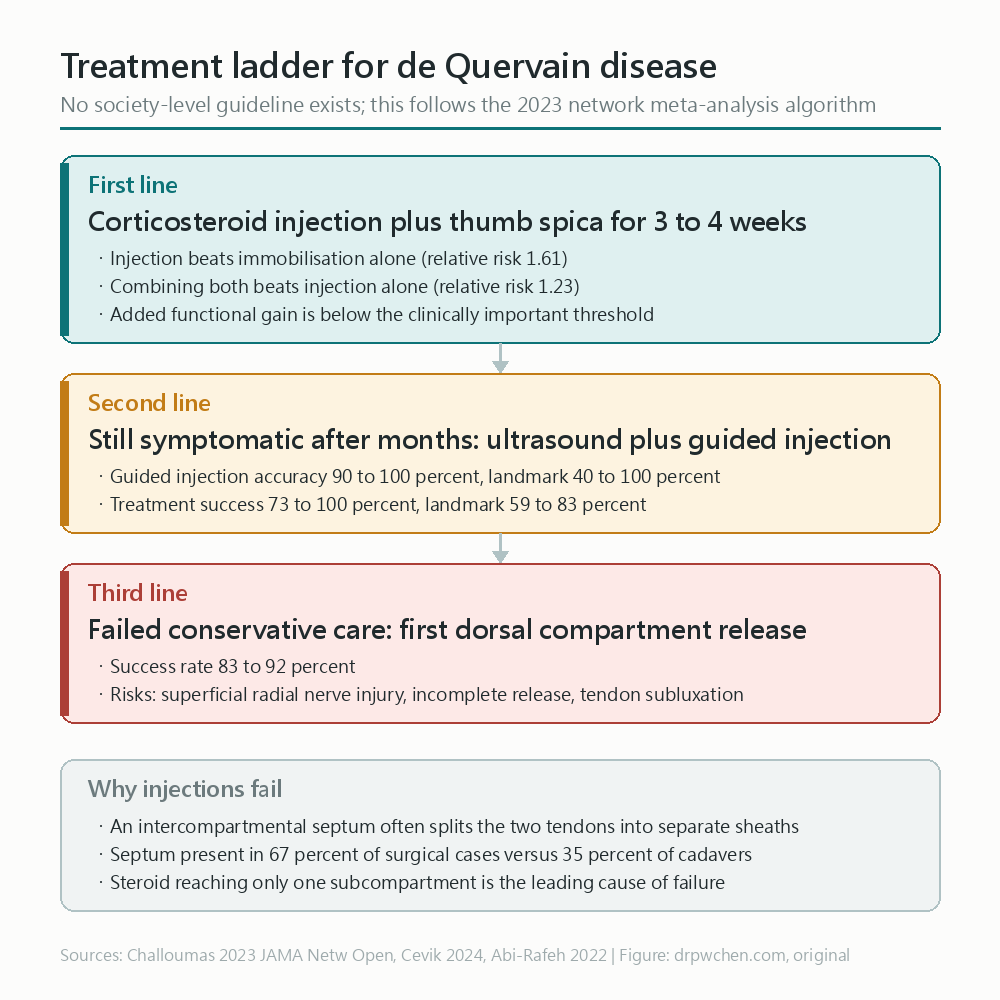
Treatment Ladder (Algorithm based on the network meta-analysis by
Challoumas 2023)First-Line
- Intra-sheath corticosteroid injection + thumb spica immobilization for 3–4 weeks
- In the network meta-analysis, “injection + thumb immobilization” is the most likely optimal intervention for short- and mid-term function
- ⚠️ However, the functional gain from adding immobilization is statistically significant but does not reach the threshold for clinical significance (Q-DASH short-term MD 10.5, mid-term 9.4) → if a patient cannot tolerate the splint, they don’t have to forgo the injection for it
- NSAIDs only as an adjunct
Second-Line (Symptoms persist after several months)
- Ultrasound confirmation + ultrasound-guided injection (to find a septum and ensure both tendon sheaths are injected)
- Multi-point injection (two-point / four-point) is superior to single-point
Third-Line
- Failure of conservative treatment (generally defined as ineffective after > 6 weeks) → surgical decompression of the first dorsal compartment
🔴 Currently, there are no society-level clinical practice guidelines for managing de Quervain’s (
Challoumas 2023explicitly states “no definitive management guidelines”); the above is a suggested algorithm from a network meta-analysis, not a CPG
Splinting and Physical Therapy
- Theory behind the thumb spica splint: limits the tendon from gliding within the narrowed canal
Frontera 4e Ch.28 - Efficacy of immobilization alone is poor: in one study, the cure rate for the splint group was only 14%, and for the rest + NSAIDs group it was 0%
Frontera 4e Ch.28 - But it is supported by moderate evidence when used as an adjunct to injection (short- and mid-term)
Huisstede 2018,Cevik 2024 - ⚠️ Cyriax uniformly listed immobilization, deep transverse friction, and ointments as obsolete; this view has been overturned by subsequent evidence (specifically regarding immobilization)
Cyriax Ch.24vsChalloumas 2023 - Mild cases or recent onsets can first try ice + splinting + NSAIDs; moderate-to-severe symptoms rarely respond to rehabilitation therapy alone
Frontera 4e Ch.28 - Evidence for physical modalities
- High-intensity laser therapy (HILT): meta-analysis did not show it to be superior to a splint or a splint + exercise (only 3 studies, VAS MD 0.21 cm, 95% CI −1.43 to 1.86)
de la Barra Ortiz 2025 - Taping / Kinesio taping: 7 studies, 241 patients, showing no significant improvement in pain, grip strength, or function; evidence is insufficient to recommend
Drapeza 2022 - Acupuncture: effective compared to topical analgesics (VAS MD −1.06), but no statistical difference compared to steroid injection, and the included studies were of limited quality
Qin 2024
- High-intensity laser therapy (HILT): meta-analysis did not show it to be superior to a splint or a splint + exercise (only 3 studies, VAS MD 0.21 cm, 95% CI −1.43 to 1.86)
Injection Therapy
- Medication and equipment: triamcinolone acetonide 10 mg / 1 mL, finest needle (2 cm)
Cyriax Ch.24 - Injection site: just proximal to the base of the 1st metacarpal, inserting the needle almost horizontally between the two tendons → tip enters the common tendon sheath
Cyriax Ch.24 - Sign of a correct injection: a sausage-shaped swelling can be palpated along the course of the tendon
Cyriax Ch.24 - The key is “the steroid must enter both the EPB and APL compartments”; injecting into only one is the main reason for failure
Frontera 4e Ch.28- Single-point < two-point (targeting the course of the EPB and APL respectively) < four-point (taking proximal and distal for each tendon)
Frontera 4e Ch.28
- Single-point < two-point (targeting the course of the EPB and APL respectively) < four-point (taking proximal and distal for each tendon)
- Intercompartmental Septum
- Cadaver study prevalence is 24–76% (huge variance)
Frontera 4e Ch.28; Cyriax notes about 30%Cyriax Ch.24 - Meta-analysis establishes: 67% in the surgical de Quervain’s population, 35% in the general cadaver population, representing a significant difference
Abi-Rafeh 2022 - Clinical significance: Those with a septum are inherently more likely to develop the disease, and more likely to fail an injection
- Cadaver study prevalence is 24–76% (huge variance)
- Ultrasound-guided vs. Landmark-guided
Abi-Rafeh 2022- Injection accuracy 90–100% vs 40–100%
- Treatment success rate 73–100% vs 59–83%
- In the network meta-analysis, ultrasound-guided injection ranked first for “pain relief”
Challoumas 2023
- When an injection fails: consider that a septum might be separating the EPB → attempt a second injection further dorsally
Cyriax Ch.24(or use direct ultrasound guidance if available) - After-pain may last up to 24 hours; avoid excessive exertion for a few days post-injection
Cyriax Ch.24 - Repeated injections are not harmless: corticosteroids carry risks of subcutaneous fat atrophy, hypopigmentation, and tendon weakening; if repeated injections fail, they should be referred for surgery
Abi-Rafeh 2020,Frontera 4e Ch.28
Injection vs. Immobilization — Evidence and Numbers
- Meta-analysis of 16 RCTs, 1206 patients
Cevik 2024- Injection > Immobilization: treatment success RR 1.61 (95% CI 1.21–2.15)
- Combination > Immobilization alone: RR 2.15 (95% CI 1.77–2.62)
- Combination > Injection alone: RR 1.23 (95% CI 1.12–1.34)
- Conclusion: Injection is first-line, immobilization is adjunctive
- Network meta-analysis of 30 RCTs, 1663 patients
Challoumas 2023- Injection + 3–4 weeks of thumb immobilization is the most likely optimal combination for short- and mid-term function
- However, the gain did not reach the minimal clinically important difference; the certainty of evidence was moderate
PRP and Other Injectates
- PRP vs. corticosteroid SR/limited meta-analysis (6 studies): both provided significant pain relief, but PRP was better for long-term pain relief at 6 months and had fewer complications (p = 0.026)
Abumadian 2026- 🔴 Extremely high heterogeneity (I² of 98.7%), small sample sizes, and low certainty of evidence; insufficient to change first-line choices, only to be discussed with patients who fail repeated injections
- Ultrasound-guided percutaneous needle tenotomy + PRP is currently only at the case report level of evidence
Frontera 4e Ch.28
Management Considerations in Postpartum and Lactation
- It mostly resolves naturally after stopping breastfeeding; you can initially use splinting + modifying infant-carrying postures to buy time
Wyss Ch.16 - The mechanical load of holding a baby is a modifiable factor (changing from weight-bearing on an abducted thumb to supporting with the forearm and palm)
Ferraro 2023 - Systemic exposure from a local corticosteroid injection is extremely low, and clinically it is not considered contraindicated for breastfeeding
- ⚠️ There are no dedicated studies on the safety of de Quervain’s injections during lactation; this is extrapolated from general medication principles, not direct evidence
Surgical Intervention
- Indications: patients who fail conservative treatment (including at least one proper injection); since the 1950s, it has retreated from being a first-line option to a salvage procedure
Frontera 4e Ch.28 - Surgical approach
Cyriax Ch.24,Frontera 4e Ch.28- Release of the extensor retinaculum (open or endoscopic), can be paired with partial resection
- If there is an EPB subcompartment septum: must ensure the EPB compartment is also released
- Incision direction: transverse vs. longitudinal show no significant differences in SBRN injury, venous injury, hypertrophic scarring, infection, or postoperative pain; this is chosen based on the surgeon’s preference and individual anatomy
Kitridis 2026 - Postoperative: lifting should not exceed 1–2 pounds for the first 2 weeks, and no more than 10 pounds before week 4
Frontera 4e Ch.28 - Success rate 83–92%
Frontera 4e Ch.28
The Workflow Behind This Note
This note was originally a reference I put together for myself when seeing patients with De Quervain’s in the clinic. I ran a fresh check on the evidence before putting it up on the site this time.
Materials Used
- PM&R and Orthopedics textbooks: Ombregt (Cyriax system), Frontera Essentials 4e, DeLee 5e, Malanga’s two books on physical examination and ultrasound-guided injections, and Wyss’s manual on therapeutic programs
- Systematic reviews and meta-analyses: Challoumas 2023 network meta-analysis (currently the most comprehensive on this topic), Cevik 2024 meta-analysis on injection vs. immobilization, Abi-Rafeh 2022 meta-analysis on ultrasound and surgical anatomy, McBain 2019 review on imaging accuracy, as well as individual meta-analyses on taping, laser, acupuncture, and PRP
- Primary epidemiological studies: the pregnant and postpartum cohort from South Korea’s National Health Insurance claims database (Bae 2023), the newborn caregiver survey (Ferraro 2023), and the cross-sectional studies on smartphone use behaviors (Morgan 2020, Nie 2023)
Tools Used
audit_note.py— my own note format auditing script, to check citation placements, images, and heading structures- PubMed MCP — for pulling systematic reviews and filling in the missing volume/issue/page numbers, DOIs, and PMIDs in the bibliography
- textbook_search — for semantic search against the local markdown index of my textbooks
- OpenEvidence — for an independent cross-check on first-line treatments
- My own Python/PIL drawing scripts — for the treatment ladder diagram and the cover image (
scripts/figures/) - Hugo’s bilingual workflow
i18n_sync.py— machine-translating the English version first, then manually proofreading the medical terminology
This workflow itself is written up as textbook-to-note. If you also have a Claude or Codex subscription, you can offload this kind of mechanical labor of fact-checking and organizing to it, leaving the judgment calls to yourself. You can start with Getting Started with AI: Installation and First Steps and How to Talk to AI Agents.
About This Version
The professional version is taken directly from my own clinical notes and was not rewritten for the blog; it retains the citation format of the notes (title + chapter, or author + year; full bibliography below). Copyrighted images from textbooks and journals are not included here; the figures were redrawn by myself.
If there’s anything I’ve misunderstood, please feel free to correct me.
Reference
Textbooks
- Ombregt Ch.24 — A System of Orthopaedic Medicine. 3rd ed. Elsevier; 2013. (Cited in text as
Cyriax Ch.24) - Frontera 4e Ch.28 — Essentials of Physical Medicine and Rehabilitation. 4th ed. Elsevier; 2019. de Quervain Tenosynovitis.
- DeLee 5e Ch.67 — DeLee, Drez, & Miller’s Orthopaedic Sports Medicine. 5th ed. Elsevier; 2020. Hand and Wrist Diagnosis and Decision-Making.
- Malanga MSK PE 2e Ch.6 — Musculoskeletal Physical Examination: An Evidence-Based Approach. 2nd ed. Elsevier; 2017.
- Malanga US Injection Ch.32 — Atlas of Ultrasound-Guided Musculoskeletal Injections. McGraw-Hill; 2014. First Extensor Compartment Injection.
- Wyss Ch.16 — Therapeutic Programs for Musculoskeletal Disorders. Demos Medical; 2013. DeQuervain’s Tenosynovitis.
Systematic Reviews and Meta-Analyses
- Challoumas D, Ramasubbu R, Rooney E, et al. Management of de Quervain Tenosynovitis: A Systematic Review and Network Meta-Analysis. JAMA Netw Open. 2023;6(10):e2337001. doi:10.1001/jamanetworkopen.2023.37001. PMID 37889490
- Cevik J, Keating N, Hornby A, et al. Corticosteroid injection versus immobilisation for the treatment of De Quervain’s tenosynovitis: A systematic review and meta-analysis. Hand Surg Rehabil. 2024;43(3):101694. doi:10.1016/j.hansur.2024.101694. PMID 38642740
- Abi-Rafeh J, Mojtahed Jaberi M, Kazan R, et al. Utility of Ultrasonography and Significance of Surgical Anatomy in the Management of de Quervain Disease: A Systematic Review and Meta-Analysis. Plast Reconstr Surg. 2022;149(2):420-434. doi:10.1097/PRS.0000000000008792. PMID 35077418
- Abi-Rafeh J, Kazan R, Safran T, Thibaudeau S. Conservative Management of de Quervain Stenosing Tenosynovitis: Review and Presentation of Treatment Algorithm. Plast Reconstr Surg. 2020;146(1):105-126. doi:10.1097/PRS.0000000000006901. PMID 32590652
- Huisstede BM, Gladdines S, Randsdorp MS, Koes BW. Effectiveness of Conservative, Surgical, and Postsurgical Interventions for Trigger Finger, Dupuytren Disease, and De Quervain Disease: A Systematic Review. Arch Phys Med Rehabil. 2018;99(8):1635-1649.e21. doi:10.1016/j.apmr.2017.07.014. PMID 28860097
- McBain B, Rio E, Cook J, Grabinski R, Docking S. Diagnostic accuracy of imaging modalities in the detection of clinically diagnosed de Quervain’s syndrome: a systematic review. Skeletal Radiol. 2019;48(11):1715-1721. doi:10.1007/s00256-019-03195-z. PMID 30888457
- Kitridis D, Karagergou E, Givissis A, et al. Optimal Skin Incision for the Surgical Treatment of De Quervain Tenosynovitis: A Systematic Review and Meta-Analysis. Medicina (Kaunas). 2026;62(3):590. doi:10.3390/medicina62030590. PMID 41901671
- Abumadian AW, Binibrahim MI, Sultan AH, et al. The Use of Platelet-Rich Plasma for De Quervain’s Tenosynovitis. Saudi Med J. 2026;47(8):1265-1276. doi:10.15537/1658-3175.8818. PMID 42445748
- de la Barra Ortiz HA, Parizotto NA, Chamorro Lange C, Liebano RE. Effects of high-intensity laser therapy in patients with De Quervain’s tenosynovitis: A systematic review and meta-analysis. J Hand Ther. 2025;38(3):464-476. doi:10.1016/j.jht.2024.10.001. PMID 39814632
- Drapeza RC, Navasca SB, Dones V, Rimando CR. The effects of taping on de Quervain’s disease: A systematic review and meta-analysis. J Bodyw Mov Ther. 2022;32:218-227. doi:10.1016/j.jbmt.2022.05.004. PMID 36180153
- Qin Y, Luo D, Qiu H, Zhang J, Yong H, Yu S. A systematic review and meta-analysis of acupuncture for De Quervain’s tenosynovitis treatment. Postgrad Med J. 2024;100(1188):709-720. doi:10.1093/postmj/qgae057. PMID 38932434
- Morgan SDJ, Sivakumar BS, An VGG, Sevao J, Graham DJ. A Review of De Quervain’s Stenosing Tenovaginitis in the Context of Smartphone Use. J Hand Surg Asian Pac Vol. 2020;25(2):133-136. doi:10.1142/S2424835520300029. PMID 32312208
- Stahl S, Vida D, Meisner C, et al. Systematic review and meta-analysis on the work-related cause of de Quervain tenosynovitis. Plast Reconstr Surg. 2013;132(6):1479-1491.
Primary Studies
- Bae KJ, Baek GH, Lee Y, Lee J, Jo YG. Incidence and Risk Factors for Pregnancy-Related de Quervain’s Tenosynovitis in South Korea: A Population-Based Epidemiologic Study. Clin Orthop Surg. 2023;15(1):145-152. doi:10.4055/cios22099. PMID 36778998
- Ferraro E, Ferraro J, Pavlesen S, Carlson C, Ablove T, Ablove R. De Quervain’s Tenosynovitis in Primary Caregivers. WMJ. 2023;122(2):110-113. PMID 37141474
- Nie X, Huang L, Hou J, et al. Smartphone usage behaviors and their association with De Quervain’s Tenosynovitis (DQT) among college students: a cross-sectional study in Guangxi, China. BMC Public Health. 2023;23(1):2257. doi:10.1186/s12889-023-16808-z. PMID 37974168
- Alberton GM, High WA, Shin AY, Bishop AT. Extensor triggering in de Quervain’s stenosing tenosynovitis. J Hand Surg Am. 1999;24:1311-1314.
- Clark MT, Lyall HA, Grant JW, et al. The histopathology of de Quervain’s disease. J Hand Surg Br. 1998;23:732-734.
- Choi SJ, Ahn JH, Lee YJ, et al. de Quervain disease: US identification of anatomic variations in the first extensor compartment with an emphasis on subcompartmentalization. Radiology. 2011;260(2):480-486.