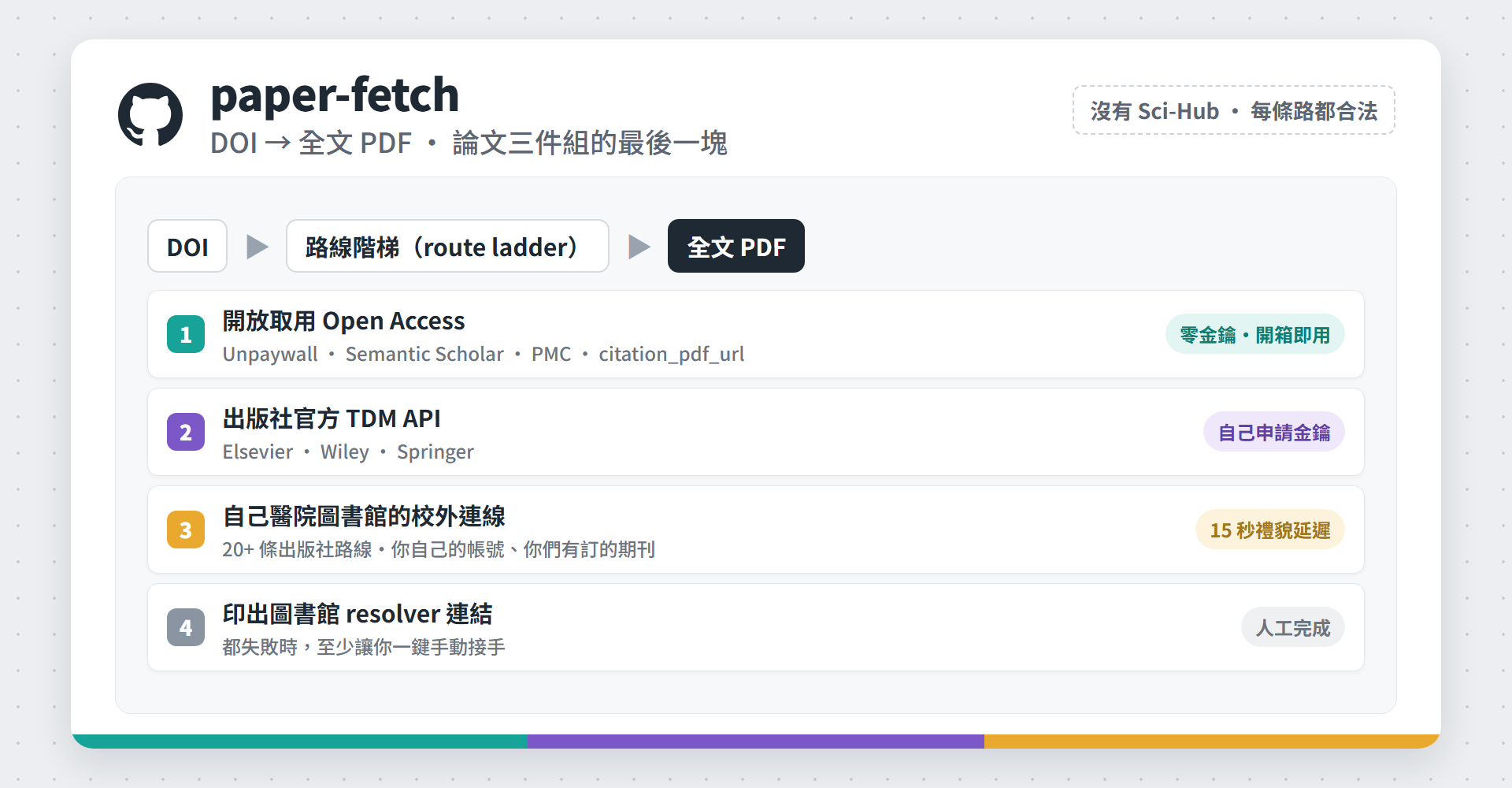
GitHub-style cover card for paper-fetch, illustrating a four-tier route: open access, official publisher TDM APIs, your own hospital library's off-campus connection, and printing the library resolver link

The last piece of The Paper Trilogy: paper-fetch. Give it a DOI, and it fetches the full text itself

When I shared my critical appraisal tool a while ago (to have Claude help with critical appraisal and summarizing content), a friend gave me a very honest reply: the tool is nice, but having to dig up the PDF yourself every single time is actually the most annoying part. It really is. To let AI read papers for you, you first need the full text. And when it comes to getting the full text, what usually gets you stuck isn’t the AI—it’s permissions, publishers, and the library. ...
July 14, 2026 · 7 min · 1399 words · 陳柏威 Po-Wei Chen
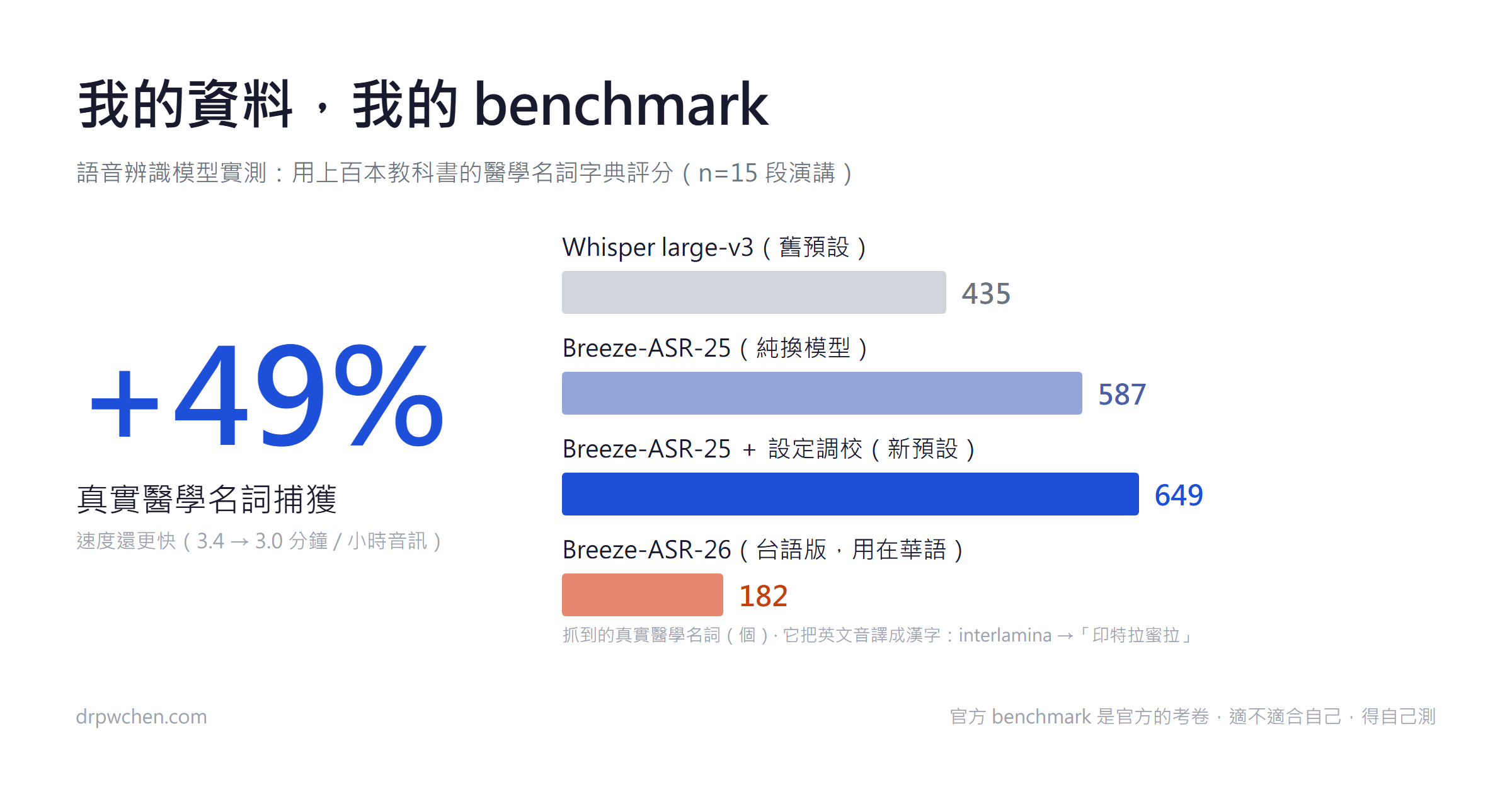
ASR model test results: Breeze-ASR-25 with tuned settings captures 649 real medical terms, 49% more than Whisper large-v3's 435; the Taiwanese Breeze-ASR-26 captures only 182 when used on Mandarin

My data, my benchmark: Swapping the speech recognition (ASR) engine for my lecture note system

Introduction: Why official scores aren’t enough My workflow for turning recorded lectures into notes goes in a straight line: transcript → matching slides → final summary. The foundation of this line is automatic speech recognition (ASR). However much it mishears, every subsequent layer of notes will be just as wrong. Originally, I was using OpenAI’s Whisper large-v3. The starting point for all this was actually me scrolling on my phone and seeing MediaTek Research announce their Taiwanese model, Breeze-ASR-26. A Taiwanese model is intriguing enough on its own, but clicking through, I learned they had already released Breeze-ASR-25 last year. Fine-tuned from Whisper-large-v2, it was optimized specifically for Taiwanese Mandarin and Mandarin-English code-switching, and open-sourced under Apache 2.0. Medical lectures happen to be ground zero for Mandarin-English code-switching. I had somehow missed this for a whole year. ...

July 13, 2026 · 18 min · 3743 words · 陳柏威 Po-Wei Chen
Adding graph retrieval to a medical note vault

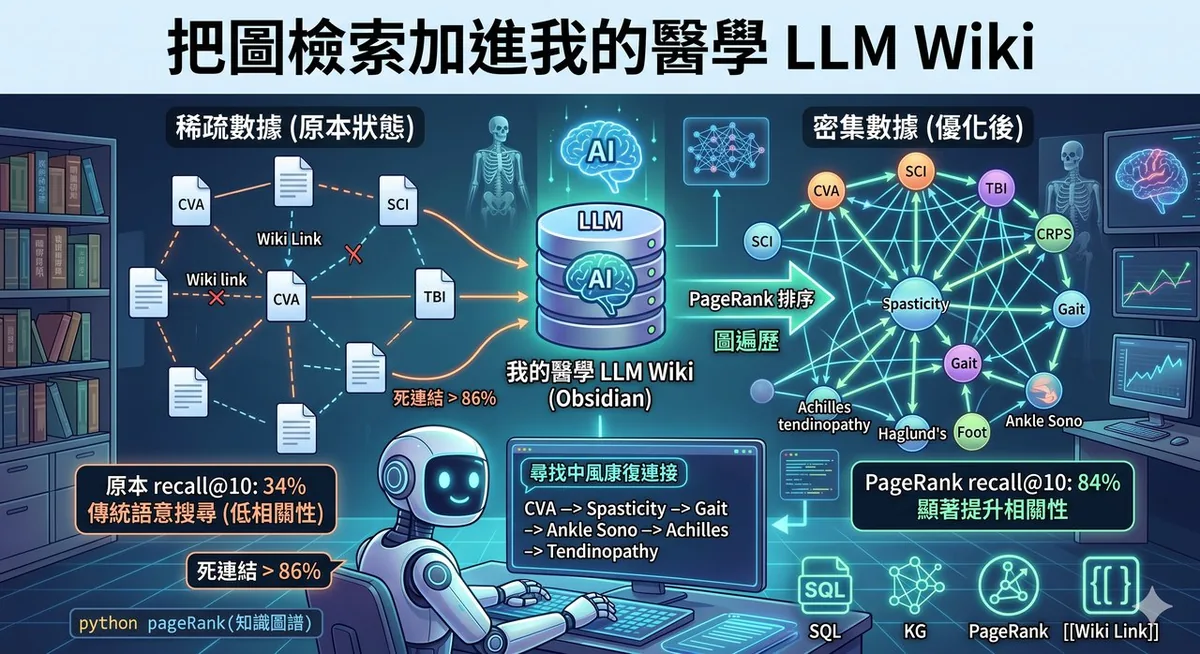
Adding graph retrieval to my medical LLM Wiki, and it actually works this time

Background: What I was already using When studying for the board examination, I set up a RAG (Retrieval Augmented Generation) pipeline for myself. Using semantic search to look at similarity, I turned hundreds of physical medicine and rehabilitation (PM&R) textbooks and my own notes into something I could search and query. I use it for reading in Obsidian, while also letting Claude find what I need via MCP. Its weakest point right now is connecting knowledge across different documents. So a few days ago, when I saw someone share a newly published paper, SAG (SQL-Retrieval Augmented Generation), claiming that adding SQL and graph concepts on top of semantic search makes cross-document search easier—with effects similar to GraphRAG but easier to build and maintain—my eyes lit up. ...

June 22, 2026 · 9 min · 1802 words · 陳柏威 Po-Wei Chen